
Església Nova in Son Servera – Mallorca's Roofless Church
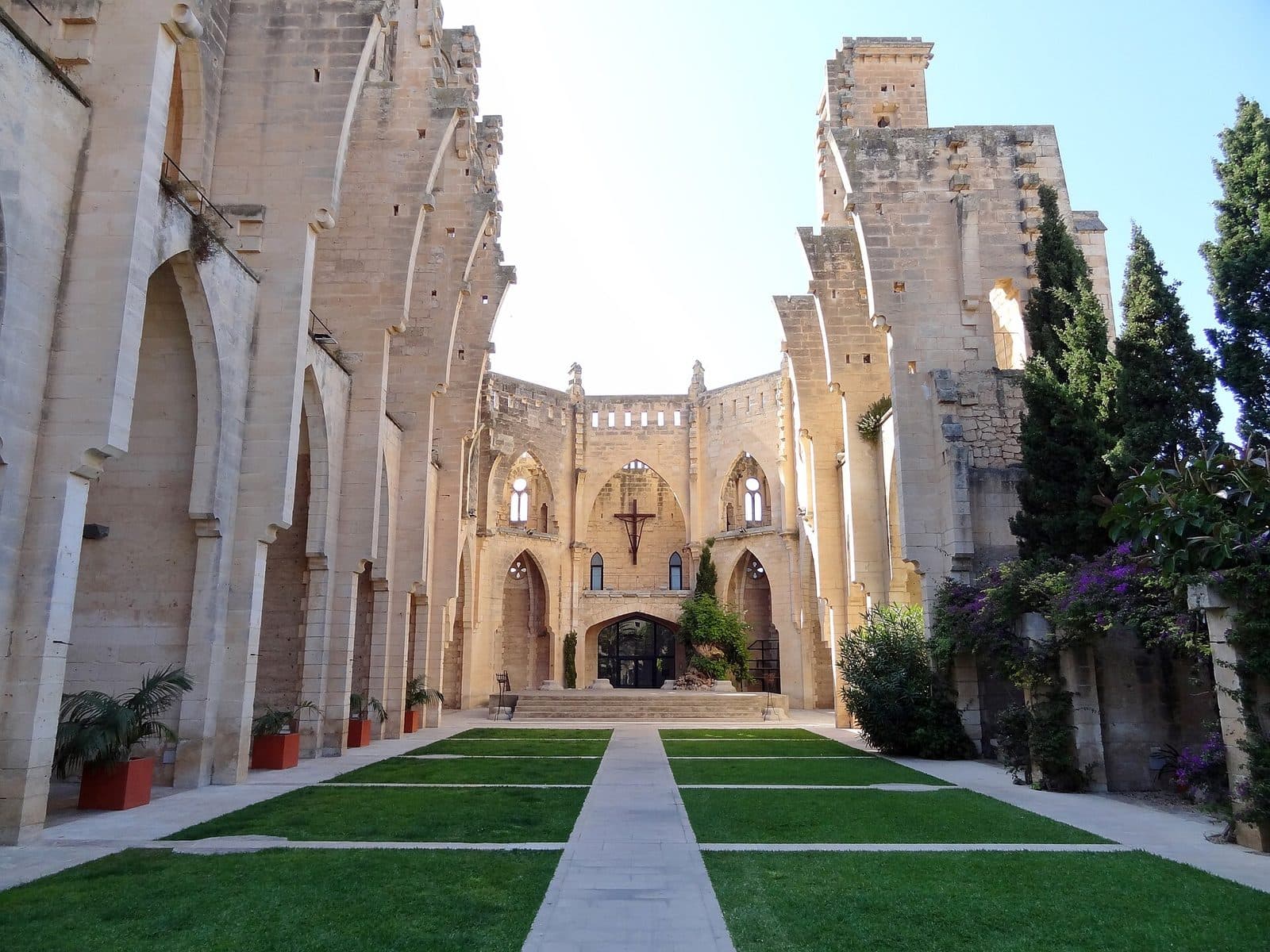

In the heart of Son Servera, a church ends where vaults and a roof would normally begin. Església Nova consists of tall stone walls, pointed arches, large window openings, and rose windows—yet open sky stretches above the former nave. What originally appeared to be the failure of an ambitious building project is now the place's defining strength. The Catalan name simply means “New Church.” It has not been new for a long time, and it was never completed. This suspended state between sacred building and ruin is precisely what makes a visit so memorable: the architecture provides the frame, while daylight, clouds, and shifting shadows continually transform the interior.
Església Nova is especially rewarding for anyone who enjoys reading architecture directly. The surviving elements reveal what was planned and what never materialized: windows and rose windows await the light without glazing, the walls outline a nave, and where a sealed vault would be expected, the view opens upward. At the same time, the ruin is not a forgotten relic. It is considered a landmark of Son Servera and is used as a cultural venue for concerts, events, and weddings. A visit can therefore easily be combined with a walk through the town center—or planned as a deliberate contrast to a day on the coast.
History and significance
The start of construction
When work began, the intention was not to create a romantic ruin but a new church for Son Servera. Joan Rubió i Bellver, a Catalan architect known as a student and colleague of Antoni Gaudí, was commissioned to design it. Rubió's design combines medieval forms with a Modernista perspective; its most immediately visible architectural language is predominantly Gothic Revival.
Rubió drew on elements reminiscent of medieval churches: tall stretches of masonry, pointed arches, emphasized window axes, and rose windows. The project underwent changes as it developed, but the basic concept remained ambitious. The surviving shell alone shows that the building was intended to have a major impact on the townscape. To this day, its effect comes not from an abundance of decoration but from the strict order of the masonry and the height of the open architecture.
Construction comes to a halt
The story took a different direction when funding ran out and work was discontinued. Large sections of the exterior walls, window openings, and rose windows had been completed by then, but the roof was missing. The intended church became a fragment that could never fulfill its original purpose in completed form.
The halt in construction is visible everywhere during a walk around the building. The ruin does not look like a fully completed place of worship that later lost its roof. Instead, a building process appears to have stopped in plain sight. The open wall tops tell of a project whose resources and possibilities did not extend to completion.
From unfinished building to landmark
Son Servera did not turn the fragment into a closed, museum-like memorial. Església Nova became the town's landmark and acquired a new role as an open-air stage. Concerts and other cultural events make use of the effect created by the tall walls, while weddings benefit from the unusual combination of ecclesiastical form and open sky.
The building has thus acquired a significance that was not envisaged in the original plan. The missing roof is no longer merely a gap; it defines the perception of the entire space and transforms the unfinished church into an unmistakable public place. The history of Església Nova is therefore as much about a failed construction project as it is about the pragmatic and creative afterlife of its ruin.
What to see
The open nave
The decisive moment comes after entering: the walls form a clearly recognizable church interior, but the eye encounters no ceiling. The sky stretches above the nave. Sunny blue, passing clouds, or muted light become part of the architecture, even though Rubió did not originally plan this effect as the building's final state.
The open structure also changes the sense of scale. In a roofed church, a vault guides the eye along the longitudinal axis or upward toward ribs and keystones. In Església Nova, this movement remains incomplete. The vertical lines of the walls point upward, but no stone enclosure follows. The eye mentally continues the space.
Anyone wishing not merely to photograph the building but to understand it should first walk through the center and then look back from the sides. The central perspective reveals the intended monumentality; from the edges, it becomes clearer how the surviving sections of wall divide the empty space. The ruin is therefore less a collection of individual artworks than a walk-in architectural concept.
Windows and rose windows
Large window openings and rose windows are among the most striking Gothic Revival elements. They have none of the usual glazing that would color the light or depict biblical scenes. Instead, they frame sections of sky and parts of the surroundings. The opening itself becomes the picture.
The rose windows in particular show how far construction had progressed. Their form clearly reflects the ambition to create a representative church interior, while their emptiness recalls its failure to reach completion. Depending on the direction of view, bright light or part of the architecture opposite appears behind the tracery. The rose windows therefore do not seem static; their impression changes with the viewer's position and the daylight.
It is worth looking through them from more than just the front. Seen at an angle, the depth of the stone, its contours, and the thickness of the walls become more apparent. The relationship between the large openings and the comparatively plain wall surfaces also explains the building's character: Església Nova is Gothic Revival, yet it is also marked by pronounced austerity and simplicity.
Pointed arches and buttresses
Pointed arches give the ruin the unmistakable rhythm of a sacred building conceived in the Gothic tradition. They lead the eye onward, divide the wall surfaces, and reinforce the upward-reaching effect. Because no roof visually binds the structure together, these individual lines can be followed with unusual clarity.
Outside, buttresses contribute to the building's powerful profile. Here they also stand as signs of a structure whose upper enclosure was never built. This makes a walk around the exterior just as revealing as looking into the interior. The façade should therefore not be regarded merely as an entrance. Only by alternating between exterior and interior views does it become clear how massive the shell is and how open the space nevertheless feels. The tall walls clearly separate the church from the surrounding streets; at the same time, the windows, rose windows, and missing roofline dissolve that boundary again.
Stone, light, and emptiness
The effect of Església Nova arises from stone surfaces, openings, proportions, and light. This restraint suits the project's documented architectural austerity. Nothing distracts for long from the crucial question: What would this building have looked like if a roof and vaults had actually been constructed above the walls?
Sunlight draws distinct shapes on the ground and in the wall openings. Under an overcast sky, by contrast, the structure of the walls becomes more prominent. The open church is therefore not an unchanging exhibit. The weather and the position of the sun help determine whether the ruin appears bright and spacious or more solemn and austere.
A multilingual information panel on site explains the main stages of the building's history. It is particularly helpful for placing the initial visual impression in its historical context afterward. Even so, the best tour begins without haste and with the space itself: first the overall form, then the rose windows and other windows, and finally the details of the arches and exterior walls.
Visiting Església Nova
Arrival and orientation
Església Nova stands in the center of Son Servera. It is not an extensive archaeological site but a clearly defined building that fits easily into a walk through the small town. It is worth pausing briefly in the entrance area before stepping into the center of the open nave. From there, the longitudinal axis, tall walls, and sky can be taken in together. Then move to the sides, where the arches and window openings appear more three-dimensional from oblique angles. Finally, the exterior provides an opportunity to connect the buttresses and façade structure with the interior seen beforehand.
Time inside the building
The length of a visit depends more on your interests than on the site's size. Anyone who simply wants to glance into the roofless church and take a few photographs can keep the visit brief. Architecture enthusiasts will need more time because the effect changes with every viewpoint, and the unfinished elements only become comprehensible when seen in relation to one another.
For a rewarding visit, it is advisable not to remain only in the center. The windows, rose windows, and exterior walls deserve viewpoints of their own. The information panel then helps place the visible halt in construction in context. During events, the character of the place changes fundamentally: the quiet ruin becomes an open cultural venue, and the interior serves as an atmospheric setting rather than as an architectural monument freely open for viewing.
Opening hours and visitor numbers
Regular visits are scheduled Monday through Friday from 9.30 to 14.30. The gate may be closed outside this period. Since the ruin is also used for concerts, weddings, and other events, anyone making a special journey should check current information to confirm whether normal access is possible.
Visitor numbers fluctuate. In addition to independent travelers, school classes and tour groups also come here. As a result, the same place may feel busy at one moment and quiet again shortly afterward. Anyone hoping to photograph unobstructed views should first observe whether a group is just finishing its tour. Unlike in an enclosed church, light and weather cannot be planned completely anyway—and this is precisely what makes repeated views through the arches and rose windows so appealing.
Getting there and parking
From Palma Airport
From Palma Airport, the drive initially follows the Ma-15 and then the Ma-4030 to Son Servera. The town is 67 road kilometers away, and the journey takes around 57 minutes. These details expressly refer to the route as far as Son Servera, not directly to the gate of Església Nova.
In town, the final stretch leads through the streets of the center. The church stands on Carrer de ses Creus and is easy to recognize as a distinct building because of its tall, open walls. Nevertheless, it is advisable to enter the exact destination for the ruin in the center of Son Servera into your navigation system.
From central Palma
From central Palma, the main route also follows the Ma-15 and the Ma-4030. The distance to Son Servera is 70 road kilometers, and the journey takes around 63 minutes. After arriving in town, continue along local streets to the church. The final section has an urban character and differs markedly from the fast cross-country drive beforehand.
The Ma-15 forms the long main section of the route toward the east or northeast of Mallorca. The Ma-4030 then leads toward Son Servera. For the return journey, it is helpful not to rely solely on the church's name but first to follow signs leading out of the town center.
Parking in the town center
Finding parking directly in the center can be more difficult on busy days. This is especially true on market days, when there is more activity around the town center. Instead of waiting a long time for a space immediately beside the church, it is often more practical to park a little farther outside the tightest part of the center and walk the final stretch.
Església Nova is particularly well suited as a short stop on a walk through town. Anyone already planning to explore Son Servera on foot does not need to bring the car as close to the ruin as possible. At the same time, sufficient extra time should be allowed so that the limited regular visiting period is not consumed by the search for parking.
By bus
Son Servera has several bus stops north and south of the center. From there, Església Nova can be reached on foot through the town. The most convenient stop depends on the bus route and direction of travel. The church is not situated out in the countryside but within the compact urban area; after getting off the bus, the final stretch follows local streets.
Anyone arriving by bus should coordinate the outward and return journeys in advance. The visit itself requires no transfer and can be combined with other stops in the center. Precisely because the gate may be closed outside regular visiting hours, it is sensible to choose a connection that leaves enough time between arrival and the end of access.
Bus lines to Església Nova at a glance
| Line | Route | Departures/day | First | Last |
|---|---|---|---|---|
| 424 | Cala Rajada - Portocristo | 84 | 08:20 | 23:12 |
| 412 | Costa dels Pins - Manacor | 62 | 05:53 | 22:46 |
From the official GTFS feeds (TIB/SFM), no real-time data. The figures cover all stops in the town; weekend and holiday services differ — check with the operator before travelling.
Getting there by bus
Son Servera nord 1 (62031) · 0.2 km as the crow flies
- 412Costa dels Pins - Manacor · Daily
- 424Cala Rajada - Portocristo · Daily
Son Servera sud 2 (62021) · 0.2 km as the crow flies
- 412Costa dels Pins - Manacor · Daily
- 424Cala Rajada - Portocristo · Daily
Son Servera nord 2 (62034) · 0.3 km as the crow flies
- 412Costa dels Pins - Manacor · Daily
- 424Cala Rajada - Portocristo · Daily
Son Servera sud 1 (62020) · 0.4 km as the crow flies
- 412Costa dels Pins - Manacor · Daily
- 424Cala Rajada - Portocristo · Daily
Timetable data: official GTFS feeds (TIB/EMT), no real-time — check with the operator before travelling.
Nearby places
Son Servera
Son Servera is a small town in northeast Mallorca and the administrative center of the municipality of the same name. Unlike the nearby coastal resorts, its center has a more everyday character. Església Nova does not stand isolated on a viewpoint but among streets and squares that form part of ordinary life in the town.
A walk through Son Servera also explains why the ruin is regarded as a landmark. Its Gothic Revival walls differ markedly from the lower buildings in the center. At the same time, it remains part of local life: as a monument open to visitors, an event venue, and a setting for weddings. This gives the visit more context than simply driving there, taking a photograph, and immediately continuing onward.
Sant Joan Baptista and Talaiot de na Pol
Other sites of cultural and historical interest in Son Servera include the church of Sant Joan Baptista and Talaiot de na Pol. This combination brings together the church of Sant Joan Baptista, the unfinished Església Nova building project, and Talaiot de na Pol. Sant Joan Baptista in particular helps prevent Església Nova from being mistaken for an ordinary active parish church. The roofless “New Church” is now primarily an architectural monument and cultural venue. Anyone who visits both places will understand more clearly just how unusual the unfinished building in Son Servera really is.
The coast and routes through Llevant
Trips to the coast can be added to a visit to Son Servera. Cala Bona, Canyamel, and the coastal landscape of Llevant offer a striking change after the stone-built, strictly defined interior of Església Nova. Routes toward Artà and coastal walking trails are also among the region's options.
This combination works particularly well when the church is visited in the morning and the rest of the day is then spent outside the town. Conversely, Església Nova should not be planned as a spontaneous late addition, since regular opening ends in the early afternoon. Son Servera is therefore better suited as the starting point of the day than as the final stop after a long coastal excursion.
The place it belongs to
Son Servera in the place guidePractical visitor information
A ruin, but not a ruin site
Església Nova does not require hiking gear. It stands in the town center and is maintained as a cultural venue. Nevertheless, it remains an open church ruin: visitors should not expect a sealed roof, climate-controlled interiors, or the shelter of a fully covered church. Sun, clouds, and weather are direct parts of the spatial experience.
Weather conditions are therefore important. Because the nave is open above, a visit on a sunny day should not be treated like entering a shady church. In changeable weather, the architecture likewise does not provide the same protection as a completed place of worship.
Visiting with children
Children can quickly understand the church's basic idea: tall walls, large windows—and no roof. The place can be explored without a long museum tour and therefore works well as a short stop during a family day out. The open rose windows and the view of the sky offer especially clear visual features that require no extensive prior knowledge.
Església Nova remains a historic building and is sometimes used as an event venue. Families will therefore get the most from a compact tour in which they look together for unfinished elements, window shapes, and traces of the planned church interior.
Photography and perspective
The most obvious photograph is taken from the central axis: in the entrance area, just before the central lawn begins, the nave and open sky can be framed together in landscape format. A wide-angle lens helps capture the full height of the walls. Do not photograph only upward, however, because the effect arises precisely from the contrast between the built frame and the unrestricted opening.
Other worthwhile perspectives can be found from the sides through the arches and outside along the buttresses. The rose windows look completely different depending on the background. A bright sky emphasizes their outlines, while an oblique viewpoint reveals the depth of the stone. Anyone arriving at the same time as a tour group can first examine the exterior and return later for a quieter overall photograph.
What not to expect
Església Nova is an unfinished church used as a cultural venue. The building itself is the focus of the visit, and its roof was never completed. Nor is it a ruin whose appeal comes from decay and overgrown isolation. The building is maintained and actively used. Concerts, weddings, or other events may alter the usual visiting arrangements. Anyone coming specifically for the quiet architecture should therefore not only observe the regular opening hours but, where possible, also check the current events calendar.
Local insider tips
The best central-axis view
For the overall view, stand in the entrance area just before the central lawn. From there, the nave walls and open sky fit together in landscape format; a wide-angle lens emphasizes the unusual height.
Look through the rose windows
Do not photograph the rose windows only from the front. From an oblique viewpoint, the depth of the stone and thickness of the walls become visible, while the open center frames either the sky or the architecture opposite, depending on the direction of view.
Compare inside and outside
After walking through the open nave, go outside and follow the line of buttresses. Only this change of perspective reveals how massive the Gothic Revival shell is and how profoundly the missing roof changes its effect.
Plan around market days
Finding parking in the center can be more difficult on market days. Instead of waiting for a space directly beside the ruin, park outside the tightest part of the town center and include Església Nova in a walk.
Look first, then read
First walk through the nave without an explanation and allow the unfinished space to make its impression. Afterward, the multilingual information panel places the main stages of the building's history and the halt in construction in context.