
Son Servera, Mallorca – Local Life Between Llevant and the Coast

Places to stay in Son Servera
AdTo load the accommodation map by our partner Stay22, we need your consent for marketing cookies. Your consent applies to all marketing content on mallorca.com.
Son Servera lies in northeast Mallorca, slightly inland from the resorts of Cala Millor and Cala Bona. The town is not a scaled-down coastal backdrop, but the established center of a municipality whose territory stretches from rural Llevant to the Mediterranean. Narrow streets, natural-stone houses, and the Plaça de Sant Joan define the center; just a few kilometers away, a distinctly more tourist-oriented world begins, with beaches, promenades, and excursion options.
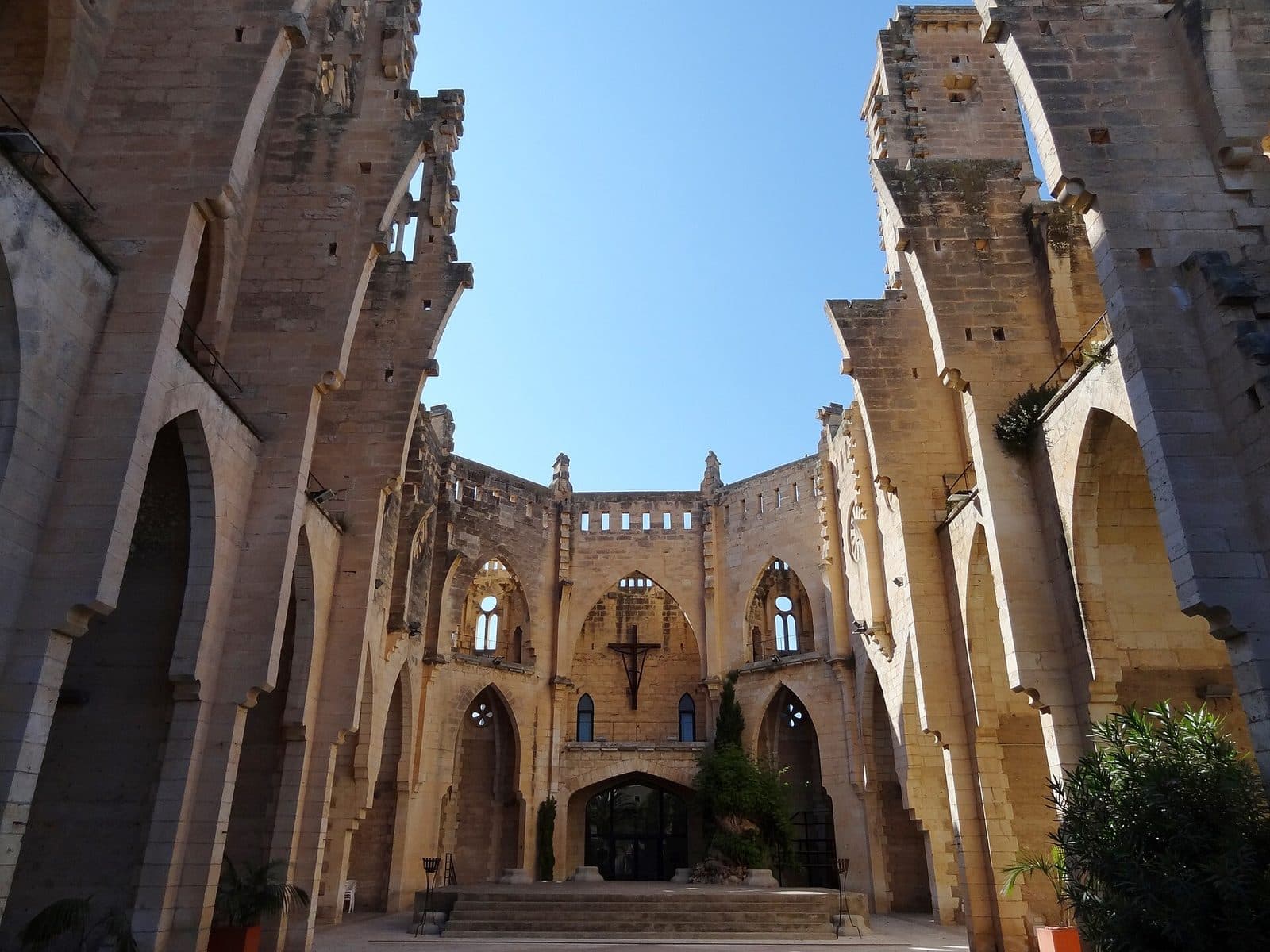
The best-known landmark is the Església Nova, an unfinished neo-Gothic church without a roof. It gives Son Servera a distinctive symbol that clearly differs from the typical parish churches found in Mallorcan towns. The historic center is also worth visiting above all for its cohesive layout: the square, church, cafés, shops, and homes can all be explored on a short walk, without the town feeling like an open-air museum.
For visitors, Son Servera works well as a peaceful counterpoint to Cala Millor, as a destination for a morning at the market, and as a starting point for trips to Artà, Canyamel, or the coast. Anyone considering a move will find year-round small-town life with grocery stores, pharmacies, bakeries, banks, and other services. The tourist amenities of the coast remain within easy reach but influence the town center far less than the beach areas.
Son Servera is therefore particularly appealing to people who want to combine everyday life with the coast: the sea is close, yet outside the front door there are no hotel complexes or beachfront promenades, but neighborhoods, local shops, and a historic center. The location is less convenient for frequent journeys to Palma than for travel within Llevant; for a life focused on the northeast, however, it can be practical.
History of Son Servera
Origins in Medieval Llevant
The origins of Son Servera are traced back to the Middle Ages. The 14th century is cited as the period of its foundation; another tradition links an early place name to Benicanella. The settlement developed into the center of the surrounding agricultural area. The historic core remained compact, and its organic structure can still be seen in the narrow streets, older stone houses, and central position of the Plaça de Sant Joan.
The origin of the present place name is explained in different ways. It is often associated with the service trees known in Mallorcan as “serveres,” which are said to have been widespread in the area. Since other interpretations also circulate, the history of the name is less clear-cut than the town’s connection with its agricultural surroundings.
Agriculture, Coast, and Municipal Development
For a long time, agriculture and connections with the nearby coast shaped everyday local life. Almond and olive cultivation were particularly important in the surrounding area. The sea did not lie directly beside the historic settlement, but it was economically and culturally present through fishing and the small coastal communities. Even today, this division explains much of the municipality’s character: Son Servera itself feels like a rural small town, while Cala Bona, Cala Millor, Costa des Pins, as well as Port Vell, Port Nou, and Port Verd, form its maritime section.
Cala Millor and Cala Bona are tourist resorts with restaurants, leisure facilities, and services. The old main town was not unaffected by this development, but it did not turn into a conventional holiday center. It retained its role as a residential, shopping, and service hub for the municipality and the surrounding area.
The Església Nova as an Unfinished Vision of the Future
A particularly visible chapter in the town’s more recent history began in 1905 with the construction of the Església Nova. The plans were drawn up by Joan Rubió, a pupil of Antoni Gaudí. The neo-Gothic church could not be completed because of insufficient funding; work was finally abandoned in the 1930s.
The failure of the construction project later produced Son Servera’s most important architectural landmark. Walls, arches, windows, and rose windows were preserved, but the roof was never completed. Today, the open nave is not treated as an ordinary ruin but used as a cultural venue. Events and weddings have given the building a new purpose without concealing its unfinished character.
Things to See in Son Servera
Església Nova
The Església Nova is the most compelling reason to make a dedicated visit. From the outside, it initially appears to be a neo-Gothic church with high walls, pointed arches, and rose windows. Inside, however, the apparent nave opens directly to the sky. Grass and plants take the place of a stone floor, while the supporting architectural elements shape a space that feels sacred, garden-like, and unfinished at the same time.
The design is by Joan Rubió, a pupil of Antoni Gaudí. The interplay of massive stone, open window spaces, and changing light is particularly impressive. Because the grounds are used for cultural events and weddings, access is not guaranteed at all times. It is advisable to check the current opening hours before planning a visit solely around this building.
Plaça de Sant Joan
The Plaça de Sant Joan is the heart of the historic center. Older buildings, church life, the town hall area, restaurants, and everyday routes all meet here. The square is less an isolated attraction than a starting point for understanding the structure of Son Servera. From here, short routes lead into the surrounding lanes and to the Església Nova.
On ordinary days, the Plaça is a manageable meeting place with cafés and bars. During the weekly market and patron saint festivities, its character changes completely: it becomes a stage, thoroughfare, and social center of the town. Anyone wishing to experience a quieter Son Servera should visit outside these events; those wanting to see public life should deliberately choose an event day.
Historic Town Center
The appeal of the old center does not lie in a long list of individual monuments. Instead, it comes from the sequence of narrow streets, partly paved sections, traditional façades, and small transitions between homes, shops, and squares. The walk remains compact and provides a good impression of how a historic main town in Llevant differs from the nearby strip of coastal resorts.
The streets rise in places and can be narrow. This repeatedly creates short sightlines across rooftops or toward the hills. A slow pace is recommended for the walk: many details are found in doorways, window frames, and the natural stone used, rather than at grandly staged viewpoints.
Puig de sa Font
Puig de sa Font rises immediately beside Son Servera and forms the town’s scenic backdrop. The hill reaches 261 meters and offers broad views from its higher sections across the municipality and toward the east coast. It is a destination for people who want to combine sightseeing with physical activity.
The view from above makes the location particularly easy to understand: the historic settlement lies inland, while the coastal communities and coves line up farther east. The climb is not essential for a short visit to the town; in clear weather and with enough time, however, it adds the landscape of Llevant to the itinerary.
Old Railway Station
The former railway station recalls the old rail connection through eastern Mallorca. Regular passenger trains no longer stop here. At the same time, the old station serves as a reference point for the extensive market area, which stretches from the center toward it.
Its real significance becomes clear in connection with the Vía Verde between Manacor and Artà, which follows a disused railway line. The old station is a visible reminder of the region’s transport history and of the present-day use of former railway land by cyclists and pedestrians.
Sights in Son Servera
The Weekly Market
The weekly market is one of the liveliest fixtures in local life. It takes place throughout the year and spreads from the area around the Plaça de Sant Joan through several streets toward the old railway station. The market is therefore not confined to a single square: following it also takes visitors through a large part of the historic center.
Fruit, vegetables, and other foods are sold alongside textiles, clothing, handicrafts, and typical everyday goods. Accordingly, the market is neither purely a farmers’ market nor exclusively aimed at souvenir buyers. Among the stalls, residents of Son Servera and the surrounding area mingle with visitors from Cala Millor, Cala Bona, and other east-coast resorts.
Around the Plaça de Sant Joan
The Plaça de Sant Joan forms the heart of the market activity. From here, the stalls spread into the adjoining streets, including along Carrer Pere Antoni Servera. The cafés and bars on the square become popular observation points that morning. The center then feels considerably larger and busier than on a normal weekday.
For visitors, the market is both convenient and demanding: it combines shopping, a walk through town, and a café break, but also brings dense pedestrian traffic and roads that are closed or difficult to pass. Driving directly to the main square is therefore not a good strategy. It is more practical to leave the vehicle outside the narrow market area and walk into the center.
Food, Textiles, and Handicrafts
The food stalls demonstrate the market’s role in local supply, while fashion, textiles, and handicrafts occupy a large proportion of the selling space. Anyone specifically looking for regional products should examine the individual sections carefully rather than assuming that every stall represents a local producer. The selection is broad and caters both to weekly shoppers and visitors.
The best atmosphere develops during full market activity, before the stalls are dismantled in the early afternoon. Anyone who mainly wants to view the Església Nova and the architecture of the town center in peace would be better served by visiting on another morning.
Markets in Son Servera
One market with dates, opening hours and what is on sale, in the market calendar.
Food and Drink
Son Servera has a strong everyday dining scene made up of restaurants, bars, cafés, and bakeries. The selection is closely tied to local life: around the Plaça de Sant Joan, a market visit, coffee break, and walk can easily be combined, while further establishments are spread through the adjoining streets. Restaurants, bars, cafés, and bakeries are strongly represented in the business directory.
Plaça de Sant Joan
The terraces on the main square are the most obvious places for a break. Their main advantage is not one particular famous establishment, but their location between the town’s most important routes. From here, visitors can watch the comings and goings in the center, the market stalls, or events. On hot days, the shadier parts of the square provide a more pleasant break than the open streets.
Seats are in much greater demand on market mornings. An ordinary weekday is often more suitable for a quiet meal; anyone wishing to experience the social side of Son Servera will find plenty of activity during the market. During the patron saint festivities, stages, processions, and evening events can once again change how the square is used.
Bakeries and Cafés
Bakeries and cafés are part of the town’s reliable local services and are not aimed only at holidaymakers. They are suitable for an early breakfast, coffee while shopping, or a short break before continuing the journey. Visitors arriving from a coastal resort will notice a different daily rhythm here: fewer promenades and excursion activities, and more brief encounters between errands.
The presence of several cafés, bakeries, and bars in the business landscape also reflects Son Servera’s function as a local center. Individual opening hours may nevertheless change, particularly on Sundays and public holidays.
Restaurants in Town and on the Coast
For lunch or dinner, there is a choice between restaurants in the main town and the considerably more tourist-oriented dining scene in Cala Millor and Cala Bona. In the town center, the atmosphere of a Mallorcan small town and short routes across the square take priority. On the coast, a wider choice, evening service, and the connection with the beach or promenade are usually more important.
This geographical separation is practical: a visit to Son Servera does not have to include a long restaurant meal, but it can easily end with food on the square. Conversely, the walk through town can take place before an evening on the coast.
Eating, drinking and staying in Son Servera
The best-rated businesses from our directory, ordered by Google rating — not by advertising.
Restaurants
- HOLY BURGER / SANTA BURGER5.0· 127 reviews
- Becky’s Baguettes5.0· 20 reviews
- Tapas La placita4.9· 529 reviews
- Café Vargas Restobar4.9· 15 reviews
- s'Oronella4.9· 15 reviews
- Restaurant Peperoncino4.8· 2017 reviews
- UNIWOK4.8· 193 reviews
- Gozo Gastrobar4.8· 85 reviews
- The Royal Burger4.7· 600 reviews
- Tomy's Pizzas4.7· 232 reviews
- Restaurante Fetget4.7· 143 reviews
- Port Verd Del Mar4.6· 1454 reviews
Cafés and bakeries
- Cafe del Parc4.9· 545 reviews
- Bernardini4.7· 983 reviews
- Cala Bona Thalassa4.7· 696 reviews
- Bar restaurant colombià La Barraquera4.7· 71 reviews
- Mady’s Cakes Son Servera4.7· 59 reviews
- Cafeteria entrevias4.6· 28 reviews
- Cafè Can Teret4.5· 44 reviews
- Cafe Eisdiele Osiris4.3· 544 reviews
- Summer's Cala Bona4.3· 110 reviews
- Supermercat L'Auborada4.1· 50 reviews
- Blat Son Servera4.1· 23 reviews
- Caroline's Bonanza2.9· 60 reviews
Bars
- RESTO-BAR ICONIC4.7· 58 reviews
- Tropical Paradise/to take away4.6· 536 reviews
- Sanddancers Bar4.6· 238 reviews
- Maria's Bar4.6· 144 reviews
- Bar Playa4.5· 1703 reviews
- Bar Rueda4.5· 255 reviews
- Bar la cubana4.5· 110 reviews
- Bar Aries4.5· 84 reviews
- Cafè Sureda4.4· 606 reviews
- 60's Pub - The Music Pub4.4· 465 reviews
- The Sun Deck4.4· 219 reviews
- Bar Sebastián4.4· 194 reviews
Hotels and fincas
- Finca Vinagrella4.8· 18 reviews
- Marins Naiya4.7· 38 reviews
- Agroturismo Ses Cases de Fetget4.6· 355 reviews
- Hotel Finca Son Gener4.6· 59 reviews
- Hotel Kyrat Amàrac4.5· 663 reviews
- Pula Suites Boutique Resort4.5· 341 reviews
- Hotel Kyrat Amàrac Suites4.5· 222 reviews
- Son Corb Boutique Hotel4.5· 115 reviews
- Levante Hotel4.4· 691 reviews
- Petit Hotel Ses Cases de Pula4.4· 454 reviews
- Ca s'Hereu4.4· 88 reviews
- El Encinar4.4· 57 reviews
Activities and Excursions
Son Servera is conveniently located between the hills of Llevant and the east coast. The town itself can be explored quickly, but the municipality and adjoining landscapes offer several possibilities for longer walks, cycling tours, and beach days. A car greatly expands the choice; individual destinations can also be reached by bus, bicycle, or on foot.
Son Servera–Artà Route
The route toward Artà passes through an agricultural landscape with old olive trees. It provides an opportunity to experience the region’s historic agriculture not merely as a backdrop to the town, but directly in the landscape. Artà is a suitable destination or second stop on a day trip. Depending on the chosen route, the connection can be made as a hike, cycling tour, or drive.
Vía Verde Manacor–Artà
The Vía Verde follows a former railway line between Manacor and Artà for 29 kilometers. It is comparatively easy to travel and is specifically recommended for families and beginners. Old railway infrastructure, open countryside, and the low technical demands make it a good alternative to more challenging mountain tours.
Son Servera’s former railway station provides a local connection to this railway history. There is no need to complete the entire route; a section can be adapted to fitness, weather, and the time available.
Cala Millor and Cala Bona
Cala Millor and Cala Bona are the nearest destinations for beaches, promenades, and tourist leisure activities. Both can be combined with Son Servera to create a varied day out.
The contrast is clear: in the morning, lanes and the market lead through an established main town; later, the sea, promenade, and coastal restaurants follow. Families will also find boat trips and other seasonal activities on the coast, while Son Servera itself is better suited to a manageable cultural visit and town walk.
Costa des Pins, Port Vell, Port Nou, and Port Verd
North of the large resort beaches, the coastline becomes more varied and intimate. Costa des Pins, as well as Port Vell, Port Nou, and Port Verd, belong to the maritime part of the municipality. This is precisely their appeal for visitors seeking smaller coastal spots and less urban shorelines. A car is the most practical option for getting there and moving between several coves.
Sa Punta de n’Amer and Canyamel
Sa Punta de n’Amer is a coastal nature area with panoramic views, flora and fauna, as well as traces from the time of the Civil War. It combines well with Cala Millor or Sa Coma and provides a scenic break between developed sections of the coast. The route offers an alternative to another visit focused solely on a town center.
To the north, paths and roads lead to Canyamel. The connection from Cala Bona to Canyamel is described as a coastal route with nature trails, sea views, and access to well-known cave destinations. Anyone using Son Servera as a base can therefore alternate between local culture, hiking routes, and coastal excursions without leaving northeast Mallorca.
Beaches in Son Servera
One beach with its own page belongs to Son Servera.
Festivals and Events
Festes Patronals de Sant Joan
The Festes Patronals de Sant Joan are the town’s most important recurring festival. They are celebrated every year in June in honor of Saint John the Baptist and focus on the town center. The Plaça de Sant Joan and the surrounding streets are transformed from everyday thoroughfares into event spaces for residents and visitors.
The program includes religious celebrations and processions, as well as traditional culture, music, dance, and open-air events. There are also sports competitions, theater, food-related events, children’s activities, and evening festivities. The exact sequence and duration are set anew each year, but the character remains community-oriented and strongly focused on local participation.
For visitors, this is the best time to experience Son Servera as the festive center of the municipality. At the same time, conditions differ from those of a quiet architectural walk: streets may be occupied, and activity continues later into the evening. Accommodation and restaurants on the nearby coast make it possible to attend the events without staying directly in the center.
The Església Nova is a particularly striking setting for cultural events. The open nave combines historic architecture with an open-air atmosphere and is also used for events and weddings outside the patron saint festivities. Anyone wishing solely to view the building should therefore check in advance whether it is freely accessible or being prepared for an event.
Getting There and Around
By Car
Son Servera is reached by road through northeast Mallorca. From Palma, the practical route crosses the island toward Manacor and then continues into Llevant. For a single day trip, the journey is considerably longer than from Cala Millor, Cala Bona, Artà, or other places on the east coast. Anyone wishing to combine several destinations in the northeast, however, benefits from the location between the coast and the inland area.
Some streets in the historic center are narrow and winding. This is particularly true of the approaches around the main square. On normal days, it is possible to drive close to the center; on market mornings, it is more sensible to park outside the occupied streets and walk the final section. Changes to traffic routes should also be expected during major festivals.
By Bus
Son Servera is connected to the public bus network and has stops in the northern and southern parts of town. This means the center can generally be reached without a car. The bus is particularly convenient for journeys from Cala Millor or Cala Bona because the coastal resorts are closely connected to the main town.
For journeys involving transfers or travel outside the summer season, the current timetable should be checked before departure. The bus is well suited to a visit to the town center; for a tour of smaller coves, rural residential areas, or several hiking starting points, a car remains more flexible.
Train and Bicycle
Son Servera does not have an active passenger railway station. The old station belongs to the former railway connection in the east, whose route is now partly used as the Vía Verde. It is therefore not possible to travel there solely by train; from the direction of Palma, passengers must switch to a bus or car for the last part of the journey.
For cyclists, the former railway line is more interesting than the station’s previous operation. It combines a landscape experience with transport history without the demands of heavily used main roads. In the town center itself, cyclists should ride slowly because of the narrow lanes, pedestrians, and market stalls.
Bus lines to Son Servera at a glance
| Line | Route | Departures/day | First | Last |
|---|---|---|---|---|
| 424 | Cala Rajada - Portocristo | 84 | 08:20 | 23:12 |
| 412 | Costa dels Pins - Manacor | 62 | 05:53 | 22:46 |
From the official GTFS feeds (TIB/SFM), no real-time data. The figures cover all stops in the town; weekend and holiday services differ — check with the operator before travelling.
Getting there by bus
Son Servera nord 1 (62031) · 0.7 km as the crow flies
- 412Costa dels Pins - Manacor · Daily
- 424Cala Rajada - Portocristo · Daily
Son Servera nord 2 (62034) · 0.8 km as the crow flies
- 412Costa dels Pins - Manacor · Daily
- 424Cala Rajada - Portocristo · Daily
Son Servera sud 2 (62021) · 0.8 km as the crow flies
- 412Costa dels Pins - Manacor · Daily
- 424Cala Rajada - Portocristo · Daily
Son Servera sud 1 (62020) · 0.8 km as the crow flies
- 412Costa dels Pins - Manacor · Daily
- 424Cala Rajada - Portocristo · Daily
Timetable data: official GTFS feeds (TIB/EMT), no real-time — check with the operator before travelling.
Living in Son Servera
Local Amenities in the Main Town
Son Servera provides for many everyday needs within the town. Local infrastructure includes two supermarkets, two pharmacies, several bakeries, a drugstore, banks, a petrol station, as well as fashion and specialist shops. Restaurants, bars, cafés, hairdressers, and beauty businesses are also strongly represented. There is therefore no need to travel to a larger coastal town or Manacor for every daily purchase.
The weekly market expands the year-round selection with food, textiles, handicrafts, and other goods. It is not only a tourist attraction but a fixed part of the local shopping rhythm. For more extensive purchases and specialized services, the larger centers of Llevant nevertheless remain relevant.
Everyday Life Without a Car
Within the compact center, many journeys can be completed on foot. Shops, bakeries, cafés, banks, pharmacies, and the main square all lie within a manageable area. The bus stops on the northern and southern edges of town provide connections to other parts of the municipality and the region.
Without a car, Son Servera is particularly suitable for people whose everyday lives are based in the town itself or along the easily accessible coastal corridor. Anyone who regularly needs to reach remote fincas, small coves, changing workplaces, or destinations outside Llevant will be considerably more flexible with their own vehicle. The hilly location and narrow roads should also be considered when choosing between cycling and walking.
Commuting to Palma
Son Servera is not conveniently located for daily commuting to Palma. The route crosses the island and is said to take around one and a half hours by car, depending on the route and traffic. In addition, there is no direct rail connection in the town. Regular journeys to the capital therefore require more planning than from municipalities on an active railway line or closer to Palma.
Son Servera is more practical for journeys to work within the northeast and along the east coast, for example toward Cala Millor, Cala Bona, Artà, or Manacor. Before moving, it is important to consider not only the distance to the workplace but also dependence on seasonal bus timetables and possible transfers.
Winter and the Low Season
The weekly market takes place throughout the year. Nevertheless, the entire municipality becomes quieter: the main season runs from June to September, and visitor numbers decline outside this period. For residents, this means less tourist activity, but also a smaller selection of seasonal services. The town center, by contrast, retains its function as a meeting place and shopping hub.
Residential Areas Between the Center, Countryside, and Coast
In the old center, homes are close to shops, cafés, and the public life of the Plaça de Sant Joan. Distances are short, although narrow streets, market setup, and festivals can temporarily bring more activity. Development becomes less dense on the edge of town; in the rural surroundings, fincas and villas lie among agricultural land and access roads.
Anyone wishing to live closer to the sea will find entirely different settings within the same municipality in Cala Bona, Cala Millor, Costa des Pins, and the smaller ports. Tourist infrastructure, proximity to the beach, or coastal living are more prominent there. Son Servera itself is more suitable for people seeking a year-round town center and neighborhood life without giving up access to the coast.
Practical Information for Your Visit
Time Needed and Time of Day
The Església Nova, Plaça de Sant Joan, and a walk through the historic center can all be combined in one visit. Anyone including Puig de sa Font, planning a longer meal, or combining the visit with the market stalls should allow more time. A full-day itinerary is particularly worthwhile in combination with Artà, Cala Bona, Cala Millor, or a coastal path.
During the week, the Església Nova is open only in the morning, while at weekends it is also open during the day. Current opening hours should nevertheless be checked before a dedicated visit, as events, weddings, or seasonal arrangements may affect access.
Market or Quiet Walk
A market morning shows Son Servera at its liveliest. It is suitable for people who want to combine shopping, street scenes, and a café visit. For architectural photography, a quiet stay in the Església Nova, and an unobstructed view of the main square, another day is better.
Anyone coming to the market should not try to drive as far as the Plaça de Sant Joan. Several streets are occupied by stalls and pedestrians. Parking outside the historic center and continuing on foot avoids unnecessary turning maneuvers in the narrow lanes.
Good Combinations
The most obvious combination leads to Cala Bona or Cala Millor: first the town center and church, then the beach or promenade. For those interested in history and landscape, Artà is the stronger addition. Cyclists and families can choose a shorter section of the Vía Verde, while hikers can include Puig de sa Font or Sa Punta de n’Amer.
The appeal of Son Servera lies in one striking individual building, its compact center, and its proximity to very different landscapes. Visitors who arrive with these expectations can plan their time purposefully and without unnecessary gaps.
Local businesses and services
The best-covered sectors in our directory for Son Servera — each with address, contact details and opening hours.
- Restaurant / Gastronomy52 listings
- Fashion & Clothing24 listings
- Supermarket23 listings
- Hairdresser / Beauty22 listings
- Bar, Nightclub & Disco20 listings
- Café & Bakery17 listings
Run a business here? Add it to the directory for free and be found on this page. Add your business
Latest news from Son Servera
- 27 Mallorca towns lack Alcover and La Balanguera
- Mallorca storm kills woman amid 173 incidents
- Mallorca cemetery yields two Civil War victims
- 1,440 places: Balearic police training grows