
Termes Romanes de Son Sard near Son Servera
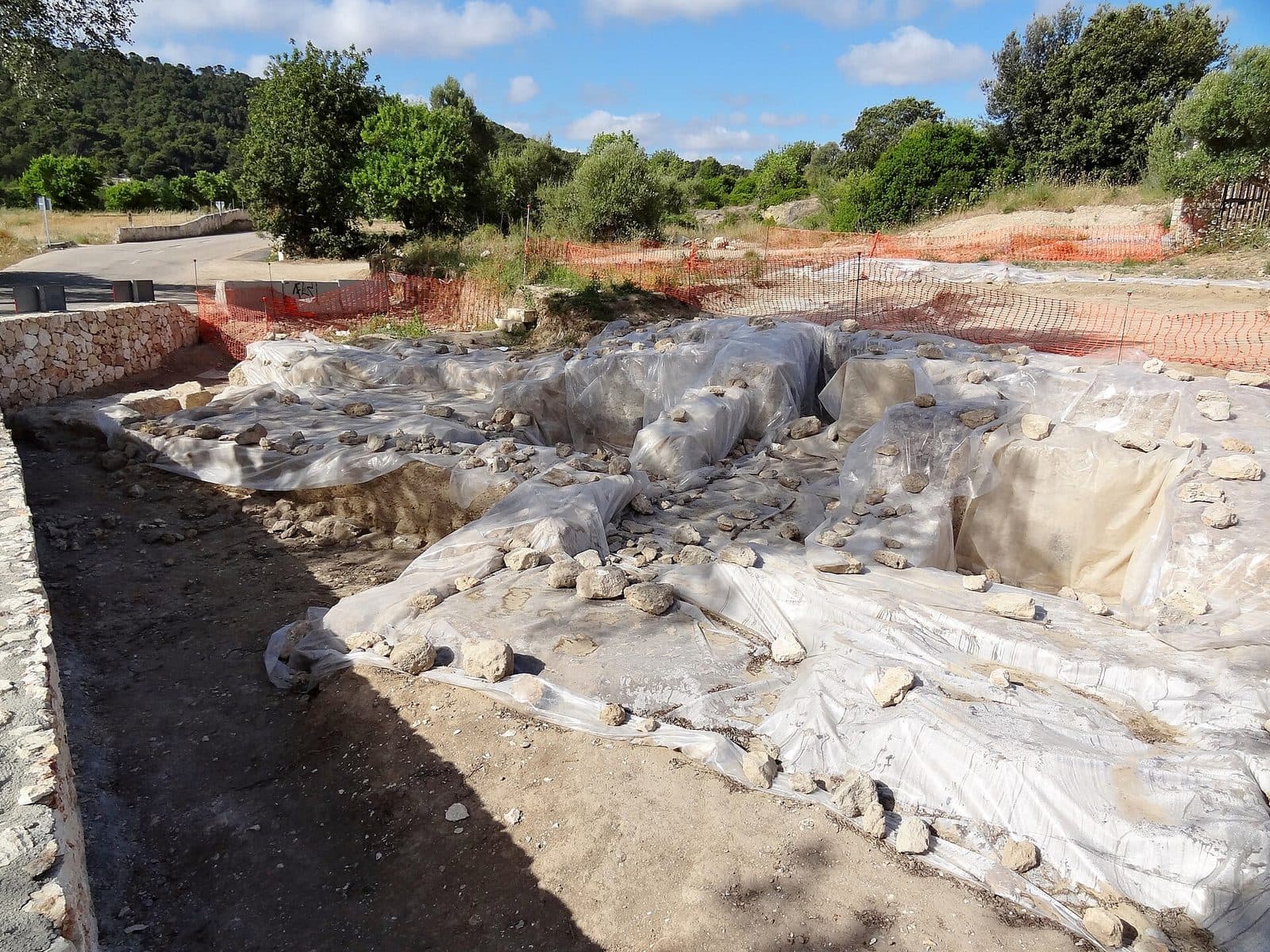

The Termes Romanes de Son Sard tell no story of emperors, legions, or a great Roman city. Their subject is everyday life in the countryside. Near Son Servera, the remains of a Late Antique bath complex came to light, probably once part of a larger Roman villa and agricultural estate. This rural context in particular makes the find unusual for Mallorca.
The complex was discovered not during a long-planned excavation, but during roadworks. Beneath the ground beside today’s MA-4034 lay structural remains whose significance first had to be recognized and then investigated archaeologically. A chance discovery developed into a research project that now looks far beyond the baths themselves to explore the historic landscape of the Son Servera valley.
A visit is therefore particularly suited to people who want to learn how to read ruins: low wall lines define the archaeological remains here. The site becomes fascinating once the visible remains are understood as part of a Roman estate—with bathing facilities, water management, agriculture, and a long history of settlement extending into Mallorca’s Islamic period.
History and significance
Discovery during road construction
It began with a construction site. When work was carried out on the MA-4034 road in early 2012, structural remains of a Roman bathhouse emerged. Specialists recognized the archaeological evidence and initiated investigations. Although the discovery was unexpected, this does not mean that the area had previously been considered entirely unremarkable: pottery sherds from the Roman and Islamic periods had already been found on the surface. The area had therefore been registered and protected as an archaeological site even before the baths were uncovered.
The find clearly illustrates how archaeology works outside well-known ruined cities. Individual sherds on the surface had initially indicated only that the area had been used historically. It was not until the ground was disturbed that it became clear that structural remains had survived here. The roadworks thus became the catalyst for a more extensive investigation of Son Sard.
The Late Antique country estate
The baths are assigned to Mallorca’s late Roman period. They probably did not operate as an independent public bathing facility but belonged to a larger villa complex. In the countryside, a Roman villa was not merely an impressive residence. It could be the center of an agricultural enterprise that combined housing, production, storage, and the management of the surrounding land.
A private bath within such an estate indicates considerable investment. Water had to be supplied, rooms had to be laid out for specific functions, and the facility had to be operated. This is precisely why the discovery raised new questions: Who lived here, how was the estate integrated into the regional economy, and what status did its inhabitants hold? The baths do not provide a complete account of their lives, but they do offer a rare material starting point.
Their significance extends beyond Son Servera. According to the Consell de Mallorca, these are the first and so far only substantial thermal-bath structures found in Mallorca’s countryside. The discovery therefore helps researchers investigate a period for which comparatively little archaeological evidence of life outside the island’s towns is known.
From Roman baths to an archaeological landscape
The history of Son Sard did not end with its Roman use. Surface finds document a long chronological span, and later investigations uncovered not only Roman pottery but also an Islamic burial. A mill of Muslim origin also stands on the site. Water links the Roman, medieval, and ethnological elements of the area, forming a common thread throughout its history.
This historical depth changes how the baths are perceived. They do not stand as an isolated ruin in an otherwise empty historical landscape, but within a setting that was repeatedly used, altered, and reinterpreted. For this very reason, the archaeological project investigates more than individual walls. It explores settlement patterns throughout the Son Servera valley and asks how rural life in Mallorca developed across different periods.
Protection and ongoing research
The Consell de Mallorca designated the Roman site a Bien de Interés Cultural in the archaeological zone category. This protection applies not merely to a single excavated room, but to the find context and its scientific potential. Soon after the discovery, consideration was also given to securing adjacent areas for further investigation and the preservation of the structural remains.
Today, a joint project involving Leiden University, local archaeologists, and the municipality of Son Servera is researching the site. The investigations combine excavation trenches with magnetometry, systematic fieldwalking, and the analysis of surface finds. Son Sard is therefore not a finished ruin with a definitive ground plan, but a research site whose interpretation can become more precise with each campaign.
What to see
The Roman bath complex
The structural remains of the baths form the heart of the site. What can be seen is not a fully preserved bathhouse with vaults and towering façades, but archaeological remains: foundations, low wall lines, and the spatial organization of a complex that once operated within a larger rural estate. Visitors therefore need to keep their attention close to the ground. The course and thickness of the walls and their positions in relation to one another are more revealing than any single spectacular architectural feature.
The term baths can easily create false expectations. According to the current interpretation, Son Sard was not a large public bathing complex modeled on those of Roman metropolises. Instead, the remains are understood as the private bathhouse of a villa. This makes them smaller in scale, but no less informative. A bath on an agricultural estate shows that Roman domestic life and bathing culture also played a role in Mallorca’s rural northeast.
At the site, it is worth viewing the baths as more than a collection of old stones. Each wall once marked a boundary between functional areas; the entire complex was organized around water, movement, and use. How individual rooms were used at different times remains a matter of archaeological interpretation. The key idea to grasp during a visit is therefore clear: this was a technically and organizationally sophisticated part of a private estate.
The possible Villa Son Sard
The bath complex was very likely part of a larger Roman site. This is why both names appear in research: Termes Romanes de Son Sard for the baths and Villa Son Sard for the broader archaeological project. The visible remains are therefore a fragment rather than the whole.
This interpretation explains why researchers include the surrounding land in their work. An estate consisted of more than residential and bathing rooms. Agricultural land, paths, water systems, and other buildings shaped its operation. Not all of these elements are exposed, but pottery finds and geophysical surveys help identify boundaries and structural remains beneath the surface.
Visitors should therefore repeatedly look up from the walls and take in the surroundings. The location in the Son Servera valley is not merely a backdrop. It is part of the research subject. Son Sard is intended to reveal how people used the landscape in Roman Mallorca and how a rural settlement was organized.
Water as a recurring theme
The proximity of water is one of the site’s most important connecting elements. A Roman bath already depended on a reliable supply. Nearby are the Torrent de Xiclatí and the water and mill landscape known as Font des Molins de Son Sard. The later historical traces on the site are also connected with the use of this locational advantage.
Son Sard thus reveals an unusually long history of technology and settlement. The Romans built a bath complex here; a mill survives from the Islamic period. The two belong to different societies and eras, yet both demonstrate that water shaped how the site was used. The Consell de Mallorca expressly included this connection in its assessment of the archaeological zone.
This context makes the site easier to understand. The baths seem less mysterious when visitors look not only for decorative remains but also for the practical requirements of their operation. Water was not a secondary concern; it made use of the baths possible in the first place. As a result, the site explains more about historical infrastructure than some more impressive ruins removed from their original setting.
Excavation trenches and invisible structures
Archaeological landscapes do not consist solely of exposed walls. Several investigative methods come together at Son Sard. Targeted excavation trenches reveal layers and specific features; magnetometry can detect unusual structures in the ground without opening the entire area. Fieldwalking documents pottery and other surface finds.
These methods are not a secondary topic, but the key to understanding the site. The visible baths prompted the work, but the research objective is broader: to determine the site’s boundaries, identify structures, and interpret their possible functions. Roman pottery helps establish chronological and cultural contexts. The Islamic burial, in turn, shows that the same part of the landscape was later used in a different way.
Son Sard is therefore especially interesting for visitors who want to understand how archaeological knowledge is created. The site presents more than a result. It also makes clear that many stages of work lie between an initial discovery and a reliable reconstruction: surveying, comparing, excavating, documenting, and reinterpreting.
Visiting the site
Plan ahead rather than treating it as a museum visit
A trip to the Termes Romanes de Son Sard should not be planned like a visit to a conventional museum with permanently accessible galleries. No confirmed opening hours or current admission fee are recorded. Before traveling, it is therefore advisable to check current access with the municipality of Son Servera or a local information office. This is especially important because research, conservation measures, and work on the site may affect visiting arrangements.
Public interpretation events are also worth watching for. The archaeological project involves the local community through digital reconstructions, events, and historical presentations, among other activities. When such an event is announced, it provides considerably more context than an unguided look at low wall remains. At a site whose broader features still lie partly underground, expert explanations can make all the difference.
Read the remains slowly
The visit itself does not revolve around a long sequence of individual attractions. A calm overview is more useful: first take in the setting beside the MA-4034 and within the valley, then examine the exposed structures, and finally consider their relationship with water, the villa, and agricultural use. Anyone looking only for a fully preserved bath will underestimate the discovery. Anyone looking for traces of a Roman country estate will find much more.
There is no fixed duration that can be recommended. For an initial impression, the site is more compact than a large archaeological park. Visitors who trace the ground plan, explore the research project, or attend an interpretation event will need correspondingly more time. Son Sard is best planned as a focused historical visit rather than a standalone destination for an entire day.
Timing and atmosphere
There is no reliable information about typical visitor numbers. Timing should therefore be based less on assumed peak periods than on confirmed access and conditions at the site. Public events can be particularly worthwhile for gaining a better understanding.
As this is a rural archaeological site, viewing the terrain is the main focus. Good visibility of the wall lines and ground features matters more than any particular visitor itinerary. After the visit, it is worth continuing the experience in nearby Son Servera rather than viewing the site in isolation: the archaeological remains explain the ancient background of a landscape that still connects an inland town, agriculture, and the east coast.
Getting there and parking
From Palma and the airport
The stated routes initially lead to Son Servera, not directly to the excavation area. The road distance from Palma Airport to Son Servera is 67 kilometers. The journey takes around 57 minutes via the Ma-15 and then the Ma-4030. From central Palma, the distance along the same main route is 70 road kilometers; allow around 63 minutes to reach Son Servera.
The Ma-15 covers the long stretch through the island’s interior toward the northeast. The Ma-4030 then leads to Son Servera. Local navigation is essential for the final section to the site: the baths lie west of the Ma-4034, the road during whose expansion they were discovered. In the northern area, the MA-4034 meets the routes MA-4032 toward Port Vell and MA-4033 toward Artà.
The final section to the site
Using the name of the archaeological site as a navigation destination is more helpful than entering Son Sard alone. The name is also used for fincas and other properties in the area; these should not be confused with the Roman baths. The relevant destination is the archaeological site on the west side of the MA-4034 near the road junctions toward Port Vell and Artà.
Because the complex originated as a roadside discovery and is not an urban museum, the final stage should be checked in advance. Access and suitable parking options in particular may depend on the site’s current security arrangements. Stop only where legally permitted and where doing so will obstruct neither the MA-4034 nor entrances to private properties.
By bus
The recorded bus stops Son Servera nord and Son Servera sud serve the town of Son Servera. They are not necessarily located at the entrance to the archaeological site. Anyone arriving by public transport must therefore also establish how to cover the final section to the MA-4034 and whether the site is accessible on the intended day.
The bus is nevertheless a practical option when combined with a walk around Son Servera. Anyone traveling solely to see the baths should plan the local onward journey more carefully than they would for an attraction in the town center. The rural location is part of the site’s historical appeal, but it requires more preparation.
Bus lines to Termes Romanes de Son Sard at a glance
| Line | Route | Departures/day | First | Last |
|---|---|---|---|---|
| 412 | Costa dels Pins - Manacor | 109 | 05:37 | 22:50 |
| 424 | Cala Rajada - Portocristo | 84 | 08:20 | 23:12 |
| A42 | Cala Bona - Aeroport | 84 | 00:40 | 23:40 |
| 425 | Cala Bona - Portocristo | 41 | 07:38 | 22:40 |
From the official GTFS feeds (TIB/SFM), no real-time data. The figures cover all stops in the town; weekend and holiday services differ — check with the operator before travelling.
Getting there by bus
Son Servera nord 1 (62031) · 1.6 km as the crow flies
- 412Costa dels Pins - Manacor · Daily
- 424Cala Rajada - Portocristo · Daily
Son Servera nord 2 (62034) · 1.7 km as the crow flies
- 412Costa dels Pins - Manacor · Daily
- 424Cala Rajada - Portocristo · Daily
Son Servera sud 2 (62021) · 1.8 km as the crow flies
- 412Costa dels Pins - Manacor · Daily
- 424Cala Rajada - Portocristo · Daily
Son Servera sud 1 (62020) · 1.8 km as the crow flies
- 412Costa dels Pins - Manacor · Daily
- 424Cala Rajada - Portocristo · Daily
Cala Bona nord 1 (62028) · 2.0 km as the crow flies
- 412Costa dels Pins - Manacor · Daily
- 425Cala Bona - Portocristo · Daily
- A42Cala Bona - Aeroport · Daily
Cala Bona nord 2 (62029) · 2.0 km as the crow flies
- 412Costa dels Pins - Manacor · Daily
Port Nou 1 (62026) · 2.0 km as the crow flies
- 412Costa dels Pins - Manacor · Daily
Timetable data: official GTFS feeds (TIB/EMT), no real-time — check with the operator before travelling.
Nearby attractions
Son Servera
Son Servera is the natural starting point for a visit. The town lies in northeastern Mallorca, slightly inland from the east coast, and is the modern reference point for the archaeological landscape of Son Sard. A walk through town highlights the contrast: on one side is an established Mallorcan community; on the other, a Roman site whose settlement structures can largely be understood only through archaeological methods.
A focused walk through the town center is sufficient as an addition to the visit. The Església Nova is another worthwhile point of interest.
Port Vell and the east coast
The site’s road connections already point toward the coast. The MA-4032 leads to Port Vell, while Cala Bona, Cala Millor, and the beaches within the municipality of Son Servera can also be included in an excursion. The coastal resorts are not merely leisure stops after an archaeological visit. They help place the Roman estate geographically between fertile inland country and the sea.
This combination is especially useful because Son Sard itself is not an archaeological park that fills an entire day. The site provides a historical focus, Son Servera adds local history and everyday life, and the coast opens up a view of the municipality’s geography. The result is a varied excursion without attributing a scale or range of facilities to the baths that they do not possess.
Other archaeological traces
In the Son Servera area, the Talaiot de Pula, the Talaiot de Mestre Ramon, and other sites reveal earlier traces of settlement. They do not belong to the Termes Romanes de Son Sard and each tells its own story. As a loose itinerary, however, they can demonstrate that the Roman villa did not mark the beginning of human activity in northeastern Mallorca.
For a single day, it is better to choose a selection rather than compile the longest possible list. Son Sard is most rewarding when there is time to consider the relationship between baths, villa, agriculture, and water. Other sites should broaden this perspective rather than simply be checked off in rapid succession.
The place it belongs to
Son Servera in the place guidePractical visitor information
What to expect at an excavation site
Do not expect a reconstructed thermal bath where complete rooms, pools, and vaults can be explored. Son Sard is an archaeological site with preserved structural remains and an ongoing scientific context. Its value lies less in monumental height than in the rarity of the evidence: a substantial private bath in rural Mallorca is archaeologically exceptional.
A brief introduction to the Roman villa as a form of enterprise is helpful. Once it is clear that housing, agriculture, and private bathing culture belonged together here, even inconspicuous wall lines become easier to understand. The site’s chronological complexity is equally important. Roman pottery, an Islamic burial, and the mill of Muslim origin represent different phases of use, not a single complex that existed at the same time.
Clothing and conduct
For an outdoor archaeological site, sturdy shoes with secure footing are more suitable than light city or beach footwear. Ground features and excavation areas should be viewed only from approved positions. Walls, layers, and loose finds must not be stepped on or moved; even inconspicuous fragments may be important for scientific documentation.
Sun protection and drinking water are sensible preparations for time spent in open terrain. A visit should also not be based on assumptions about shade, seating, or restroom facilities. Such services do not determine the site’s archaeological value and may change depending on its current condition.
Visiting with children
Son Sard becomes most engaging for children when the visit is presented as a search for clues: Where did a wall run, why did a bath need water, and why do archaeologists also look for pottery in the surrounding fields? A digital reconstruction or public interpretation event can help transform the low structural remains back into rooms and scenes of everyday life.
Supervision remains important because an excavation site is not a playground. The visit is more suitable for children who enjoy observation and a short historical story than for a long stay with recreational activities. The chance discovery during road construction provides an especially good introduction: history here was literally hidden beneath a modern transport route.
Local insider tips
Follow the water
The baths are best understood through the theme of water. The bath, Torrent, Font des Molins, and the mill of Muslim origin show why this site was used across several periods.
Look beyond the walls
The visible bath remains are only one section of the site. Let your gaze range across the surrounding land as well: the research project investigates the entire rural settlement landscape and the possible Roman villa.
Watch for research events
Public interpretation events featuring digital reconstructions or historical presentations can make the low structural remains much easier to understand. Check for relevant announcements from the municipality before traveling.
Find the right Son Sard
The name Son Sard is also used by fincas in the area. The destination is specifically the archaeological site west of the MA-4034 near the junctions toward Port Vell and Artà.
Combine it with Son Servera
The baths are not an archaeological park that fills an entire day. Combine them with a walk around Son Servera and, if time allows, the nearby east coast or another archaeological site.