
Sant Joan Baptista in Son Servera: Church with Defensive Tower
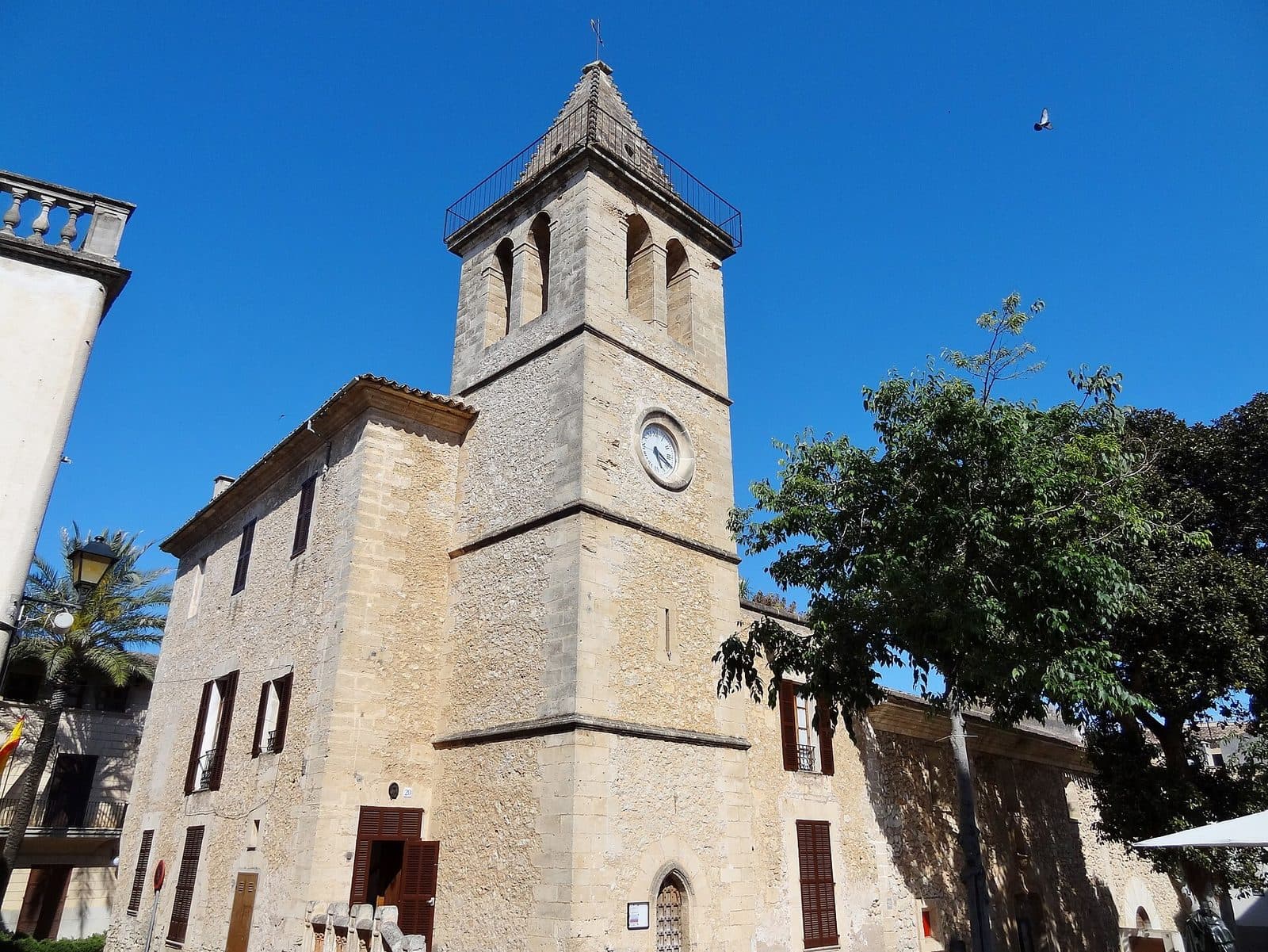

Sant Joan Baptista stands in the heart of Son Servera’s old town, on the eastern side of Plaça de Sant Joan. At first glance, the parish church appears enclosed and fortified. A closer look reveals why: an older defensive tower was incorporated into the church and now serves as its bell tower. Sacred architecture and defensive construction are not separate here but literally layered on top of one another.
The church is particularly worth visiting for travelers who see Mallorca’s churches as more than decorative backdrops. Sant Joan Baptista tells the story of a town’s religious center, earlier defensive needs, and later Baroque alterations. The rectangular building, with a single nave and side chapels, is manageable in scale but displays clear architectural contrasts: strong Gothic arches meet Baroque ornamentation at the high altar.
At the same time, this is not a museum piece frozen in time. Sant Joan Baptista remains a Catholic parish church and bears the name of Son Servera’s patron saint, John the Baptist. Services, celebrations, and local traditions continue to be part of its life. Anyone entering is therefore visiting a place of worship, not an exhibition hall.
The church makes the most sense when viewed together with its immediate surroundings. Plaça de Sant Joan forms the town’s religious center; to the northwest, the Es pastoret sculpture commemorates a plague epidemic. Just a short walk away stands the unfinished Església Nova, a completely different kind of church building. Together, the two churches make Son Servera’s history unusually easy to read.
History and significance
The church’s most striking feature is older than the place of worship that now surrounds it. When construction of Sant Joan Baptista began to progress from 1622 onward, the remains of a defensive tower were incorporated into the building. The tower stood above the altar or presbytery area and was converted into a bell tower. This reuse is precisely what makes the church historically revealing: a structure originally built for protection became part of Son Servera’s religious center.
The defensive tower
The tower recalls a time when fortified buildings had practical importance for the inhabitants of Mallorcan towns. Sant Joan Baptista preserves this older element not as a freestanding ruin but as part of its architecture. From the square, attention should therefore not be limited to the portal and façade. The bell tower’s position above the sanctuary explains why its integration appears more unusual than that of a conventional tower placed beside the nave.
Its function changed fundamentally over the centuries. The defensive structure became a church tower whose bells were part of the town’s religious and communal life. The physical fabric remained, but its meaning shifted from a place of protection to a widely visible symbol of the parish.
The church building from 1622 onward
For the present church, 1622 is the decisive starting point. The structure was given a rectangular ground plan, a single nave, and side chapels. Later alterations during the Baroque period changed its visual character without abandoning the basic spatial form. Gothic and Baroque elements can therefore be seen side by side in Sant Joan Baptista.
The building’s history should not be understood as a neat succession of completely separate stylistic periods. Instead, the church reveals a place of worship that remained in use while being altered and embellished. The robust Gothic arches define the structure of the space, while Baroque forms provide decorative accents, especially at the high altar. This contrast is one of the main reasons to view the church from inside as well.
John the Baptist and Son Servera
The church is dedicated to John the Baptist, known in Catalan as Sant Joan Baptista. He is also the patron saint of Son Servera. This dedication connects the building directly with the town’s identity and also explains the name of the square in front of it.
In this context, Sant Joan Baptista is not merely a historical monument: it forms part of the town’s religious tradition.
What to see
Even the exterior requires a second look. Sant Joan Baptista is not a church whose impact comes solely from a richly decorated show façade. More interesting are the building volumes and their relationship to one another: the enclosed rectangular church, the single-nave interior, the side chapels, and above all the former defensive tower rising over the presbytery.
The location on Plaça de Sant Joan
The church occupies the eastern side of Plaça de Sant Joan, creating a clear boundary within the historic town center. The square provides enough distance to view the building not only from the front but also within its urban setting. Here, it becomes clear that Sant Joan Baptista was not built in isolation but marks the religious center of a town that developed over time.
The location also helps visitors understand the building. Anyone who first walks across the square and then examines the tower can more easily recognize that it does not simply stand beside the church. Its position follows the area above the presbytery. This is precisely where the older defensive architecture and the later church interior meet.
The defensive tower and bell tower
The tower is the defining architectural feature of Sant Joan Baptista. Its history lies less in decorative details than in its position and its changing uses. As the remains of a defensive structure, it was incorporated into the church and converted into a bell tower. It therefore represents the oldest visible layer of the ensemble.
It is worth viewing the tower both from the square and from a slightly angled perspective. From the front, it can appear to be an ordinary church tower; from the side, its integration above the sanctuary becomes clearer. Once this relationship is understood, the architecture reads differently: a tower was not added to a completed church; instead, older fabric shaped part of the later sacred building.
The single-nave interior
Inside, Sant Joan Baptista follows a clear layout. A single nave directs the eye toward the presbytery and high altar. The rectangular ground plan makes orientation easy; visitors should not expect lengthy circuits or a complicated succession of different spaces. The overall impression comes from the straight sightline, the supporting arches, and the side openings leading into the chapels.
The Gothic arches give the interior its strong structural framework. They are not merely stylistic references but shape the sequence of the nave. As visitors walk toward the altar, the perspective changes from arch to arch. This divides the space visually even though it remains a continuous single nave.
The side chapels
Side chapels open along the nave. They expand the rectangular main space without disrupting its clear axis. For visitors, this means that the high altar usually attracts the first glance, while the details reveal themselves along the sides. A slow walk through the nave offers a better understanding of how the main and secondary spaces relate to one another.
The chapels also emphasize that Sant Joan Baptista was created for the religious life of a community. They divide the interior into smaller devotional areas and give the single-nave layout greater spatial depth. Anyone who looks toward the altar only from the doorway will therefore miss an essential part of the architecture.
The high altar
The Baroque phase of the church’s design is especially evident at the high altar. Ornamental elements contrast with the robust construction of the Gothic arches. The appeal lies not in finding a completely uniform style but in recognizing traces of different periods within a church that remains in use.
The contrast is best appreciated from the middle of the nave. From there, the arches, presbytery, and high altar align along a single sightline. The structural austerity of the space leads toward the more richly decorated liturgical center. Only from this distance does it become clear how deliberately the Baroque ornament focuses attention.
The presbytery
The presbytery is crucial not only liturgically but also in terms of the building’s history. The former defensive tower stands above this area. The interior and the tower are therefore two sides of the same story: below lies the religious center of the church, while above rises a structure with older defensive origins.
This relationship is easy to overlook because the tower outside and the altar inside are usually viewed separately. A well-planned visit connects both impressions. First, examine the tower’s position from the square; then follow the axis of the nave toward the presbytery. In this way, a short church visit becomes a small architectural investigation.
Visiting the church
Sant Joan Baptista is best explored in two stages. First, walk around Plaça de Sant Joan to understand the basic form of the building and the position of the tower. Then, provided the church is accessible and no religious service is taking place, view the single-nave interior. The visit does not take long, but it becomes considerably more rewarding when the tower, arches, side chapels, and high altar are consciously compared.
On Plaça de Sant Joan
From the square, the visit should not end directly at the portal. Taking a few steps back makes the building’s proportions and the tower’s position easier to understand. A side view is then recommended because it shows more clearly how the tower connects with the area above the presbytery.
Current access to the interior should be checked.
Inside the church
If the door is open, the most useful approach is to walk a few steps into the nave. From a central position, the Gothic arches and the Baroque-decorated high altar can be viewed together. The side chapels can then be examined one after another.
A compact visit is sufficient for the church alone; allow more time if Plaça de Sant Joan, Es pastoret, and the nearby Església Nova are included in the same walk. Comparing the two churches is particularly revealing: here stands a completed parish church altered over a long period, while nearby is an unfinished church with an open character.
Opening times and religious use
No generally reliable opening hours or admission price have been recorded. Because Sant Joan Baptista is an active parish church, access may depend on services, celebrations, and other church events. Anyone planning specifically to see the interior should therefore check the latest information in advance.
Getting there and parking
From Palma and the airport, the route crosses Mallorca toward the northeast. The stated distances and driving times apply as far as Son Servera, not directly to the church portal. The final section leads into the town center and Plaça de Sant Joan, where the church stands on the eastern side.
From Palma Airport
The road distance from Palma Airport to Son Servera is 67 kilometers. The journey takes around 57 minutes and follows the Ma-15 and then the Ma-4030. After reaching the town, continue toward the center and Plaça de Sant Joan. Because the church stands in the heart of the historic town center, it is better to drive calmly through the final streets than to look for direct vehicle access to the entrance.
From central Palma
The road distance from central Palma to Son Servera is 70 kilometers. Allow around 63 minutes for the route via the Ma-15 and Ma-4030. The Ma-4030 leads to Son Servera; within the town, Sant Joan Baptista is away from the through road in the central area on the square of the same name.
Visitors arriving by car can easily approach the church as part of a walk through the center rather than driving exclusively toward the closest possible point to the building. This also makes it easier to combine the visit with Plaça de Sant Joan, the Es pastoret sculpture, and Església Nova. Local parking and access regulations must be observed.
By bus
Son Servera is served by bus stops in the northern and southern parts of town. The stops are named Son Servera nord and Son Servera sud respectively. From there, continue on foot toward Plaça de Sant Joan. The name of the square is more helpful for orientation than the church name alone, as Sant Joan Baptista stands directly on its eastern side.
Bus lines to Sant Joan Baptista at a glance
| Line | Route | Departures/day | First | Last |
|---|---|---|---|---|
| 424 | Cala Rajada - Portocristo | 84 | 08:20 | 23:12 |
| 412 | Costa dels Pins - Manacor | 62 | 05:53 | 22:46 |
From the official GTFS feeds (TIB/SFM), no real-time data. The figures cover all stops in the town; weekend and holiday services differ — check with the operator before travelling.
Getting there by bus
Son Servera sud 2 (62021) · 0.2 km as the crow flies
- 412Costa dels Pins - Manacor · Daily
- 424Cala Rajada - Portocristo · Daily
Son Servera nord 1 (62031) · 0.3 km as the crow flies
- 412Costa dels Pins - Manacor · Daily
- 424Cala Rajada - Portocristo · Daily
Son Servera nord 2 (62034) · 0.3 km as the crow flies
- 412Costa dels Pins - Manacor · Daily
- 424Cala Rajada - Portocristo · Daily
Son Servera sud 1 (62020) · 0.3 km as the crow flies
- 412Costa dels Pins - Manacor · Daily
- 424Cala Rajada - Portocristo · Daily
Timetable data: official GTFS feeds (TIB/EMT), no real-time — check with the operator before travelling.
Nearby sights
Around Plaça de Sant Joan, Son Servera presents a different face from the nearby coastal resorts. The church stands in the inland town rather than on the beachfront promenade. This makes it particularly easy to combine a visit with a walk through the traditional center. The routes between the main sights are part of the experience: the parish church, square, memorial, and unfinished sacred building tell different chapters of the same local history.
Plaça de Sant Joan
The square is the natural starting point. It provides the distance needed to view Sant Joan Baptista as a whole and bears the name of the same patron saint. Visitors who do not immediately move on will gain a better sense of how strongly the church defines Son Servera’s historic center.
Es pastoret
The Es pastoret sculpture stands northwest of the church. It commemorates a plague epidemic and adds another historical layer to the walk. The memorial should not be confused with the architectural history of Sant Joan Baptista, but it stands nearby and is one of the most meaningful additions to a walk across the square.
The short transition from the church to the sculpture leads from a parish church used for centuries to a specific local remembrance. It shows that the square is not only an architectural center but also a place of collective memory.
Església Nova
Església Nova is only a short walk away. Visiting both churches is particularly revealing because their effects could hardly be more different. Sant Joan Baptista is a completed, enclosed parish church with an older defensive tower and later Baroque alterations. Església Nova remained unfinished and therefore creates an open, almost opposite spatial impression.
The combination should not be understood as a competition between the buildings. Together, they show how religious architecture in Son Servera developed across different periods and under different circumstances. Even visitors with little time can gain a concentrated insight into the municipality’s cultural heritage on this short walk through town.
Son Servera and the east coast
Son Servera lies at the foot of Puig de sa Font and is connected to neighboring towns by the Ma-4030 and Ma-4040. The municipality also includes coastal areas along Badia de Son Servera, including Cala Bona, part of Cala Millor, and Costa dels Pins. The parish church therefore provides a worthwhile cultural contrast to a day on the coast.
Rather than hurriedly linking several distant destinations, visitors can first explore the town center on foot and then continue to the coast. Sant Joan Baptista remains the historical reference point: the church shows where the municipality’s older heart lies, while tourist life is concentrated more strongly around the bay.
The place it belongs to
Son Servera in the place guidePractical visitor information
Sant Joan Baptista is a manageable destination, but it is not an exhibition space with unrestricted access. The church remains in religious use, and this should guide any visit. Current access times should be checked in advance; an open entrance does not guarantee that an undisturbed tourist visit is appropriate at that moment.
Visiting with children
With children, a practical search task works better than a lengthy art-historical explanation: Where is the tower, and which part of the church lies below it? Outside, first identify the position of the former defensive tower; inside, direct attention toward the presbytery. This makes the unusual building history understandable without requiring a long stay.
Plaça de Sant Joan makes it easy to view the exterior from a distance. Information about strollers and individual accessibility requirements should be checked before visiting.
What not to expect
Sant Joan Baptista is not a monastery museum, a major exhibition, or an extensive church complex. The value of the visit lies in its concentrated architecture and its continuing function as a parish church. Anyone expecting spectacular staging or a long museum circuit will miss its real appeal.
Careful observation is more rewarding here than quickly ticking off a sight. The tower above the presbytery, the sequence of Gothic arches, the side chapels, and the Baroque high altar provide the key details. Together with Es pastoret and Església Nova, they create a coherent walk through Son Servera’s religious and local history.
Local insider tips
View the tower from the side
From the edge of Plaça de Sant Joan, it becomes clearer that the bell tower does not stand conventionally beside the nave. It rises above the presbytery and originated as a defensive tower incorporated into the church.
Compare both churches
Visit Sant Joan Baptista and the nearby Església Nova on the same day: the enclosed historic parish church with its defensive tower provides a particularly revealing contrast to the unfinished, open church.
Include the weekly market
Son Servera’s weekly market can be combined with a walk through the town. The church’s exterior architecture can be viewed from Plaça de Sant Joan along the way.
Align the arches and altar
The main stylistic contrast is best appreciated from the middle of the nave: the robust Gothic arches frame the view toward the more richly ornamented Baroque elements of the high altar.