
Far d'Alcanada Lighthouse off Port d'Alcúdia
.jpg)
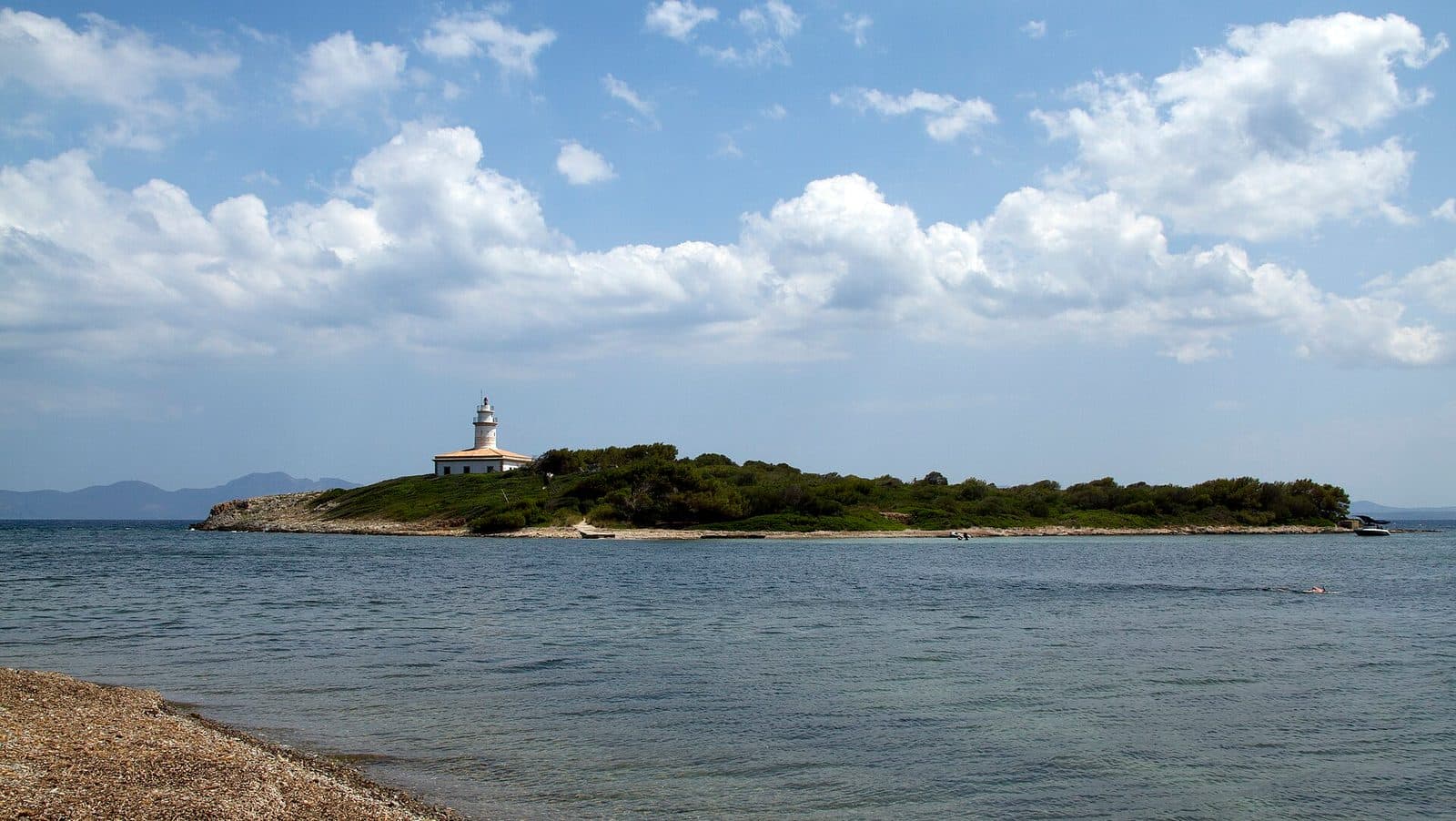
Off the pebbly coast of Alcanada stands one of those structures that define an entire landscape even from afar: Far d'Alcanada. The lighthouse rises on a small, uninhabited island on the northern side of the Bay of Alcúdia. From the shore, the tower, island, and sea appear as a single scene—clearly outlined yet different in every kind of weather.
Its appeal lies less in a conventional tour than in its setting. The lighthouse is experienced from the beach, the coastal path, and the water. Pebbles, rocks, and patches of washed-up Posidonia fill the foreground; beyond them lie the shallow coastal waters, the wooded island, and Far d'Alcanada. Large ships heading for the port of Alcúdia are a reminder that this is not a decorative fantasy but a shipping area that remains in use today.
The excursion is particularly worthwhile for visitors who want to combine a peaceful coastal walk, a picnic beneath pine trees, or a swimming stop with a striking landmark. Photographers will also find a subject that can be reached without a demanding hike. The focus is the ensemble formed by the active navigational aid, the island, and the bay.
Alcanada provides a clear contrast to the lively centre of Port d'Alcúdia. Just a few kilometres from the port, the coast becomes rockier, greener, and quieter. This rapid change is precisely what makes Far d'Alcanada a good destination for both a short detour and a longer stay by the sea.
History and significance
Construction and purpose of the lighthouse
Far d'Alcanada was built in 1861. Its position on the northern side of the bay is closely connected with shipping to Alcúdia. The port has both a commercial area and a harbour for smaller boats, with a fishing quay and marina. It is also used for freight traffic and connections to other ports. Against this background, the lighthouse should be understood as a working structure: it marks the island and aids navigation in a coastal area used by leisure boats, fishermen, and larger ships.
The tower remains active. This distinguishes it from historic navigational aids preserved only as monuments. Its much-photographed appearance should therefore not obscure the fact that Far d'Alcanada still fulfils a nautical function today. Anyone sitting on the shore and watching a ship cross the bay is witnessing the exact relationship for which the lighthouse was built.
From working site to landmark
As Port d'Alcúdia and Alcanada developed into holiday areas, perceptions of the structure changed. The small island became the unmistakable counterpart to the beach, and the lighthouse became a frequently photographed landmark of the bay. The island is uninhabited, and the lighthouse is an active navigational aid.
That is precisely where its present-day significance lies. Far d'Alcanada connects modern shipping with the landscape of the bay. The coast, island, and port make its purpose immediately apparent.
What to see
Far d'Alcanada is most impressive not close up but in combination with its surroundings. From the mainland, the view extends across shallow water to the small island. The pale lighthouse rises above the trees, while the tower's usually clear silhouette creates a fixed point in the broad bay. Depending on the viewpoint, the background may be open sea or passing ships.
The lighthouse
Built in 1861 and still active, the tower is the island's dominant structure. Its form is particularly easy to appreciate from Platja d'Alcanada and the coastal area east of the port town. Unlike a lighthouse standing directly beside a road, there is always a strip of sea between the viewer and the structure here. This distance is part of the experience: it makes Far d'Alcanada a true navigational aid rather than merely a lookout tower on land.
The visual emphasis is on the tower's exterior form and position. From a distance, it is easy to see how it rises above the vegetation and gives vertical definition to the low-lying island.
Illa d'Alcanada
The island is uninhabited and lies immediately off the coast. Pine trees and rocky ground give it a distinctly more natural appearance than many developed sections of the bay's coastline. The lighthouse rises above the trees and therefore remains visible from the mainland. From some places on the shore, the island appears almost close enough to touch; only the stretch of water in the foreground reveals its separation.
In calm seas, the island is approached by swimmers or kayakers. Other descriptions also mention crossing through the shallow water. However, this should not be mistaken for an ordinary footpath: it is a passage through the sea, not a bridge or constructed access route. Water depth, the seabed, and sea conditions determine whether approaching the island is advisable at all. In any case, crossing is unnecessary for the characteristic view of Far d'Alcanada.
The view from Platja d'Alcanada
The classic view opens up from Platja d'Alcanada. Rather than an uninterrupted expanse of fine sand, the beach consists of pebbles, small patches of sand, and Posidonia. Pine trees extend close to the shore and frame the view of the island. New compositions constantly appear between the trunks: in one, the tower stands freely above the water; in another, branches, beach, and island appear layered one behind the other.
This foreground makes the location more interesting for photography than a completely open promenade. Walking a few steps along the coast changes the tower's position in relation to the trees and shoreline. A thicker sitting mat is more practical than a thin beach towel, as the ground remains rocky in many places.
The view from the water
From the sea, the scene changes fundamentally. The island appears more strongly as a separate landform, and the lighthouse is no longer merely the focus of a view from the beach but a widely visible point of orientation in the bay. Kayaks and excursion boats pass this part of the coast; some boat tours from Alcúdia sail past the islet or stop nearby for a swim.
Its maritime function can also be observed without a boat. From the shore, larger ships can be seen entering or leaving the port of Alcúdia. Together with smaller leisure craft, they provide an impression of the bay's varied uses. Far d'Alcanada remains the fixed reference point within this moving scene.
Light, coast, and vegetation
The appearance changes mainly with the light and weather. In clear daylight, the tower and island stand out sharply against the water and sky. Beneath the pine trees on the mainland, by contrast, a dark frame forms that highlights the pale lighthouse even more strongly.
The natural coast is not merely a secondary backdrop. Pebbles, rocks, Posidonia, and pine trees clearly distinguish Alcanada from the long sandy beaches farther west in the bay. Visually, Far d'Alcanada belongs precisely to this rougher, less developed stretch of shoreline.
Visiting Far d'Alcanada
A visit usually begins not at the tower but on the opposite shore. After the final stretch through Alcanada, the first unobstructed view of the island opens up between the pine trees and the coast. From there, the visit can be arranged flexibly: as a short photography stop, a walk along the rocky beach, or a longer break with swimming and a picnic.
A short scenic stop
Anyone who only wants to see the lighthouse does not need an extensive itinerary. Far d'Alcanada is clearly visible from the coastal area and Platja d'Alcanada. A few steps along the shore are enough to find different perspectives with trees, rocks, or open water in the foreground. When time is limited, the excursion can therefore be combined easily with Port d'Alcúdia or Alcúdia's old town.
For this short visit, stay on the mainland. This is not only straightforward but also provides the most familiar overall view of the island. From close range, some of the relationship between the water, vegetation, and tower would be lost.
Beach break and picnic
Many visitors stay longer because the pine trees along the shore provide natural shade. The location is better suited to a simple break in nature than a day with full beach services. Platja d'Alcanada lacks the typical facilities of a large resort beach, including rows of loungers, showers, and a beach bar. Food, water, and a suitable mat should therefore already be in your bag.
The shore is characterised by pebbles and Posidonia. Anyone who wants to swim will benefit from water shoes, while those who simply want to sit and look at the lighthouse should bring a sturdy mat. Families often use the area for picnics, particularly because the pine trees provide shade. Nevertheless, its natural character is no substitute for a supervised or extensively equipped bathing area.
When it is quieter
In summer, parking spaces and the beach fill up early, particularly at weekends. Arriving before 10 a.m. is considered a good option, especially in July and August.
On weekdays and outside the high season, the car park is generally less busy as well. Photographers should consider not only the position of the sun but also how busy the beach is: with fewer people on the shore, it is easier to capture the pine trees and island as a unified composition.
Approaching the island
In calm seas, swimmers and kayakers reach Illa d'Alcanada. However, this is a separate water-based experience and not a necessary part of seeing the lighthouse. There is no constructed pedestrian connection. The seabed is rocky, and conditions on the water may differ from the calm impression given by the beach.
Anyone who simply wants to experience the island as a sight is better off remaining on the coast or choosing a view from a boat. Particularly with children, the view from the mainland should not be equated with an easy crossing. The lighthouse is already the clear focus of the excursion when seen from the shore.
No approach to the structure is necessary for the view from the coastal area.
Getting there and parking
From Palma, the journey initially leads to Port d'Alcúdia. From Palma Airport, the road distance to the port town is 60 kilometres; the drive takes around 47 minutes via Ma-30, Ma-13, and Ma-3460. From the centre of Palma, the route via Ma-13 and Ma-3460 covers a total of 57 kilometres by road and takes around 51 minutes.
These figures expressly apply only as far as Port d'Alcúdia, not directly to Far d'Alcanada. From the port, Ma-3460 leads towards the commercial harbour and then eastwards along the coast. The final stretch runs through Alcanada to the beach opposite the lighthouse island. The tower itself stands on Illa d'Alcanada and therefore cannot be reached directly by car.
Driving through Port d'Alcúdia
In the port area, tourist traffic, access roads to the marina, and routes to the commercial harbour converge. To reach Alcanada, follow the coast eastwards. As the distance from the centre increases, the buildings become more scattered; eventually, the drive ends at the natural beach area overlooking the island.
Visitors coming from Palma should not regard the stated driving time as a complete door-to-door estimate. Traffic in the port town, finding a parking space, and the subsequent walk along the beach all add time. Allowing extra time is advisable during the high season and on summer weekends.
Parking at Platja d'Alcanada
A public car park is located directly beside Platja d'Alcanada. It is divided into several sections, but only a few spaces are shaded by trees. There are also parking options along the access road. If the spaces closest to the beach are occupied, the walk will be correspondingly longer.
On weekdays and outside the high season, parking is generally easier. In summer, spaces become scarce early, particularly at weekends; arriving before 10 a.m. improves your chances. As in all publicly accessible parking areas, valuables should not be left visible inside the vehicle.
Travelling by bus
Bus stops are located around Platja d'Alcanada, Cala en Poncet, and Ses Pedreres. From the stops, the final stretch continues on foot through the coastal area. It is advisable to check the current service before departure. Even when arriving by bus, the island itself remains separated from the mainland; the usual destination is the beach overlooking the lighthouse.
Bus lines to Far d'Alcanada at a glance
| Line | Route | Departures/day | First | Last |
|---|---|---|---|---|
| 323 | Alcanada - Es Mal Pas | 84 | 08:00 | 21:50 |
From the official GTFS feeds (TIB/SFM), no real-time data. The figures cover all stops in the town; weekend and holiday services differ — check with the operator before travelling.
Getting there by bus
Platja d'Alcanada (3066) · 0.7 km as the crow flies
- 323Alcanada - Es Mal Pas · Daily
Cala en Poncet 1 (3024) · 1.1 km as the crow flies
- 323Alcanada - Es Mal Pas · Daily
Cala en Poncet 2 (3067) · 1.1 km as the crow flies
- 323Alcanada - Es Mal Pas · Daily
Ses Pedreres 2 (3070) · 1.8 km as the crow flies
- 323Alcanada - Es Mal Pas · Daily
Ses Pedreres 1 (3068) · 1.8 km as the crow flies
- 323Alcanada - Es Mal Pas · Daily
Timetable data: official GTFS feeds (TIB/EMT), no real-time — check with the operator before travelling.
Nearby attractions
Port d'Alcúdia is close enough to include Far d'Alcanada in a holiday itinerary without a major detour, although it feels considerably livelier. The fishing quay, marina, and commercial area stand side by side at the port. Leisure boats, ferries, and freight traffic reveal different aspects of a port town whose history reaches back to the use of the bay by Roman Pollentia.
Port d'Alcúdia
After the tranquillity of Alcanada, the harbour promenade is ideal for a walk or a stop for food and drink. Boat excursions also depart from here, showing the coastal area around Alcanada from a different perspective. The journey on the water makes it particularly clear why the lighthouse stands in this location: from the open bay, it appears as a point of orientation off the northern coast.
The long sandy beach of Alcúdia begins west of the port. Its contrast with Platja d'Alcanada is striking. Fine sand, tourist infrastructure, and a broad range of leisure activities dominate there, while pebbles, pine trees, and the lighthouse island define Alcanada. The two sections of coastline can therefore be compared easily in a single day.
Alcúdia's old town
The walled old town of Alcúdia adds a historical perspective to the excursion. It lies inland and differs completely in atmosphere and architecture from the modern port. The history of Roman Pollentia recalls the region's long-standing importance. However, an extensive visit to the old town should be planned as a separate activity; Far d'Alcanada remains a landscape and coastal destination.
Cala en Poncet and the Alcanada coast
Between Port d'Alcúdia and Platja d'Alcanada lie residential areas and smaller coastal sections such as Cala en Poncet. A walk through this area shows how the port gradually gives way to a quieter landscape of villas and coastline. Farther east, the golf course of Alcanada, pine trees, and the sea shape the surroundings.
Those wishing to combine art with the coastal excursion will find the Sa Bassa Blanca museum in the wider Alcanada area. Such destinations require separate planning, however, and should not be regarded as a casual extension of a short lighthouse stop.
The place it belongs to
Port d'Alcúdia in the place guidePractical visitor information
Far d'Alcanada stands as an active navigational aid on an uninhabited island. The view from the mainland shows it in its original setting between the coast, island, and shipping traffic.
Footwear and terrain
The shore consists of pebbles, rocks, and Posidonia. Sturdy sandals or lightweight shoes with grippy soles are more comfortable for walking than smooth water shoes. Water shoes are useful for swimming because the seabed is not comfortable everywhere. A sturdy sitting mat makes a picnic on the rocky beach considerably more pleasant.
Approaching the island means travelling through the water rather than along a constructed path. Even when the sea appears calm and shallow, the seabed, currents, boat traffic, and changing conditions must still be considered. A crossing should never be planned as part of an ordinary walk.
Sun and shade
The pine trees on the beach provide natural shade and are an important reason why families and local residents value this section of the coast. Shaded spaces are not guaranteed, however, and may be occupied when visitor numbers are high. Sun protection and sufficient drinking water should therefore be packed even for a short stay.
Along the open shoreline and on the water, there is no protection from the trees. Anyone taking photographs or travelling by kayak often spends longer in direct sunlight than initially planned. During the cooler months, by contrast, wind may shape the experience more strongly than the temperature in the sheltered residential area would suggest.
Visiting with children
For families, the best option is a combination of lighthouse views, a picnic, and time beneath the pine trees. The water is shallow near the shore, but pebbles and uneven ground require attention. As extensive beach infrastructure should not be expected, food, water, water shoes, and a good mat are sensible items to bring.
Crossing to the island is not a necessary family adventure. Far d'Alcanada can be experienced fully as a landscape feature from the mainland without having to lead children through open water. Anyone wishing to swim or paddle should assess the current conditions independently and cautiously.
What not to expect
The beach does not have the usual rows of loungers and parasols. Alcanada is a place for looking, walking, swimming, and sitting—with the lighthouse as a constant presence across the water.
This simplicity requires a little initiative. Food, water, and beach equipment should be brought along, and all rubbish should be taken away again. Those who visit in this way experience Far d'Alcanada in the setting that makes it special: as an active navigational aid between a rocky coast, an uninhabited island, and the shipping traffic of the bay.
Local insider tips
Pine trees as a natural frame
For the classic photograph, do not stop at the first open spot on the shore. Walking a few steps along Platja d'Alcanada changes the tower's position in relation to the pine trees; branches and the pebbly beach create a natural foreground.
Arrive early for a quieter coast
In July and August, it is worth arriving before 10 a.m. The car park and beach are generally less busy then, making it easier to photograph Far d'Alcanada from the shore without dense groups of people in the foreground.
Wait for the ships
The lighthouse's purpose becomes particularly vivid when a larger ship enters or leaves the port of Alcúdia. From the beach, the navigational aid and modern port traffic then appear together in the same view.
Picnic instead of a beach bar
Beneath the pine trees, the lighthouse view can easily be combined with a break. Bring a sturdy mat, water, and food: the beach is pebbly and does not have the facilities of the bay's large resort beaches.
The view from the water
In calm seas, the island appears as a distinct coastal landmark from a kayak or passing excursion boat. There is no need to enter the tower; the perspective from the water alone explains its nautical position.