
Far des Cap Blanc: Lighthouse Above Mallorca’s South Coast
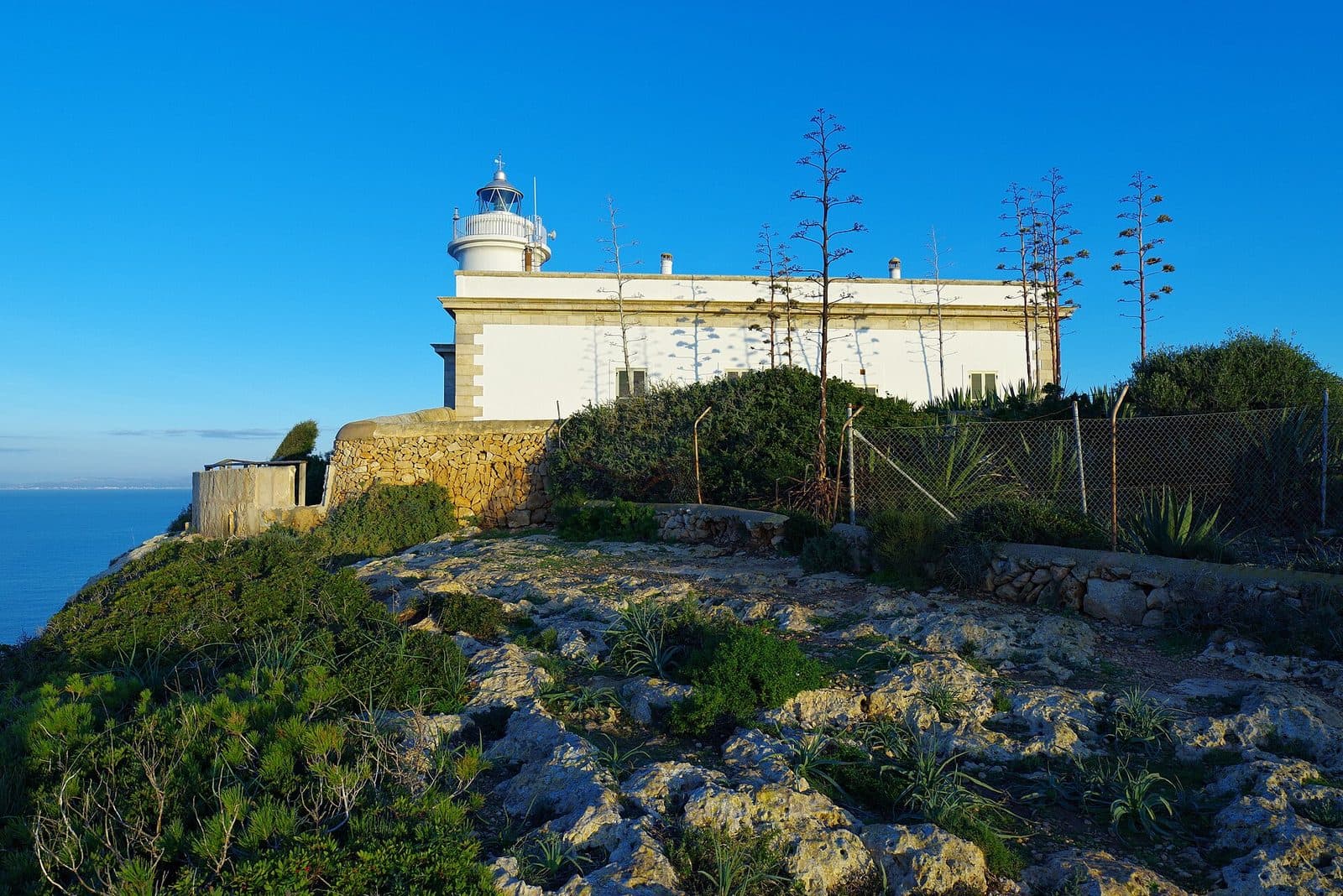

White tower, flat stony terrain, and nothing but sea beyond: Far des Cap Blanc stands on one of Mallorca’s starkest stretches of coastline. Its appeal lies not in a major exhibition or an accessible tower, but in the combination of a historic navigational beacon and sweeping cliff scenery. Anyone wishing to leave Mallorca’s noise and dense development behind for a while will find an impressive alternative here.
The lighthouse rises at Cabo Blanco, the white cape, southeast of the Bay of Palma and not far from Cala Pi. The surrounding landscape is almost horizontal: low garrigue, dry expanses of stone and old walls line the approach road. Only at the coast does the terrain plunge sharply toward the Mediterranean. As a result, the small tower appears understated from close up, while its location becomes all the more prominent.
Far des Cap Blanc is particularly worthwhile for travelers interested in coastal landscapes, historic technology and photography. In clear weather, the view extends far across the open sea; Cabrera may appear on the horizon. During the late hours, warm light moves across the white structure, the rocks and the water. Away from busier visiting times, the silence is one of the place’s most important impressions.
A visit is deliberately simple. The lighthouse grounds are fenced off, and the tower cannot be entered. What visitors can see and experience is therefore the exterior ensemble, the cliffs and the vastness of Cap Blanc. This restraint is precisely what makes the place special: there is no staged attraction to distract from the real subject—the purpose of a beacon on a remote coast.
History and Significance
When the light was first lit on the evening of 31 August 1863, Cap Blanc was considerably more remote than it is today. The lighthouse was intended to assist shipping at the southern approaches to the Bay of Palma and mark the course of this rocky coastline. High above the sea, the beacon achieved a long range even though the tower itself remained comparatively low.
Emilio Pou and the 1862 Construction
The complex was designed by Emilio Pou, one of the Balearic Islands’ most influential lighthouse engineers. More than 20 lighthouses across the archipelago are associated with his work. Far des Cap Blanc was built in 1862 and entered service the following year. Its clear, functional design belongs to the generation of navigational beacons that made the Balearic coasts systematically safer.
The construction site presented particular challenges. The cape consists of a flat, dry limestone platform that abruptly gives way to high rock faces at the coast. Materials and supplies had to be transported through a sparsely populated landscape. The remoteness was not a romantic addition but part of everyday life for the lighthouse keepers, who had to maintain the light and its equipment reliably.
From Olive Oil to Electric Light
The first beacon was fueled with olive oil, a fuel readily available on Mallorca. Paraffin was used later. Each of these technologies required regular maintenance and a reliable supply system for the station. Remarkably, despite its position on a steep coast, Far des Cap Blanc was among the lighthouses also supplied by boat. A road along the cliff was used to transport fuel up from the sea to the station.
The lighthouse was electrified in 1970. This fundamentally changed its technical operation, but not its purpose as a highly visible navigational landmark. The preserved tower and keeper’s house therefore recall two eras at once: the labor-intensive period of fuel lamps and the modernized navigation of the later century.
A Beacon on the Bay of Palma
Cap Blanc marks the eastern end of the Bay of Palma. The location was therefore not chosen at random for a beacon. Ships approaching the bay from the south or sailing along Mallorca’s south coast were given a prominent point of reference here. The height of the cape’s rock face performed part of the role that would have required a much taller tower elsewhere.
Today, the structure’s importance is best understood from the outside. Anyone looking from the white tower toward the horizon immediately recognizes why this particular edge of the island needed a beacon. Vast stretches of water, a rugged coastline and the exposed location illustrate its function more clearly than a technical information panel could.
What to See
Even on the approach, the lighthouse does not announce itself as a monumental structure. A compact white tower and the former residential and service building appear above the low vegetation. Only at the edge of the cape does the true scale of the location become visible: the structure stands on a coast almost 100 meters above the Mediterranean.
The White Tower
The tower is 12 meters high and emphatically functional in appearance. Its white finish clearly distinguishes it from the earthy tones of the garrigue and the darker rock. The lantern sits at the top, and its effectiveness was by no means limited by the tower’s low height. The elevated location places the light far above the sea.
From close up, it is worth looking at more than the top of the tower. Its proportions reveal how economically the structure was designed: this is not a prestigious coastal monument, but a technical building whose form follows its function. Against the open horizon, this simplicity has a particularly strong impact. The tower places a vertical line in a landscape otherwise defined by flat plains and the horizontal boundary of the sea.
The Keeper’s House
The ensemble includes the low house once occupied by the lighthouse keepers. It serves as a reminder that a historic beacon consisted of more than a lantern and optical equipment. People had to live here, store fuel, maintain the complex and ensure that the light operated reliably night after night.
The building can only be viewed from the outside because the grounds are fenced off and have not been arranged as an accessible museum. The windows, façades, house and tower are therefore best appreciated from a short distance. Anyone expecting an interior tour, historic living quarters or an exhibition would miss the character of the visit.
The Cliffs of Cap Blanc
The most impressive part of the visit is not man-made. The flat Marina de Llucmajor ends here in steep rock faces, while the Mediterranean opens widely toward the south. Pale limestone, low garrigue and blue water form large, distinct expanses. On windy days, the exposed nature of the location becomes especially noticeable.
The view follows the coast or disappears across the open sea. On clear days, Cabrera can be seen on the horizon. This distant view also explains the choice of location: the beacon stands not in a sheltered bay but on a widely visible landmark. Caution is still more important than the panorama because the terrain around the cliffs is rocky and uneven.
The Garrigue on the Cape
A dry landscape of low vegetation lies between the road and the coast. This garrigue makes Far des Cap Blanc stand out more strongly than a lighthouse surrounded by houses or tall trees would. Stone walls, barren ground and low shrubs characterize the route through the Marina de Llucmajor.
The apparent emptiness is an essential part of the visitor experience. The lighthouse does not appear isolated because there is nothing to see around it, but because the landscape and structure speak the same clear, functional language. Photographers therefore find particularly minimalist subjects here: a white tower against the sky, rock above the sea and long lines in the warm evening light.
Sunset Views
Toward the end of the day, the subject changes less than its atmosphere. The light strikes the tower, keeper’s house and rock at a lower angle; harsh contrasts soften while the contours of the coast remain distinct. Far des Cap Blanc is therefore considered a popular location for golden-hour and sunset photography.
The view works best not directly beside the fence, but from a position with enough distance to show the entire ensemble. The tower and keeper’s house then do not stand alone in the picture but are framed by the garrigue, cliff line and sea. In clear conditions, Cabrera can form a subtle counterpoint on the horizon.
Visiting Far des Cap Blanc
The approach is short and unspectacular—and that is precisely what makes it effective. From the parking area by the lighthouse, the route leads across rocky, uneven ground toward the coast. The structure remains behind its fence while views across the cliffs and sea open up beside it. There is no conventional tour; the visit consists of looking, taking photographs and experiencing the exposed cape.
A Short Scenic Stop
Anyone who simply wants to see the lighthouse and take a few pictures can plan Far des Cap Blanc as a short stop during a drive through southern Mallorca. There are no long access routes between the parking area, fence and viewpoint. Even so, the visit should not be planned too tightly because the landscape only fully reveals itself when different perspectives of the tower, coast and sea are explored.
For visitors interested in architecture, the appeal lies in the proportions of the ensemble, while nature enthusiasts are more likely to focus on the limestone platform and cliffs. Photographers often wait for changing light. The ideal length of a visit therefore depends less on a prescribed route than on personal interests.
Golden Hour and Quieter Times
The late daylight is considered particularly rewarding because it casts the white tower, keeper’s house and rocks in warm tones. However, sunsets also attract other visitors. Anyone primarily seeking peace should avoid the typical peaks around this light. Outside the busier periods, the cape can feel remarkably quiet.
At midday, the light is harsher, and the largely unshaded surroundings become more tiring in the sun. For clear long-distance views, however, the weather is more important than the time of day. On a transparent day, the view reaches Cabrera; in hazy conditions, the horizon remains less distinct, while the lighthouse itself still offers a good photographic subject.
A Lighthouse You Cannot Enter
The grounds of Far des Cap Blanc are fenced off, and the tower itself is not open to visitors. The visit should therefore not be planned with expectations of climbing the tower, seeing an exhibition or entering the keeper’s rooms, as the experience takes place entirely outdoors.
Current access conditions may change and should be checked before traveling. No reliable opening hours or admission price have been recorded. In any case, the key planning detail is that the familiar viewpoint stop in front of the lighthouse does not include a tour of the building.
Visiting Cap Blanc with Children
The lighthouse can be an exciting visible destination for children, particularly if its former function is explained: before electrification, keepers had to tend the fuel and light regularly. However, the open coastal location requires constant attention. The ground is rocky, and keeping well away from the edge is essential around the high cliffs.
Children should not be allowed to run ahead unsupervised here. The location is more suitable for families making a manageable scenic stop together than for unrestricted play. The fenced lighthouse grounds offer no visitor area or child-oriented exhibition.
Getting There and Parking
The drive to Far des Cap Blanc leads from the more densely developed Bay of Palma into the open Marina de Llucmajor. Long sections of road, low vegetation and stone walls define the final stretch. The Ma-6014 approaches the cape through a landscape that feels significantly more remote than its distance from Palma would suggest.
From Palma via the Ma-19
The road distance from central Palma to Cala Pi is 28 kilometers. The drive takes around 32 minutes and initially follows the Ma-19. These figures apply specifically to Cala Pi, not to the parking area directly beside the lighthouse. Far des Cap Blanc is then reached—or approached before entering the village—by taking the turn through the coastal road network; the Ma-6014 provides access to the cape.
The approach is possible in a normal car, and an off-road vehicle is not required. Even so, a relaxed driving style suits the route because the final approach passes through a sparsely developed area. The lighthouse only becomes clearly visible relatively late.
From Palma Airport
The road distance from Palma Airport to Cala Pi is 22 kilometers; the drive takes around 21 minutes. This information also ends at Cala Pi and should not be interpreted as the exact distance or driving time to Far des Cap Blanc. For the final stretch to the lighthouse, follow the route toward Cap Blanc or the Ma-6014.
The connection is particularly practical for travelers exploring the southern part of the island by rental car. However, the location is only suitable for a stop directly after arrival if no luggage remains visible inside the vehicle. The same applies before departure.
Parking at the Lighthouse
There is a free parking area directly beside Far des Cap Blanc; free roadside parking is also available nearby. It is only a short walk from the parking area to the lighthouse and cliffs. The ground outside the paved sections is rough and stony.
Vehicle break-ins are repeatedly reported at the parking area. Broken glass on the ground is a warning sign that should be taken seriously. Valuables, bags and travel luggage should never be left visible or unattended inside the car. This also applies to what seems like a very short photo stop.
Visiting Without a Car
No bus stop has been recorded in the immediate vicinity of Far des Cap Blanc. The location is therefore unsuitable for a spontaneous trip on a regular bus service stopping directly in front of the lighthouse. Anyone traveling without a vehicle should plan the entire outward and return journey in advance rather than relying on finding a nearby stop upon arrival.
A hiking route toward Cala Pi begins in the lighthouse area. However, it should not be confused with the short walk from the parking area to the viewpoint. A longer coastal hike requires independent preparation, sufficient water and a realistic assessment of the rocky terrain.
Things to See Nearby
Between the lighthouse and the swimming cove, southern Mallorca reveals two very different sides. At Cap Blanc, open limestone expanses, cliffs and sea dominate the scenery. Cala Pi, by contrast, lies in a deeply cut cove with a sandy beach. The two places can easily be combined in one day without reducing the lighthouse to a mere stopover.
Cala Pi
Cala Pi is the obvious starting or finishing point for an excursion to Far des Cap Blanc. The small coastal village feels quieter than the large holiday resorts around the Bay of Palma. Its sandy cove lies deep between rock walls and creates a striking scenic contrast to the open cape.
A sensible order depends on the light and the season. Time at the cove can be spent during the day, with the lighthouse saved for the later golden hour. Anyone wishing to avoid sunset crowds can reverse this order and visit Cap Blanc earlier.
Torre de Cala Pi
The historic Torre de Cala Pi can easily be combined with the lighthouse. However, the two structures originated in different contexts. Visiting both locations adds another historic sight to the excursion.
Torre de Cala Pi should be regarded as a destination in its own right. It is not part of Far des Cap Blanc and is not located within its fenced grounds. For planning the day, it is enough to combine both as coastal stops around Cala Pi.
Marina de Llucmajor
The flat landscape behind the cliffs is known as Marina de Llucmajor. Its character already shapes the approach: dry limestone terrain, garrigue, low walls and long sightlines. Anyone familiar only with Mallorca’s popular sandy beaches will encounter a different side of the island’s interior and south coast here.
The drive itself is therefore part of the excursion. It explains why Far des Cap Blanc feels remote despite its proximity to the capital. Rather than dense development, an open, stony landscape frames the historic navigational beacon. For photographers, the tower and sea are not the only interesting subjects; the straight roads, walls and low plants along the route to the cape are equally appealing.
An Excursion of Striking Contrasts
The lighthouse is best combined with a small number of carefully chosen stops. Cala Pi adds a beach and sheltered cove to the day, while Torre de Cala Pi contributes another historic sight. Cap Blanc remains the place for open space, wind and the technological history of seafaring.
Too many additional destinations would shorten the very sense of calm that distinguishes the visit. Instead of a long list, a simple sequence is more rewarding: cove, coastal landscape and finally the white lighthouse above the open sea—or the same stops in reverse order if fewer evening crowds are preferred.
The place it belongs to
Cala Pi in the place guidePractical Visitor Information
The terrain is not forgiving of overly urban preparation. Although the parking area is close to the lighthouse, the ground around the cliffs is uneven, rocky and rough in places. Sturdy shoes with good grip are therefore more suitable than smooth sandals. Even anyone stepping out only for a photograph should not underestimate the ground conditions.
Sun, Wind and Shade
There is very little shade at Cap Blanc. Sun protection, a hat and your own water are essential, especially on warm, clear days. At the same time, the exposed location can be windy. Depending on the weather, an additional light layer can therefore be useful even when it feels warm farther inland.
The open terrain offers few opportunities to shelter if the weather suddenly becomes unpleasant. Before a longer stay or a hike toward Cala Pi, it is therefore worth checking the wind, cloud cover and visibility. Anyone visiting for sunset should also consider the return route across the uneven ground.
Keep Away from the Cliff Edge
The view is created by the great height of the coast, and this leads directly to the most important safety rule. No one should step out to the very edge for a photograph. Rocky ground, wind and distraction from a camera or phone are a dangerous combination. A position set farther back often produces the better picture anyway because it shows the coastline and lighthouse together.
Children require consistent supervision. Dogs should also be kept securely under control near the cliff edge. The openness of the terrain should not obscure the fact that this is a rugged cliff coast.
What Not to Expect
Far des Cap Blanc is not a conventional lighthouse museum. The tower cannot be climbed, the keeper’s house is not accessible as an exhibition space, and the grounds behind the fence remain closed. The value of the visit lies in the exterior ensemble, its history and the coastal panorama.
A developed tourist trail is not part of the experience either. Infrastructure is limited, the ground remains natural and the surroundings offer almost no shade. Anyone who sees this simplicity not as a drawback but as part of the location’s character will experience Cap Blanc at its best.
Photographing from a Distance
For a complete view of the lighthouse, keeping some distance from the fence is advantageous. This allows the 12-meter-high tower, low keeper’s house and horizontal landscape to be captured together. The golden hour produces warm contrasts, while in clear daylight the long-distance view toward Cabrera becomes the focus.
Additional caution is required after dark because the rocky ground is harder to see. Anyone staying for the evening light should not wait until complete darkness before returning to the vehicle and should carry a suitable light source.
Leave No Valuables in the Car
The parking area requires particular attention. Repeated reports of vehicle break-ins mean that bags, camera cases, electronics and luggage should be taken along or not transported in the car in the first place. Even a covered item may attract interest.
This warning is especially important for travelers on their way from or to the airport. A trunk full of holiday luggage should not be left unattended at Cap Blanc. It is better to visit the lighthouse on a day when the vehicle is empty and nothing visible remains inside.
Local insider tips
Step Back for a Better Photo
Do not stop directly beside the fence: with a little distance, the white tower, low keeper’s house and flat garrigue all fit into the frame. This also shows how small the structure appears compared with the coastal landscape.
Choose the Light, Avoid the Rush
The golden hour casts warm light across the tower and rocks, but it also attracts visitors. Anyone primarily seeking silence should experience Cap Blanc outside the typical sunset peak and schedule Cala Pi for earlier or later.
Cabrera on the Horizon
On clear days, it is worth looking carefully across the open sea: Cabrera may be visible on the horizon. Good long-distance visibility matters more for this detail than any particular time of day.
Short Walk, Rough Ground
The walk from the parking area is short, but the ground around the lighthouse remains rocky and uneven. Sturdy shoes are the better choice even for what seems like a quick photo stop.
Empty Car, Worry-Free Visit
Vehicle break-ins are repeatedly reported at the parking area. If possible, do not visit the lighthouse with visible luggage in the car, and never leave valuables behind, even during a short stay.