
Montuïri, Mallorca – Guide to the Rural Heart

Places to stay in Montuïri
AdTo load the accommodation map by our partner Stay22, we need your consent for marketing cookies. Your consent applies to all marketing content on mallorca.com.
Montuïri stands on a hill in the Pla de Mallorca, roughly between Palma and Manacor. Even as you approach, it becomes clear what distinguishes the town from many villages on the plain: the houses rise towards the old centre, with the church and mill towers outlined above them. From the upper streets, views extend across fields, vineyards, almond trees and small country estates in the island’s central region.
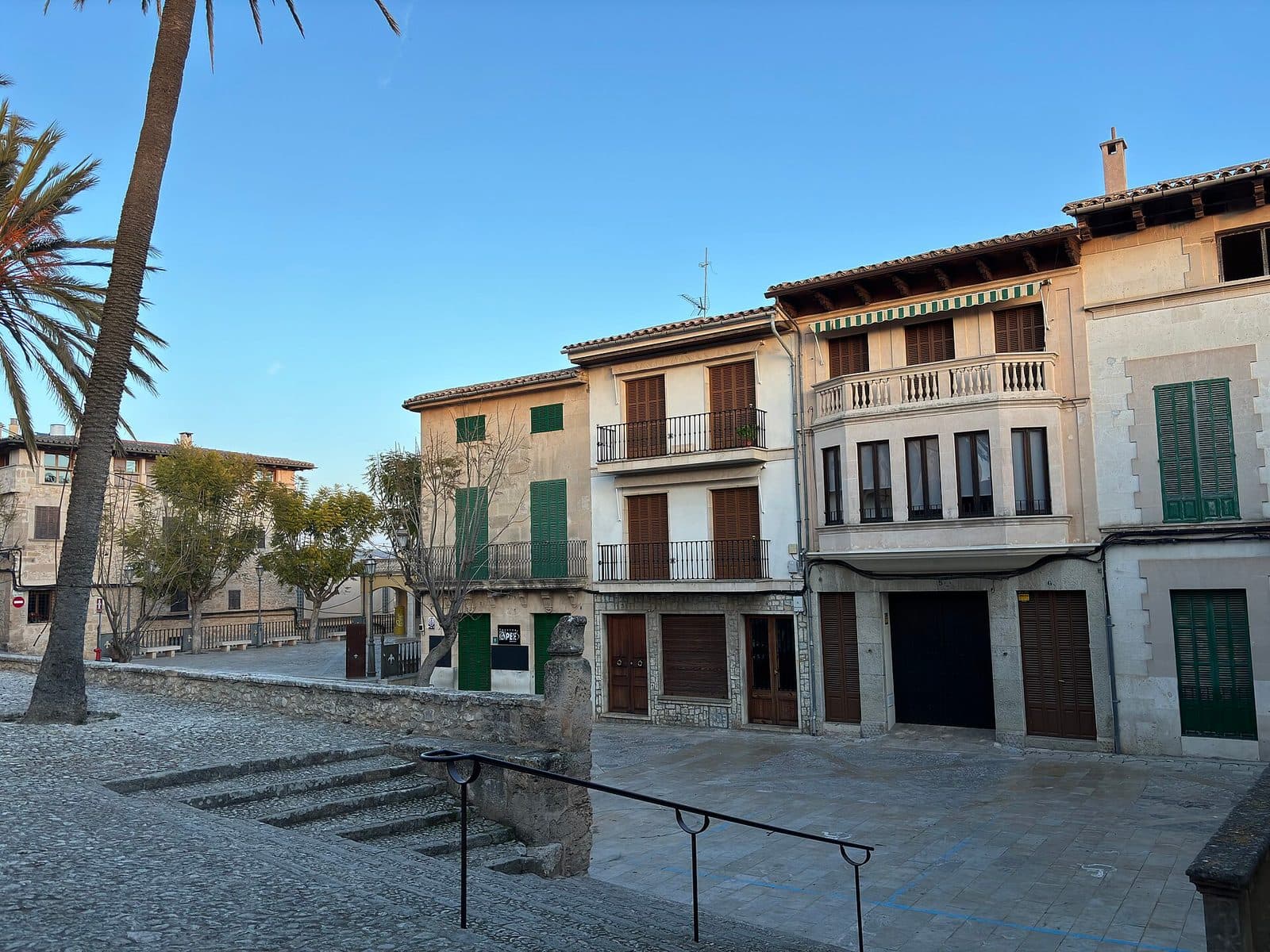
The town is not a traditional holiday resort and has no seafront promenade. Instead, Montuïri is interesting as a historically evolved residential community where agriculture, archaeology and everyday life can still be clearly understood. Cobbled lanes, simple natural-stone façades and the windmills of Es Molinar give a walk through the town a distinctly local character.
For visitors, Montuïri is particularly worthwhile as a peaceful cultural stop on a journey through the island’s interior. The talayotic site of Son Fornés, its museum, the parish church and the elevated old town provide enough material for an excursion in their own right. Those who live here or are considering moving here will find a different quality: a manageable municipal centre with food shops, dining options and short distances within the centre, but also with a much greater dependence on the road than in Palma. Montuïri is best explored without rushing, as the town rewards visitors less for ticking off individual attractions than for appreciating the interplay of archaeology, village architecture and landscape.
History of Montuïri
The settlement history of the area reaches back long before the present-day town. Archaeological traces demonstrate prehistoric use of the municipality; its most important visible evidence is Son Fornés. The buildings and finds excavated there show that the fertile centre of the island was an organised place of life and economic activity long before the medieval town was founded. This prehistory is more than a decorative footnote when interpreting Montuïri: it links today’s farmland with a settlement tradition spanning thousands of years.
The place name is traced back to the Arabic “Muntuy”, a term referring to the hilly landscape. Even without a preserved, cohesive Arab townscape, this origin suits the topography: Montuïri does not lie flat on the plain but stretches across a hill. Its hillside location continues to shape the centre, with rising streets, elevated viewpoints and a town profile visible from far away.
The year 1329 is regarded as the official historical reference point for present-day Montuïri. The dense development, irregular lanes and understated façades still recall this phase of growth, even though individual houses have been altered over long periods. Montuïri is therefore less a place of spectacular individual monuments than a legible ensemble of street layout, church, homes and functional agricultural buildings.
The area surrounding Montuïri is shaped by agriculture. Grain fields, vineyards, almond trees and livestock farming formed the landscape, while windmills became a visible part of local working life. The mill towers of Es Molinar are landmarks today, but they were originally not scenery; they were technical structures serving an agricultural economy. The close proximity of archaeology, the village centre and the mills makes Montuïri’s historical development unusually easy to understand.
Things to See in Montuïri
Església de Sant Bartomeu
The parish church of Sant Bartomeu dominates the upper town centre and is Montuïri’s most important architectural landmark. Its origins go back to the Middle Ages, and the church is associated with Mallorcan Gothic architecture. Outside, its powerful stone architecture and bell tower stand out, while religious furnishings and altarpieces define the interior. Even when the building is closed, the walk uphill is worthwhile: the town’s hillside position becomes particularly clear around the church.
Sant Bartomeu should not be viewed in isolation. The climb through the old streets, the increasingly expansive views between the houses and the transition from the busier lower town to the ecclesiastical centre are all part of the experience. Anyone who walks only as far as the main square misses an essential part of Montuïri’s spatial structure.
Plaça Major
Plaça Major is the town’s social centre and the natural starting point for a walk. The market, dining and everyday routes all meet here. Unlike the large representative squares of Palma, Plaça Major primarily feels like a village square in active use: it serves as a meeting place, a shopping area and a link between the streets of the historic centre.
From here, the church, the upper lanes and Es Molinar can all be connected on foot. The contrast between an ordinary weekday and market day is particularly revealing. For several hours, the quiet square becomes a regional trading place without losing its village scale.
Es Molinar
Es Molinar is the area containing the historic mill towers that shape Montuïri’s silhouette. Some now appear only as stone towers, yet this makes their former role as working structures especially clear. They recall a time when grain cultivation and processing determined the rhythm of the municipality far more strongly than they do today.
The route to the mills combines cultural history with landscape. Between the structures, views open across the Pla de Mallorca, with its fields and low ridges surrounding the town. Es Molinar is particularly rewarding for photography when low light falls across the stone surfaces; from a factual perspective, it is also one of the best places for understanding Montuïri’s agricultural past.
Son Fornés
Son Fornés is the municipality’s most important archaeological attraction. The talayotic excavation site contains monumental stone structures built by a prehistoric community and reveals a dimension of the island’s history that is easily overlooked in its later village centres. Rather than reconstructed scenery, original building structures lie within the landscape, allowing the settlement’s form and surroundings to be understood in direct relation to one another.
Some prior knowledge is helpful during a visit because the walls and ground plans do not explain themselves completely. This is precisely why combining the site with the Museu Arqueològic de Son Fornés is recommended. The excavation and museum tell two sides of the same story: outside are the spatial structures, while inside is the interpretation of the finds and life at the time.
Museu Arqueològic de Son Fornés
The archaeological museum places the finds from Son Fornés in context and turns the excavation site into more than a collection of old walls. Attention is therefore focused not only on the age of individual objects but also on the people who lived in the island’s central region and used its environment.
Visitors with little time should treat the museum and site as a single combined focus. The museum provides the historical framework, while Son Fornés makes the scale, setting and construction methods visible. For families with children interested in history, this combination is usually more engaging than a tour devoted solely to churches and the old town.
Puig de Sant Miquel
Puig de Sant Miquel is among the named excursion destinations near Montuïri and is a suitable addition for visitors who still have time to explore the surrounding area after seeing the church, museum and mills. Puig is optional on a short first visit; during a longer stay, it is one of the worthwhile destinations outside the centre.
Sights in Montuïri
The Weekly Market
The weekly market takes place on Plaça Major and brings producers, traders, local residents and visitors together in the centre of Montuïri. Fresh food and agricultural products are sold, along with plants, flowers, clothing and shoes. It is therefore neither purely a farmers’ market nor a tourist craft market, but a traditional local supply market offering different categories of goods.
For visitors, the market is a good opportunity to experience the square in its true everyday role. While the centre can seem quiet on other days, its routes and public spaces are used more intensively on market day. A visit combines well with a walk to the church and mills because every destination can be reached on foot from the square. Anyone mainly interested in photography or viewing the architecture undisturbed should also consider visiting on an ordinary weekday.
For residents, the market is a regular shopping occasion but not a substitute for the town’s other local services. The combination of market stalls and permanent food shops makes Montuïri more practical for everyday life than a scattered settlement consisting solely of fincas. At the same time, the selection remains more limited than at the island’s large markets.
The central location has practical consequences: more pedestrians should be expected around Plaça Major. It makes sense not to drive all the way to the square but to begin the walk at the edge of the densely built-up centre. This allows the market to be combined with the church, old town and Es Molinar without searching for parking in the narrower streets.
Food and Drink
Montuïri’s dining profile reflects its location in the agricultural Pla de Mallorca. Fields, vineyards and almond trees form part of the view. Because of its inland setting, beachfront dining is not the focus. Instead, the town has restaurants, a café, a bistro and a pizzeria.
The selection is notable for a rural municipal centre and shows that Montuïri does not function solely as a dormitory town. For visitors, this means a walk can be combined with breakfast, lunch or a break. For residents, the different types of establishment provide several alternatives to eating at home without requiring a journey to a larger neighbouring town for every meal.
Restaurant S’Hostal
S’Hostal is one of Montuïri’s established restaurant names. Its classification as a restaurant already distinguishes it from a quick café stop or pizzeria and makes it more suitable for a full meal. Its significance to the town does not lie in short-term rankings but in the fact that it is regularly associated with dining in Montuïri.
Pizzeria Es Molí
Pizzeria Es Molí adds an informal, family-friendly option to the local selection. A pizzeria is particularly practical for visitors who are not looking for an extensive regional menu after exploring the archaeology and old town; for residents, it provides an everyday alternative to traditional restaurants.
Café Can Pieres
Can Pieres is one of Montuïri’s named dining establishments.
Bistro 33
Bistro 33 brings another dining format to the town and shows that the selection is not limited to traditional village restaurants. This variety is especially relevant to residents because it makes everyday life more varied. Visitors should nevertheless not treat Montuïri like a destination with a densely packed nightlife district: these establishments are in a small rural town, not an urban dining quarter.
Restaurant Puig Sant Miquel
Restaurant Puig Sant Miquel is one of Montuïri’s documented named dining establishments.
Eating, drinking and staying in Montuïri
The best-rated businesses from our directory, ordered by Google rating — not by advertising.
Restaurants
- NU4.9· 144 reviews
- Pizzería Pepe d’Oro4.7· 67 reviews
- Pizzeria "Es Molí"4.5· 629 reviews
- Es Cantó de Ca’n Pieres4.5· 229 reviews
- Bar Sami4.5· 196 reviews
- Can Miquel de Ses Roques4.5· 165 reviews
- Bar s’Hostal4.4· 3185 reviews
- Ca'n Antonio4.3· 915 reviews
- Son Bascós4.3· 836 reviews
- Restaurant ses Jardines4.3· 409 reviews
- Restaurant “Es Revolt”4.2· 940 reviews
- Jacaranda Restaurant4.2· 96 reviews
Activities and Excursions
Walking Through the Historic Town Centre
The most obvious activity is a walk from Plaça Major through the rising lanes to Sant Bartomeu church and onwards towards Es Molinar. Large distances are not the issue; the gradient, paving and many small changes in perspective are what matter. Views across the Pla repeatedly open between the façades, while the mill towers and church tower make orientation easier.
The route is suitable for anyone who enjoys viewing village architecture in context. Individual façades are understated, but together the streets, natural stone and staggered elevations create a cohesive picture. Sturdy footwear is more comfortable than smooth sandals, especially on uneven paving and steeper sections.
Son Fornés and the Archaeological Museum
For a cultural and historical excursion, the site and museum should be planned together. They can be visited before or after a walk through the town and give Montuïri a depth that goes beyond the image of a pretty village. Anyone interested in Mallorca’s early history can make Son Fornés the main destination, followed by the old town and mills as the second part of the visit.
The open excavation landscape requires a different perspective from a fully furnished museum. Sun protection and water are useful in warm weather, while the museum provides an opportunity to examine details and connections between finds more closely. Opening and access times should be checked before travelling.
Cycling in the Pla de Mallorca
The minor roads and country lanes around Montuïri pass through fields, vineyards and scattered agricultural properties. This makes the municipality a suitable starting point for cycling tours through the Pla de Mallorca. Unlike on the coast, routes here are defined not by promenades and bathing coves but by villages, hills, dry-stone walls and open agricultural landscapes.
The area is not entirely flat. Even the approach to the elevated town centre and the short climbs around Montuïri require suitable gear selection. In return, the higher ground repeatedly provides expansive views. Route planning should distinguish between busier connecting roads and quiet side roads.
Walks Through the Cultural Landscape
The surrounding area can also be explored on foot, especially along the country lanes between fields and smaller estates. The landscape is open and characterised by a mixture of farmland, almond trees, vines and low elevations. Shade cannot be expected everywhere outside the town.
Good orientation is important because agricultural tracks should not automatically be understood as signposted walking trails. The value of these walks lies in their closeness to rural Mallorca: the sounds of agriculture, expansive views and Montuïri’s silhouette replace spectacular mountain paths or coastal panoramas here.
Excursions to Algaida, Porreres and Sineu
Montuïri’s central location makes it easy to take scenic drives to other places in the Pla de Mallorca. Algaida, Porreres and Sineu each offer a distinct perspective on the rural region and can be combined effectively with Montuïri. Rather than ticking off as many villages as possible in succession, a themed route is more rewarding: markets and village squares, for example, archaeology and churches, or windmills and agricultural landscapes.
Montuïri is not an immediate seaside starting point for a beach day. The coasts are accessible by car but should be treated as a separate part of the itinerary. Anyone wishing to combine culture in the morning with swimming later must allow additional driving time and will benefit considerably from having their own vehicle.
Getting There and Getting Around
By Car
Montuïri lies roughly between Palma and Manacor and is therefore easy to reach from both directions. Its position between the two cities makes the town a practical stop on a journey across Mallorca. From the main road, the approach climbs into the town; even at this stage, the church and mill towers become visible landmarks.
The streets in the historic centre are narrower and partly uphill. Visitors unfamiliar with the town will find it more comfortable to leave the car at the edge of the densely built-up area and connect the church, square and Es Molinar on foot. This strategy is particularly sensible on market day because Plaça Major and its access roads are more heavily used. Access regulations and local signs always take priority.
By Bus
The stops Sant Joan 1 and Sant Joan 2 are recorded within the GTFS area.
On Foot and by Bicycle in the Town
Within the compact centre, the most important stops are close enough together to visit on foot. However, the hillside location should not be underestimated: the routes between the square, church and mills combine gradients with uneven paving. People with limited mobility should choose their route according to accessibility and should not assume that every historic lane is easy to navigate.
Montuïri can be incorporated effectively into bicycle tours through the Pla. Slow riding and consideration for pedestrians are appropriate in the town centre itself. A secure place to leave the bicycle is recommended before exploring the narrower lanes on foot.
Bus lines to Montuïri at a glance
| Line | Route | Departures/day | First | Last |
|---|---|---|---|---|
| 442 | Sant Joan | 33 | 07:06 | 21:47 |
| 432 | Sineu - Algaida | 1 | 06:12 | 06:12 |
From the official GTFS feeds (TIB/SFM), no real-time data. The figures cover all stops in the town; weekend and holiday services differ — check with the operator before travelling.
Getting there by bus
Sant Joan 1 (49004) · 2.8 km as the crow flies
- 432Sineu - Algaida · Daily
- 442Sant Joan · Daily
Sant Joan 2 (49005) · 2.8 km as the crow flies
- 442Sant Joan · Daily
Timetable data: official GTFS feeds (TIB/EMT), no real-time — check with the operator before travelling.
Living in Montuïri
Montuïri is an independent municipal centre, not a holiday village that comes alive only seasonally. This is evident in the structure of the centre: food shops and supermarkets, dining establishments, and everyday service and logistics facilities are not aimed solely at guests. Routine shopping therefore does not generally require a journey to a larger town. More extensive purchases, specialised services or a particularly broad selection are, however, easier to combine with trips to Palma, Manacor or other larger towns.
Everyday Life in the Town Centre
Many everyday journeys are short in the old centre. Shopping, cafés, the market and municipal life are concentrated within a manageable area that works on foot. This is balanced by gradients, narrow streets and historic buildings. A home near Plaça Major makes everyday life easier without constant car journeys but brings more activity during markets and events. The upper streets offer stronger views and more historic atmosphere, but every journey home involves an uphill climb.
Anyone considering a house in the centre should take access, parking and steps as seriously as the charm of natural stone and old floor plans. The practical quality of a residential location here often depends less on its straight-line distance from the centre than on elevation differences, street width and accessibility.
Living on the Outskirts and in the Countryside
Development becomes less dense on the edge of Montuïri, and the transition to fields and country lanes begins quickly. These locations offer a more immediate connection to the landscape and greater distance from the square, but they increase dependence on a car. This is even more pronounced for scattered fincas: even when the town appears visibly close, shopping and everyday errands may involve narrow country roads.
For households that travel regularly to Palma or Manacor, the location in relation to the access route is often more important than proximity to the church. A location below the historic centre can be more practical for commuters than a particularly picturesque address in the upper lanes.
Commuting and Living Without a Car
The location roughly between Palma and Manacor may be relevant to commuters. Via the Ma-15, Montuïri is 35 km and 34 minutes by car from Palma Airport (PMI), and 37 km and 42 minutes from central Palma. Anyone making the journey daily should test the route at their own commuting times rather than relying solely on a general distance estimate.
Life without a car is more feasible in the town centre than on a remote finca because food shops and dining establishments are accessible on foot. The options for spontaneous evening trips, specialised errands and more distant destinations nevertheless remain limited. An e-bike can make short journeys in the surrounding area easier, but it eliminates neither summer heat nor the demands of busier roads.
Montuïri in Winter
The selection of dining and accommodation is relatively extensive for a rural town, although individual operating times may change over the course of the year. For residents, local everyday services are therefore more important than the number of tourist facilities.
Long-Time Residents and Newcomers
Montuïri has a well-established local population as well as a documented history of immigration from abroad. The town is therefore neither a purely international residential colony nor socially closed off. Catalan or Mallorcan and Spanish shape everyday life; anyone living here permanently will find that language skills make it easier to connect with neighbours, shops and municipal life.
Newcomers encounter a town where the market, festivals, dining and agriculture did not develop as tourist decoration. Integration therefore primarily means respecting everyday rhythms and not expecting services and communication to be geared entirely towards holidaymakers.
Practical Information for Your Visit
Time of Day and Walking Route
A walk can be combined with Son Fornés, the museum, a meal and a detour to Puig de Sant Miquel.
Market Day or a Quiet Weekday
On the designated market day, Montuïri is livelier and more visibly functions as a regional service centre. Anyone wishing to experience market stalls, shopping and village life should choose this time. Another weekday is more suitable for architecture, photography and a quiet walk through Plaça Major. Both options reveal different but equally typical sides of the town.
Parking and Walking Routes
It rarely makes sense to try to drive directly to every attraction. The old centre is compact but hilly and narrow in places. A parking space at the edge of the more densely built-up area avoids unnecessary manoeuvring and allows for a continuous walking route. Comfortable shoes are more useful than simple beach sandals because of the gradients and paving.
Preparing for Son Fornés
Current access times for the museum and excavation site should be checked in advance, and the two should ideally be visited together. Water, sun protection and some time for reading are advisable at the open site. Anyone stopping only briefly between two coastal destinations will hardly do justice to the town’s archaeological focus.
What Montuïri Is Not
Montuïri is not a destination for an immediate beach visit. The town is suitable for people seeking archaeology, village history, regional dining and rural Mallorca. This clear focus is precisely what makes a visit worthwhile: Montuïri does not try to be a coastal holiday resort in the island’s interior.
Local businesses and services
The best-covered sectors in our directory for Montuïri — each with address, contact details and opening hours.
- Restaurant / Gastronomy13 listings
- Supermarket10 listings
- Courier & Logistics8 listings
- Hotel / Accommodation8 listings
Run a business here? Add it to the directory for free and be found on this page. Add your business
Latest news from Montuïri
- 27 Mallorca towns lack Alcover and La Balanguera
- Mallorca: €1.2m to complete delayed Son Fornés centre
- Mallorca police seize 25 kilos of cannabis in parcels
- Mallorca schools get €624,641 for roof repairs