
Temple talaiòtic de Son Corró near Costitx
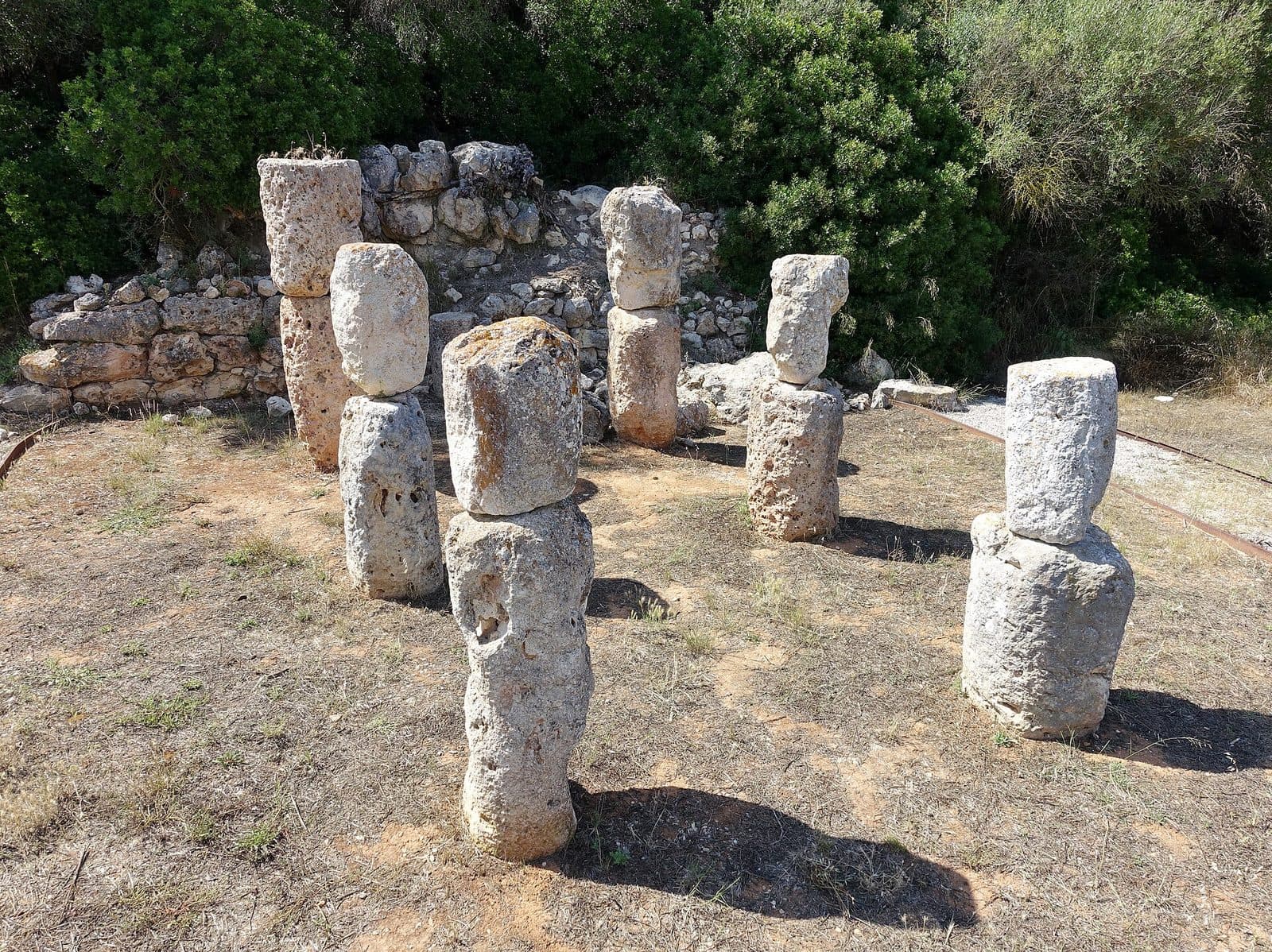

In the heart of the rural Pla de Mallorca, the stone columns of the Temple talaiòtic de Son Corró rise from a site that appears almost inconspicuous at first glance. This is precisely where its appeal lies: instead of a large ruined settlement, visitors find a single prehistoric cult site whose significance extends far beyond the remains visible today. The sanctuary became famous for three bronze bull heads known as the “Bous de Costitx” or “Caps de Bou de Costitx.” The originals are now housed in the National Archaeological Museum in Madrid. At the site itself, traces of walls and upright columns draw attention to the question of what this sacred space once looked like—and to a reconstruction that experts continue to debate today.
The visit is particularly worthwhile for travelers who want to explore Mallorca’s history before the Romans, Moors, or medieval castles. Son Corró leads into the post-Talaiotic period and the religious beliefs of the island communities before the Roman conquest. Because the site is manageable in size, it can easily be included as a focused archaeological stop on a journey through the island’s interior.
Anyone expecting monumental halls, an extensive exhibition, or fully preserved rooms will misunderstand the site. Its strength lies in looking closely: at the positioning of the stones, the reconstructed rows of columns, and the connection between a small sanctuary near Costitx and some of Mallorca’s best-known prehistoric metal finds.
History and significance
The sanctuary of the post-Talaiotic period
Son Corró belongs to the post-Talaiotic period, the Iron Age phase that followed the end of the Talaiotic culture proper. The complex is dated to the period after 550 BC. Sanctuaries from this era were generally compact buildings with an undivided interior, substantial walls, and individual pillars or columns. Research has not conclusively established whether such spaces were completely roofed or partly open to the sky.
Their function also cannot be reduced to a modern term such as church or temple. Objects found in comparable sanctuaries point to ritual activities, but the exact course of the ceremonies remains unknown. What is certain is that such buildings were places of communal importance. Mallorcan society changed during the post-Talaiotic period; social differences became more pronounced, and part of the population served as warriors and mercenaries in the western Mediterranean. Religious spaces such as Son Corró must be viewed against this background without hastily attributing them to a single deity or ceremony.
The chance discovery of the bull heads
The story of the site’s rediscovery begins not with a planned excavation but with farm work. The farmer Joan Vallespir de Can Pere Pina came across three bronze bull heads in the area of the overgrown sanctuary. The discovery made Son Corró a key site in Mallorcan prehistory. Hardly any other object connects the name Costitx so directly with the island’s prehistoric archaeology.
What the heads once represented has not been conclusively established. The bull may have been associated with livestock farming, fertility, or martial ideas, but no unambiguous interpretation can be derived from this. There has also been debate over whether the pieces were made in Mallorca or imported from a center with greater technical and artistic specialization. These unanswered questions are precisely what make the find significant.
The originals were taken to the National Archaeological Museum in Madrid. The fact that they did not remain in Mallorca is still regarded with regret on the island today. Replicas in Costitx and the Museu de Mallorca commemorate the discovery, but there are no original bronzes at the sanctuary itself. The site today therefore primarily tells the story of its architecture and archaeological context; anyone wishing to discover the appearance of the bull heads should combine the visit with the replicas in Costitx.
Research and reconstruction
Bartomeu Ferrà was among the first archaeologists to study Son Corró systematically. His interpretation assumed a roof supported by a larger number of columns. Later investigations under Guillem Rosselló Bordoy concluded that there had been significantly fewer columns and led to the form visible at the site today.
This restoration is not without controversy. Critics doubt that the cylindrical stones were originally arranged as regularly as they are in today’s presentation. According to another interpretation, they may instead have been freestanding ritual pillars. Son Corró is therefore not merely a window into prehistory but also a vivid example of how archaeology develops a spatial picture from fragmentary evidence—and why that picture remains open to debate.
What to see
The rectangular sanctuary space
The first impression is defined by a clearly outlined, apparently rectangular ground plan. Low stone courses trace the former structure, while the upright elements divide the interior space. Unlike a large Talaiotic village, there are no houses, lanes, or defensive structures to walk through here. Everything is concentrated within a single area interpreted as sacred.
This concentration makes the site easier to read. From outside, visitors can follow how the traces of the walls enclose an interior; inside, it becomes apparent that there are no numerous small chambers. This corresponds to the general type of post-Talaiotic sanctuary, whose interior was not divided like a dwelling. Nevertheless, the preserved and supplemented sections should not be understood as a fully verified building plan. What can be seen is an archaeological presentation that combines original evidence with modern arrangement.
The columns and their arrangement
The most striking architectural elements are the six columns or column-like upright stone structures visible today. They make the space appear divided into three longitudinal sections and immediately suggest the idea of a supported roof. Yet this is precisely where the scholarly controversy begins: the regular positioning is the result of modern reconstruction and is not an undisturbed arrangement preserved from prehistory.
This distinction is essential during a visit. The columns are no less worth seeing because their current position is debated; on the contrary, they illustrate a fundamental issue in archaeological interpretation. Architectural elements found lying loose reveal little about height and spatial effect. Setting them upright again creates a more comprehensible picture—but at the same time increases the risk of making a hypothesis look like certainty.
It is best to view the complex from outside first. From there, the ground plan and the arrangement of the columns can be seen together. A change of perspective along the long side is then worthwhile: the stones stand one behind another, making the intended effect of a divided hall particularly clear. Anyone who then moves closer to the individual elements can better appreciate how massive and irregular the stone material is.
Wall remains and the edge of the site
Son Corró lies on a slightly elevated slope above the adjoining field. The position is not dramatic, but it raises the cult site above its immediate agricultural surroundings. At the same time, the setting demonstrates how closely prehistory and the present-day cultural landscape coexist in the Pla de Mallorca: the sanctuary is not a secluded mountain monument but part of a rural area that has been used for a very long time.
The low wall remains require more attention than the columns. They mark the boundary between the former interior and its surroundings and help explain the building’s orientation. Because only part of the original complex survives or is presented, visitors should not look for a complete façade. The transitions are more informative: where does the reconstructed edge of the space end, where does the open terrain begin, and how are the upright stones arranged within this boundary?
The invisible archaeological context
The most famous objects from Son Corró cannot be seen at the site. This is precisely why it is worthwhile to imagine the empty space between the stones as part of the story. The three bronze bull heads that link the site to the religious beliefs and craftsmanship of the post-Talaiotic population were discovered here. Without this find, the complex could easily appear to be a small and difficult-to-interpret arrangement of stones; with it, the site becomes one of the most important archaeological locations in Mallorcan prehistory.
The bronzes were not decorative additions to a modern exhibition but objects from the sanctuary’s historical context. Their exact placement and use remain uncertain. Restraint at the site is therefore more productive than a fully formed story of its rituals: the walls outline the space, the columns reproduce a possible architectural form, and the known finds show that activities took place here that went beyond everyday life.
Visiting the site
Arriving and getting oriented
The site is accessible around the clock. Daylight is nevertheless essential for the visit itself, because the site’s significance lies in its low wall lines, stone surfaces, and spatial relationships, which are difficult to understand meaningfully in the dark. Whether any special admission arrangements currently apply should be checked before traveling.
After arriving, it is advisable not to walk between the columns immediately. The clearest introduction is from outside the ground plan, where the entire complex can be viewed at once. Only from some distance does it become apparent how small the sanctuary space is in comparison with its archaeological significance. The eye can then move from the outer walls to the upright elements.
A circuit without a fixed direction
A slow walk around the site followed by closer views of the columns and low stone courses is worthwhile. The picture changes considerably along the way: viewed from the front, the upright elements appear as individual pillars, while along their axis they form an ordered row. These two perspectives help visitors understand the idea behind the reconstruction while also viewing it critically.
For a basic overview, Son Corró remains a short archaeological stop. Anyone familiar with the history of the bull heads who follows the wall lines and tries different viewpoints can spend considerably longer exploring the site. A fixed duration would therefore be of little help. The place does not require a long walk, but it rewards visitors who do more than take a single photograph of the columns and immediately move on.
Time of day and visitor numbers
Thanks to its continuous accessibility, the visit can be fitted flexibly into the day. Anyone wishing to avoid other visitors as much as possible is not restricted to a narrow time window. No reliable fixed peak times can be given for this small, freely accessible site. The main consideration is to allow enough daylight to see the low structures.
When the light is low, the edges and surfaces of the stones stand out more clearly than under flat, even illumination. However, the choice of time should not depend on photography alone. A quiet walk around the site and a comparison of several sightlines convey more than trying to capture the current arrangement of the columns from a single supposedly ideal viewpoint.
Getting there and parking
From Palma and the airport to Costitx
From Palma Airport, the stated route follows the Ma-3011 to Costitx. The distance to the village is 32 kilometers by road, and the drive takes around 34 minutes. From central Palma, the route initially follows the Ma-19 and then the Ma-3011. The distance to Costitx is 35 kilometers by road, with around 42 minutes of driving time to allow.
These distances and driving times explicitly apply only as far as Costitx, not directly to the sanctuary. Son Corró lies outside the village center on the road between Costitx and Sencelles. For the final section, follow the Ma-3121 toward Sencelles. The site is located on this country road at kilometer marker 2,8 and can be seen or is signposted from the road.
The final section on the Ma-3121
Its location on the Ma-3121 makes Son Corró comparatively easy to find, but turning off and stopping require care. This is not an attraction in a pedestrian zone but an archaeological site beside a country road. The entrance should therefore be identified in good time without braking abruptly.
When parking, take care not to block either the road or entrances to agricultural land. The site is intended as a compact stop. Anyone planning the journey with navigation should use the name of the sanctuary and the Ma-3121 as reference points rather than relying solely on the center of Costitx.
By bus and on foot
Costitx is served by regional bus routes; the page’s transport module shows the current stops. Passengers get off in or near the village, while Son Corró lies outside the center on the road toward Sencelles. Additional time must therefore be allowed for the remaining section.
Anyone continuing on foot will not be following an urban museum path but walking through a rural roadside landscape. Visibility, traffic, and weather should all be considered when planning. The archaeological route through Sencelles and Costitx is also designed to be traveled on foot or by bicycle, but the individual sites are spread out; Son Corró is only one stop and not a central starting point with extensive facilities.
Bus lines to Temple talaiòtic de Son Corró at a glance
| Line | Route | Departures/day | First | Last |
|---|---|---|---|---|
| 304 | Inca - Sencelles - Palma | 78 | 06:25 | 22:20 |
From the official GTFS feeds (TIB/SFM), no real-time data. The figures cover all stops in the town; weekend and holiday services differ — check with the operator before travelling.
Getting there by bus
Camí dels Horts (17002) · 0.9 km as the crow flies
- 304Inca - Sencelles - Palma · Daily
Camí de ses Ànimes (47011) · 1.3 km as the crow flies
- 304Inca - Sencelles - Palma · Daily
Costitx 2 (17006) · 1.4 km as the crow flies
- 304Inca - Sencelles - Palma · Daily
Costitx 1 (17007) · 1.5 km as the crow flies
- 304Inca - Sencelles - Palma · Daily
Camí d'Establiments (47017) · 2.0 km as the crow flies
- 304Inca - Sencelles - Palma · Daily
Timetable data: official GTFS feeds (TIB/EMT), no real-time — check with the operator before travelling.
Nearby
Costitx
Costitx is small enough not to feel like a second major sightseeing program after Son Corró. This makes it particularly well suited to the sanctuary. The archaeological context of the find can be continued in the village, where replicas of the famous bull heads are displayed. They give visible form to the bronzes missing from the actual discovery site and make it clear why Son Corró became known far beyond the municipality.
The village streets are quiet, and the parish church Nativitat de la Mare de Déu is another defining feature of the townscape. Costitx is not a staged open-air museum; instead, it conveys the character of the Pla de Mallorca, where villages, fields, old paths, and prehistoric sites follow closely one after another. A walk through the center is therefore a fitting addition without distracting from the main subject of the visit.
The Sencelles–Costitx archaeological route
Son Corró forms part of an archaeological route through the municipalities of Sencelles and Costitx. It connects sites from different prehistoric periods and is suitable for travelers who want not only to view a single monument but also to understand developments over time. Stops include the Cova des Camp des Bisbe, the Talaiot de Son Fred, and the naviform settlement of Turassot.
The sequence reveals differences that can easily become blurred when sites are visited in isolation: a communal burial complex, a Talaiotic settlement, a post-Talaiotic sanctuary, and naviform dwellings do not automatically belong to the same period or serve the same function. Within this route, Son Corró has the role of a cult site whose fame is closely connected with the bronze bull heads.
Other sites such as Binifat and Cas Canar are accessible only as part of periodically organized guided tours. A spontaneous visit to every location mentioned is therefore not always possible. For an uncomplicated excursion, Son Corró can be combined with the freely accessible stops and time in Costitx or Sencelles.
The rural Pla de Mallorca
The journey between Costitx and Sencelles passes through the island’s peaceful interior, where archaeological traces are not obscured by modern urban development. Son Corró is particularly easy to understand in this setting: the site lies slightly elevated at the edge of cultivated land rather than on a spectacular summit or by the coast.
Anyone combining several stops should avoid overloading the day with too many widely separated destinations. The value lies in comparing forms of construction and use. After seeing a Talaiot or a naviform settlement, the small sanctuary of Son Corró no longer appears to be a random collection of stones but a distinct building type within a long and varied prehistory.
The place it belongs to
Costitx in the place guidePractical information for your visit
Footwear and sun protection
The upright columns are no substitute for a shaded building and therefore offer no protection from the sun.
Visiting with children
The visible columns, the story of the chance discovery, and the bronze bull heads provide concrete points of interest. The visit becomes easier to understand if children are told beforehand that the original heads are not at the discovery site and that the present arrangement of the columns is a reconstruction debated by scholars.
Supervision remains important. The low walls are archaeological remains, not climbing structures; the site is also close to a country road. A short, clearly guided circuit focusing on the ground plan, columns, and history of the discovery is generally more rewarding than trying to use the site as an adventure playground.
What Son Corró is not
Son Corró is neither a fully preserved temple hall nor an extensive Talaiotic settlement. There is no collection of original finds at the site, no furnished cult chambers, and no archaeological circuit containing numerous buildings. The famous bronze heads are in Madrid; replicas can be seen in Costitx.
The upright columns should not be mistaken for an unchanged original state either. Their current arrangement is the result of a reconstruction whose plausibility is assessed differently by different experts. Knowing this caveat does not diminish the effect of the site. On the contrary, Son Corró demonstrates particularly clearly that archaeological attractions do not only provide answers but also consist of hypotheses, gaps, and competing interpretations.
Respecting the archaeological site
The site’s small size makes the surviving structures vulnerable. The walls should not be climbed, stones should not be moved, and gaps should not be used for storage. Even apparently loose fragments belong to the archaeological context. The site’s value lies not in a single photogenic object but in the relationship between the ground plan, landscape, and history of the discovery.
Son Corró is best understood when the visit begins with some prior knowledge and ends with a look at the replicas of the bull heads. This connects the architecture visible today with the objects that gave the sanctuary its special status within Mallorcan prehistory.
Local insider tips
See the bull heads afterward
The famous bronze heads are not at the discovery site. After visiting the sanctuary, it is therefore worth making the short trip to Costitx, where replicas clearly show the size and design of the “Bous de Costitx.”
Walk around the outside first
Do not step between the columns immediately: from outside the ground plan, the wall lines and arrangement of the columns can be seen together. The reconstructed division into three sections is particularly clear along the long side.
Keep the reconstruction in mind
The regular arrangement of the columns is not an undisturbed surviving feature. Anyone viewing it as a debated reconstruction can see particularly clearly at Son Corró how excavation evidence is turned into a spatial model.
Follow the archaeological route
Son Corró is a stop on the Sencelles–Costitx route. Combined with the Talaiot de Son Fred and the naviform settlement of Turassot, it makes the differences between several prehistoric building forms easier to understand.