
Mirador des salt de la Bella Dona: Views and Legend near Escorca
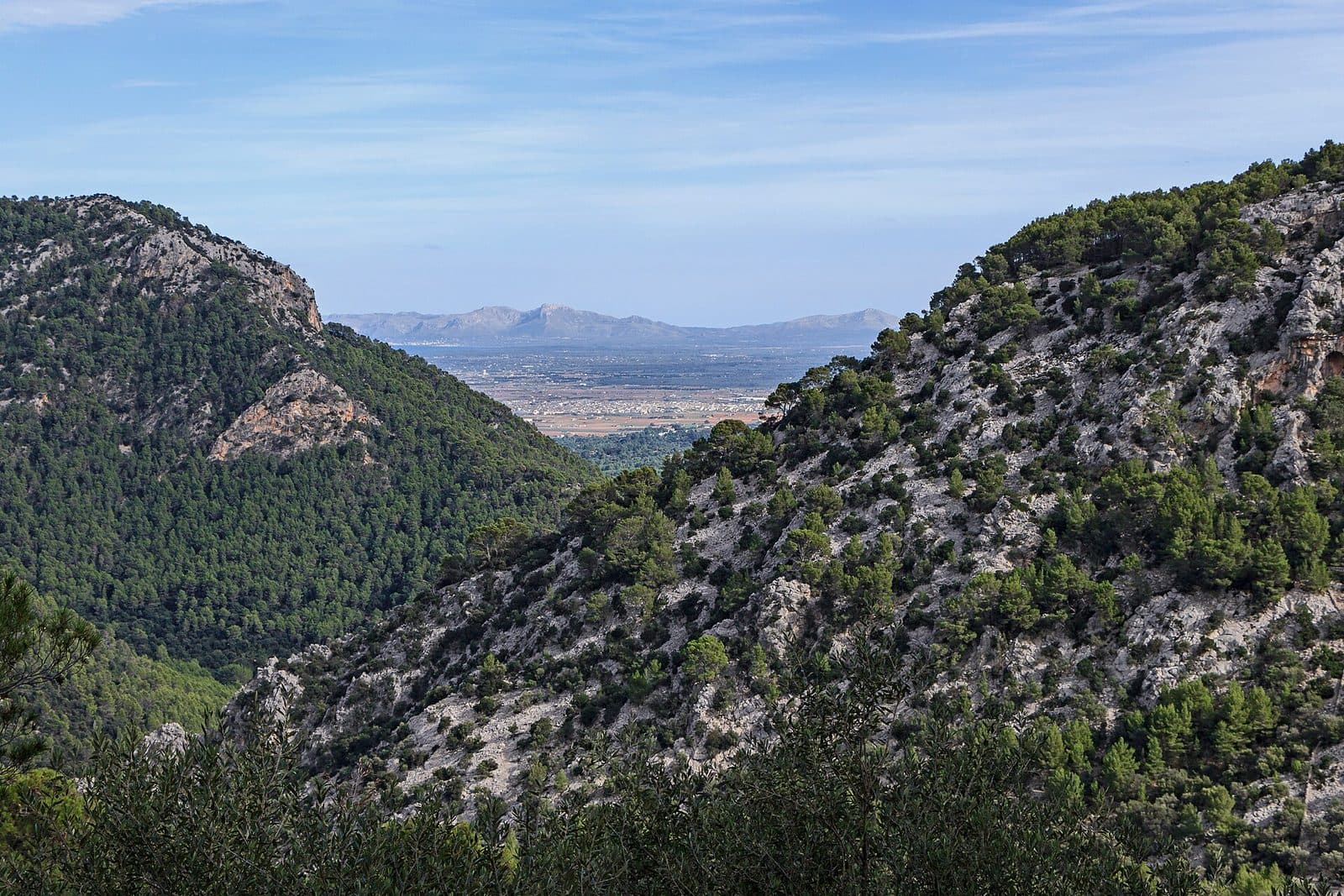

The Mirador des salt de la Bella Dona is more than a viewpoint on the mountain road to Lluc. Above the Es Grau gorge, the view opens across Es Raiguer, the transitional landscape between the Serra de Tramuntana and the island’s central plain. At the same time, the site is associated with one of Mallorca’s best-known and darkest legends. The viewpoint can be enjoyed as a short stop, but it becomes far more meaningful when you know the story behind its name: what initially appears to be a beautiful roadside view becomes the setting for a tale of jealousy, violence, remorse and a miracle that has been passed down through generations in Mallorca.
The site is especially suitable for travellers who are heading to Lluc and want not only to photograph the scenery but also to learn something about the island’s oral culture. Hiking routes from Caimari and Lluc also include the Mirador, allowing it to serve as either a stop on a drive or a stage on a longer tour. The viewpoint should not be confused with Cala Bella Dona near Calvià: the Mirador lies in northwestern Mallorca near Escorca, on the mountain route between Inca or Caimari and the Santuari de Lluc.
History and significance
The old route to Lluc
The legend is set on a route leading from the Inca area up to the sanctuary of Lluc. The landscape was therefore more than merely a place to pass through: rocks, narrow sections and viewpoints became fixed points in people’s collective memory, places where stories were told and passed on.
The Salt de la Bella Dona belongs in this context. Tradition places the events at the Es Grau gorge, from which there are extensive views across Es Raiguer. Whether the story was based on a real event cannot be verified. Its close connection to the route to Lluc and the veneration of the Madonna there, however, explains why it remains well known in Mallorca today.
The legend of the beautiful woman
According to tradition, a young woman lived near Inca and regularly made pilgrimages to Lluc to pray before the Virgin. One day, her lover or husband accompanied her. He remained silent along the way; the admiring looks and words of other men had driven him into a jealous rage.
The couple stopped to rest at the Es Grau gorge. When the woman stood at the edge of the precipice, the man pushed her over. He then continued alone, tormented by guilt. When he reached Lluc, he was horrified to see the woman he believed dead praying before the image of the Virgin. According to the legend, the Verge de Lluc had saved her from death.
The miraculous rescue belongs to the religious storytelling tradition surrounding the sanctuary. Today, the story is also read more critically: not as a romantic drama of jealousy, but as a tale about violence against a woman. It is precisely this change in perspective that keeps the legend alive. The Mirador therefore does not commemorate a confirmed historical event, but rather the way Mallorca has linked landscape, pilgrimage and moral warning.
What to see
The Es Grau gorge
The defining view looks down into the rocky hollow of Es Grau. Here the name “Salt,” meaning a leap or fall, takes on an immediate spatial significance. The steep forms of the surrounding landscape make it easy to understand why this particular place became the setting for such a dramatic tale. Without knowing the legend, it is a mountain landscape; with the story in mind, the edge becomes its narrative focal point.
The viewpoint stands at an elevation of 577 metres. Even so, the view is not limited to the nearby rock faces: from the gorge, the landscape opens towards Es Raiguer, bringing the mountains and the flatter parts of Mallorca together in a single panorama.
Es Raiguer
Es Raiguer forms the transition between the Serra de Tramuntana and the island’s central plain. This gradual change is particularly easy to see from the Salt de la Bella Dona: the rugged, tightly enclosed mountain formations lie in the foreground, with the land widening beyond them. Traditional descriptions of the site emphasise that the view extends across the plain from east to west.
What is interesting is less any single distant landmark than the structure of the landscape itself. The mountains appear like a threshold here. Travellers driving up from Caimari can see from the Mirador how quickly the open central plain gives way to the rugged relief of the Tramuntana.
Visiting the viewpoint
A stop with two perspectives
Most visits begin with the view across the landscape. It is worth resisting the urge to leave immediately: first take in the Es Grau gorge, then the opening towards Es Raiguer. Only the shift between near and far reveals why the site feels both dramatic and expansive.
The legend then adds a second dimension. Visitors who know the story before arriving can place its individual elements in the landscape: the arduous route to Lluc, the rest beside the precipice and the sanctuary as the tale’s destination. The length of a visit therefore depends on whether you simply want a panoramic view or plan to experience the site consciously as part of a hike and the Lluc tradition.
Between a roadside stop and a hiking destination
The Ma-2130 is a busy mountain road. A spontaneous stop therefore requires more care than a visit to a viewing tower with a large forecourt. Before leaving the vehicle, make sure it can be parked safely and legally. Passing traffic must also be considered when walking beside the road.
Several published hiking routes connect the Mirador with Caimari, the Coll de sa Batalla and Lluc. In this case, a short viewpoint stop becomes a stage on a longer route through the landscape. Such tours should not be confused with a simple visit to the Mirador: the distance, elevation profile and course of the chosen route must be checked separately.
No specific opening hours or admission charge are recorded for the viewpoint. As accessibility, road conditions or local regulations may change, checking the latest information before travelling is recommended. Clear visibility is also more important for the panorama than any supposedly ideal time of day.
Getting there and parking
From Palma and the airport to Escorca
From Palma Airport, the route initially follows the Ma-30, then the Ma-13 and finally the Ma-2130. Escorca is 52 kilometres away by road, and the journey takes around 64 minutes. These details apply specifically to Escorca and not to the exact location of the Mirador. The final section follows the winding Ma-2130 towards Lluc to the stretch of road at the Salt de la Bella Dona.
From central Palma, the route follows the Ma-13 and the Ma-2130. Escorca is 49 kilometres away by road, with around 68 minutes required for the journey. Here too, the distance and driving time refer to Escorca. On the mountain road beyond it, bends and other traffic determine the pace, so allowing only a narrow margin for the onward journey is not advisable.
The road section at the Mirador
The two bus stops at the Coll de sa Batalla are located in the wider surrounding area. Travellers arriving by public transport should not expect to get off directly at the viewpoint. The onward route to the Mirador must be planned using the current timetable and a suitable walking route; walking directly beside a mountain road is not a substitute for a designated hiking connection.
Bus lines to Mirador des salt de la Bella Dona at a glance
| Line | Route | Departures/day | First | Last |
|---|---|---|---|---|
| 312 | Lluc - Inca - Muro | 32 | 08:32 | 18:03 |
| 231 | Port de Sóller - Alcúdia | 8 | 10:15 | 19:55 |
From the official GTFS feeds (TIB/SFM), no real-time data. The figures cover all stops in the town; weekend and holiday services differ — check with the operator before travelling.
Getting there by bus
Coll de sa Batalla 2 (19002) · 1.1 km as the crow flies
- 312Lluc - Inca - Muro · Daily
Coll de sa Batalla 1 (19003) · 1.1 km as the crow flies
- 312Lluc - Inca - Muro · Daily
Lluc (19011) · 2.2 km as the crow flies
- 231Port de Sóller - Alcúdia · Daily
- 312Lluc - Inca - Muro · Daily
Timetable data: official GTFS feeds (TIB/EMT), no real-time — check with the operator before travelling.
Nearby places
Caimari and the climb into the Tramuntana
Caimari lies on the southern side of the mountain ascent and is a useful starting point for deliberately following the changing landscape. From here, the route climbs towards the Coll de sa Batalla and Lluc. Documented hikes lead from Caimari past the Mirador to the sanctuary, illustrating the old connection between the island’s interior and the pilgrimage site.
Visitors who stop at the viewpoint only while passing through can choose Caimari as the beginning or end of their trip. For hikers, however, the village is part of a considerably longer undertaking whose exact route should be established in advance.
Coll de sa Batalla and Lluc
The Coll de sa Batalla marks an important junction in the road network around Lluc. The Mirador can therefore easily be included in a drive to the Santuari de Lluc. This connection is not only practical but also helps explain the legend: the sanctuary is the destination of the two figures, and the woman’s miraculous rescue is attributed to the Verge de Lluc.
Combining the visit with Lluc gives the story a fitting conclusion. At the Mirador, the dramatic landscape takes centre stage; at the sanctuary, the focus is on the religious context of the tradition. Anyone visiting both places on the same day broadly follows the historic direction of travel along which the story has been told for generations.
Hikes around the Mirador
The Salt de la Bella Dona appears on routes that also include the Pas d’en Bartomeu, the Coll de sa Batalla and the Mirador de Sa Llonganissa. Other tours begin in Caimari and continue via the viewpoint to Lluc. This shows that the Mirador is not an isolated photo opportunity but a landmark within an extensive hiking landscape.
The names of similar viewpoints and climbing sectors can easily cause confusion when choosing a route. The key is to select the Mirador des Salt de la Bella Dona on the Ma-2130 explicitly as the destination. Cala Bella Dona in southwestern Mallorca belongs neither to this landscape nor to this legend.