
Plaça Major in Palma: The Old Town’s Grand Square
,_interior,_cara_nord.jpg)
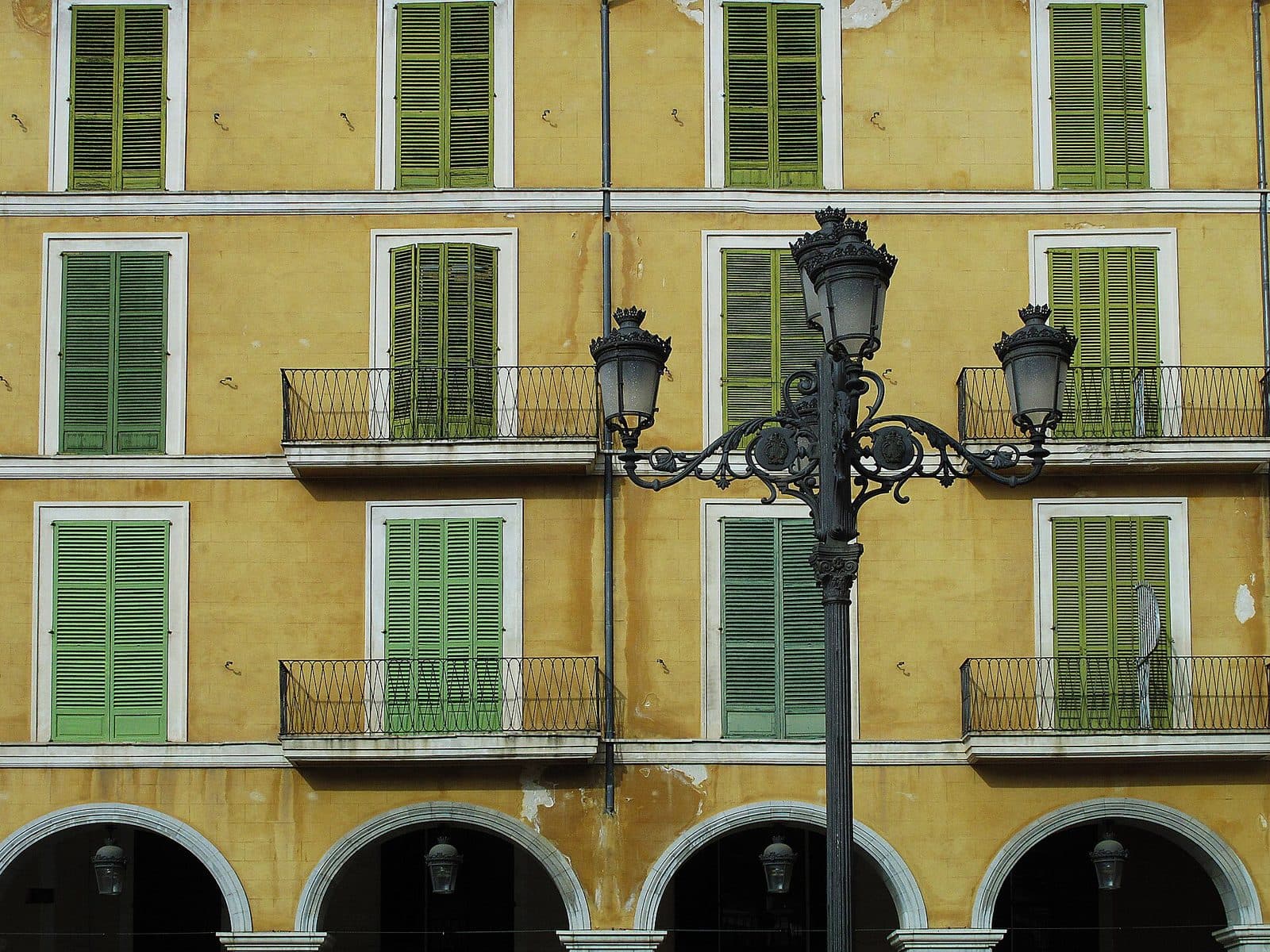
Amid the maze of lanes in the Old Town, a broad rectangular space suddenly opens up: Plaça Major. Anyone arriving from the narrow Carrer de Sant Miquel or one of the neighboring streets experiences the square almost like a stage. The façades form an enclosed frame, with shops and eateries beneath the arcades, while the city’s everyday life unfolds across the open space. Its strength lies in the ensemble: yellow façades, green shutters, continuous arcades and numerous entrances reveal how a classic city square absorbs and distributes the flow of people. Street performers, terraces and occasional craft stalls give it an ever-changing character.
At the same time, the welcoming surface conceals a far darker history. A monastery once stood here, followed by the Mallorcan headquarters of the Spanish Inquisition. The square acquired its present form only after the Inquisition ended, and construction continued over a long period. This contrast between a troubled past and everyday life today makes Plaça Major an important stop on a walking tour of Palma. Visitors get the most from the square if they do more than cross it diagonally: a walk beneath the arcades, a look back from one of the entrances and a short break at the edge reveal more than a quick photo from the center. For architecture enthusiasts, Plaça Major is a coherent urban ensemble; for families and city strollers, it is an easy-to-recognize meeting point; and for history enthusiasts, it is a place whose present openness emerged only after a profound historical rupture.
History and significance
Before café tables, passersby and street performers came to define the scene, the San Felipe Neri monastery stood here. The site later became the headquarters of the Spanish Inquisition on Mallorca. In Palma, the complex was also associated with the ominous name “Casa Negra,” the Black House. The open character that seems so natural today did not exist then: the site was shaped by an institution that represented control, persecution and fear.
San Felipe Neri and the Inquisition
The history of Plaça Major therefore does not begin with its current architectural frame, but with the repurposing of an inner-city property. The monastery was followed by the Inquisition, which maintained its Mallorcan headquarters here until the early 19th century. This background explains why historical accounts portray the square as more than merely a picturesque center of the Old Town. Beneath the orderly layout created later lies the memory of one of the darkest institutions in Spanish history.
After the Inquisition ended, the former complex was demolished. This marked the true beginning of the square as it appears today. Construction began in 1825 and continued throughout the 19th century; additions were still being made until the beginning of the 20th century. This explains both the square’s strong formal unity and the lengthy building history behind its façades.
From market to urban salon
From the outset, the new square was more than an empty representative space. Shops, stalls and merchants selling fish and meat made it a place for everyday necessities. Some of these functions later moved to Mercat de l’Olivar. Plaça Major nevertheless remained a place of commerce and social interaction: the arcades offered shelter and display space, while the open center accommodated market activity and public life.
Another profound change followed in the second half of the 20th century. During a redesign, the ground beneath the square was excavated, additional structural elements were added and the characteristic arcade frame was completed. A parking garage now lies beneath the square. The disappearance of cars below ground while pedestrians stroll above is therefore part of a more recent layer in the site’s history.
An Old Town hub
Today, Plaça Major is less an enclosed destination than a hub. Four important streets lead onto the square, with Carrer de Sant Miquel in particular bringing a steady stream of pedestrians from the northern city center. Anyone exploring Palma on foot will therefore often arrive here even without precise planning. This location has made the square one of the city’s best-known meeting places.
Its significance lies precisely in this continued use. The former site of the Inquisition was not preserved as an isolated memorial but reclaimed for everyday life. People shop, sit on the terraces, watch performers or choose their next route through the Old Town. The history remains invisible, but it is essential to understanding Plaça Major: only this background explains why Palma’s seemingly classic main square is comparatively young.
What to see
The strongest impression comes from standing at one of the entrances to the square. Narrow Old Town streets lie behind you, while the rectangular space suddenly opens ahead. Here, the entire perimeter becomes the main attraction: the façades repeat colors, window axes and arches, giving the space its clearly defined frame.
The rectangular square
The basic layout can be understood at a glance. The rectangle feels orderly but not forbidding because several streets break through the enclosed frame. These entrances make excellent observation points: arcades, terraces and upper floors unfold one behind another, while passersby cross the open center. Anyone standing only in the middle can easily overlook how carefully the architecture stages the transition between lane and square.
Depending on the day, the open area may serve as a thoroughfare, a stage for street performers or a site for craft stalls. As a result, its atmosphere changes more noticeably than that of a monumental square. On one occasion, the symmetry may stand out first; on another, it may be the mix of musicians, living statues, puppeteers and strolling groups.
The yellow façades
The surrounding buildings are painted in warm shades of yellow, with green shutters providing a recurring contrast. Together, they create the image most strongly associated with Plaça Major. It is worth looking beyond the ground floors. Only by looking upward can you see how the rows of windows and shutters structure the long frontages and reduce the large square to a more human scale.
The buildings date from construction phases that began in the 19th century and extended into the beginning of the 20th century. Despite this long development, the perimeter buildings form a cohesive ensemble. This is precisely where their architectural quality lies: no single building demands attention; instead, similar motifs repeat along the entire rectangle.
Those wishing to take photographs will usually find stronger perspectives at the corners and entrances than in the middle of the square. From there, the lines of the façades recede into the distance while the arches of the arcades remain visible. The center, by contrast, is ideal for a slow panoramic view that reveals the ensemble’s enclosed character.
The arcades
At ground level, the arches form a covered walkway. Merchants once displayed their goods here under shelter; today, the arcades contain shops, cafés, bars and restaurants. The walkway is therefore not merely decorative but a usable transitional zone between the interiors and the square.
As you walk around, each arch changes the composition of the view. One may frame the row of buildings opposite, another a street performer or the movement on the terraces. At the same time, the arcades provide protection from direct sunlight and make it possible to circle the square along its edge without continually crossing the open area. This contrast between the bright center and the shaded walkway is one of Plaça Major’s most striking spatial features.
The shopfronts also reflect the square’s commercial function. Although the range of goods has changed fundamentally since its earlier market days, the underlying principle remains: a regular urban façade above and a public corridor for commerce and dining below. Anyone who merely crosses the square will barely notice this second layer.
Street performers and crafts
Street performers are a familiar part of Plaça Major. Puppeteers, musicians, artists and performers posing as figures use the open center and its steady stream of visitors. Unlike a theater, there is no fixed program, which is precisely why no two visits are exactly alike. The architecture provides a calm backdrop while the cast changes in front of it.
Craft stalls are also set up in the square. Their products are aimed largely at visitors looking for souvenirs. However, a market should not be regarded as a permanently guaranteed exhibition, as uses and dates may change. Anyone visiting specifically for this reason should check the current events calendar. Regardless of whether a market is taking place, Plaça Major remains a place for observation: its true attraction is the interplay between the built setting and changing city life.
Visiting Plaça Major
A visit often begins without a deliberate arrival. Carrer de Sant Miquel leads directly onto Plaça Major, while from other directions the square suddenly opens between the buildings. This transition is part of the experience. Instead of heading immediately for the center, it is worth pausing at the entrance, where the entire rectangular layout becomes visible.
A worthwhile walking route
For a first impression, the best approach is to walk once around the edge. Beneath the arcades, you can examine the arches, shopfronts and changing views of the façades opposite. The open center then provides an overview. To finish, look back from a different entrance, where the square’s symmetry is more apparent than it is directly in front of the buildings.
Plaça Major does not require a long sightseeing block. Anyone treating it as one stop on an Old Town walk can appreciate the square during a short break. More time is worthwhile when street performers are present, market stalls have been set up or you want to watch the activity from a terrace. The length of your stay is therefore best determined by your interests rather than by a fixed schedule.
Crowds and the daily rhythm
As one of Palma’s central thoroughfares, the square is often busy. Its connection to the Sant Miquel shopping street brings many people across the open space, while restaurants and street performers encourage others to stay. Complete silence should not be expected. Plaça Major is not a secluded historic courtyard but a main square with shops, terraces and several entrances. That is precisely what gives it its appeal.
Opening hours and admission
The square is a public urban space rather than an enclosed exhibition with a conventional visitor route. Individual markets, events, shops and restaurants may nevertheless have their own rules. As no reliable current opening hours or admission details are listed on this page, visitors should check the relevant information before setting out.
A guided tour is not necessary to recognize the square’s main features. However, historical background greatly enhances the experience: without knowing about the monastery, the Inquisition and the lengthy redesign, Plaça Major may seem like little more than a pleasant dining square. With this knowledge, it becomes a legible chapter of urban history.
Getting there and parking
From Palma Airport, the documented route follows the Ma-19 to Palma. The road distance is 11 kilometers, and the journey takes around 20 minutes. These details apply specifically to Palma, not to a stopping point directly on Plaça Major. For the final stretch, remember that the square lies in the historic center and is experienced as a pedestrian space.
From the airport via the Ma-19
The Ma-19 takes travelers from the airport toward the city. Within Palma, the journey becomes more intricate than on the main road because Plaça Major lies among the narrow streets of the Old Town. Anyone arriving with luggage or a rental car should therefore not attempt to approach the square itself as if it were an ordinary street address. It is better to navigate to a parking garage or suitable drop-off point and continue on foot.
The central location makes orientation relatively easy. Carrer de Sant Miquel is one of the main pedestrian routes to the square. Several other entrances also provide access from the surrounding Old Town. The final stretch is therefore not an isolated approach to an attraction but already part of the walk through the city.
Parking beneath Plaça Major
Aparcament de la Plaça Major is located directly beneath the square. Its entrance is on Carrer de la Riera. Stairs and an escalator lead from the parking garage up to the square. For drivers, this is the most direct way to park in the heart of the center without having to drive through the Old Town’s pedestrian areas.
The parking garage is also a convenient starting point for a longer walk. From Plaça Major, the surrounding lanes, Plaça de Cort, Passeig des Born, Rambla and Mercat de l’Olivar are all within walking distance. Before entering, it is advisable to check the latest information about access, availability and payment, as operating arrangements may change.
Arriving by bus
The nearby stops include pl. d’en Coll, pl. del Mercat and pl. de sa Quartera. From there, the final stretch leads on foot through the city center. The best connection depends on your starting point and the current timetable. The stop names are more useful for navigation than searching for a stop directly on the square, as Plaça Major itself is primarily a pedestrian space.
Anyone already sightseeing in Palma will usually find it most pleasant to reach the square on foot. Many of the Old Town’s major attractions lie along a continuous walking route. In this way, Plaça Major becomes not an isolated photo stop but what it is in urban terms: a junction between shopping streets, historic lanes and other squares.
Bus lines to Plaça Major at a glance
| Line | Route | Departures/day | First | Last |
|---|---|---|---|---|
| 1 | Portopí - Sindicat | 6 | 07:15 | 09:15 |
| 3 | Pont d'Inca / Joan Carles I | 6 | 07:37 | 09:46 |
| 8 | Son Roca - Sindicat | 6 | 07:24 | 09:50 |
| 31 | Sant Jordi - Sindicat | 6 | 07:25 | 09:25 |
| 46 | la Bonanova - Gènova - Sindicat (dreta) | 6 | 07:20 | 09:15 |
| 47 | Gènova - la Bonanova - Sindicat (esquerra) | 6 | 07:30 | 08:53 |
| 20 | Portopí - Son Espases | 4 | 07:17 | 07:31 |
| 6 | Son Espases - Sindicat | 2 | 08:11 | 08:50 |
From the official GTFS feeds (TIB/SFM), no real-time data. The figures cover all stops in the town; weekend and holiday services differ — check with the operator before travelling.
Getting there by bus
663-pl. d'en Coll · 0.1 km as the crow flies
- CCCircular Centre Ciutat · 08:00–08:00 · Daily
106-pl. del Mercat · 0.2 km as the crow flies
- 3Pont d'Inca / Joan Carles I · 08:00–08:00 · Daily
- 4Ses Illetes - Pl. Columnes · 08:00–08:00 · Daily
- 7Son Gotleu - Son Serra - Sa Vileta / Son Vida · 08:00–08:00 · Daily
- 20Portopí - Son Espases · 06:06–22:40 · Daily
664-pl. de sa Quartera · 0.2 km as the crow flies
- CCCircular Centre Ciutat · 08:00–08:00 · Daily
52-pl. del Mercat · 0.2 km as the crow flies
- 4Ses Illetes - Pl. Columnes · 08:00–08:00 · Daily
- 7Son Gotleu - Son Serra - Sa Vileta / Son Vida · 08:00–08:00 · Daily
- 20Portopí - Son Espases · 06:06–22:40 · Daily
- 35Aquàrium - Pl. Reina | Catedral · 06:21–22:41 · Daily
662-pl. de Cort · 0.3 km as the crow flies
- CCCircular Centre Ciutat · 08:00–08:00 · Daily
1-Sindicat - Àrea d'intercanvi Sindicat · 0.3 km as the crow flies
- 46la Bonanova - Gènova - Sindicat (dreta) · 08:00–08:00 · Daily
- 47Gènova - la Bonanova - Sindicat (esquerra) · 08:00–08:00 · Daily
360-Sindicat - Àrea d'intercanvi Sindicat · 0.4 km as the crow flies
- 6Son Espases - Sindicat · 08:00–08:00 · Daily
- 8Son Roca - Sindicat · 08:00–08:00 · Daily
983-Jutjats Nous · 0.4 km as the crow flies
- CCCircular Centre Ciutat · 08:00–08:00 · Daily
6-Sindicat - Àrea d'intercanvi Sindicat · 0.4 km as the crow flies
- 1Portopí - Sindicat · 08:00–08:00 · Daily
105-pl. de Joan Carles I - Catedral · 0.4 km as the crow flies
- 3Pont d'Inca / Joan Carles I · 08:00–08:00 · Daily
- 4Ses Illetes - Pl. Columnes · 08:00–08:00 · Daily
- 7Son Gotleu - Son Serra - Sa Vileta / Son Vida · 08:00–08:00 · Daily
- 20Portopí - Son Espases · 06:06–22:40 · Daily
1377-Sindicat Àrea Sindicat · 0.4 km as the crow flies
- 31Sant Jordi - Sindicat · 08:00–08:00 · Daily
53-pl. de Joan Carles I - Catedral · 0.4 km as the crow flies
- 4Ses Illetes - Pl. Columnes · 08:00–08:00 · Daily
- 7Son Gotleu - Son Serra - Sa Vileta / Son Vida · 08:00–08:00 · Daily
- 20Portopí - Son Espases · 06:06–22:40 · Daily
Timetable data: official GTFS feeds (TIB/EMT), no real-time — check with the operator before travelling.
Nearby attractions
Routes lead from Plaça Major in almost every direction, each revealing a different side of Palma. To the north lies the lively Carrer de Sant Miquel; the adjoining streets contain shops and the basilica of the same name. Toward Mercat de l’Olivar, the city center’s market function becomes more prominent again. To the south, the network of historic lanes grows denser around Plaça de Cort and Santa Eulàlia.
Carrer de Sant Miquel and Mercat de l’Olivar
Carrer de Sant Miquel is the obvious route if you want to combine your visit with shopping or continue toward Plaça d’Espanya. Shop windows line the route through the center, and the contrast with the enclosed square is clear: on the street, everything moves lengthwise, while on Plaça Major the paths spread in several directions.
Mercat de l’Olivar fits especially well with the square’s historical context. Some of the market and supply functions once located on Plaça Major moved there. Without needing to compare the two places in detail, this route shows how trade in the city center shifted from open stalls to a dedicated market hall.
Plaça de Cort and Passeig des Born
Toward Plaça de Cort, the route continues through the older urban core. Here you will find Palma’s city hall and other representative façades. From there, you can continue to Passeig des Born, whose broad promenade provides a clear contrast to the narrow Old Town lanes and the enclosed rectangle of Plaça Major.
This connection is ideal for visitors who want to compare Palma’s different urban squares. Plaça Major is regular, bustling and framed by arcades, while other public spaces are shaped more strongly by administrative buildings, churches or promenades. Its distinctive role becomes clearer through this comparison than when viewed in isolation.
Santa Eulàlia, Sant Francesc and La Seu
Santa Eulàlia, the Basilica of Sant Francesc and La Seu cathedral can also be included in an Old Town walk. They should not be seen as mere additions to Plaça Major, but as destinations in their own right, each revealing different layers of the city’s history. The main square serves as a practical point of orientation between the shopping streets farther north and the southern part of the Old Town.
A coherent walk can therefore follow a simple sequence: begin with the lively streets around Sant Miquel, continue to Plaça Major as an open center and then enter the denser historic quarter toward the city hall and cathedral. This allows you to experience the square not merely as an attraction but in its actual role within Palma.
The place it belongs to
Palma in the place guidePractical visitor information
Plaça Major is easy to access but not necessarily self-explanatory. Anyone arriving without historical context will initially see restaurants, souvenir shops and a large thoroughfare. The most important practical advice is therefore to read the entire square first and then examine individual details. Walking quickly from one entrance to another makes the arcades and the effect of the façades almost disappear.
Sun, shade and clothing
The open center is more exposed to the sun, while the surrounding arcades provide shelter. On bright, warm days, it is therefore easy to divide your walk between the open square and the covered walkway. Comfortable shoes are useful for a longer Old Town walk, as a visit almost inevitably continues through Palma’s streets and lanes.
When taking photographs, avoid setting the exposure solely for the bright center of the square. The arches create darker frames while the yellow façades opposite stand in the light. A position just inside the arcades shows this contrast particularly clearly while also incorporating the recurring arch motif into the image.
Visiting with children
For families, Plaça Major is primarily an engaging stop along the way. The open area offers a clear overview, and street performers or puppeteers can make the visit more interesting. However, there is no fixed program, as performances and market stalls change. Parents should also not mistake the square for a playground: it remains a busy public space with terraces, shops and many passersby.
The square’s clear layout makes it useful as a meeting point. During busy periods, however, families should agree on a specific location, such as a particular entrance or section of the arcades. Simply arranging to meet “on Plaça Major” is less precise than the orderly rectangle might initially suggest.
What to expect—and what not to expect
Plaça Major is not a museum and has no linear visitor route. Anyone expecting spectacular interiors or an extensive exhibition may underestimate the place or leave disappointed. What makes it worth seeing is the overall urban composition: the rectangle, arcades, façades and the way people use the space.
The restaurants and tourist-oriented businesses are also part of the square’s present-day reality. They can make it lively and entertaining but can easily push its historical dimension into the background. The most rewarding approach is therefore to adopt a dual perspective: first observe the activity today, then consciously reflect on the former headquarters of the Inquisition and the long transformation since 1825. Few other moments reveal the site’s transformation so clearly.
Changes and events
Markets, street performances and public uses can alter the appearance of the square from one visit to the next. Anyone hoping to experience a particular craft market or event should check the current calendar. No special event is required to appreciate the architecture, however. The façades, arcades and entrances are best explored during an ordinary stroll through the Old Town.
The square also continues to be the subject of discussion and planning as an important urban space. Current construction or redesign work may temporarily affect its familiar appearance. Before a visit focused specifically on architecture, it is therefore worth checking recent local information. The essence of the experience nevertheless remains the same: you emerge from a narrow street into Palma’s grand Old Town space framed by arches.
Local insider tips
Photograph it from an entrance
The most cohesive perspective is not necessarily found in the middle of the square. From one of the street entrances, the façades and arcades recede into the distance, making the rectangular layout of Plaça Major especially clear.
Take a closer look at the façades
From the street entrances and beneath the arcades, you can view the façades, green shutters and arches from different perspectives. In the open area, passersby, terraces and street performers shape the experience.
Walk beneath the arches
Do not merely cross Plaça Major diagonally: beneath the arcades, the composition changes with every arch. At the same time, you can see how closely commerce, dining and architecture are connected here.
Park directly beneath the square
Aparcament de la Plaça Major is located immediately beneath the square. Its exit leads up by stairs or escalator, making it a convenient starting point for a longer walk through Palma’s Old Town.
Follow the square’s market history
A walk to Mercat de l’Olivar is especially fitting thematically: commercial functions once located on Plaça Major moved there. This makes the transformation of Palma’s market life easy to understand.