
poblat de s'Hospitalet Vell: Mallorca's Prehistory in Stone

Between the coast near Cales de Mallorca and the rural south of the municipality of Manacor lies a place where Mallorca's prehistory becomes unusually easy to read. The poblat de s'Hospitalet Vell preserves Bronze Age dwellings, a striking talaiot and an enigmatic rectangular monument built from massive stone blocks. Rather than isolated ruins, visitors encounter a settlement with several phases of construction and use.
Its appeal lies less in spectacular presentation than in its closeness to the original remains. Walls still mark the outlines of houses, large blocks demonstrate the technical skill of their builders, and part of the stone ceiling structure even survives in the square talaiot. Those who read the information panels carefully will notice clear differences among the seemingly similar stone structures: elongated dwellings, added rooms, courtyards and monumental architecture.
S'Hospitalet Vell is particularly suitable for travelers who want to discover Mallorca's history beyond churches, manor houses and beach resorts. Families can also gain a clear understanding of how archaeologists reconstruct the history of a settlement from walls, hearths and floor plans. The site is manageable in size, but it rewards curiosity and attention to detail.
The contrast with the nearby resort coast is also remarkable. Fields, carob trees and pastureland shape the landscape around the excavation, while Cales de Mallorca, with its coves and holiday complexes, begins only a little farther away. This transition makes the site a worthwhile stop during a beach day or a destination in its own right for a quiet morning in eastern Mallorca.
History and significance
The naviform settlement
The oldest visible traces date from the Bronze Age. During the Naviform period, dated here to approximately between 1700 and 1200 or 1100 BC, several families lived in small settlement groups. Their houses are known as naviforms because their elongated plans, rounded at one end, resemble the hull of an upturned ship.
Four such buildings have been identified in s'Hospitalet Vell. They were used for living and domestic work, while farming and livestock provided the economic foundation. The stone bases and wall sections survived, but the original roofs made from trunks, branches and other perishable materials disappeared. As a result, visitors today do not see complete houses but their carefully constructed foundations. This is precisely where their archaeological value lies: the walls reveal how living space was organized long before Mallorca's characteristic talaiots appeared.
The Talayotic phase
Architecture changed markedly with the Talayotic culture. Monumental towers and other structures appeared alongside the older forms of housing. A talaiot with a square plan was built at s'Hospitalet Vell, with additional rooms and houses added later. Its use was not limited to a single brief period but continued through several phases.
The complex therefore documents more than a change in architectural style. It also shows how an established settlement was altered, expanded and reinterpreted. Some structures adjoining the talaiot date chronologically as far as the Balearic period and the time of the Roman conquest of Mallorca. Traces from the Islamic period show that the site was still visited or used much later. Fertile land and accessible water resources probably helped keep the location attractive over a long period.
The enigmatic rectangular building
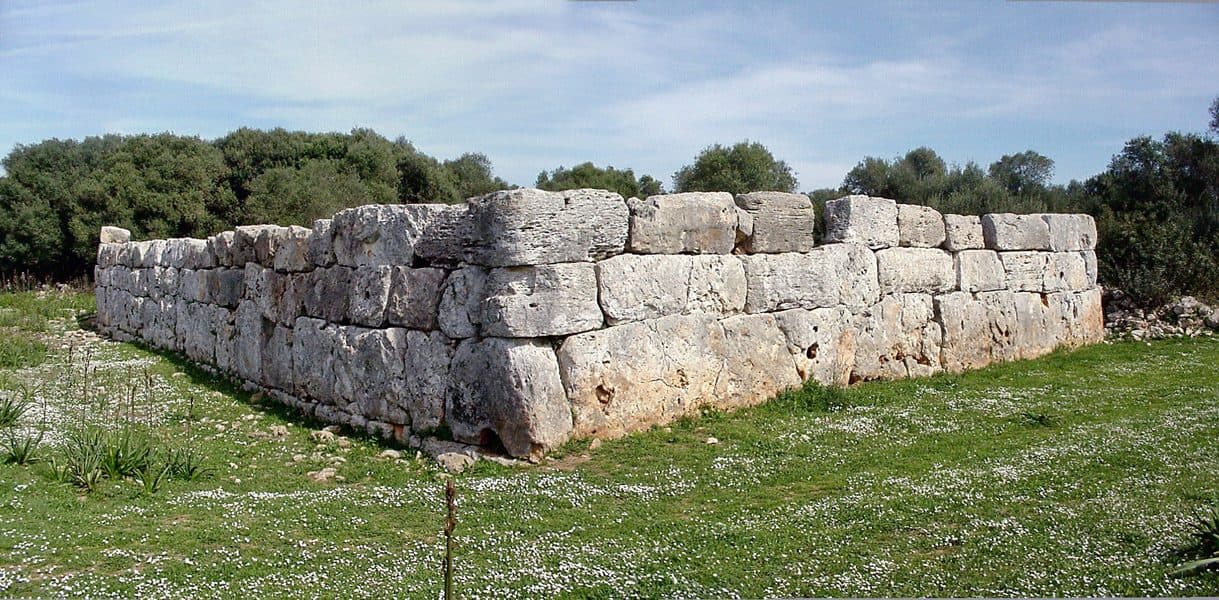
A rectangular structure enclosed by a massive wall has attracted particular attention. Its precisely placed large stone blocks differ strikingly from typical Mallorcan Talayotic architecture. Inside were rooms and a courtyard, where hearths were also identified. Finds from the Punic period and the unusual construction method led to suggestions that the building may have been connected with trade or military activities.
It has even occasionally been proposed that Mallorcan slingers, whose skills were feared across the western Mediterranean, may have trained here. This remains an interpretation, not an established fact. Yet that open question is precisely what makes the building so intriguing: S'Hospitalet Vell provides not only answers but also demonstrates where archaeological research must rely on evidence and inference.
Excavation and preservation
The settlement became a stronger focus of research during the 1970s. A preliminary survey of the talaiot was published in 1973; archaeologists investigated the tower, the naviforms and the enclosed area until 1983. Work then paused for an extended period.
Since 2002, the Historical Museum of Manacor has run a project to continue investigating, securing and preparing the excavated structures for visitors. The site is therefore not merely a preserved monument but part of ongoing scientific research. Pottery vessels, stone tools, jewelry and other recovered objects are not displayed in the open-air site but are preserved and exhibited in the museum in Manacor. At the site itself, the focus is on the buildings and their spatial relationships.
What to see
The four naviforms
At first, some parts may look like a succession of low walls. The Bronze Age houses become recognizable only when their complete plans are considered. The naviforms have an elongated shape with a rounded end, and the individual examples vary in size. Recorded dimensions range between 11 and 16 meters in length and between 7 and 9 meters in width.
The rows of stones mark what were once enclosed living spaces. Roofs made from timber and branches stretched above them, while the massive wall bases stabilized the structures. Because only the stone elements survived, some imagination is needed to turn the exposed plan back into a house. The panels help visitors distinguish entrances, wall lines and areas of use.
The naviforms are essential for understanding the site because they show that s'Hospitalet Vell did not begin with the monumental talaiot. People had already lived and worked here several centuries earlier in small family-based units. Those who visit this oldest area first will perceive the later transition to larger and technically more sophisticated stone structures all the more clearly.
The square talaiot
The site's focal point is the square talaiot. While many visitors know talaiots mainly as round or square towers with massive exterior walls, the example at s'Hospitalet Vell has an additional special feature: large parts of its internal ceiling structure survive. Stone slabs rest above the central support and reveal how the building's weight was distributed.
This construction makes the tower an exceptional example on Mallorca. The central column was not merely decorative but supported the slabs above it. The structure probably carried another story or a raised level from which the surrounding land could be monitored. The precise use of Talayotic towers was not necessarily identical in every case, however; their monumental construction is clearer than any single conclusively proven function.
A modern elevated viewing point makes it easier to look inside the talaiot. From there, the relationship between the central column, stone slabs and exterior wall can be understood more clearly than from ground level alone. It is worth noting not only the size of the blocks but also their bearing points: the structure demonstrates how skillfully its builders handled heavy stone and structural loads.
The additions and hypostyle hall
The talaiot did not stand in isolation. Rooms and houses adjoin it and were used during different periods. Their walls form a denser network than those of the older naviforms, revealing how a settlement changed around an existing monumental structure.
This area also includes a hypostyle hall, meaning a room whose roof was supported by columns. Such columned spaces were technically more demanding than simple open courtyards. Today, it is primarily the stone structures that remain legible; the original height and perishable building elements must be mentally reconstructed. Those who walk slowly through the area can nevertheless recognize the transitions between interiors, passageways and attached units.
The different wall junctions are more than minor details because they reveal that not everything was built at the same time. Some walls accommodate older buildings, while others alter existing plans. S'Hospitalet Vell can therefore be read like an archive in stone, in which each generation left traces beside or above those of its predecessors.
The rectangular cyclopean masonry
The unusual rectangular building stands in another part of the settlement. Its approximately 22-meter-long exterior wall encloses a clearly defined area and consists of large, carefully positioned blocks. The technique appears more precise and regular than that of many other Talayotic walls on Mallorca. Comparisons have been drawn more readily with ancient Mediterranean masonry than with the local building methods used over centuries.
The interior initially seems to have been largely open. Two roofed groups of rooms with various chambers were later built, together with a courtyard containing two hearths. This sequence is particularly informative: the rectangle was not an unchanging structure but was adapted to new needs. The walls visible today therefore do not necessarily all belong to the same period.
Punic-period finds and the masonry's unfamiliar character have fueled discussion about contacts with Carthage. A trading post, a site used for military purposes or a local building constructed under strong external influence have all been considered possibilities. The building should therefore not be hastily described as a fortress. Its importance lies precisely in the way it makes Mallorca's connections with the wider Mediterranean world visible without providing a definitive answer.
Information panels and artifacts
Multilingual panels guide visitors on the self-guided route. They translate low wall remains into understandable plans and help distinguish between Naviform, Talayotic and later phases of use. Without this context, some rooms might appear to be random arrangements of stones; with it, construction phases, courtyards and interiors become recognizable.
Original finds such as vessels, tools and jewelry are held by the Historical Museum of Manacor. The site itself is therefore not a conventional museum with display cases but presents the place of discovery, its architecture and the landscape in which the objects were used. Those wishing to see both can combine s'Hospitalet Vell with the museum in Manacor at another time.
Visiting the site
A self-guided tour
The visit begins at the entrance gate to the fenced site. Visitors open the gate themselves and close it again after passing through because animals are kept on the grounds. This simple procedure immediately makes clear that s'Hospitalet Vell is not a staged visitor attraction with a permanently staffed reception but an archaeological site in a rural setting.
Information panels lead through the site's most important areas. A chronological order is useful: first the naviforms, then the square talaiot with its additions and finally the rectangular monument. This makes the transition from family-based dwellings to monumental and more highly structured architecture easier to understand.
How much time to allow
It is difficult to specify a fixed visit duration. Those seeking only an overview can take in the compact site without a lengthy tour. However, time should be deliberately allowed to examine the plans, read the panels and compare the different masonry techniques, as neither the talaiot nor the rectangular building can be understood from a single photo stop.
Visitors with an interest in archaeology usually stay longer because many details can be discovered in the wall junctions, supports and sequences of rooms. Families, by contrast, can easily adapt the tour to their children's attention spans. There is no extensive indoor exhibition that must be completed in full.
Crowds and time of day
S'Hospitalet Vell is considered a quiet place that usually receives few visitors. Even with its proximity to Cales de Mallorca, it does not generally have the atmosphere of a heavily visited coastal attraction. A particular time of day is therefore less important than at popular viewpoints or swimming coves.
Clear daylight is helpful for recognizing the plans. Specific opening hours and admission conditions may change and should be checked before traveling.
Getting there and parking
From Palma Airport
From Palma Airport, the route initially follows the Ma-19, then the Ma-5120 and the Ma-4010 toward Cales de Mallorca. The road distance to the coastal resort is 62 kilometers, and the drive takes around 55 minutes. This distance and journey time refer specifically to Cales de Mallorca, not to the excavation site's entrance gate.
The archaeological site is located on the access road to Cales de Mallorca, in the southern half of the municipality of Manacor. For the final section, follow the road toward the resort and watch for signs to the site. A large sign marks the access road to the gate.
From central Palma
From central Palma, the route follows the Ma-15, Ma-4015 and Ma-4014. The road distance to Cales de Mallorca is 67 kilometers, and the drive takes around 64 minutes. Here too, the figures apply to the coastal resort. S'Hospitalet Vell is reached on the final section before or outside the main resort development.
The Ma-4015 is also an important reference point when approaching from Manacor. At the junction for the road to Cales de Mallorca, signs point toward the archaeological site. Because the site is rural and does not look like a large museum, visitors should watch carefully for the entrance.
Parking and bus travel
Parking is available directly by the site or its access road. Only a short final stretch leads from the vehicle to the entrance gate. After opening it, the gate must be closed again to prevent the animals kept on the grounds from escaping.
Several bus stops serve the Cales de Mallorca and Cala Antena area. However, they are located within the resort rather than directly beside the excavated structures. Those arriving by bus should therefore carefully plan both the service for their chosen day and the onward route from the stop to the rural archaeological site.
Bus lines to poblat de s'Hospitalet Vell at a glance
| Line | Route | Departures/day | First | Last |
|---|---|---|---|---|
| 428 | Cala d'Or - Portocristo | 113 | 08:20 | 22:11 |
| 416 | Cales de Mallorca - Manacor | 69 | 06:55 | 21:34 |
From the official GTFS feeds (TIB/SFM), no real-time data. The figures cover all stops in the town; weekend and holiday services differ — check with the operator before travelling.
Getting there by bus
Platja de Cala Antena 1 (33070) · 1.7 km as the crow flies
- 416Cales de Mallorca - Manacor · Daily
- 428Cala d'Or - Portocristo · Daily
Platja de Cala Antena 2 (33069) · 1.7 km as the crow flies
- 416Cales de Mallorca - Manacor · Daily
- 428Cala d'Or - Portocristo · Daily
Alcanada - Espalmador (33073) · 1.8 km as the crow flies
- 416Cales de Mallorca - Manacor · Daily
- 428Cala d'Or - Portocristo · Daily
Carrer Cala Antena (33025) · 1.9 km as the crow flies
- 416Cales de Mallorca - Manacor · Daily
- 428Cala d'Or - Portocristo · Daily
Passeig Manacor (33071) · 2.3 km as the crow flies
- 416Cales de Mallorca - Manacor · Daily
- 428Cala d'Or - Portocristo · Daily
Timetable data: official GTFS feeds (TIB/EMT), no real-time — check with the operator before travelling.
Nearby places
Cales de Mallorca
Cales de Mallorca is the closest base for a visit. The resort offers accommodation, restaurants and access to several coves, while s'Hospitalet Vell lies outside the dense development along the access road. An archaeological tour can therefore be easily combined with time on the coast without the site itself losing its rural character.
The contrast between periods is particularly appealing: modern resort architecture dominates the seafront, while beyond the developed area low walls tell the story of Bronze and Iron Age settlement forms. Those who know Cales de Mallorca only as a beach resort will gain a completely different perspective on the same stretch of coast at s'Hospitalet Vell.
Coves of the east coast
Cala Antena lies southeast of the site and is one of the resort area's easily accessible coves. More natural stretches of coast north and east of the excavation include Cala Bota, Cala Virgili, Cala Pilota and Cala Magraner. These coves are often linked together on a hike.
Such a combination requires more time and preparation than a short beach visit, but it fits well thematically: the settlement's stone plans are followed by a coastal landscape that has preserved its open character away from resort development. The hiking trails are an excursion in their own right and should not be underestimated as merely an addition to the archaeological tour.
Manacor and the museum
In Manacor, the Historical Museum fills the most important gap in the on-site visit. Finds from s'Hospitalet Vell are preserved and displayed there, including pottery, stone tools and jewelry. At the excavation, visitors see the spaces; in the museum, they encounter the objects used by the people who lived and worked in them.
Combining both places in a single day is possible but not essential. Those with a serious interest in the settlement gain a second perspective from the museum: walls provide the architectural framework, while finds offer clues about activities, contacts and everyday life. Before combining the visits, the museum's current visitor conditions should be checked separately.
The place it belongs to
Cales de Mallorca in the place guidePractical information for your visit
Footwear and terrain
The site is an open archaeological area with uneven and sometimes stony ground. Sturdy, closed shoes are more comfortable than smooth-soled sandals. Particular care is needed where low walls, loose stones and varying ground levels are close together. There is no need to climb the ruins for good photographs, as an elevated viewing point provides a clearer view of the square talaiot.
Sun and visitor facilities
This is an archaeological site in a rural setting, and its quiet landscape is an important part of the experience. Explanations are provided on panels in several languages. Those wishing to explore the site in greater depth should read each panel beside the relevant structure rather than waiting until after the tour. This makes the differences between the naviform, talaiot and rectangular cyclopean structure significantly easier to recognize.
Visiting with children
For children, s'Hospitalet Vell can be more tangible than an exhibition consisting only of display cases. They can walk around the house plans, see the talaiot's central support directly and compare different masonry techniques. Adults should explain, however, that the low rows of stones are genuine architectural remains and not a play area.
A short, focused tour usually works better than trying to read every panel in full. Useful guiding questions include where an entrance may have been, which structure appears older or how a roof could have been supported on the walls. In this way, the exposed plans become an imaginable settlement once again.
What not to expect
S'Hospitalet Vell is not a reconstructed prehistoric setting. There are no fully rebuilt houses, no permanently furnished living spaces and no large exhibition on the site. Those expecting colorful reconstructions or spectacular presentations may initially underestimate the low walls.
The site's strength lies in its original remains. The square talaiot, its surviving ceiling slabs, the four naviforms and the unusual rectangular building place several periods directly alongside one another. With a little time, a field full of stones becomes a precisely structured picture of early settlement history.
Local insider tips
View the talaiot from above
Use the elevated viewing point beside the square talaiot. From there, the central column, surviving stone slabs and exterior wall are much easier to understand as a single load-bearing structure.
Examine the masonry technique
At the rectangular building, look beyond the size of the blocks. Their unusually precise placement differs significantly from many local Talayotic walls and is key to the scholarly debate surrounding the structure.
Begin with the naviforms
Start the tour chronologically with the four naviforms. The transition to the monumental talaiot then becomes particularly clear because the family dwellings can be compared directly with the later communal architecture.
See the finds in Manacor
The site focuses on walls and floor plans. Pottery, stone tools and jewelry from the settlement are displayed at the Historical Museum of Manacor, providing a complementary view of everyday life at the time.
Close the gate behind you
Visitors open the entrance gate themselves. It should be closed again after passing through and when leaving because animals are kept on the rural site.