
Cova des Moro near Cales de Mallorca
_12.jpg)
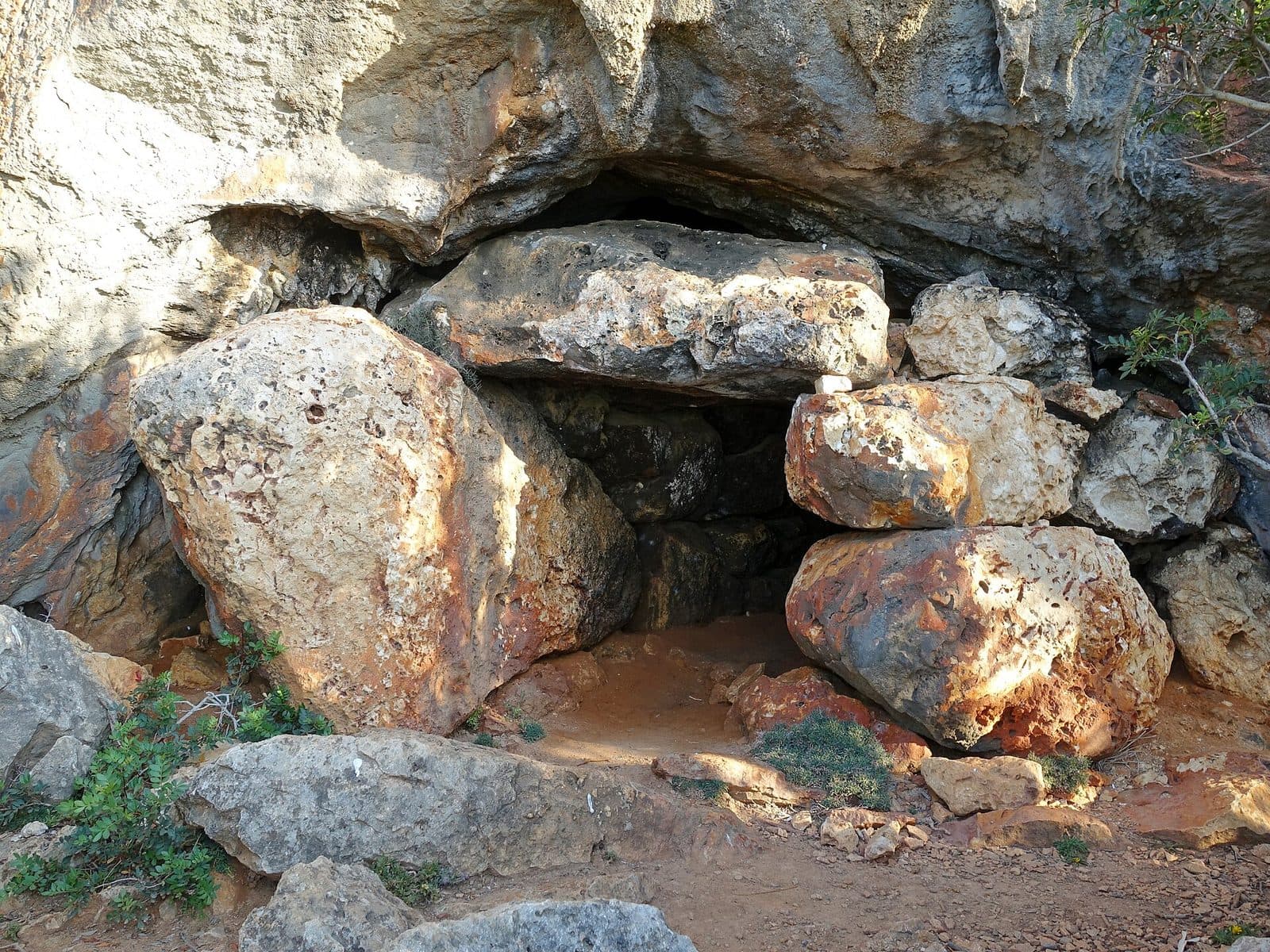
On Mallorca’s east coast, Cova des Moro opens directly onto the sea from a heavily weathered rock face. Behind the striking entrance, reminiscent of an upturned boat hull, lies an untouched karst cavity with dripstone formations and archaeological traces. It is precisely this combination of landscape, geological history, and early human use that makes the site remarkable.
The cave appeals to visitors looking for an independent excursion away from illuminated visitor trails. Even the approach is part of the experience: the coastal path crosses rocky terrain, followed by a short descent at the end. There is no artificial lighting inside. Daylight enters only through the entrance and smaller openings in the rock, while the rear areas remain dark.
Cova des Moro should not be confused with the much-visited Caló des Moro swimming cove near Santanyí, nor with the cave of the same name on the island of Sa Dragonera. This article refers exclusively to the cave in the municipality of Manacor, close to Cala Falcó and the coast near Cales de Mallorca.
A visit is worthwhile less for a long sequence of spectacularly staged chambers than for the site’s unaltered character. The large main chamber, massive dripstone formations, subdued light, and visible evidence of archaeological investigations reveal why the cave attracted people throughout very different periods.
History and significance
Long before holiday resorts appeared along Mallorca’s coasts, natural caves provided shelter, orientation, and spaces for activities that can now be understood only through archaeological traces. Cova des Moro is one of these places used over a long period. It is classified both as a dwelling cave and as a site used at times for rituals; according to archaeological descriptions, its occupation spans from Mallorca’s earliest settlement phases to the Islamic period.
The earliest phases of use
Its location directly on the coast made the cave both sheltered and widely visible. Large stones near the entrance are associated with its prehistoric use. Archaeological excavation areas in the main chamber also demonstrate that this is not merely a geological attraction.
It is not possible to read on site, as in a museum, which activity took place in each part of the cave. Its classification as a dwelling and ritual cave instead makes clear that its function changed over time. Natural karst caves often preserve such remains better than open sites because wind and rain have less impact inside. At the same time, later users may displace or overlay older layers. This sequence of different phases of use is particularly significant archaeologically at Cova des Moro.
From prehistory to the Islamic period
The name roughly means “Moor’s Cave,” but it does not describe only the site’s later history. Use began in prehistoric times and continued through several cultural periods. The name can therefore draw attention to just one phase, even though the cave documents a much longer period of human presence.
Its repeated use can also be explained by its spatial form. Behind the large entrance lies a spacious chamber, with individual areas divided by stalagmites and other limestone deposits. Such natural niches could be perceived and used differently at different times without any need for walls or purpose-built rooms.
Exploration of the cave
Systematic speleological investigations and the first recovery of fossils from the extinct Myotragus balearicus began in the seventies. The context of these finds is significant because the cave preserves not only evidence of human use but also material relating to the natural history of the Balearic Islands.
Later archaeological work focused partly on the main chamber. Visitors should therefore not expect a completely untouched cave floor: areas showing signs of excavation are part of the site’s more recent research history. Today, Cova des Moro is simultaneously a natural space, an archaeological site, and the destination of a more demanding coastal hike. These three aspects should be considered together during a visit.
What to see
The first powerful impression comes before entering. Several horizontally aligned openings lie in a rock face heavily eroded by the sea. The large entrance, described as naviform, is particularly striking: its outline resembles the shape of a boat hull and stands out clearly from the irregular cracks in the surrounding limestone.
The naviform entrance
At the entrance, the site’s two defining elements meet directly: outside lies the open coast, while only a few steps farther in, the rock absorbs much of the daylight. The opening is not the portal of a building but the result of natural karst and erosion processes. Nevertheless, it has a clear, almost architectural effect.
This area also contains large upright or supported stones that are regarded as evidence of the cave’s prehistoric use. They should not be moved or used as seats or climbing aids. Their value lies precisely in preserving their position within the context of the archaeological site.
The large main chamber
Beyond the entrance, Cova des Moro expands into a surprisingly spacious chamber. The cave has a total length of 60 metres, with 16 metres between its different levels. These figures, however, only partly convey the sense of space. What is most striking is the contrast between the broad entrance area and the darker sections beyond, divided by limestone formations.
The main chamber has no masonry walls. Stalagmitic formations visually divide it into several zones, creating vistas, niches, and natural boundaries. In places, large columns extend from floor to ceiling. This can make the space feel almost like a hall with supporting pillars, even though all of its forms were created by limestone deposits.
Dripstones and karst formations
Geologically, this is a dripstone and karst cave in limestone. As water passes through the rock, it dissolves lime and deposits it again inside the cavity. This process created the stalagmites, columns, and other formations that structure the large chamber. The most interesting views are found not only overhead but also along the floor, where deposits form natural thresholds and distinct areas.
The formations are not sturdy climbing holds. Touching them can soil or damage their surfaces, while damp limestone is also slippery. Visitors wishing to appreciate the spatial effect should remain on already discernible footholds and view the columns from a little distance.
Light openings and dark zones
There is no electric lighting in Cova des Moro. Some light enters through the main entrance, while smaller fissures allow a little additional brightness into the rock. Near the opening, outlines and surfaces can still be seen in the natural backlight, but farther inside, details quickly disappear into darkness.
This transition is an essential part of the visitor experience. From inside, the entrance appears as a bright opening towards the coast; in the opposite direction, the outlines of the dripstone formations gradually dissolve. Bringing your own light is not about staging the cave but about safe orientation and protecting the archaeological site.
Archaeological traces
Archaeological excavations have taken place in the main chamber. The site reveals itself through its spatial characteristics: the sheltered chamber, the divided areas, the stones at the entrance, and the visible investigation zones. The cave therefore rewards careful observation. What initially appears to be a purely natural chamber was also a space used by people over a long period. Loose stones, floor surfaces, and deposits are consequently not merely part of a rugged setting but may possess archaeological context.
Visiting the cave
The excursion begins on a coastal path. One frequently described route starts at the beach of s’Estany d’en Mas and follows a clearly visible trail south across the rocks. Another access option begins at the Ma-4014. The approach is said to take around 30 minutes; at the end, there is a short descent over the rock.
From the coastal path to the entrance
For much of the route, the path runs across the terrain above the coast. The surface remains natural and may consist of solid limestone, loose stones, and uneven footholds. Shortly before the cave, access becomes more demanding. Although the final descent is short, it requires sure-footedness and should not be mistaken for an ordinary promenade.
According to the available route description, the more scenic option begins at s’Estany d’en Mas because it follows the coast for longer. The alternative start at the Ma-4014 may seem more direct, but it still requires navigation across open terrain. Parking spaces can be in high demand at both starting points.
Inside the cave
After entering, it is worth allowing your eyes time to adjust. Direct backlighting from the entrance initially makes the darker sections appear blacker than they do after a short period of adaptation. Only then do the large columns, the divisions of the main chamber, and individual openings become more apparent.
The visit consists of careful exploration followed by a return through the same entrance. Because the cave has no electric lighting and the floor is uneven, the slowest person in the group should set the pace. The approach is just as important as the cave itself when planning your time: according to the route description, the outward walk alone takes around 30 minutes, in addition to the time needed for exploration and the return journey.
Daylight and visitor numbers
Visiting with sufficient daylight is particularly advisable. Although much of the cave remains dark even then, the coastal path, short descent, and entrance area are easier to assess. Enough time should remain for the complete return journey before darkness falls.
There is no reliably quiet time of day to recommend. It is known only that the possible starting points and parking areas can be busy. Anyone wishing to avoid other groups in the narrow access should therefore allow extra time and wait at a safe spot if necessary rather than crowding the descent.
Access and current status
No fixed opening hours or admission price are recorded for Cova des Moro. Because it is both a natural space and an archaeological site, access conditions, protective measures, or local regulations may change. Before travelling, visitors should therefore check whether the route is currently accessible and which rules apply on site.
The cave has no electric lighting, and access is across natural terrain. Anyone seeking a comfortably developed show cave will not find the right destination here. Those wishing to experience an untouched cave with an archaeological context, however, will gain an unusually immediate impression.
Getting there and parking
The listed road routes initially lead to Cales de Mallorca, not directly to the cave entrance. This is important when navigating: Cova des Moro has neither a forecourt nor a visitor car park that can be reached directly by vehicle. From the coastal area, the remaining approach must be planned independently and completed on foot.
From Palma Airport
The road distance from Palma Airport to Cales de Mallorca is 62 kilometres. The drive takes around 55 minutes and follows the Ma-19, then the Ma-5120 and the Ma-4010. This information ends at the holiday resort. Additional driving and walking time must be allowed for the final section to the chosen starting point of the coastal path.
Visitors approaching the cave from s’Estany d’en Mas begin at the beach area and follow the coastal path. The second described option starts at the Ma-4014. Neither route leads to a developed visitor entrance; instead, both cross open, rocky terrain towards the coast.
From central Palma
From central Palma, the road distance to Cales de Mallorca is 67 kilometres. The drive takes around 64 minutes. The route follows the Ma-15, the Ma-4015, and the Ma-4014. Here too, the distance and driving time refer specifically to Cales de Mallorca; the onward drive to the starting point and the walk to the cave are additional.
The Ma-4014 is also relevant to one of the described approaches. Vehicles should be parked only where this is clearly permitted and where they do not obstruct access routes or road traffic. The coastal location does not justify parking on unpaved ground or in front of blocked paths.
Parking at the starting point
The Ma-4014 and s’Estany d’en Mas are mentioned as possible starting areas. Parking spaces may be limited at both. There is no guaranteed cave car park, and Cova des Moro itself must always be reached on foot. Planning should therefore include not only a navigation point but also a legal alternative place to leave the vehicle.
Coastal access may change because of closures or amended property and conservation regulations. Barriers and local signs take precedence over older route descriptions. Shortcuts through vegetation or across land not open to the public are not suitable alternatives.
Arriving by bus
Punta Reina, with stop identifier 33041, is recorded as a bus stop in the wider area. However, it is not at the cave entrance. Current route and path information for the connection between the stop, a suitable starting point, and the subsequent coastal trail must be checked separately. Because of the rocky approach, travelling by bus does not replace the walk under any circumstances.
Bus lines to Cova des Moro at a glance
| Line | Route | Departures/day | First | Last |
|---|---|---|---|---|
| 427 | Cala Mendia - Portocristo | 48 | 08:09 | 22:17 |
From the official GTFS feeds (TIB/SFM), no real-time data. The figures cover all stops in the town; weekend and holiday services differ — check with the operator before travelling.
Getting there by bus
Punta Reina (33041) · 1.9 km as the crow flies
- 427Cala Mendia - Portocristo · Daily
Platja de Cala Mendia 1 (33039) · 2.1 km as the crow flies
- 427Cala Mendia - Portocristo · Daily
Timetable data: official GTFS feeds (TIB/EMT), no real-time — check with the operator before travelling.
Nearby places
Cales de Mallorca is the practical reference point for reaching the area and offers a clear contrast to the cave: holiday accommodation, roads, and tourist infrastructure shape the coast here, while Cova des Moro can be reached only on foot across natural terrain. Anyone staying in the resort should therefore think of the excursion as a short coastal hike rather than a quick visit between other activities.
Cales de Mallorca
The holiday resort is useful for preparing the excursion and for orientation within the road network of eastern Mallorca. The stated driving times from Palma and the airport end here. From Cales de Mallorca, the onward drive to the appropriate starting point must be planned separately; the cave itself is not located on a town street with a signposted reception area. Cales de Mallorca is particularly useful after the cave visit, as food, rest, and other practical needs can be planned in the inhabited coastal area.
Cala Falcó and s’Estany d’en Mas
Cova des Moro is also known as the cave of Cala Falcó. This stretch of coast provides the immediate landscape setting for the archaeological site. Its proximity to the sea explains the horizontally aligned openings in the eroded rock face and shapes the entire approach.
S’Estany d’en Mas serves as the starting point for the particularly scenic route option. From the beach, a visible path leads onto the rocks and then follows the coast south. This route is especially appealing to visitors who regard the walk itself as part of the excursion and reserve enough time for both the outward and return journeys.
Cala Varques
Cala Varques can be combined with an exploration of the coastal landscape. The cove lies in the same area characterised by limestone cliffs and caves and is mentioned in route descriptions as a nearby destination. Such a combination, however, considerably extends the day and should not tempt visitors to delay the return from Cova des Moro until dusk.
Other cave openings are found along the cliffs. They are not necessarily as accessible as Cova des Moro. Some cavities require specialised equipment or experience. Visitors on an ordinary excursion should therefore not improvise a route from one opening to the next.
The place it belongs to
Cales de Mallorca in the place guidePractical information for your visit
There is no electric lighting in Cova des Moro. The most important preparations are therefore suitable equipment and a realistic assessment of the approach.
Footwear and lighting
Sturdy shoes with grippy soles are the appropriate choice for the coastal path, the short descent, and the uneven cave floor. Smooth soles make it harder to maintain traction on loose stones and limestone. A headlamp is more practical than a handheld torch because it leaves both hands free during the descent and while walking inside. An independent backup light source should also be carried.
The light is primarily needed to identify footholds and obstacles. Dripstones, excavation areas, and possible archaeological traces should neither be stepped on nor used for storage. Even apparently robust limestone columns may have delicate surfaces.
Coast, sun, and weather
The approach crosses exposed coastal terrain. Sun protection and sufficient drinking water should therefore be part of your equipment, even if the cave feels cool and shaded inside. Limestone can be more slippery after rain, while strong winds make safe walking more difficult, especially near the coast and during the final descent.
Before entering, always allow enough time for the return journey. A headlamp does not turn a coastal path after dark into a developed hiking trail. Daylight remains the most important safety reserve for orientation outside the cave.
Visiting with children
An excursion with children is advisable only if they can walk safely over uneven rock and reliably follow instructions during the descent. The path is not suitable for pushchairs. Inside, there is also darkness, irregular ground, and delicate formations. Young children should be closely accompanied at exposed or slippery points.
The cave is not an adventure playground. Climbing on columns, running in the main chamber, and moving stones endanger not only visitors but also the archaeological site. Families should explain in advance that despite its open access, the site must be treated with the same care as an excavation area.
What not to expect
Cova des Moro has no electric lighting; its appeal lies precisely in encountering the site without artificial presentation. Those who enter slowly, allow their eyes to adjust to the darkness, and observe the divisions of the main chamber will notice more than visitors who take a quick photograph at the entrance. There is also a clear limit: dark side passages or more difficult sections are not a sensible part of a spontaneous visit without caving experience and appropriate equipment.
Local insider tips
Bring two reliable lights
The cave has no electric lighting. A headlamp keeps both hands free during the descent and on the uneven ground, while a second independent light source prevents a technical failure from making the return journey more difficult.
Let your eyes adjust first
Wait briefly at the entrance instead of immediately heading deep into the main chamber. Once your eyes adjust to the low light, the large columns and the chamber’s natural divisions become much more apparent.
Coastal route from s’Estany d’en Mas
The route from the beach of s’Estany d’en Mas is considered the more scenic option. It follows the coastal rock south and makes the roughly 30-minute approach an essential part of the excursion.
Notice the entrance stones
Large stones associated with prehistoric use stand out at the naviform cave entrance. Many visitors pass them without noticing, even though they demonstrate that Cova des Moro is more than a natural cavity.
Combine it with Cala Varques
Nearby Cala Varques can be included in a longer day along the coast. Start early enough to ensure that the cave visit and the complete return journey take place with sufficient daylight.