
Torres de senyals costaneres de Son Viulí near Betlem
_03.jpg)
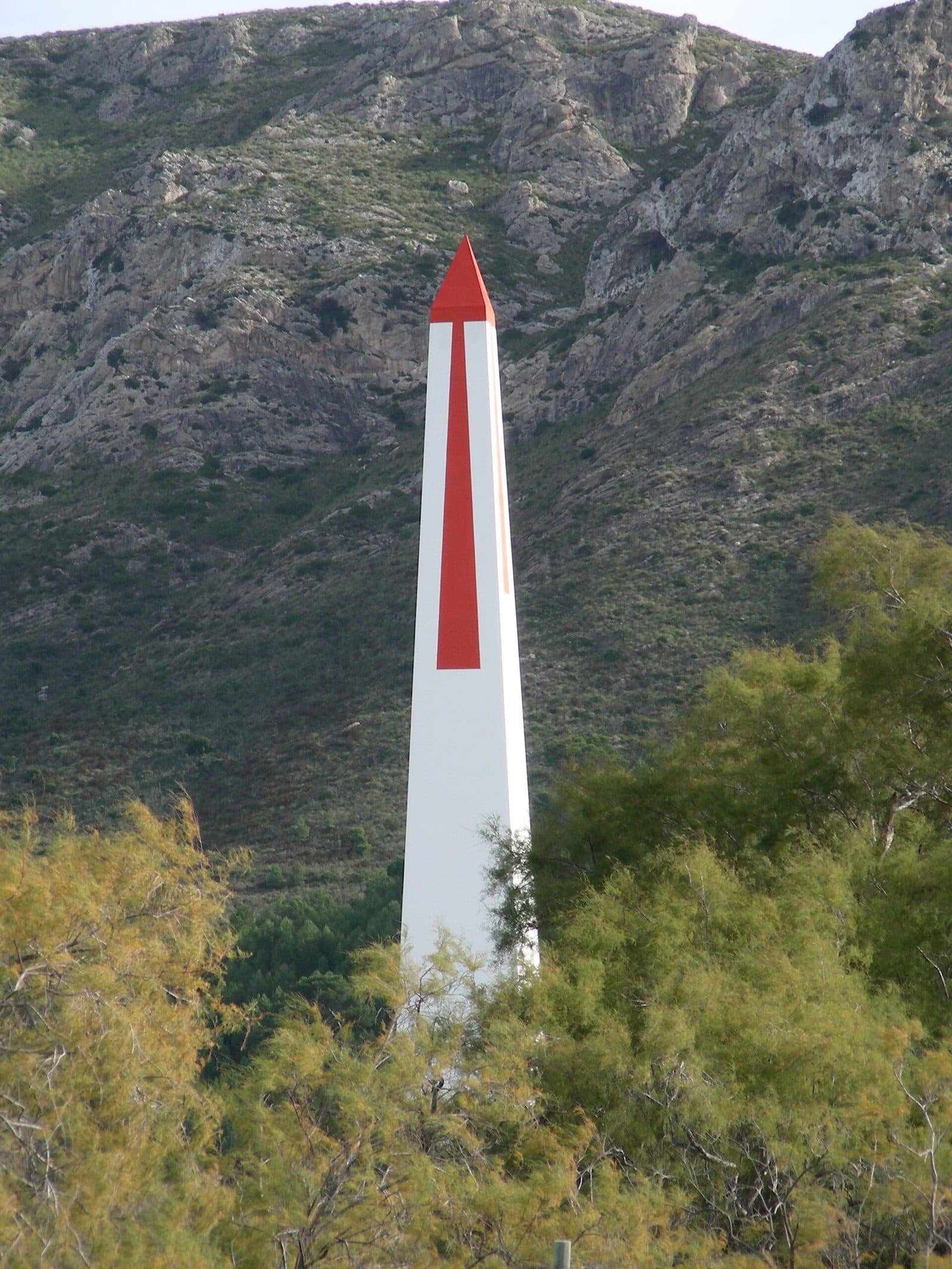
Between the Colònia de Sant Pere and Betlem stand two structures that can easily be mistaken for old coastal watchtowers. In fact, the Torres de senyals costaneres de Son Viulí tell a much more recent chapter in Mallorca’s military history. The two signal towers date from the 20th century and were used during military exercises and by the Kriegsmarine as distance markers.
It is precisely their simplicity that makes them worth seeing: two squat structures built from local Marès stone stand on the coast, narrowing towards the top. Their purpose only becomes clear when viewed as a pair, because the towers were not independent observation posts but components of a military orientation system.
A visit is especially worthwhile for anyone looking beyond the major fortresses and museums for lesser-known traces of the island’s history. Architecture enthusiasts will also find a vivid example of a rectangular floor plan, a truncated-pyramid structure, doors, and side openings. Their location between two coastal settlements also makes the monument a suitable stop on an excursion to Betlem or along the coast of Artà.
Son Viulí reveals itself through close observation: in the relationship between the two towers, their unusual silhouette, and the contrast between military form and Mallorcan building material.
History and significance
Military structures of the 20th century
Mallorca’s coast is shaped by towers from very different periods. At Son Viulí, however, this familiar appearance initially leads visitors down the wrong path, because the structures were built in the 20th century as military signaling installations. They were used during military maneuvers and served the Kriegsmarine as distance markers.
This historical context changes the way the architecture is perceived. What at first glance looks like a simplified version of an old defensive tower follows a modern functional logic. Both towers have a rectangular floor plan, a truncated-pyramid structure, an entrance door in the lower section, and several openings on the sides.
Exercises and distance measurement
The Torres de Son Viulí therefore fulfilled two documented purposes: they were used during military maneuvers and served the Kriegsmarine as distance markers. Their historical value lies less in a single event than in the preserved function of the pair. Here, the coastline became a military training and measuring area, with the towers providing fixed reference points that were visible from afar.
The plural in the name is essential. The monument is not formed by a single tower but by two interrelated signal structures. When viewing them, your gaze should therefore repeatedly shift from the nearby structure to the second tower. This change of perspective makes it especially clear that the installations were not intended as isolated observation posts.
From functional structure to monument
The towers have been restored and repainted. Today, they document a part of the island’s history that is easily overlooked alongside castles, early modern watchtowers, and fortifications. Their functions involved military maneuvers and their use by the Kriegsmarine as distance markers.
What to see
The pair of towers
The most important feature is revealed not on a single façade but through the interaction between both structures. The signal towers stand on the stretch of coast between the Colònia de Sant Pere and the Betlem development. Anyone who looks only at the first tower they encounter will see a compact military utility structure. Only with the second example does it become a system.
It is therefore worth viewing the sites from different directions. Sometimes the similarity between the towers comes to the fore, while at other times their separate positions on the coast become more apparent. This spatial relationship is not a decorative coincidence but the key to understanding their former use as markers during military exercises and for determining distances.
The rectangular floor plan
Both towers have a rectangular floor plan. Unlike a round watchtower, whose form appears similar from every direction, each structure has clearly distinguishable sides. This makes the signal towers look almost like upright markers. The straight façade surfaces and clearly defined edges give them a simple silhouette that is recognizable from a distance.
The form is functional: nothing distracts from the outline, and the few structural elements are subordinate to the military purpose.
The truncated-pyramid structure
The towers narrow from the ground upwards. This truncated-pyramid shape—a wider base and a narrower top—is their most striking architectural feature. It makes the structures appear squat and stable without requiring decorative reinforcements.
From close by, the eye should follow the sloping exterior surfaces upwards. This reveals how markedly the form differs from an ordinary house with vertical masonry walls. At the same time, the tapering explains why the installations are immediately recognizable as distinctive functional structures despite their simple design.
Doors and side openings
Each tower has an entrance door in its lower section, together with several openings on the sides. Here too, the design is limited to what is necessary. The arrangement of the openings breaks up the otherwise enclosed surfaces and provides a useful sense of scale for the solidity of the structures.
Comparison is particularly revealing: Which elements were designed identically on both towers, and how does each viewing direction change their effect?
Local Marès stone
Marès from the surrounding area was used for the construction. The form is strict, geometric, and tailored to a technical purpose; the stated structural features can be identified on the façades.
Restoration and new paintwork
The restored and newly painted surfaces ensure that the towers’ clear outlines continue to stand out. Their documented features are the rectangular floor plan, the tapering form, the few openings, the material, and their relationship to the second tower. Anyone who examines these points one by one can read the monument almost like a technical drawing in the landscape.
Visiting the towers
A monument explained by its architecture
A visit focuses on the characteristic silhouette on the coast and the comparison between the two structures. The towers can be examined through their documented architectural form and their relationship to each other. Your gaze should therefore not rest only on the nearest façade; a few carefully chosen perspectives reveal more about their former function than a quick photo stop.
A simple sequence works well for viewing them: First, take in the entire structure, then examine the floor plan, sloping sides, and openings. Afterwards, shift your gaze to the second tower and the coastline. In this way, two seemingly inconspicuous buildings become an understandable system of military orientation.
Time required and pace of the visit
As a destination in its own right, Son Viulí offers a compact monument visit. How long you stay depends mainly on whether you simply photograph the towers or study their relationship to each other more closely. Architecture enthusiasts will spend more time examining façades, materials, and sightlines; on a coastal excursion, the site can be included as a quiet cultural and historical stop.
That is precisely why it is worth not moving on after the first glance. The essential detail is neither a sign nor an individual structural element, but the fact that two similar signal towers jointly fulfilled a military function.
Planning before setting out
Current official visiting hours and admission conditions should be checked before the excursion, as they may change. On site, visitors should also respect the fact that a preserved monument does not automatically mean that every part of the building may be entered. Doors, barriers, and local notices must be observed.
Information about typical peak times is not reliable enough to recommend a particular time of day as guaranteed to be quiet. What matters more for viewing the monument is having a clear view of both structures and their side surfaces. Anyone visiting the site as part of a longer coastal excursion can adapt the stay flexibly to the rest of the route.
Getting there and parking
From Palma Airport
The stated driving distance from Palma Airport to Betlem is 73 road kilometers. The journey takes around 65 minutes and follows the Ma-15, then the Ma-3322 and the Ma-3331. These figures expressly apply only as far as Betlem, not directly to either of the two signal towers.
At the destination, the monument’s exact location on the stretch of coast between Betlem and the Colònia de Sant Pere must therefore still be taken into account. Current map navigation should be used for the final section.
From Palma
From central Palma to Betlem, the road distance is 75 kilometers. The journey takes around 71 minutes and also follows the Ma-15, the Ma-3322, and the Ma-3331. The Ma-15 covers the longer section through the island’s interior; the other roads lead northeast and finally into the coastal area around Betlem.
Once again, the stated journey time ends in Betlem. Additional navigation should be planned for the onward journey or access to the monument, without assuming that the towers stand directly at the location entered as the destination. Their position on the coast between the development and the Colònia de Sant Pere is the key consideration.
By bus
The stops in the Colònia de Sant Pere and near Montferrutx are possible public transport access points. The visit is not complete once you get off the bus, however, because the towers stand in the coastal area between the settlements. The appropriate connection and the onward route should therefore be planned together before departure.
For the return journey, it is advisable to check the current timetable before setting out for the towers. This is particularly important if Son Viulí is combined with a coastal walk or other destinations near Betlem and the length of the stay cannot be estimated precisely.
Bus lines to Torres de senyals costaneres de Son Viulí at a glance
| Line | Route | Departures/day | First | Last |
|---|---|---|---|---|
| 421 | Colònia de Sant Pere - Artà | 48 | 07:30 | 19:55 |
From the official GTFS feeds (TIB/SFM), no real-time data. The figures cover all stops in the town; weekend and holiday services differ — check with the operator before travelling.
Getting there by bus
Colònia de Sant Pere (6003) · 1.4 km as the crow flies
- 421Colònia de Sant Pere - Artà · Daily
Montferrutx 2 (6009) · 1.8 km as the crow flies
- 421Colònia de Sant Pere - Artà · Daily
Montferrutx 1 (6004) · 1.8 km as the crow flies
- 421Colònia de Sant Pere - Artà · Daily
Timetable data: official GTFS feeds (TIB/EMT), no real-time — check with the operator before travelling.
Nearby places
Betlem
Betlem forms the eastern reference point of the coastal section where the signal towers stand. The quiet settlement is suitable as the starting or finishing point of an excursion focused not on a single major structure but on several small impressions along the coast. Son Viulí adds an unexpected layer of military history to this landscape experience.
The place name should not be confused with the Ermita de Betlem. The hermitage is a separate excursion destination in the Artà area and has a completely different history and function. Combining both destinations is possible, but the signal towers are neither part of the Ermita nor religious structures.
Colònia de Sant Pere
The Colònia de Sant Pere lies west of the towers. This coastal settlement is a convenient place from which to incorporate the monument into a longer stay in the northeast. From this side in particular, it becomes clear why the location of the structures is always described as the section between the Colònia and Betlem: The two towers are not part of an enclosed museum site but of a historically used coastal landscape.
Anyone traveling from the Colònia towards Betlem should therefore look out for both signal structures. The first tower you encounter is not the entire monument. Only the second completes the picture and explains why the site is named in the plural.
Coves and other coastal destinations
Cala des Camps, the Playa de Sant Pere, and Cala na Clara lie in the wider coastal area. They make it possible to combine a cultural and historical stop with time by the sea, without turning the towers themselves into a beach attraction. Son Viulí remains a monument with its own meaning and should not be treated merely as a backdrop on the way to the next cove.
Son Serra de Marina is another possible destination on a broader tour along the bay. Such a combination is especially worthwhile if the northeast is planned as a full excursion day. To understand the towers, however, the nearby coastal area between Betlem and the Colònia de Sant Pere is sufficient.
The place it belongs to
Betlem in the place guidePractical information for your visit
The Torres de Son Viulí are military signal towers from the 20th century. Their documented purpose was their use during military maneuvers and by the Kriegsmarine as distance markers.
Visitors should behave with restraint around the structures themselves. The towers have been restored and repainted. Their value as monuments can be understood through the documented features: rectangular floor plan, truncated-pyramid structure, low entrance, side openings, Marès stone, and their paired position on the coast.
The site can be especially interesting for children if its former function is presented as a small observation task: Why are there two similar towers, why are their outlines so clear, and how could fixed points on the coast help during exercises and when estimating distances? Accompaniment and supervision on the coastal section remain important.
Visitors should expect a monument whose documented architecture and location are the main focus. Son Viulí does not require extensive historical preparation, but rather attention to form and setting. Anyone who consciously compares the two towers will recognize a precise military purpose in just a few structural elements, as well as a rarely noticed piece of Mallorca’s coastal history.
Local insider tips
Always look for the second tower
The first visible tower is only half of the monument. Only by comparing both structures does their former function as connected military markers become clear.
Notice the sloping sides
Do not photograph them only from the front: From the side, it is particularly easy to see how the rectangular structure narrows towards the top and forms its truncated-pyramid silhouette.
Examine the Marès up close
The austere military form was built using Marès from the surrounding area. This contrast between a modern functional structure and typical Mallorcan building material is one of the most interesting details.
Plan it as a coastal stop
Son Viulí can be usefully combined with Betlem or the Colònia de Sant Pere. The towers stand between the two places and are better understood as part of this stretch of coast than as an isolated photo subject.