
Buying Property in Spain with German Equity: Lombard Loans, Leveraging & Smart Capital Deployment
Anyone looking to buy a property on Mallorca or elsewhere in Spain using German equity faces a core strategic question: how do you deploy your money in a way that minimises lost returns, optimises your tax position, and still meets Spain's strict mortgage requirements? This guide explains which financing routes work for a property purchase in Spain using German equity — from a straightforward equity transfer to a Lombard loan or leveraging an existing property in Germany. You'll learn how much equity you actually need, how to document the transfer of funds correctly, and which tax levers you should be aware of.

Are you planning a purchase and want to know which financing route suits your personal situation?
- 📩 Submit a personal enquiry — we'll discuss Lombard loans, property leveraging, and equity transfers with you individually
- A full overview of purchase ancillary costs on Mallorca
Why equity plays such a central role in buying in Spain
Spanish banks approach property finance in a fundamentally different way from German ones. As a non-resident — that is, a buyer without a registered address in Spain — you will generally receive a maximum of 60 to 70 % of the purchase price or the assessed value as a mortgage, with the bank always using whichever of the two figures is lower. If the assessed value falls below the purchase price, your financing will be reduced accordingly.
In practice, this means you must provide at least 30 % of the purchase price from your own funds — plus all ancillary purchase costs on top. In the Balearen, depending on the purchase price, an additional 10 to 14 % is added (property transfer tax ITP, notary fees, land registry registration, solicitor). Buyers of existing properties typically find themselves closer to 12 to 14 %, while new-build buyers tend to pay 12 to 13 %.
| Purchase price | Equity (30 %) | Ancillary costs (approx. 12 %) | Minimum total equity required |
|---|---|---|---|
| 500.000 € | 150.000 € | 60.000 € | 210.000 € |
| 1.000.000 € | 300.000 € | 120.000 € | 420.000 € |
| 2.000.000 € | 600.000 € | 240.000 € | 840.000 € |
Please note: Ancillary costs can never be financed — they must be covered entirely from your own funds. It is better to budget for 14 % than for 10 % to avoid any unpleasant surprises.
For many German buyers, equity is not sitting in an easy-access account but is invested — in securities portfolios, life insurance policies, unit-linked policies, or a mortgage-free property in Germany. This is precisely where the real strategy begins.
Option 1: Classic equity transfer from Germany
The most straightforward route is transferring funds from a German account to a Spanish account. It sounds simple — but legally it is not entirely so, as Spain requires complete documentation of the origin of all funds involved in a property purchase.
You will absolutely need:
- Bank statements evidencing the source of the funds (salary payments, property sale proceeds, gifts, inheritance, etc.)
- For proceeds from a property sale: purchase contracts and proof of tax payment
- For gifts or inheritances: relevant documents, where applicable with an apostilled translation
- Proof that the funds have been taxed in Germany
Please note: Spanish notaries and banks are required to carry out anti-money-laundering checks. Incomplete documentation can hold up the notary appointment. Have your lawyer review the documents in advance.
Another topic to be aware of is the declaration requirement for amounts exceeding 10,000 euros when physically crossing the border (cash). Bank transfers are not affected by this, but must also be documented. For more details on a smooth transfer, I recommend the guide Transferring money to Spain for a property purchase.
Option 2: Lombard loan – borrow against your portfolio instead of selling it
For buyers with a substantial securities portfolio, a Lombard loan is often the most elegant solution. Instead of liquidating your portfolio and triggering capital gains tax on realised profits, you simply use it as collateral.
Here is how it works:
- You lodge your securities portfolio (shares, funds, ETFs, bonds, and also life insurance policies) with a German or Austrian private bank as security.
- The bank grants you a loan – typically between 50 and 70 % of the portfolio value, depending on the quality and volatility of the assets held.
- You use this loan to cover the equity portion and the ancillary costs of the Spanish property purchase.
- Your portfolio remains fully invested and continues to generate returns.
| Portfolio value | Lending limit (approx. 50–70 %) | Available Lombard loan |
|---|---|---|
| 500.000 € | 50–70 % | 250.000–350.000 € |
| 1.000.000 € | 50–70 % | 500.000–700.000 € |
| 2.000.000 € | 50–70 % | 1.000.000–1.400.000 € |
Please note: The specific lending limits depend heavily on the composition of your portfolio. Individual shares are often valued lower than broadly diversified ETFs or government bonds. Clarify this in advance with your bank or private bank.
Tax advantage: Anyone who does not liquidate their portfolio pays no capital gains tax on accrued paper gains. The higher the unrealised gains in the portfolio, the greater the advantage compared with selling.
Cost of a Lombard loan: Interest rates on Lombard loans are generally above the Euribor reference rate, but often considerably lower than the rates on a Spanish mortgage for non-residents. Since the Lombard loan is typically structured on a short-term basis (to be repaid through later portfolio withdrawals or other incoming funds), the overall cost remains manageable.
Risk: If the portfolio value falls sharply (for example due to market turbulence), the bank may issue a so-called margin call – you would then either need to provide additional assets or repay part of the loan immediately. Plan for a sufficient buffer and avoid borrowing up to the maximum lending limit.
Option 3: Borrowing against a German property
Anyone who owns a mortgage-free or readily mortgageable property in Germany has a further option: a conventional loan from a German bank secured against the German property.
Financing through a German bank, secured against property in Germany, for a purchase in Spain is, according to available market information, possible up to approximately 57.6% of the purchase price. The remainder can come from additional German loans. This is an important distinction from a direct Spanish mortgage, where 70% is the maximum.
Advantages:
- You negotiate with your German house bank in a familiar language and with well-known terms and conditions
- No Spanish bureaucratic hurdles when applying for the loan
- Potentially more favourable interest rates depending on creditworthiness and loan-to-value ratio
Disadvantages:
- The German property is encumbered – this ties up capital and limits future flexibility
- Interest on a German loan taken out to purchase a Spanish holiday property is generally not tax-deductible in Germany (no deduction as income-related expenses, given its private nature)
- The German bank typically does not accept the Spanish property as collateral – the risk lies entirely with the German property
Note: Always have the tax deductibility of the interest checked in advance by a tax adviser, particularly if you intend to let the Spanish property. In that case, the financing costs may be claimed on a pro-rata basis as income-related expenses against rental income. Find out more in the guide IRPF deductions for landlords in the Balearen.
Option 4: Combined model – equity + Spanish mortgage
The most common approach in practice is the combined model: you bring the necessary equity from one of the sources described above and additionally take out a Spanish mortgage for the remaining amount.
Why a Spanish mortgage can make sense:
- Mortgage debt reduces the taxable net asset value for Spanish wealth tax purposes (more on this below)
- Depending on the timing, Spanish mortgage interest rates can be comparatively attractive
- The property itself serves as collateral – your German assets remain untouched
For everything relating to applying for a mortgage as a non-resident, read the guide Mortgage as a non-resident in Spain.
The Balearic ITP scale: what you actually pay
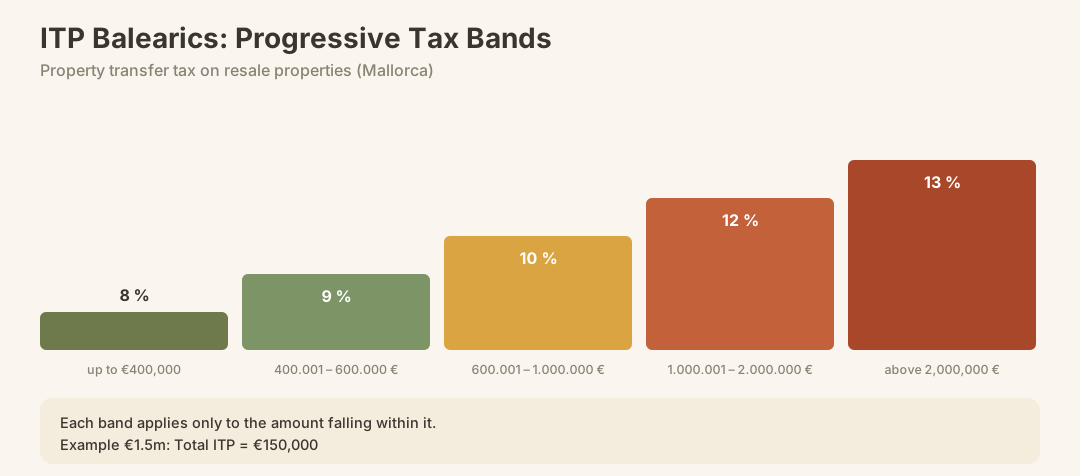
Transfer tax (ITP) is the single largest cost item for resale properties. It is levied on a progressive sliding scale – each band applies only to the portion of the price that falls within it.
| Purchase price band | ITP rate |
|---|---|
| Up to 400.000 € | 8 % |
| 400.001 € – 600.000 € | 9 % |
| 600.001 € – 1.000.000 € | 10 % |
| 1.000.001 € – 2.000.000 € | 12 % |
| Over 2.000.000 € | 13 % |
Worked example for a property at €1,500,000:
| Band | Amount | Rate | ITP |
|---|---|---|---|
| Up to €400,000 | 400.000 € | 8 % | 32.000 € |
| 400.001–600.000 € | 200.000 € | 9 % | 18.000 € |
| 600.001–1.000.000 € | 400.000 € | 10 % | 40.000 € |
| 1.000.001–1.500.000 € | 500.000 € | 12 % | 60.000 € |
| Total ITP | 150.000 € |
For new-build properties, ITP is replaced by VAT (10% IVA) plus stamp duty (AJD). The overall tax burden is broadly similar.
Wealth tax in Mallorca: why mortgages can be strategically effective
The Balearic Islands have a particular feature that is directly relevant to the use of equity: the Spanish wealth tax (Impuesto sobre el Patrimonio).
For non-residents in Mallorca, there is currently a tax-free allowance of 3.000.000 € on net assets held in Spain (applicable from 1 January 2024). Those who fall below this threshold must still file a return, but no payment is due.
If the allowance is exceeded, the tax applies progressively at rates between 0.28% and 3.45%. Consult a tax adviser for the precise band thresholds.
Strategic lever: A mortgage on the Spanish property directly reduces the taxable net value — because what counts is the market value minus any outstanding liabilities. Someone who buys a €500,000 property entirely in cash has €500,000 of taxable wealth. Someone who has financed €300,000 of that via a mortgage has only €200,000.
For high-value properties, or where multiple Spanish assets are involved, this can be a compelling reason to take out partial financing even when sufficient equity is available.
Note: The current tax-free allowance of €3,000,000 is not set in stone politically. Should the government in the Balearic Islands change, it could revert to the previous level of €700,000. Do not build a long-term structure solely on the basis of the current allowance.
NIE number, Spanish bank account, and documentation: the preparation
Without these three elements you cannot purchase — regardless of how much equity you have:
- Apply for your NIE number (Número de Identificación de Extranjero): Without an NIE there is no purchase contract, no Spanish bank account, and no tax payment. Apply as early as possible — either through the Spanish consulate in Germany or directly in Spain. During peak season there may be waiting times.
- Open a Spanish bank account: The purchase price is paid at the notary appointment by banker's draft from a Spanish bank. Ongoing costs (IBI, community charges, electricity, water) must be debited from a Spanish account.
- Proof of origin for all funds: All funds used for the purchase — whether paid directly, as repayment of a Lombard loan, or as a gift — require complete documentation. Gather bank statements, tax assessments, gift agreements, and inheritance documents well in advance.
For the precise purchase process, also refer to the guide Legal process for purchasing property in Spain.
German bank vs. Spanish bank: which is right for you?

| Criterion | German bank (lending against German property) | Spanish bank (non-resident mortgage) |
|---|---|---|
| Max. financing share of purchase price | approx. 57.6 % | up to 70 % |
| Language & process | familiar, in German | Spanish, extensive documentation required |
| Security | German property | Spanish property |
| Impact on wealth tax (ES) | none | reduces taxable net assets |
| NIE required | no | yes |
| Apostilled translations | no | yes |
| Tax deductibility (DE) | generally no (private) | not applicable |
Most common mistakes when deploying equity
1. Transferring equity without proof of origin Anyone who simply transfers money without having documentation of its origin to hand risks the notary postponing the appointment or the bank freezing the account. Gather all supporting evidence months in advance.
2. Excluding ancillary costs from the purchase price The 10 to 14 % in ancillary purchase costs are non-negotiable and cannot be financed. Anyone who underestimates them may suddenly need to inject additional equity — or fall back on a more expensive emergency loan.
3. Stretching a Lombard loan to its maximum loan-to-value If the portfolio value falls at the same time as the purchase process is under way, a margin call can jeopardise the entire timeline. Never use more than 50 to 60 % of the theoretical loan-to-value limit.
4. Failing to examine the tax implications in Germany If structured incorrectly, a Lombard loan can result in portfolio returns losing their tax-privileged status — particularly in the case of policies and insurance wrappers. Have this checked in advance.
5. Ignoring the wealth-tax allowance Buyers in the segment above 3 Mio. € sometimes overlook the fact that borrowing reduces the taxable net value. This can translate into several thousand euros in tax savings each year.
6. Not factoring in the tasación result If the tasación value (official valuation report) falls below the purchase price, the Spanish bank will only lend on the basis of the tasación value. The equity must then bridge the gap. Find out more in the guide Tasación – property valuation in Spain.
What comes next? Ongoing costs and tax obligations
After the purchase comes the tax return. As a non-resident in Spain, you have the following ongoing obligations:
| Tax / levy | Due date | Note |
|---|---|---|
| IBI (property tax) | annually, date varies by municipality | Based on the cadastral value |
| IRNR (non-resident income tax) | annually, Modelo 210 | Even without letting: deemed rental income |
| Impuesto sobre el Patrimonio | annually, if the allowance is exceeded | 3 Mio. € allowance (Balearen, non-residents) |
| Community charges (Comunidad) | monthly or quarterly | Managed by the owners' community |
If you let the property, income declarations are also required. Find out more in the guide Declaring rental income as a non-resident in Spain.
Checklist: buying property in Spain using German equity
- Purchase price calculated inclusive of 12–14 % additional costs
- NIE number applied for (early – waiting times possible)
- Spanish bank account opened
- Proof of origin documentation for all funds used, complete
- Lombard loan option clarified with house bank/private bank
- Tasación value known or commissioned
- Financing route chosen (pure equity / Lombard / German mortgage / combination)
- Tax implications in Germany and Spain discussed with an adviser
- Lawyer instructed for due diligence (land register, encumbrances, licences)
- Reservation contract reviewed before signing
- Notary appointment planned with sufficient buffer
Conclusion: Strategy beats speed
When buying property in Spain with German equity, what matters is not how much money you have – but how you deploy it. Those with a well-stocked investment portfolio are often better off using a Lombard loan than selling holdings at a cost that includes capital gains tax. Those who own a mortgage-free property in Germany can borrow against it and remain liquid. And those who take out a Spanish mortgage in any case gain an additional lever when it comes to wealth tax.
The ground rules are clear: at least 30 % equity plus 12–14 % in additional costs, everything fully documented, NIE and Spanish bank account organised in good time. Those who know these basic rules and set up their financing structure early with a specialist adviser have the greatest advantage over unprepared buyers in a market that remains highly competitive.
📩 Let's discuss your specific situation – we'll help you find the right structure for your Mallorca purchase.
Official sources
- ATIB – Agència Tributària de les Illes Balears (ITP rates Balearic Islands, wealth tax): https://www.atib.es
- AEAT – Agencia Estatal de Administración Tributaria (IRNR Modelo 210, Impuesto sobre el Patrimonio): https://www.agenciatributaria.es
- Consell de Mallorca (local taxes, IBI): https://www.conselldemallorca.net
- Registro de la Propiedad / Registradores de España (land registry searches): https://www.registradores.org
- Banco de España (mortgage regulation, consumer information): https://www.bde.es
- Notariado.org – Estadísticas del Consejo General del Notariado (transaction data): https://www.notariado.org