
Ley de Costas Mallorca: Coastal Protection Zone, Servidumbre and Building Restrictions by the Sea
Anyone purchasing a property directly on the waterfront in Mallorca, renovating one, or building from scratch will inevitably encounter the Ley de Costas Mallorca – Spain's coastal law. It divides the entire coastline into three overlapping protection zones and stipulates what may be built, altered, or used within them. The consequences for buyers are far-reaching: a holiday home within the 100-metre protection zone cannot, in practice, be extended any further, concessions expire, and plots that appear to be private property are, in legal terms, owned by the state. This guide explains how the three protection zones work, what role the so-called Informe de Costas plays when buying a property, what the competent authority in Palma checks – and which political developments in 2025/26 are currently shifting the legal landscape.

Are you buying a property in the first or second sea-view row and unsure whether it falls within a Costas zone?
- 📩 Submit a personal enquiry — We will assess the Costas status of your desired property together with experienced solicitors and architects
- Understanding the legal process of buying a property
What is the Ley de Costas – and why does it apply to existing buildings too?
The Ley de Costas is Spanish federal law No. 22/1988 of 28 July 1988, which defines and protects the entire public coastal area of Spain. It was most recently fundamentally reformed by Law 2/2013 of 29 May 2013 (Ley de protección y uso sostenible del litoral) and the Reglamento General de Costas (Real Decreto 876/2014 of 10 October 2014). The law applies to all coastal regions of Spain – and therefore in full to Mallorca and the Balearic Islands.
The aim sounds simple: the coast belongs to everyone. The state designates a coastal strip as public property (Dominio Público Marítimo-Terrestre, or DPMT for short), within which privatisation is fundamentally excluded. Beyond this lie further protection and right-of-way easements that can impose significant restrictions on private plots – without these necessarily being recorded in the land register.
Please note: The Servidumbres (easements) of the Ley de Costas do not have to be entered in the Registro de la Propiedad. A 'clean' land register search therefore does not rule out Costas restrictions.
The law takes direct effect by virtue of its legal nature – regardless of whether an entry exists in the land register or not. Anyone who purchases a property near the coast without first checking its Costas status may be in for a nasty surprise: from prohibitions on alterations through to state reclamation claims over areas of land.
An overview of the three protection zones
The law distinguishes three concentric zones running inland from the water. They do not overlap, but are built upon one another.
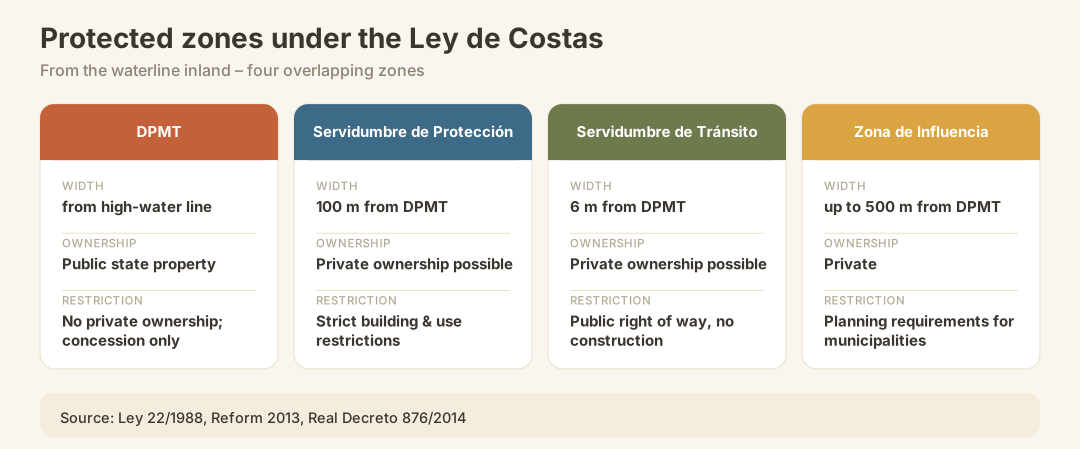
| Zone | Spanish term | Width (standard measurement) | Property rights | Key restriction |
|---|---|---|---|---|
| 1 | Dominio Público Marítimo-Terrestre (DPMT) | Variable – from the mean high-water line | Public property of the state | No private ownership possible; concessions only |
| 2 | Servidumbre de Protección | 100 m inland from the DPMT boundary | Private ownership possible | Strict construction and use restrictions |
| 3 | Servidumbre de Tránsito | 6 m from the DPMT boundary (seaward side) | Private ownership possible | Public right of passage; no development permitted |
| 4 | Zona de Influencia | Up to 500 m from the DPMT boundary | Private ownership | Planning law requirements for local authorities |
The width of the DPMT itself is not fixed: it depends on the position of the mean high-water line, the extent of dunes, cliffs, and other natural coastal features. On Mallorca, with its highly varied coastline – ranging from shallow sandy coves to towering rocky cliffs – the DPMT can differ considerably from one stretch to the next.
Zone 1: The DPMT – Public Coastal Area
The Dominio Público Marítimo-Terrestre is the cornerstone of the legislation. It encompasses:
- Beaches, dunes, cliffs, and natural transition zones to the land
- The shoreline (Ribera del Mar) up to the mean high-water line
- Natural lagoons, estuaries, and wetlands connected to the sea
This area is inalienable public property of the state. It is legally impossible to establish or acquire private ownership here. Anyone wishing to make use of this area – for example, a beach facility, a slipway, or an infrastructure installation – requires a state concession (concesión), which is granted for a limited period.
Important: Old title deeds dating from before 1988 that include coastal land may be invalid, or will have been converted into concession rights through the Deslinde process (the official state survey and boundary demarcation).
What is a Deslinde?
The Deslinde is the official demarcation of the DPMT carried out by the competent authority. It establishes exactly where the public coastal area ends and private land begins. This process has been under way in Spain since the 1990s – on Mallorca, large sections of the coastline have already been deslindado (surveyed and demarcated), but not all stretches have been completed. An ongoing or still-pending Deslinde process represents a significant risk when purchasing property.
Zone 2: Servidumbre de Protección – The 100-Metre Protection Strip
The Servidumbre de Protección is the zone of greatest practical importance for property buyers on Mallorca. It begins directly on the landward side of the DPMT and typically extends 100 metres inland. In certain urban-planned areas that already existed before the law came into force, this strip may exceptionally be reduced to 20 metres.
What is prohibited or restricted within the Servidumbre de Protección?
- New buildings or parts of buildings not expressly authorised
- Demolition and complete reconstruction of existing buildings
- Alterations that jeopardise existing-use protection or increase the volume
- Installations that block access to the coast
- Camping and permanent pitches
- Dumping of waste or environmentally hazardous substances
Please note: Existing buildings benefit in many cases from existing-use protection (fuera de ordenación). They may be used, but as a rule their volume or cubic capacity may not be extended. Repair and maintenance works are possible subject to conditions – but any planned intervention requires prior clarification with the Costas authority.
Zone 3: Servidumbre de Tránsito – The Right of Passage
Directly along the seaward boundary of the DPMT lies a 6-metre-wide strip known as the Servidumbre de Tránsito, which serves as a public thoroughfare. Even where the land here is privately owned, any construction or barrier that prevents public passage is impermissible. Fences, walls, and planting must not obstruct access.
Zone 4: Zona de Influencia – The Planning Buffer
The Zona de Influencia extends up to 500 metres inland from the DPMT boundary. It is not in itself a prohibited zone for private owners, but it obliges local authorities to take coastal proximity into account in their development plans (PGOU). For buyers this means: even plots that appear to be sufficiently far from the sea may be subject to municipal planning restrictions motivated by the Zona de Influencia.
The Informe de Costas: A Mandatory Check Before Purchase
The Informe de Costas is an official statement from the Demarcación de Costas de Illes Balears indicating whether, and to what extent, a property or plot is affected by the protected zones under the law. You should not sign any purchase contract for a coastal property without this document.
How the application process works
- Submit an application to the Demarcación de Costas de Illes Balears (the competent regional office of MITECO for the Balearic Islands)
- Submit the cadastral reference and site plans for the plot
- Allow for processing time – several weeks depending on current workload
- Receive the Informe: it provides information on DPMT overlaps, ongoing Deslinde proceedings, and applicable Servidumbres
- Review the findings with a lawyer and architect before making a purchase decision
Tip: At the same time, engage an experienced local architect to cross-reference the land plans against the Costas documentation. Only then will you get a complete picture of the actual development potential.
Responsible Authority
| Authority | Function |
|---|---|
| Dirección General de la Costa y el Mar (MITECO) | Federal authority, sets the statutory framework |
| Demarcación de Costas de Illes Balears | Responsible regional office for Mallorca, Menorca, Ibiza, Formentera |
| Municipalities (Ajuntaments) | Local planning policy within the Zona de Influencia |
Concessions within the DPMT: What does this mean for existing buildings?
Some existing buildings on Mallorca – in particular older fincas and houses built directly by the sea before 1988 – now fall within the DPMT. They were not demolished through the Deslinde process; instead, their owners were granted state concessions (concesiones demaniales), which permit time-limited use.
Following the 2013 reform, the terms of such concessions were extended. Under the current state of the reform, an extension of the concession period for marine cultivation facilities to 75 years is also planned (previously 50 years under the 2014 legislation). A concession is not a property right – it expires, cannot be inherited in the same way as normal property, and obliges the holder to pay a usage fee to the state.
Caution: Anyone purchasing a house that stands on concessioned DPMT land is not buying a conventional property, but is taking over the concession. This has significant implications for financing, insurability, and future resaleability. In practice, obtaining a mortgage on concessioned land is virtually impossible.
What may be built within the protected zone – and what may not?
The question "Can I extend the house?" is the decisive one for many buyers. Here is a practical overview:
| Measure | Within the DPMT | Within the Servidumbre de Protección (100 m) | Outside (subject to municipal plan) |
|---|---|---|---|
| New build | No (concession only) | Generally not permitted | Possible if the municipal plan allows it |
| Existing-building refurbishment (maintenance) | Only with concession | Possible with Costas authorisation | Possible |
| Extension/addition of a storey | No | No (existing-use protection remains, but no increase in volume) | Possible subject to municipal plan |
| Pool/terrace | No | Heavily restricted, case-by-case assessment | Possible |
| Demolition and new build | Prohibited | Loss of existing-use protection possible | Possible |
| Solar installation on roof | Only with a concession | Costas case-by-case assessment | Possible |
Please note: Every measure within the Servidumbre de Protección requires, in addition to the municipal planning permission, a separate authorisation or at least a statement from the Demarcación de Costas. Without this, municipal planning permission alone is not sufficient.
If you would like to know how the standard planning permission process works in Mallorca, read our guide to planning permission in Mallorca.
Latest developments 2025/26: reform and demolition moratorium
The Ley de Costas is currently undergoing significant political change. This is relevant for buyers in Mallorca:
Pressure for reform from the Autonomous Communities: In February 2026, representatives of all of Spain's coastal regions — including Baleares — met in Madrid to call for a reform of the Reglamento de Costas. The regions are demanding greater recognition of territorial realities and calling for the transfer of coastal competences to the Autonomous Communities.
Annulled Reglamento 2022: The central government had already reformed the coastal regulations in 2022 — however, the Tribunal Supremo overturned this reform in 2024 due to a procedural error (lack of public consultation). The official consultation procedure for the revised version ran from 4 to 19 February 2026; a subsequent Audiencia-pública period ran until 1 April 2026. A new Reglamento is expected to be adopted before the end of 2026. The government has pledged to consult all coastal regions before the final version is agreed.
Demolition moratorium in the Senate: In May 2026, Baleares and other PP-governed regions called in the Senate for a moratoria on all demolition proceedings relating to buildings affected by the Ley de Costas. The initiative contains ten measures and calls, among other things, for the suspension of all Deslinde proceedings and a halt to reclamation and demolition measures. The Conseller del Mar i del Cicle de l'Aigua of the Balearic government, Juan Manuel Lafuente, acted as the spokesperson for the islands.
Please note: Until these reforms have been formally passed into law, the Ley 22/1988 continues to apply in its most recently valid form. Purchase decisions should not be based on the assumption of future relaxations.
The most common mistakes when buying coastal property in Mallorca
Relying solely on the land registry: Servidumbres frequently do not appear in the Registro de la Propiedad. A clean land registry entry is no guarantee of a clean title.

Not requesting an Informe de Costas: Many buyers skip this request — and only discover after the purchase that they face severe restrictions.
Overlooking ongoing Deslinde proceedings: Where the DPMT has not yet been definitively surveyed, a subsequent boundary determination can significantly reduce the size of the plot.
Confusing a concession with ownership: A house built on concessioned state land is not a standard property. This creates serious problems in particular when it comes to financing.
Making assumptions about extensions and renovations without consulting Costas: Existing-use protection does not mean that every measure is permitted. Without authorisation from the Demarcación de Costas, you risk fines and an obligation to restore the property to its original state.
Underestimating the Zona de Influencia: Even 200 or 400 metres from the sea, municipal planning rules motivated by proximity to the coast may apply.
Waiting for reform and delaying a purchase: Anyone hoping for political relaxations is building on uncertain ground — the reforms are not yet in force.
You can find out more about the typical risks involved in buying a property in our guide to the Legal process for buying property in Spain and in the article on Checking the land registry in Spain.
What comes next? Steps to take after the Costas check
If the Informe de Costas comes back positive — meaning there are no restrictions, or only minor ones — you can proceed with the standard purchase process. If it contains critical findings, you have three options:
- Renegotiate: Adjust the purchase price to reflect the actual restrictions on development.
- Withdraw: Check whether a withdrawal clause covering Costas restrictions was included in the reservation agreement or the Arras contract.
- Continue planning with restrictions: Work with an architect and a solicitor to establish what is possible within the existing structure — and whether the property suits your plans.
For the next steps in the purchase process, the following guides are recommended:
- Solicitor for property purchases in Spain
- Additional purchase costs in Mallorca
- Reservation contract in Spain
Checklist: Ley de Costas before buying a property
- Cadastral plot and precise coordinates of the property identified
- Informe de Costas requested from the Demarcación de Costas Illes Balears
- Land registry extract (Nota Simple) obtained – but not relied upon as the sole source
- Checked whether an ongoing or completed Deslinde procedure exists for the coastal section
- Established whether the building stands on concession land (DPMT) or on private land within the Servidumbre
- Architect has compared existing plans against Costas zones
- Legal status of the existing building clarified (existing-use protection, fuera de ordenación, etc.)
- Purchase contract includes a withdrawal clause in the event of previously unknown Costas restrictions
- Notary was informed of the coastal proximity and has flagged the Costas relevance
- Municipal development plan (PGOU) for the Zona de Influencia reviewed
Conclusion
The Ley de Costas is not a bureaucratic detail that can be sorted out after the purchase – it is a fundamental characteristic of the property itself. In Mallorca, where the coastline is among the most attractive in Europe not only scenically but also in terms of price, the Costas status is one of the most important due-diligence points of all. The good news is: anyone who requests the Informe de Costas early, involves an experienced architect, and secures the purchase contract with a withdrawal clause can buy safely even within the protected zone – as long as expectations regarding future extensions and conversions remain realistic.
The political debate in 2025/26 shows that the law in this area will evolve. For now, the rule is: buy on the basis of current law, not on the basis of hoped-for reforms.
Official sources
- Ley 22/1988, de 28 de julio, de Costas (basic legislation): https://www.boe.es/buscar/act.php?id=BOE-A-1988-18762
- Ley 2/2013, de 29 de mayo, de protección y uso sostenible del litoral: https://www.boe.es/boe/dias/2013/05/30/pdfs/BOE-A-2013-5670.pdf
- Real Decreto 876/2014 – Reglamento General de Costas: BOE núm. 247, de 11 de octubre de 2014
- MITECO – Frequently asked questions on the Ley de Costas: https://www.miteco.gob.es/es/costas/preguntas-frecuentes/
- Demarcación de Costas de Illes Balears (MITECO): https://www.miteco.gob.es/es/costas/participacion-publica/00_ppublica_anteriores_07_baleares.html
- Public consultation on the reform of the Reglamento de Costas 2026 (MITECO): Consultation procedure 4 to 19 February 2026, followed by Audiencia pública until 1 April 2026