
AWV Reporting Obligation When Buying Property in Spain: What Germans Must Report to the Bundesbank
You are buying a property on Mallorca or elsewhere in Spain and transferring a larger sum abroad – in that case you are very likely obliged, under the German AWV reporting requirement when purchasing property in Spain, to report this payment to Deutsche Bundesbank. Since January 2025 a new, significantly raised threshold of 50.000 € has applied. That may sound like red tape, but in practice it is dealt with quickly. In this guide you will learn exactly who is required to report, which payments are covered, how and by when you must report, what to bear in mind with a staged property purchase – and which mistakes experienced buyers avoid. We also look at the Spanish side: Spain too requires notification of cross-border investments under certain circumstances.

Are you currently buying a property in Spain and want to be on the safe side?
- 📩 Submit a personal enquiry — we will connect you with experienced legal and tax advisers on the ground
- All the information on purchase ancillary costs on Mallorca
What the AWV reporting requirement actually is – and what it is not
The Außenwirtschaftsverordnung (AWV) obliges German residents to record certain cross-border payment flows statistically and report them to Deutsche Bundesbank. The aim: to compile the balance of payments of the Federal Republic and the European Monetary Union. The data provide economic and monetary policy, associations and companies with reliable information about German foreign trade transactions.
Important note: The AWV report is not a tax, not a licensing requirement and not an additional levy. It serves exclusively statistical purposes. Anyone who submits it correctly has nothing to worry about – but anyone who forgets it risks a fine.
Note: The AWV reporting requirement is completely separate from German tax law. It triggers neither an income tax nor a gift tax liability. Nevertheless, for larger property purchases it is always worth looking at the overall picture – in particular the German and Spanish tax obligations that may arise in parallel.
Who is required to report? Residents vs. non-residents under the AWV
What matters is not where your account is held, but your status as a resident or non-resident within the meaning of the AWV.
| Status | Definition (AWV) |
|---|---|
| Resident | Natural persons with a domicile or habitual residence in Germany; legal entities with their registered office in Germany |
| Non-resident | All other natural and legal persons, even if they hold a German account |
This means: if you are domiciled in Germany and transfer money to a Spanish property seller (= non-resident), you are required to report – regardless of whether you use a German or a Spanish account. What is decisive is the status of the parties involved, not the location of the account.
If you have already relocated your primary residence to Spain and are tax-resident there, you are generally treated as a non-resident under the AWV — in which case the German AWV reporting obligation does not apply, though Spanish reporting requirements may kick in (more on this below).
The new threshold from 2025: €50,000
On 1 January 2025 the reporting threshold was raised from the previous €12,500 to 50.000 € This is a significant relief for smaller amounts, though it has little practical impact on a typical property purchase in Spain: most purchase prices comfortably exceed this threshold.
| Period | Reporting threshold |
|---|---|
| Until 31.12.2024 | 12.500 € |
| From 01.01.2025 | 50.000 € |
The threshold applies per individual payment or transaction. Where several partial payments are made (e.g. reservation deposit, arras payment, remaining purchase price at the notary appointment), each payment must be assessed separately. If a single payment exceeds €50,000, it must be reported — regardless of whether other partial payments fall below that amount.
Please note: Straightforward account transfers between your own accounts (i.e. from one domestic account to another) are generally not subject to reporting. If you transfer money from your German account to your own Spanish account, the situation may need to be assessed differently — it is worth a quick check with the reporting institution or directly with the Bundesbank.
Which payments in a property purchase are specifically captured
A property purchase in Spain typically involves several payment flows. Here is an overview of which of these may trigger the AWV reporting obligation:
| Payment | Typical amount | AWV reporting obligation? |
|---|---|---|
| Reservation fee (reservation agreement) | 3.000 – 20.000 € | Generally no (under €50,000) |
| Arras deposit (preliminary contract) | 10% of the purchase price | Often yes, for purchase prices from approx. €500,000 |
| Remaining purchase price at the notary appointment | Main payment | Yes, almost always |
| Estate agent's commission to Spanish agent | depends on the individual case | Depends on the amount |
| ITP / taxes (to the Spanish tax authority) | Tax amount | Depends on the amount |
Note: If you are paying via a German lawyer or trustee who in turn forwards the funds to the seller, it must be examined on a case-by-case basis who is subject to the reporting obligation. Have this clarified in advance.
Deadline and technical process: how to submit your report
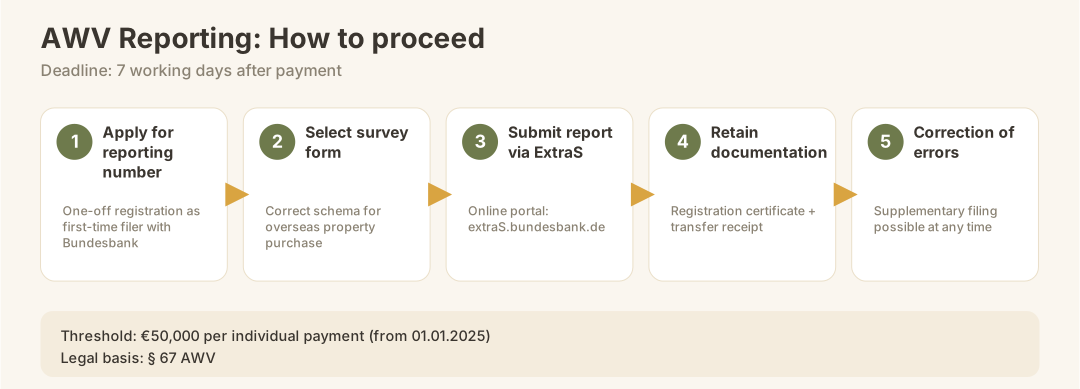
The report must be received by the Deutsche Bundesbank within 7 working days of the payment transaction . Submission is exclusively electronic.
Step by step: submitting an AWV report
- Apply for a reporting number (first-time reporters): Before submitting your first report, you will need a reporting number. You apply for this once with the Deutsche Bundesbank.
- Select the appropriate survey form: For payments related to the acquisition of property abroad, the correct survey form must be used. The Bundesbank provides selection lists on its portal.
- Submit the report via the ExtraS online portal: The Bundesbank's portal is called ExtraS (https://extraS.bundesbank.de). Log in there and submit your report.
- Retain supporting documents: The reporting documents must be retained for a specified period after submission (more on this below).
- Corrective report in the event of errors: If an incorrect or no report was submitted, a correction or subsequent report can and should be made — the Bundesbank explicitly provides for this option.
| Step | What to do |
|---|---|
| Once only (first-time reporters) | Apply for a reporting number with the Bundesbank |
| Within 7 working days of payment | Submit the report via the ExtraS portal |
| Permanent | Retain reporting documents |
| In the event of errors | Submit a corrected report |
Retention obligations: How long must you keep your documents?
The Bundesbank explicitly states in its FAQ on payment reports that reporting documents must be retained. The exact retention period can be found in the current Bundesbank FAQ (source below). In practice, it is advisable to retain all documents – transfer receipts, purchase contracts, notarial deeds – for at least as long as statutory tax retention periods apply.
Note: If you are subsequently unable to prove that a payment was correctly reported, you may in the worst case face a fine. It is therefore worth setting up your own 'property folder' system in which the reporting confirmation, transfer receipt and purchase contract are all filed together.
Staged property purchase: What applies when there are several instalment payments?
The process of purchasing a property in Spain typically follows three stages: reservation agreement, arras pre-contract, notarial deed. Each stage may trigger its own payment.
Since the threshold was raised to €50,000 (from 2025), the following applies: Each individual payment is assessed in isolation. Artificially splitting payments in order to remain below the threshold is not permitted and may be treated as an attempt to circumvent the rules.
Practical example: Purchase price €800,000.
| Payment | Amount | Reportable? |
|---|---|---|
| Reservation fee | 10.000 € | No |
| Arras (10% of the purchase price) | 80.000 € | Yes |
| Remaining purchase price (notary appointment) | 710.000 € | Yes |
In this example, two AWV reports must be submitted – each within 7 working days of the respective transfer.
The Spanish side: Reporting obligations in Spain
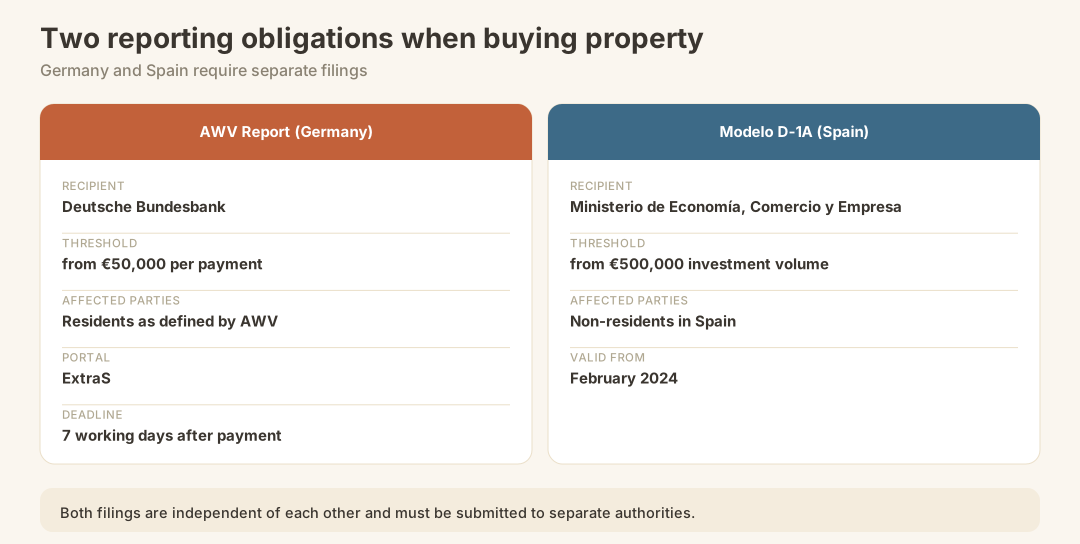
In addition to the German AWV reporting obligation, there are also Spanish reporting obligations that may apply when purchasing a property. These are entirely separate from the AWV and must be submitted to a different authority.
Spanish Modelo D-1A (foreign investments)
Spain requires non-residents investing in Spain to file a declaration with the Ministry of Economy, Trade and Enterprise in Madrid under certain circumstances. Retroactive to February 2024, this threshold was reduced from the previous 3 Mio. € to 500.000 € This means: any non-resident purchasing a Spanish property worth 500.000 € or more must submit the Modelo D-1A.
| Declaration | Recipient | Threshold (from Feb. 2024) | Who is affected? |
|---|---|---|---|
| Modelo D-1A | Ministerio de Economía, Comercio y Empresa | from 500.000 € investment volume | Non-residents in Spain |
| AWV declaration | Deutsche Bundesbank | from 50.000 € per payment | Residents as defined by the AWV |
Please note: Shareholder contributions and loans between non-residents or foreign companies and Spanish companies also count as declarable investments for the purposes of the Modelo D-1A.
Modelo 720: Foreign assets for Spanish residents
Anyone already resident in Spain (tax resident) is required, under the Modelo 720 to declare all assets held abroad that exceed the threshold of 50.000 € per category. For most Germans buying property on Mallorca without relocating there, the Modelo 720 is not relevant — however, for those who emigrate and become residents, it is. This also applies to German bank accounts, securities, and real estate in Germany.
Cash and non-standard payment methods: what applies?
Taking cash abroad or bringing it into Germany from abroad may also be subject to reporting requirements under certain circumstances. In the context of buying property in Spain, cash payment at the notary is now rarely used for practical and legal reasons — nevertheless, for the sake of completeness: the Bundesbank clarifies in its FAQ whether carrying cash is subject to AWV reporting obligations. If in doubt, check with your tax adviser or the Bundesbank before the notary appointment.
For transfers made via payment service providers (e.g. Wise, Revolut), the same rules apply as for conventional bank transfers: the AWV reporting threshold must be observed here too if you, as a domestic resident, are making a payment to a foreign party.
The most common reporting mistakes — and how to avoid them
In practice, experienced advisers encounter the same mistakes time and again:
- Failing to file because the purchase price was transferred in instalments — each individual payment exceeding 50.000 € is independently subject to reporting.
- Filed too late – the 7-working-day deadline begins on the day of payment, not on the date of the notary appointment.
- Incorrect registration number or incorrect reporting form – first-time reporters must apply for a registration number in advance.
- No retention of reporting documentation – proving that a report was properly filed after the fact is very difficult without supporting evidence.
- Confusing the AWV report with a tax obligation – the AWV report is not a tax return and does not give rise to any tax liability.
- Overlooking the Spanish reporting requirement (D-1A) – non-residents investing €500,000 or more in Spain must additionally notify the Spanish Ministry of Economy.
- Incorrectly reporting transfers between one's own accounts – straightforward transfers between one's own accounts held by the same domestic individual are generally not subject to reporting (seek clarification if in doubt).
What comes next? Further obligations surrounding the property purchase
The AWV report is one of several obligations that arise when purchasing property in Spain. Directly afterwards, or simultaneously, the following typically apply:
- NIE (Número de Identificación de Extranjero) – apply for one if you do not already have it; no notary appointment is possible without a NIE.
- Spanish property transfer tax (ITP) – payable at rates of currently 8% to 13% in the Balearic Islands, depending on the purchase price bracket (progressive scale).
- Land Registry entry (Registro de la Propiedad) – arrange this promptly.
- IBI (council tax/property tax) – factor in ongoing costs.
- Modelo D-1A – submit if the purchase price is €500,000 or more and you are a non-resident.
Anyone wishing to let the property after purchase should also familiarise themselves with the rental regulations on Mallorca at an early stage.
Find out more about the complete property purchase process and taxes & legal matters in our in-depth guides.
Checklist: AWV report when purchasing property in Spain
- Am I a resident in Germany for the purposes of the AWV? (Domicile in Germany?)
- Does a single payment to the Spanish seller / notary exceed €50,000?
- Registration number applied for with the Deutsche Bundesbank (first-time reporter)?
- Correct survey diagram selected?
- Report submitted via the ExtraS portal no later than 7 working days after payment?
- Reporting documentation (confirmation + transfer receipt) filed?
- Spanish Modelo D-1A checked: purchase price ≥ €500,000 and non-resident?
- Tax adviser / solicitor informed?
Conclusion: A brief report with a big impact
The AWV reporting obligation when purchasing property in Spain is not a bureaucratic hurdle but a statistical instrument — and thanks to the raising of the threshold to €50,000 since January 2025, it no longer applies to many smaller payments. Anyone buying a property on Mallorca will generally still need to file a report: the purchase price almost always exceeds this threshold, and the deadline of 7 working days after the transfer is tight. The good news is that the Bundesbank's online portal ExtraS can be completed in just a few minutes if you have the relevant data to hand. Also make sure you keep an eye on the Spanish parallel obligation (Modelo D-1A from €500,000 onwards) — this goes to a different authority in Madrid and has different deadlines. If in doubt, speak to your tax adviser or solicitor early on, before you make the first transfer.
Official sources
- Deutsche Bundesbank — FAQs on cross-border payment reports (AWV): https://www.bundesbank.de/resource/blob/611818/322dc306160147799d35615f61a029d3/472B63F073F071307366337C94F8C870/faqs-zur-awv-zahlungsmeldungen-data.pdf
- Deutsche Bundesbank — Online reporting portal ExtraS: https://extraS.bundesbank.de
- Foreign Trade and Payments Regulation (AWV), in particular § 67: https://www.gesetze-im-internet.de/awv_2013/
- Spanish Ministry of Economy — Foreign investments (Modelo D-1A): https://www.mineco.gob.es
- AEAT (Agencia Tributaria) — Modelo 720, assets held abroad: https://www.agenciatributaria.es