
Checking the Spanish Land Registry: Due Diligence Before Buying Property in Mallorca
Anyone wishing to buy a property on Mallorca needs more than enthusiasm for the sea view. Spanish law offers only limited options for withdrawal, reduction or damages after a purchase has been completed – which is why due diligence, above all checking the Registro de la Propiedad, must take place before signing an option contract or arras agreement. In this guide you will learn which registers you need, what a Nota Simple contains, how the land registry and the catastro are connected, which encumbrances and planning issues are particularly critical, and how to organise the entire verification process step by step – with specific authorities, documents and deadlines that apply in 2026.

Want to know whether a specific property on Mallorca is genuinely clean?
- 📩 Submit a personal enquiry — We will connect you with a locally registered abogado on Mallorca for the due diligence review
- Complete purchase process at a glance
Why due diligence on Mallorca is indispensable
On Mallorca and the other Balearic Islands, not all properties comply with every building regulation. Demolition orders and enforcement notices have been issued by the authorities in the past and have actually been carried out. Anyone who acquires a property without first carefully examining the legal situation risks buying exactly such an object.
Spanish civil law – governed in principle by Articles 1445 ff. of the Código Civil – offers the buyer only limited legal remedies after ownership has been transferred at the notary. Unlike in Germany, there is no far-reaching statutory right of withdrawal solely on grounds of fraudulent misrepresentation or hidden defects; the burden of proof lies with the buyer. Due diligence is therefore not a luxury for large investors, but an essential requirement for every property purchase on the island – whether holiday flat, townhouse or finca.
Please note: Even a signed arras pre-contract is legally binding. Due diligence must be completed before this step, or at the very least agreed contractually as a condition subsequent.
The Spanish land registry: Registro de la Propiedad
The central instrument of legal review is the Registro de la Propiedad – the Spanish land registry. It is organised under public law and divided regionally throughout Spain. For Mallorca there are several competent registros, determined by the location of the property.
What is recorded in the Registro
The register documents exclusively the legal status of properties. It contains:
- The current owner (Titular registral) and the nature of the transfer of ownership (purchase, inheritance, gift)
- Date and deed number of the most recent transfer of title
- Encumbrances of all kinds: mortgages (hipotecas), easements (servidumbres), rights of pre-emption, rights of use
- Description of the plot with area, location and, where applicable, any building standing on it
Important to understand: the Registro de la Propiedad and the Catastro (Catastro) are two entirely separate authorities with different databases. Discrepancies between the two are common in practice and may indicate unresolved building works, boundary disputes, or outdated area measurements.
The Nota Simple: Requesting a Land Registry Extract
The Nota Simple informativa is the straightforward, informal land registry extract. It is the most important document in the initial phase of due diligence.
What the Nota Simple Contains
| Section | Spanish Term | Content |
|---|---|---|
| Property Description | Descripción | Area, location, buildings, reference number |
| Owner(s) | Titulares Actuales | Name(s), type of acquisition, share |
| Type of Acquisition | Título de adquisición | e.g. compraventa (purchase), herencia (inheritance) |
| Registration Date | Fecha de inscripción | Date of most recent transfer |
| Encumbrances | Cargas | Mortgages, easements, rights of pre-emption, charges |
The Nota Simple is a non-binding information document — it does not carry public faith in the legal sense. For binding purposes (e.g. before a court or at notarial deed signing) the Certificación registral is required, a certified land registry extract with official authentication.
How to Request the Nota Simple
- Online via the portal of the Colegio de Registradores: www.registradores.org – application via "Nota Simple Online"
- In person at the relevant Registro de la Propiedad – you will need either the Datos registrales (register number, folio, volume) or alternatively the address and/or the name of the registered owner
- Through a solicitor or notary – recommended, as a legal mandate is recognised as a legitimate interest and processing times are often shorter
Note: The easiest way to identify the property is with the Datos registrales. If you only have the address, the search can be more involved. The seller's full name is also very helpful.
Land Registry and Catastro: A comparison of the two registers
| Criterion | Registro de la Propiedad | Catastro |
|---|---|---|
| Authority | Ministry of Justice (private registrars) | Ministry of Finance (Hacienda) |
| Purpose | Legal ownership | Fiscal recording, rateable value |
| Contents | Owner, encumbrances, mortgages | Floor area, buildings, type of use, Valor catastral |
| Binding effect | Public faith (fe pública registral) | No binding effect under private law |
| Online access | registradores.org | sede.catastro.gob.es |
| Reference number | Register number (Tomo/Folio/Finca) | Referencia catastral (20 digits) |
Identifying and understanding discrepancies
In practice, the Land Registry and Catastro frequently differ – in terms of floor area, buildings, or boundary lines. Possible causes:
- Extensions or conversions that were never formally applied for or registered
- Boundary shifts arising from informal agreements
- Outdated measurements in the land registry, more recent cadastral data or vice versa
- Divisions and mergers that were only carried out in one of the two registers
Such discrepancies are not automatically a deal-breaker – but they must be resolved before purchase, as they can cause problems later when applying for planning permission, transferring ownership or securing a mortgage.
Identifying encumbrances: what the Cargas section contains
The most important part of the Nota Simple for the buyer is the summary of encumbrances. The following types of charge regularly appear in Mallorca:
| Type of encumbrance | Spanish term | Relevance for the buyer |
|---|---|---|
| Mortgage | Hipoteca | Must be discharged before or upon transfer of ownership |
| Easement | Servidumbre | Remains in place upon change of ownership; examine the terms carefully |
| Right of pre-emption | Derecho de tanteo/retracto | A third party may purchase on the same terms in preference to you |
| Seizure / Embargo | Embargo | Precautionary measure in enforcement proceedings |
| Right of use | Usufructo | Use by a third party, often for life |
| Right of habitation | Derecho de habitación | Restricted right of use by a third party |
| Right of reversion | Condición resolutoria | Ownership reverts if the purchase price is not paid |
Please note: A registered mortgage does not automatically lapse upon sale. The notary must ensure that it is either discharged before the deed is signed, or that the outstanding amount is paid directly to the lending bank from the purchase price. Insist on a written carta de pago (discharge receipt) from the bank before the keys are handed over.
Planning law review: development, permits and protected areas
Checking the register alone is not sufficient. In Mallorca, public planning and building law plays a decisive role – particularly when it comes to fincas, plots of land and older buildings.
Documents you will need
- Planning permission (Licencia de obras) – enquire at the responsible municipal planning office (Departamento de Urbanismo)
- Habitation certificate (Cédula de habitabilidad / Licencia de primera ocupación) – confirms that the building has been approved for residential use
- Extract from the urban development plan (Plan General de Ordenación Urbana, PGOU) – shows the designation (residential zone, commercial zone, protected area) and building rights
- Certificado de fin de obra – sign-off by the architect upon completion
- Land Registry entry for the building (Declaración de obra nueva) – proof that the new build has been formally registered
Particularities in Mallorca
- Large parts of the island fall within protected zones (suelo rústico protegido, ANEI, ARIP, APT). In these areas, new builds and extensions are severely restricted or prohibited.
- Buildings in rural areas (suelo rústico) are subject to particularly strict usage regulations under Balearic spatial planning law.
- Existing unauthorised extensions can, in the worst case, result in a compulsory demolition order from the authorities – even after purchase.
Please note: When purchasing historic properties (town palaces, Possessions), additional listed-building requirements apply. Read more in the guide on historic properties in Mallorca.
Communal ownership: checks when buying flats and apartment complexes
When purchasing a flat or apartment within a Comunidad de Propietarios (owners' community), further documents must be reviewed:
| Document | Purpose | Where to obtain it |
|---|---|---|
| Declaration of division (Escritura de división horizontal) | Description of the unit, share of co-ownership | Registro de la Propiedad |
| Community regulations (Estatutos) | Rules governing use, letting, and alterations | Management / Register |
| Minutes of the most recent owners' meetings | Outstanding resolutions, planned special levies | Property manager |
| Certificate of no outstanding debts | No outstanding service charge arrears on the part of the seller | Property manager |
| Current balance of the community account | Reserve fund status, current liabilities | Property manager |
Note: In Spain, outstanding service charge payments can pass to the property as a charge in rem. The new owner is liable for arrears from the current and the preceding year.
Check for historic tax liabilities and ongoing taxes
In addition to private-law encumbrances, tax arrears may also attach to the property.
IBI – Property Tax
The Impuesto sobre Bienes Inmuebles (IBI) is levied annually by the local authority. At the notary, the seller must present the current IBI assessment notice and demonstrate that no arrears exist. Unpaid IBI may be registered as a charge on the property and pass to the buyer.
Plusvalía Municipal
The Plusvalía Municipal (tax on the increase in land value) is in principle payable by the seller. However, the obligation may be contractually transferred to the buyer in the purchase agreement — check the contract wording carefully.
Holiday Rental Licence (ETV)
If you are planning to let the property as holiday accommodation, the question of the Estancia Turística en Vivienda (ETV) is central. The Balearic Islands currently have a licensing freeze — new ETV licences for residential properties are no longer being issued. You must verify whether an existing licence is in place and transferable before considering the purchase as an investment property. Further background can be found in the guide on buying holiday properties in Mallorca.
Step by step: an overview of the due diligence process
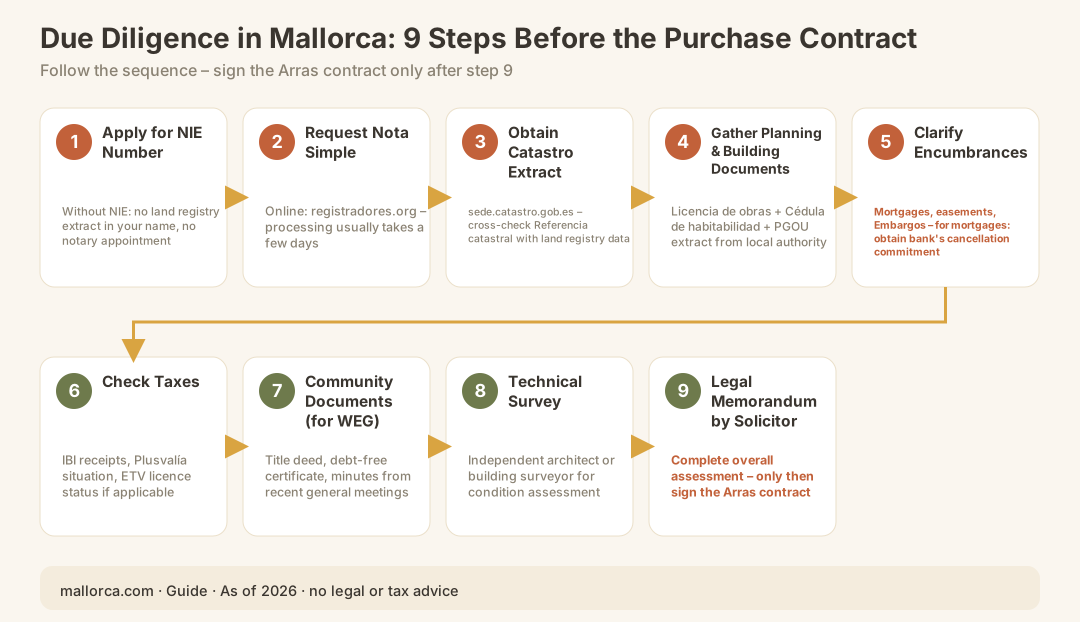
- Apply for your NIE number — without a Spanish foreigner identification number (Número de Identificación de Extranjero) you can neither request Land Registry extracts in your own name nor have a purchase contract notarised
- Request a Nota Simple — online via registradores.org or through a lawyer; processing time is generally a few days
- Obtain a cadastral extract – via sede.catastro.gob.es; Referencia catastral cross-reference with Land Registry data
- Gather planning and building documents – building permit, Cédula de habitabilidad, request the local development plan from the town hall
- Clarify encumbrances – check mortgages, easements and embargos; if a mortgage exists, obtain a written cancellation commitment from the bank
- Check taxes – IBI receipts, Plusvalía situation, and where applicable the ETV licence status
- For flats: community documents – title deed of division, certificate of no outstanding community debts, meeting minutes
- Technical inspection – independent architect or building surveyor for a condition report
- Overall assessment by a solicitor – final legal memorandum before signing the Arras contract
Most common mistakes when checking the Land Registry in Spain
Mistake 1: Relying solely on the estate agent's information Estate agents typically represent the seller's interests. An independent review by your own solicitor is indispensable.
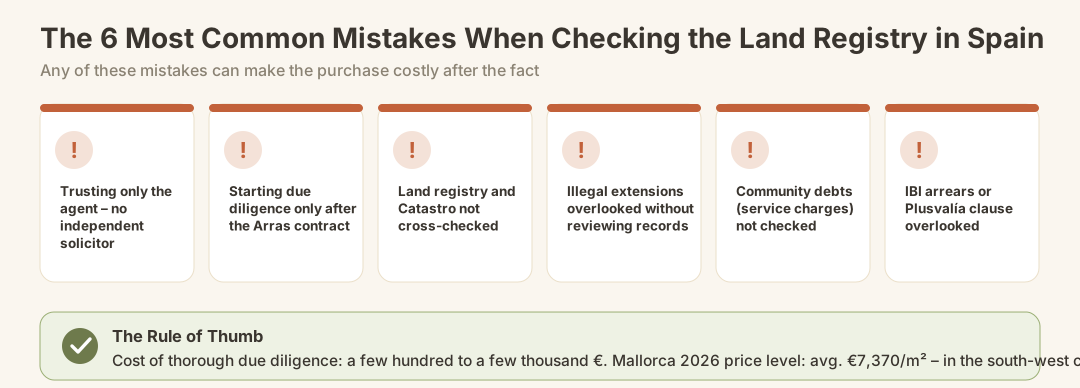
Mistake 2: Due diligence only after the Arras contract The Contrato de Arras (preliminary contract with deposit) is legally binding. If it is signed without a due-diligence reservation clause and defects come to light afterwards, withdrawing from the deal is costly.
Mistake 3: Not cross-referencing the Land Registry and the Catastro Discrepancies between the two registers go unnoticed and can later cause serious problems with planning permissions or mortgage lending.
Mistake 4: Ignoring unauthorised extensions An extension built without a permit is often not registered in the Land Registry. Without inspection of the files at the town hall, the risk remains invisible.
Mistake 5: Not checking community debts Outstanding service charges from the current and previous year pass to the new owner – this can quickly amount to thousands of euros.
Mistake 6: Overlooking tax liabilities Unpaid annual IBI amounts or a poorly structured Plusvalía agreement can significantly increase the additional costs. You can find an overview of all additional costs in the guide to purchase costs on Mallorca.
Checklist: documents for due diligence on Mallorca
| Document | Required / Recommended | Source |
|---|---|---|
| Nota Simple informativa | Required | registradores.org / solicitor |
| Land registry extract (Certificado catastral) | Mandatory | sede.catastro.gob.es |
| Planning permission (Licencia de obras) | Mandatory | Local council office (Ayuntamiento) |
| Habitation certificate (Cédula) | Mandatory | Local council / Consell |
| Urban planning extract (PGOU) | Mandatory | Local council office |
| Certificado de fin de obra | Recommended | Architect's archive / council |
| IBI notice (last year, paid) | Mandatory | Seller / council |
| Plusvalía clarification | Mandatory | Purchase contract review |
| Community debt-free certificate | Mandatory for WEG | Property management company |
| Owners' meeting minutes | Recommended for WEG | Property management company |
| ETV licence (if letting is intended) | Recommended | Consell de Mallorca |
| Technical survey | Recommended | Independent architect |
What comes next? From the land registry to the notary appointment
Once the due diligence is complete and all questions have been resolved, the next steps in the purchase process follow:
- Reservation agreement or Arras contract – typically with a deposit; the consequences of withdrawal are governed by the contract
- Price negotiation based on the results of the due diligence – any identified defects or outstanding issues can be used to negotiate a reduction in the purchase price
- Notary appointment (Escritura pública) – the public notarisation of the purchase contract; ownership does not transfer until this point
- Registration in the Registro de la Propiedad – only registration secures ownership against third parties; it is carried out after the notary appointment by the notary or solicitor
- Tax payment – for resale properties, Impuesto sobre Transmisiones Patrimoniales (ITP) applies; for new builds purchased from a developer, IVA plus AJD is due
You can find the complete step-by-step buying process in the guide to Property Purchase: Legal Process.
Conclusion
Checking the land registry in Spain is the single most important step in the entire buying process – and at the same time the one that is most frequently underestimated. The Nota Simple provides information on ownership and encumbrances within a matter of days. The Catastro supplies the tax-relevant area and land-use data. Only by cross-referencing both registers with the planning and building permit documentation held by the local authority does a complete picture emerge.
Anyone buying in Mallorca is buying in a high-price market – according to the Steinbeis Transfer Institut, the island-wide average in 2026 stood at around 7,370 Euro per square metre, with prices in the south-west approaching the 10,000 Euro mark. At these sums, the cost of thorough due diligence – a few hundred to a few thousand euros for a solicitor and surveyors – is unquestionably justified. The alternative is far more expensive.
Official Sources
- Colegio de Registradores de España (Nota Simple Online): https://www.registradores.org
- Sede Electrónica del Catastro: https://sede.catastro.gob.es
- Código Civil Español, Art. 1445 ff. (compraventa): https://www.boe.es/buscar/act.php?id=BOE-A-1889-4763
- Ley Hipotecaria (LH), Art. 221, 222 (land registry access): https://www.boe.es/buscar/act.php?id=BOE-A-1946-2453
- Agencia Tributaria Balear (ATIB) – ITP, IBI, Plusvalía: https://www.atib.es
- Consell de Mallorca, Departament de Territori – planning permissions, protected areas: https://www.conselldemallorca.cat
- Govern de les Illes Balears – spatial planning, ETV licences: https://www.caib.es