
Exit Tax Spain: What Germans Need to Know When Moving to Mallorca
For many people, the dream of living on Mallorca begins with a sobering question: what will leaving Germany actually cost me — in tax terms? The exit tax Spain is no myth; it is a very real concern for anyone holding a stake in a GmbH, a shareholding above the relevant threshold, or other hidden reserves in corporations. Germany treats relocation as a deemed disposal of those shares — even if you have not actually sold a thing. This guide explains who is affected by the rules under § 6 AStG, how the EU deferral rule works when moving to Spain, what the double taxation agreement (DTA) covers, which registration forms are required in Spain, and how the Beckham Law fits into the overall strategy. You will also learn the most common mistakes made by emigrants — and how to avoid them.

Are you planning a move to Mallorca and hold GmbH shares or significant capital assets?
- 📩 Submit a personal enquiry — we will connect you with experienced tax advisers who specialise in Spain
- Taxes & Legal Matters on Mallorca: an Overview
What is exit tax — and who does it actually affect?
Exit taxation under § 6 of the Foreign Tax Act (AStG) is one of the most frequently underestimated tax burdens when emigrating. The underlying principle: anyone who has built up hidden reserves in corporations whilst in Germany should not be able to take those reserves abroad tax-free.
The legislation treats departure as a deemed disposal of the shares at current market value — even if you sell nothing and receive no cash. The gain between the original acquisition cost and the market value at the time of departure is taxed at your personal income tax rate.
Who is specifically affected?
Three conditions must be met cumulatively:
| Criterion | Requirement |
|---|---|
| Shareholding percentage | At least 1 % in a corporation (GmbH, AG, UG, etc.) |
| Years of tax liability | In the preceding 12 years at least 7 years of unlimited income tax liability in Germany |
| Triggering event | Giving up German residence / habitual abode |
Please note: ETFs, retail funds, and widely held shares are generally not affected — the personal shareholding percentage there is typically well below the 1% threshold.
Beyond the classic case of emigration, the tax charge can also be triggered if you transfer your shares by way of gift, or if the management of a company is relocated abroad. Exit taxation can even arise on death, significantly increasing the overall tax burden for heirs — an aspect that is frequently overlooked in succession planning.
How is the tax amount calculated?
Germany treats departure as a deemed disposal of shares at fair market value. Tax is charged on the difference between the market value at the time of departure and the original acquisition cost.
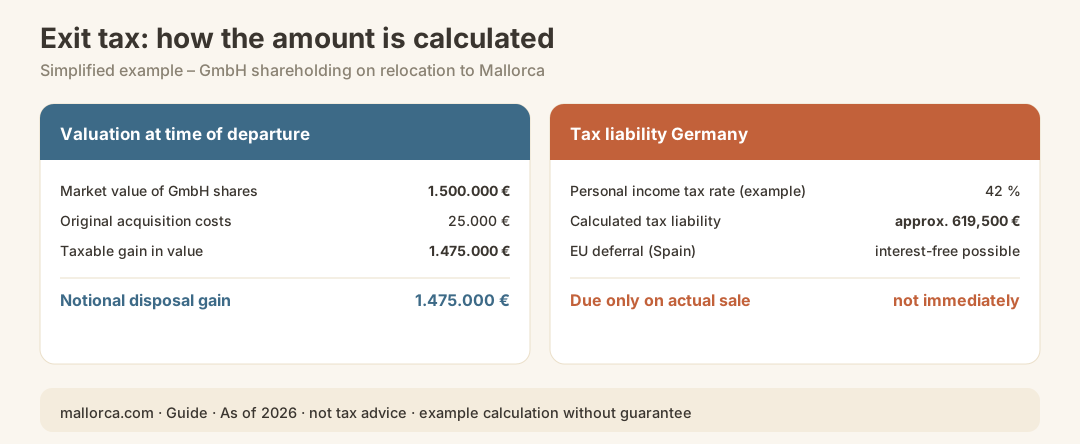
Simplified calculation outline
| Item | Amount (example) |
|---|---|
| Market value of GmbH shares at the time of departure | 1.500.000 € |
| Original acquisition cost | 25.000 € |
| Taxable gain | 1.475.000 € |
| Personal income tax rate (assumed) | 42 % |
| Estimated tax liability | ca. 619.500 € |
Please note: In practice, a business valuation report is required for the assessment of GmbH shares. Depending on complexity, the costs for this typically run into several thousand euros. The tax authorities do not accept every simplified approach — the methodology should be agreed in advance with a tax adviser.
The EU deferral rule: why Spain is an advantage
This is where the crucial difference compared with relocating to a third country such as Switzerland or Dubai comes into play: because Spain is an EU member state, the interest-free deferral rule applies.
The legal basis at European level is the EU Anti-Tax Avoidance Directive (ATAD, Directive 2016/1164/EU), which obliges member states to allow instalment payments over at least five years in the case of intra-EU relocations, so as not to curtail freedom of establishment.
Deferral vs. immediate payment — a comparison
| Destination country | Immediate payment | Deferral possible |
|---|---|---|
| Switzerland (third country) | Yes, due immediately | No |
| USA (third country) | Yes, due immediately | No |
| Spain (EU) | No | Yes, interest-free |
| Austria (EU/EEA) | No | Yes, interest-free |
| Norway (EEA) | No | Yes, interest-free |
When moving to Mallorca, you can therefore leave the deferred tax on the shelf for the time being — payment only falls due when you actually sell the shares. This protects against the liquidity problem that would arise without deferral: a substantial tax liability on a gain you have not yet realised.
Important: Deferral is not automatic — it must be applied for with the competent German tax office applied for. If you miss the application deadline, the tax becomes due immediately.
Returning to Germany: The Seven-Year Rule
Anyone considering returning to Germany after a few years should be aware of this rule: if you return within seven years of leaving, the exit tax is retrospectively cancelled – provided the shares have not yet been sold.
This opens up a planning tool known in professional circles as "trial emigration" : you temporarily leave Germany – for example for a multi-year stay on Mallorca – and return before the seven-year period expires; the deferred exit tax then lapses entirely.
Note: This model is legally permissible, but strict requirements apply regarding the genuine relocation of your centre of life. A nominal residence will not be recognised under tax law – the tax authorities scrutinise this very carefully (see: the "Boris Becker trap"). Your centre of life, social ties, days of physical presence, and economic activities must credibly substantiate the move.
The DBA Germany–Spain: What It Covers
The double taxation agreement between Germany and Spain (in force since 2012, BGBl. 2012 II / BOE-A-2012-10212) determines which country has the right to tax each type of income. It prevents you from being fully taxed on the same income in both countries.
Selected Provisions of the DBA Germany–Spain
| Type of income | Taxing right |
|---|---|
| Employment income (employees) | Generally the state where the work is performed |
| German state pensions | Germany retains the taxing right |
| Dividends | Source state, with credit in the state of residence |
| Real-estate income | State of location (where the property is situated) |
| Business profits | State of residence (provided there is no permanent establishment) |
| Capital gains from the sale of shares | Generally the state of residence |
The DBA does, however, have a particular feature with regard to exit taxation under § 6 AStG: exit taxation is linked to the point of departure – that is, a point in time at which Germany is still the state of residence. For this reason, the DBA can generally not fully block the exit tax itself. The deferral provision is therefore the more important instrument.
Reporting Obligations in Spain: Modelo 720 and More
Anyone who moves to Spain and becomes a tax resident enters a new reporting-obligations system. The most important forms for individuals with assets held abroad:
| Form | Content | Deadline 2026 |
|---|---|---|
| Modelo 720 | Declaration of assets held abroad (accounts, securities, property > 50,000 €) | 31 March 2026 |
| Modelo 100 (IRPF) | Spanish income tax return | 30 June 2026 |
| Modelo 714 | Wealth tax (from approx. 700,000 € net assets) | 30 June 2026 |
| Modelo 210 | Non-resident income tax (prior to residency) | Various deadlines |
Please note: The Modelo 720 had its penalty structure significantly amended following a 2022 ECJ ruling. However, a reporting obligation still exists. Anyone holding foreign bank accounts, securities portfolios or property with a total value exceeding 50,000 € must declare these. Late submission can result in substantial penalties.
The Beckham Law: special taxation for newcomers
The so-called Beckham Law (governed by Art. 93 of the Spanish Income Tax Act LIRPF) allows qualifying newcomers to be taxed as quasi non-residents – at a flat rate of 24 % on Spanish employment income up to 600,000 € (47 % above that threshold).
For emigrants with GmbH shareholdings, the Beckham Law can be attractive because under the special regime many foreign assets are less exposed to taxation in Spain than under the standard resident regime.
The Beckham Law at a glance
| Feature | Rule |
|---|---|
| Tax rate on Spanish employment income | 24 % up to 600,000 €, 47 % above that |
| Duration of the regime | Year of arrival + 5 subsequent years |
| Application deadline | Modelo 149 within 6 months of starting social security contributions |
| Requirement | Not tax-resident in Spain for at least 5 years prior |
| Family members can be included | Possible under certain conditions since the Start-up Act (December 2022) |
| Wealth tax | Only on Spanish assets (not worldwide) |
Critical deadline: The application via Modelo 149 must be submitted within six months of the relevant start date (usually the date on which social security liability commences). Anyone who misses this deadline loses their entitlement irrevocably and falls under the regular progressive Spanish tax regime.
The Beckham Law and the German exit tax under § 6 AStG interact with one another: deferral of the German exit tax remains possible even if you opt for the Beckham regime in Spain, since you are formally resident for tax purposes in an EU member state. The precise interaction should, however, be examined on a case-by-case basis.
Property and exit tax: an important distinction
Here is a distinction that is frequently confused: the German exit tax under § 6 AStG applies exclusively to shareholdings in corporations – not to property. Anyone who owns a flat or house in Germany and relocates to Mallorca does not thereby trigger an exit tax liability.
Different rules apply to property on departure:
- Rental income from German property remains taxable in Germany (limited tax liability under § 49 EStG).
- For a tax-free sale of property after departure, the German speculation periods continue to apply (as a rule, a 10-year holding period for let properties).
If you are planning to purchase a property on Mallorca after your move, it is worth taking a closer look at the ancillary purchase costs and legal procedures:
→ Ancillary purchase costs on Mallorca in detail → The legal process when buying property in Spain
The most common mistakes when relocating to Mallorca
Advisory practice repeatedly reveals the same mistakes:
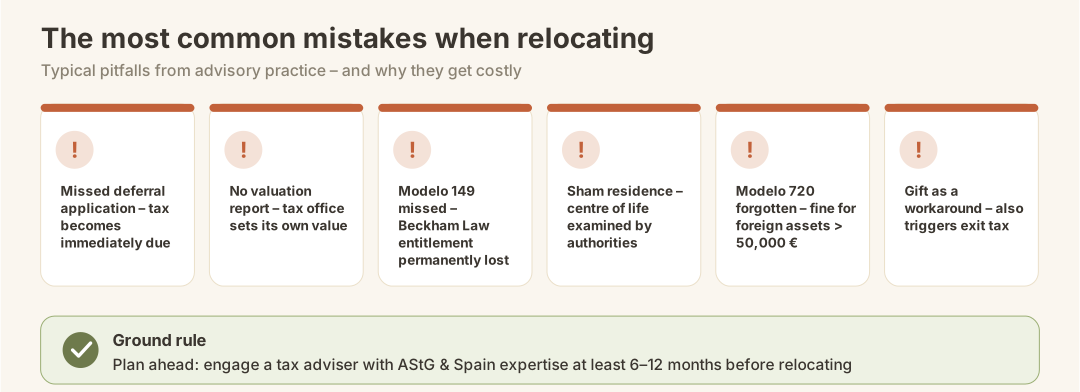
Forgetting to apply for deferral: EU deferral is not automatic. Anyone who fails to submit the application to the German tax office in time will have to pay immediately – even without liquid funds from a sale.
Underestimating the valuation report: GmbH shares must be valued at market value. If a robust valuation report is lacking, the tax office will set the value itself – often to the taxpayer's disadvantage.
Missing the Modelo 149 deadline: The window for the Beckham Law is six months from the relevant start date. Many new arrivals only learn about it after the deadline has passed.
Fictitious residence: Anyone who only formally relocates to Mallorca while retaining their actual centre of life in Germany risks the German tax authorities refusing to recognise the abandonment of residence. Days spent in each country, tenancy agreements, deregistrations and social ties will all be scrutinised.
Forgetting the Modelo 720: Anyone who, as a new Spanish resident, holds foreign assets in excess of €50,000 and fails to declare them by 31 March risks fines.
Gifting as a way out: Transferring GmbH shares by way of gift prior to departure can also trigger exit taxation – in addition to gift tax. This attempt to "plan backwards" frequently backfires.
Failing to plan for inheritance: The exit tax can lead to a significant increase in the overall tax burden in the event of death if the heirs are based abroad. Early succession planning is essential.
→ Inheritance and gifts in the Balearic Islands
What comes next? Tax life as a resident on Mallorca
After the move, a new tax chapter begins as a Spanish resident. The most important ongoing tax obligations at a glance:
| Tax | Trigger | Note |
|---|---|---|
| IRPF (income tax) | Worldwide income as a resident | Progressive rates; Beckham exemption possible |
| Wealth tax (Modelo 714) | Net assets exceeding approx. 700.000 € | Allowance for primary residence: 300.000 € |
| IBI (property tax) | Property owners | Municipal tax, annual |
| Plusvalía Municipal | On sale of property | Increase in land value |
| Corporate tax Spain | Spanish limited company (SL) | Standard rate 25 % |
→ IBI tax in Spain explained → Wealth tax in Spain → Taxes on property sales in Spain
Checklist: relocating to Mallorca with company shareholdings
6–12 months before the move
- Engage a tax adviser with expertise in Spain and knowledge of German AStG legislation
- Review shareholding percentages in all capital companies (≥ 1 %?)
- Commission a company valuation report
- Prepare a deferral application (for EU relocations: apply for interest-free deferral)
- Review the DBA Deutschland-Spanien: which types of income are taxable where?
- Assess eligibility for the Beckham Law (not resident in Spain for at least 5 years?)
- Review succession and inheritance planning
At the time of the move
- Actually and demonstrably give up your German residence (registrations/deregistrations, termination of contracts)
- Apply for a Spanish NIE/TIE and complete the empadronamiento (registration of residence)
- Submit a deferral application to the German tax authority
During the first months in Spain
- Modelo 149 to be submitted within 6 months of starting social security contributions (Beckham Law)
- Modelo 720 by 31 March for foreign assets > 50.000 €
- Register your Spanish tax number (NIF) with the tax office
- Engage a local IRPF adviser for your first tax return
Conclusion
Exit taxation in Spain is not an insurmountable problem for most emigrants – but it is a complex one. Anyone who holds a stake of at least 1 % in a GmbH and has been subject to unlimited tax liability in Germany for at least seven of the last twelve years will trigger taxation of hidden reserves upon leaving. The decisive advantage of relocating to Mallorca is that Spain is an EU member state, an application for deferral is possible, and the tax only becomes due upon an actual sale.
Added to this are the Beckham Law with its flat rate of 24 % and the DBA Deutschland-Spanien, which prevents double taxation. Anyone who plans ahead – ideally twelve months before the intended move – with a specialist tax adviser can set the course so that relocating to the island becomes neither a tax nightmare nor a costly package of surprises.
Official Sources
- § 6 Außensteuergesetz (AStG) – Exit taxation: https://www.gesetze-im-internet.de/astg/__6.html
- EU Anti-Tax Avoidance Directive (ATAD), Directive 2016/1164/EU: https://eur-lex.europa.eu/legal-content/DE/TXT/?uri=CELEX%3A32016L1164
- DBA Deutschland-Spanien (BGBl. 2012 II, BOE-A-2012-10212): https://www.boe.es/diario_boe/txt.php?id=BOE-A-2012-10212
- Agencia Tributaria (AEAT) – Modelo 720, Modelo 149, Modelo 100: https://www.agenciatributaria.es
- Art. 93 LIRPF – Beckham Law (Spanish Income Tax Act): https://www.boe.es/buscar/act.php?id=BOE-A-2006-20764
- Federal Ministry of Finance – Guidance Note on Exit Taxation: https://www.bundesfinanzministerium.de