
Balearic Inheritance Tax for Siblings: What Group III Really Pays
Anyone who bequeaths a property on Mallorca, Ibiza or Menorca to siblings, nieces or nephews will often face an unpleasant surprise: the generous tax exemption that German media report on so extensively applies exclusively to children, parents and spouses — that is, Groups I and II. For all other close relatives falling under Group III, the Balearic Islands apply their own rates, significantly higher taxes and limited allowances. Since the reform of July 2025, however, the situation has improved noticeably. This guide explains exactly how heavily Balearic inheritance tax affects siblings and other Group III heirs, which reductions now apply, how the deadlines work and what planning options are available — with real figures rather than generalities.

Do you belong to Group III, or are you inheriting a Mallorca property following the death of a sibling?
- 📩 Submit a personal enquiry — tax experts and solicitors with Balearic experience will respond directly
- An overview of all inheritance and gift tax topics
Family groups in the Balearic Islands: who belongs where?
Balearic inheritance tax law divides heirs into four groups. The classification determines the allowance, tax rate and available reductions — and it is non-negotiable.
| Group | Who is included |
|---|---|
| I | Descendants under 21 years of age (children, grandchildren …) |
| II | Descendants aged 21 and over, grandchildren, parents, grandparents, spouses, registered civil partners |
| III A | Blood relatives in the collateral line of the 2nd/3rd degree: siblings, aunts/uncles, nieces/nephews + relatives by marriage in the ascending/descending line (e.g. stepchildren, parents-in-law) |
| III B | Relatives by marriage in the collateral line of the 2nd/3rd degree (e.g. stepnephew, sister-in-law) |
| IV | Relatives of the 4th degree or persons with no family relationship (cousins, friends, unmarried partners) |
Siblings therefore fall into Group III A, as do nieces and nephews. Anyone who inherits from a brother or sister is also classified in this group — with all the associated tax consequences.
Please note: An unmarried partner without a registered civil partnership faces an even heavier burden: they fall into Group IV, with an allowance of just 1.000 Euro.
The allowances: what remains tax-free
Allowances in Spain are known as reducciones – they reduce the taxable base before the rate is applied.
| Group | Personal allowance (Balearic Islands) |
|---|---|
| I | 25.000 – 50.000 € (depending on age) |
| II | 25.000 € |
| III | 8.000 € |
| IV | 1.000 € |
Group III therefore has an allowance of 8.000 Euro. This means: if you inherit a Mallorca property worth 600.000 Euro as a sibling, the taxable base amounts to 592.000 Euro – and it is on this figure that the national tax tables with Balearic modifications are applied.
Please note: Unlike Groups I and II, Group III has no special additional allowances for disability, primary residence, or other personal circumstances that would significantly reduce the amount.
Tax rates for Group III: the national table applies
Whilst the Balearic Islands have introduced a de facto 100 per cent exemption for Groups I and II (provided the property value remains within certain valuation thresholds), Groups III and IV are subject to almost the full national tax table – with progressive rates that are considerably higher.
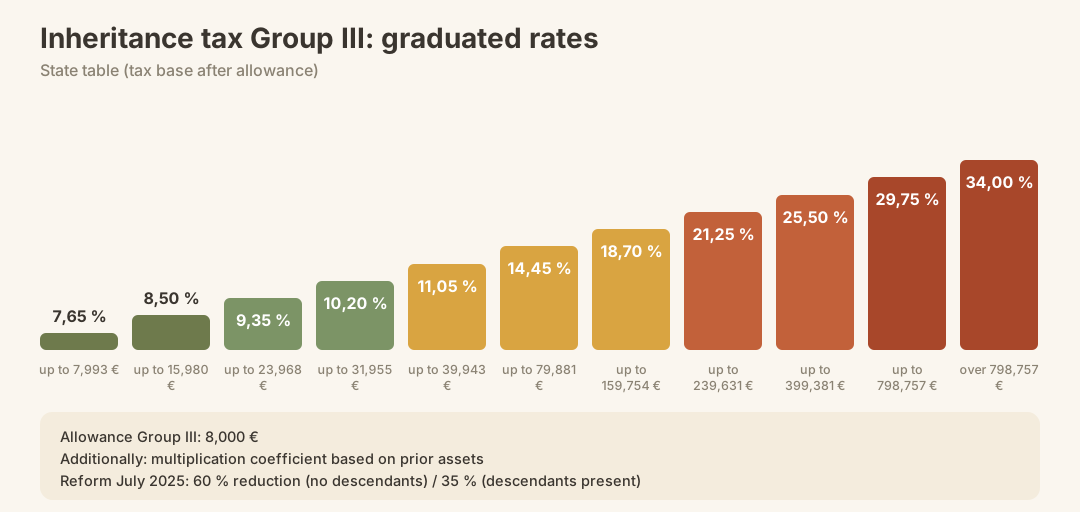
National tax table (taxable base after allowance)
| Taxable base up to … | Fixed tax amount | Marginal tax rate on remainder |
|---|---|---|
| 7.993 € | 0 € | 7,65 % |
| 15.980 € | 612 € | 8,50 % |
| 23.968 € | 1.290 € | 9,35 % |
| 31.955 € | 2.037 € | 10,20 % |
| 39.943 € | 2.851 € | 11,05 % |
| 79.881 € | 7.270 € | 14,45 % |
| 159.754 € | 18.765 € | 18,70 % |
| 239.631 € | 33.698 € | 21,25 % |
| 399.381 € | 67.584 € | 25,50 % |
| 798.757 € | 169.557 € | 29,75 % |
| above 798.757 € | – | 34,00 % |
In addition, multiplication coefficients apply, which are determined by the heir's pre-existing wealth. The more assets an heir already holds, the higher the coefficient – which can increase the effective tax liability still further.
Please note: For Groups I and II, the Balearic Government has introduced more favourable rates that are significantly lower than the national table for comparable amounts. These more favourable rates do not apply to Group III not.
The July 2025 Reform: Tangible Relief for Group III
Here lies the real news that many of those affected are not yet aware of: in July 2025, the Balearic Islands passed a further tax reform that, for the first time, provides meaningful relief for Group III as well.
| Constellation | Reduction before July 2025 | Reduction from July 2025 |
|---|---|---|
| Group III, no direct descendants of the deceased present | 50 % | 60 % |
| Group III, direct descendants of the deceased present | 25 % | 35 % |
What does this mean in practice?
- If your brother dies without children and you inherit his Mallorca flat worth €400,000, the taxable base after the allowance is approximately €392,000. The resulting tax calculated from the national rate table is then reduced by 60 per cent.
- If, on the other hand, your brother has children (direct descendants) who also inherit, the reduction is only 35 per cent.
Please note: The reduction applies to the calculated tax, not to the taxable base. The calculation is multi-stage: taxable base → tax table → multiplication coefficient → reduction.
Calculation example: sibling inherits a Mallorca Finca (€600,000)
Scenario: Brother (heir, Group III A) inherits a Finca on Mallorca following the death of his unmarried sister. Tax value: €600,000. The deceased has no children.
| Calculation step | Amount |
|---|---|
| Tax value of the property | 600.000 € |
| Deduction of Group III allowance | – 8.000 € |
| Taxable base | 592.000 € |
| Tax per national rate table (approx.) | approx. €170,000 |
| Multiplication coefficient (simplified, standard case) | × 1.5882 |
| Tax before reduction (approx.) | approx. €270,000 |
| Reduction 60% (no direct descendants, from July 2025) | – 60 % |
| Remaining tax liability (approx.) | approx. €108,000 |
Please note: This is a simplified calculation example for guidance purposes. The actual coefficient depends on the heir's pre-existing assets; the ATIB (Agència Tributària de les Illes Balears) calculates the final amount on the basis of the tax return. Be sure to seek professional advice for your specific situation.
The figure makes it clear: even after the reform, the tax burden for Group III remains considerable – significantly higher than the effectively zero amount paid by children and spouses. Nevertheless, the 60% reduction represents genuine progress.
Deadlines and procedures: what you need to do and when
The procedure is strictly regulated in Spain. The deadlines apply regardless of whether you live in Germany or on Mallorca.
- Date of death → Start of all deadlines
- Within 5 months: Submit an application for an extension of the deadline (possible if the 6-month deadline cannot be met)
- Within 6 months of the date of death: Submit the inheritance tax return and pay the tax – the obligation to file a return must be fulfilled even where a tax exemption applies
- Responsible authority: ATIB (Agència Tributària de les Illes Balears)
- Submitting the return: As a rule, this is done through a tax adviser or lawyer admitted in Spain, using the heir's Spanish NIE number
Please note: The 6-month deadline also applies to heirs who are resident in Germany and have no residence in the Balearic Islands. Missing the deadline will result in surcharges and interest.
Required documents (selection):
- Death certificate (apostilled, with a certified translation if required)
- Will or probate document (European Certificate of Succession or Spanish will)
- Heir's NIE number
- Cadastral extract and current land registry extract for the property
- Proof of the family relationship
Who pays the tax? Residents and non-residents
A common misconception: many Germans believe that the Balearic tax advantages apply only to Mallorca residents. This is only partially true.
What matters is where the assets are located and where the heir is ordinarily resident:
- If the deceased was ordinarily resident in the Balearic Islands, their worldwide assets are subject to Balearic inheritance tax (the heir's unlimited tax liability).
- If the deceased was resident in Germany but owned a property on Mallorca, that property is also subject to Balearic inheritance tax – the heirs can generally apply the more favourable Balearic rules.
- Non-residents from the EU have also been able, since 2015, to opt for the regional tax law of the Balearic Islands under certain conditions.
Please note: There is no double taxation agreement between Germany and Spain for inheritance and gift tax. This means that a Mallorca property inherited in Spain may be subject to inheritance tax in both Spain and Germany, provided the deceased was not exclusively tax-resident in Spain. Mutual offsetting is possible, but both returns must be filed.
Group III vs Group IV: why the difference is enormous
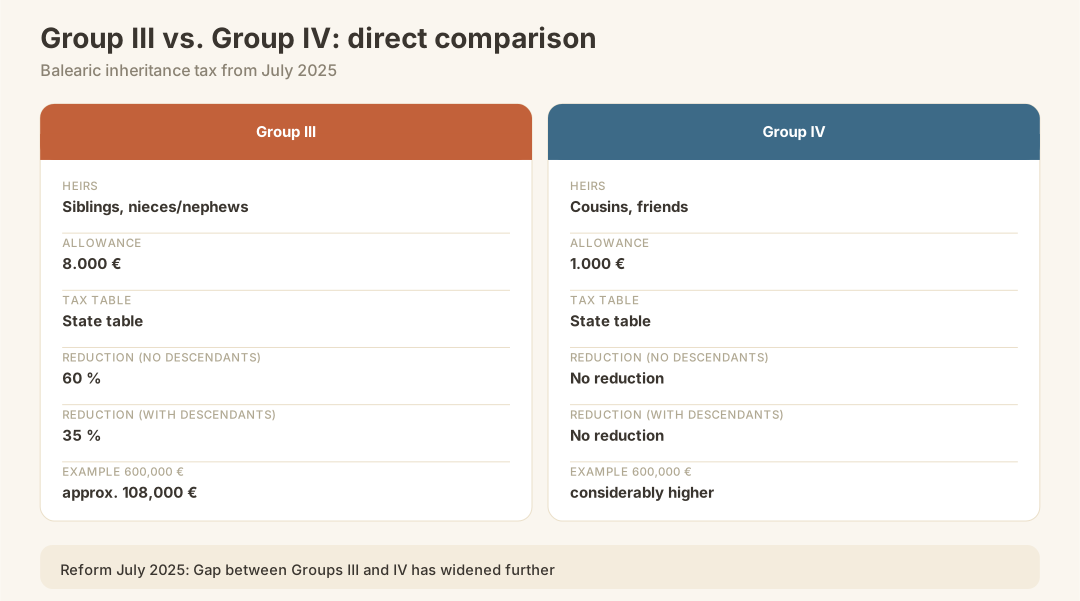
Many people ask why cousins or unmarried partners are even worse off. A direct comparison:
| Feature | Group III (siblings, nieces/nephews) | Group IV (cousins, friends) |
|---|---|---|
| Personal allowance | 8.000 € | 1.000 € |
| Tax table | National table | National table |
| Reduction (no descendants) | 60 % (from July 2025) | No reduction |
| Reduction (with descendants) | 35 % (from July 2025) | No reduction |
| Effective burden at €600,000 (estimate) | approx. €108,000 | considerably higher |
The gap between Group III and IV has widened further as a result of the 2025 reform.
Most common mistakes with an inheritance in Group III
1. Missing the deadline The 6-month period runs from the date of death – not from the date you become aware of the inheritance or from the completion of proceedings in Germany. Late submission automatically incurs surcharges.
2. Not engaging a Spanish tax adviser The calculation involving the multiplication coefficient, personal allowance, reduction, and valuation rules is complex. Anyone who does their own calculations risks errors that the ATIB will correct retrospectively – often not in your favour.
3. Using a German certificate of inheritance without an apostille A document issued by a German probate court must be apostilled and, where necessary, translated into Spanish by a sworn translator before it will be accepted by the ATIB or a Spanish notary.
4. Overvaluation of the property For Group I and II, the taxable value must not exceed 120 per cent of the reference value (valor de referencia), otherwise the tax exemption is forfeited. For Group III this specific mechanism is structured differently, but a correct property valuation is equally decisive for the amount of tax payable.
5. Ignoring double taxation Anyone who, as a German taxpayer, inherits a property from Spain must also file an inheritance tax return in Germany. The tax paid in Spain can be credited – but only if the transaction is correctly documented.
6. Overlooking the Pacto Sucesorio as an option This succession agreement under Balearic law is available exclusively between direct descendants (parents and children). It is not available as an instrument for siblings – anyone who wishes to make provision for their siblings as a testator must pursue other means.
What comes after inheritance tax?
Inheritance tax is not the only tax that arises when inheriting a property on Mallorca.
Plusvalía Municipal (municipal capital gains tax) This municipal tax captures the increase in the value of the land during the period the deceased held it. It is levied by the relevant municipality and is payable by the heir. The amount varies depending on the municipality, the land value, and the length of ownership.
Subsequent sale of the inherited property Anyone who sells the property after the inheritance pays income tax in Spain on the capital gain (the difference between the inheritance value and the sale price). Important: the market value established for inheritance tax purposes is treated as the acquisition cost for any subsequent sale – which can be advantageous from a tax perspective. For more detail, see the guide on taxes on property sales in Spain.
Ongoing taxes as the new owner As the owner of a property on Mallorca, you will be liable each year for the IBI (property tax) as well as, where applicable, the wealth tax.
Checklist: Inheritance as a Group III heir in the Balearic Islands
- Date of death noted and 6-month deadline entered in the calendar
- NIE number of the heir available (apply immediately if not yet obtained)
- Spanish-registered Abogado / Gestor engaged
- Will or European Certificate of Succession obtained and apostilled
- Land registry extract for the Mallorca property requested
- Property valuation (reference value) checked
- Proof of family relationship certified with Spanish translation
- Application for extension of deadline submitted (if 6 months are not sufficient)
- German inheritance tax return prepared in parallel (check for double taxation)
- Plusvalía Municipal registered with the local authority
Conclusion: Group III pays – but considerably less in 2025
The inheritance tax Balearic Islands siblings remains a serious financial consideration. Anyone inheriting a Mallorca property worth several hundred thousand euros as a brother, sister, niece or nephew will still face a substantial tax liability even after the reform of July 2025 – unlike children or spouses, who effectively pay nothing. Nevertheless, the reduction of up to 60 per cent (where the deceased had no descendants) represents a genuine step forward compared with the previous rules.
The key points at a glance:
- Personal allowance Group III: 8.000 Euro
- Tax table: essentially the national progressive table
- Reduction from July 2025: 60 % (no descendants) or 35 % (descendants present)
- Filing deadline: 6 months from the date of death, extendable up to month 5 upon application
- No double taxation agreement between Germany and Spain: both countries may levy tax
The earlier you address the situation – ideally before the inheritance event occurs – the more room there is for planning. Anyone who, as a testator, wishes to provide for siblings or nieces/nephews should work with a specialist to examine whether alternative transfer routes (lifetime gifts, will drafting, structured transfer) can reduce the tax burden in advance. You can find more on general tax matters in the Taxes & Legal Overview and on the Pacto Sucesorio – even though the latter cannot be used by siblings themselves, it is highly relevant for testators with children.
Official Sources
- ATIB – Agència Tributària de les Illes Balears (the authority responsible for inheritance tax in the Balearic Islands): https://www.atib.es
- Ley 29/1987, de 18 de diciembre, del Impuesto sobre Sucesiones y Donaciones (national framework legislation): https://www.boe.es/buscar/act.php?id=BOE-A-1987-28141
- Decreto Legislativo 1/2014, de 6 de junio, por el que se aprueba el Texto Refundido de las disposiciones legales de la Comunitat Autónoma de les Illes Balears en materia de tributs cedidos por el Estado (Balearic tax law, amended inter alia by Law 11/2023 and Legislative Decree 4/2023): https://www.caib.es
- AEAT – Agencia Estatal de Administración Tributaria (general tax information for Spain): https://www.aeat.es
- BOE – Boletín Oficial del Estado (official legislation gazette of Spain): https://www.boe.es