Pacto Sucesorio Balear: passing property to children while alive
Responsible for this content: Frank Menze
If you own a property in Mallorca and want to pass it on to your children one day, inheritance or a gift may be the first options that come to mind. But you may be overlooking the most effective tool under Balearic law: the Pacto Sucesorio Balear. This succession agreement allows you to transfer assets to the next generation during your lifetime in a binding arrangement that is generally tax-free, without incurring the tax disadvantages of an ordinary gift. Its legal basis is Ley 8/2022 of 11 November 2022, which came into force on 17 January 2023 and substantially modernised Balearic succession agreement law. This guide explains how the Pacto Sucesorio works, the two main forms available in Mallorca, who can use it — including non-residents and foreign nationals — which taxes apply and where the most common pitfalls lie.
What is the Pacto Sucesorio Balear — and why is it not an ordinary gift?
A Pacto Sucesorio is an agreement through which a person makes binding arrangements for their succession during their lifetime. They designate one or more beneficiaries — as heirs or as recipients of specific assets — and the beneficiaries expressly accept the arrangement. Crucially, the agreement cannot be revoked or amended unilaterally by a later will. It can be changed only if both parties agree.
The tax treatment is the key advantage. Under Spanish law, an ordinary gift (donación) is subject to gift tax as a separate tax liability and may also trigger income tax for the donor on any gain in value. A Pacto Sucesorio, by contrast, is treated as an inheritance on death — it is subject to inheritance tax (ISD), not gift tax, and the increase in the property's value is not treated as a realised gain.
Note: The main difference from an ordinary gift is that, with a Pacto Sucesorio, the person transferring the property pays no income tax on its increase in value. With an ordinary gift, the gain since purchase may be taxable. This advantage comes with a condition: if the beneficiary sells the property within five years of the Pacto (or before the transferor's death, if that occurs earlier), they must use the transferor's original purchase price and purchase date when calculating their income tax (Art. 36 Ley 35/2006, IRPF).
The arrangement is not new, but it was substantially modernised by Ley 8/2022. Before this reform, a Pacto Sucesorio was tied to so-called vecindad civil mallorquina — meaning that only people with this legal status could use Balearic civil law. This requirement was removed on 17 January 2023.
The two main forms in Mallorca and Menorca
Ley 8/2022 sets out different rules for each island. For Mallorca and Menorca, two forms are particularly relevant:
Form
What it involves
Effect
Typical use
Definición (Definición o renuncia)
A child waives future inheritance rights in return for a settlement – usually a specific property or sum of money
The settlement is transferred immediately; the child loses their entitlement to a compulsory share
Settling matters between siblings during the parent's lifetime
Donación Universal
The person making the transfer gives all their current assets to another person (e.g. a child)
A complete transfer of assets can take effect on signing
Passing the entire family estate to the next generation
Note: For Ibiza and Formentera, separate rules apply – the equivalent arrangement there is the so-called Finiquito de legítima. This guide focuses on Mallorca and Menorca.
Both forms are valid only if executed before a notary (Escritura Pública). Ley 8/2022 also requires the date and time of signing to be recorded in the notarial deed. The signing is also reported to the Registro General de Actos de Última Voluntad (Central Register of Wills).
Who can use the Pacto Sucesorio?
Before 2023, its use was limited to people with vecindad civil balear restricted. Ley 8/2022 has significantly expanded the group of people eligible. The key factor today is the EU Succession Regulation No. 650/2012: Under this regulation, the applicable inheritance law is determined by the deceased’s habitual residence at the time of death – or by the law of their nationality, if they chose it.
Group of people
Requirement
Is a Pacto Sucesorio possible?
Spanish nationals resident in the Balearic Islands
Vecindad civil balear
Yes, without difficulty
EU nationals (e.g. Germans) resident in Mallorca
Habitual residence in the Balearic Islands → Balearic law applies
Yes
EU nationals resident in Germany with property in Mallorca
German law governs the succession; Balearic inheritance law cannot be chosen
Generally not directly possible – advice required
Non-EU nationals resident in Mallorca
Assessment under the EU Succession Regulation and, where applicable, national law
Possible in individual cases – a notary must assess the case
Note: Determining the applicable inheritance law is complex. The EU Succession Regulation allows people to expressly choose the law of their nationality – which, in some cases, may allow or prevent the use of a Balearic Pacto Sucesorio. Before entering into one, be sure to consult a lawyer specialising in international inheritance law.
Under Balearic law, a Pacto Sucesorio can generally benefit direct descendants – in other words, it can be used for transfers from parents to children. Spouses, grandchildren and other relatives cannot directly benefit under this specific arrangement; inheritance or a gift is more suitable for these groups.
Tax treatment: What is payable, and when?
Gift tax Mallorca
Explanation
What is given decides which law applies and what the deduction depends on. For a property it is always the law of the region where it lies — even when donor and recipient both live abroad.
Explanation
For a property, the value declared, at least the Valor de referencia — the official reference value of the land registry office, below which no gift may be taxed. For money, the amount given.
Explanation
The group decides the multiplier and the deduction. For gifts the law treats groups I and II alike; within group III it separates blood relatives from relatives by marriage.
Explanation
For the deduction, the Escritura pública — the notarial deed — must state a value for a property that exceeds the reference value by no more than a fifth. Where there is no reference value, the market value applies. Miss the condition and groups I and II are left with the fallback formula, everyone else with nothing.
To pay (Cuota a ingresar)
€0.00
Value of the gift
€350,000.00
Kinship group
Group I/II — child, grandchild, spouse, parent
Where the recipient lives: On the Balearics
Legal status: 25 July 2025
This calculation is provided for guidance only and is not a substitute for tax or legal advice in specific cases.
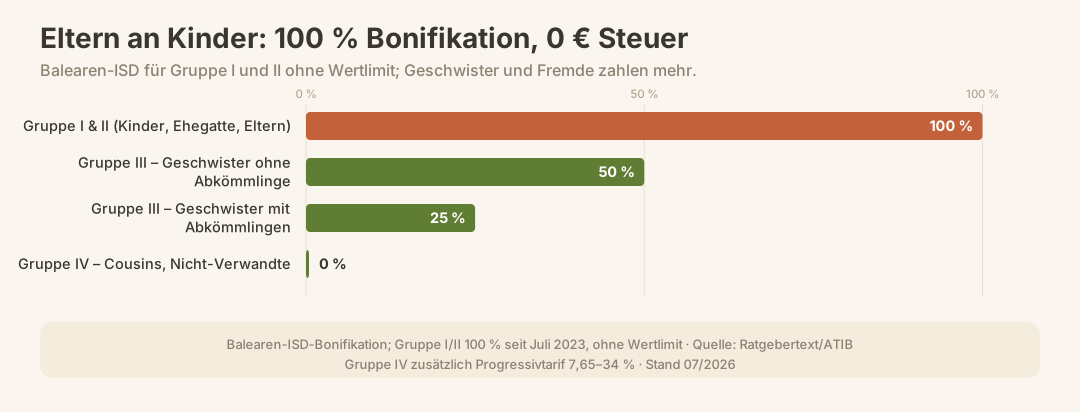
Since 18 July 2023, a 100% tax relief of inheritance tax for Groups I and II – with no value limit. This tax relief was confirmed in subsequent years and remains unchanged in 2026.
Group
Beneficiaries
Tax relief in 2026
Tax on a property valued at 800,000 €
Group I
Children and adopted children under 21
100 %
0 €
Group II
Children over 21, spouses, parents, adoptive parents
100 %
0 €
Group III – special case
Siblings where the deceased has no descendants with a competing claim
60 % (since 25.07.2025)
approx. 8,000–12,000 € (estimate)
Group III – standard case
Other Group III beneficiaries
35 % (since 25.07.2025)
approx. 17,000–21,000 € (estimate)
Group IV
Cousins, non-relatives
0 % tax relief
Progressive tax rates of 7.65–34 %
The Pacto Sucesorio is treated as an inheritance for tax purposes, so it benefits from the same tax relief. This means that transfers between parents and children generally incur 0 € inheritance tax – regardless of the property’s value.
Note on the taxable value: The tax is calculated on the basis of the Valor de Referencia (cadastral reference value) or the actual market value, whichever is higher. You can check your property's current Valor de Referencia on the Catastro website.
No capital gains income tax for the transferor
A key advantage over a conventional gift: under a Pacto Sucesorio, the transferor does not have to pay income tax on the increase in value realised. With an ordinary gift, any increase in value since purchase is treated for tax purposes as a gain realised by the donor. Depending on how long the property has been held and how much its value has risen, this can result in substantial IRPF costs. If the beneficiary sells within five years of the Pacto (or before the transferor's earlier death), they must use the transferor's original purchase price and purchase date when calculating their own income tax (Art. 36 Ley 35/2006).
Municipal capital gains tax (IIVTNU)
The municipal tax on increases in land value (plusvalía municipal) may apply, depending on the municipality. Here too, the specific terms of the Pacto Sucesorio determine how it is treated for tax purposes. Get advice on the position in your municipality beforehand.
The German perspective: what happens in Germany?
Inheritance double tax
Explanation
Germany and Spain do not always place the same person in the same category. A stepchild counts as a child in Germany and as a relative by marriage in Spain — with a very different tax.
Explanation
The value of the finca or apartment, at least the cadastral reference value (valor de referencia) — the official floor below which Spain may not tax. Only this item counts as foreign assets for the German credit.
Total burden
€80,250.00
Remaining double burden
€0.00
Spain levies no tax on this share. There is nothing to credit, then — the burden arises in Germany alone.
Legal status: 25 July 2025
This calculation is provided for guidance only and is not a substitute for tax or legal advice in specific cases.
For German citizens resident in Germany who want to transfer a Mallorca property through a Pacto Sucesorio, there is an important point to bear in mind: Spain and Germany have no double taxation agreement covering inheritance and gift taxes.
In theory, this means tax could be due in both countries. In practice, however, there are two mitigating factors:
Tax credit: Tax paid in Spain can be credited against German inheritance tax. As the amount currently due in the Balearic Islands for Groups I and II is €0, there is generally nothing to credit for transfers from German parents to their children.
German tax-free allowances: In Germany, there is an inheritance and gift tax allowance that renews every 10 years of €400,000 per parent per child. If the value of the Mallorca property transferred by each parent is below this amount, no tax is due in Germany either.
Scenario
Property value
Share per parent
German allowance of €400,000
German tax
Both parents transfer jointly
€700,000
€350,000
Covered
€0
Both parents transfer jointly
€1,000,000
€500,000
€100,000 over the allowance
Taxable on the excess
One parent transfers alone
€350,000
€350,000
Covered
€0
Note: This overview is a guide, not legal advice. Whether and how the Pacto Sucesorio is classified in Germany as a gift or an inheritance depends on the details of the individual case. The tax residency of everyone involved must also be considered. Have a German-Spanish tax adviser review this.
Step by step: How a Pacto Sucesorio works
Preparation and advice: Tax and legal review by a lawyer and/or tax adviser specialising in Balearic inheritance law – particularly regarding the applicable inheritance law (relevant for non-residents).
Property valuation: Establish the current Valor de Referencia and, if necessary, obtain a market valuation as the basis for the tax calculation.
Drafting the Escritura: The notary prepares the draft agreement, including details of the parties, the property being transferred, the chosen option (Definición or Donación Universal) and when it takes effect.
Signing before a notary: Both parties (the transferor and the beneficiary) sign the agreement before a Spanish notary. The date and time are recorded.
Notification of the wills register: The notary automatically reports the agreement to the Registro General de Actos de Última Voluntad.
Land Registry registration: If the property is transferred immediately, the change of ownership is registered with the Registro de la Propiedad.
Tax return: File the ISD return within one month with the Balearic tax authority (ATIB) if the transfer takes immediate effect; if it takes effect only upon the transferor’s death, the normal inheritance tax deadlines apply (6 months, extendable on request).
Note: The one-month deadline for filing the tax return for Pactos that take immediate effect is a statutory deadline. Missing it will result in surcharges and interest.
Pacto Sucesorio vs. a conventional gift vs. a will: a comparison
Criterion
Pacto Sucesorio
Conventional gift
Will
Type of tax
ISD (inheritance tax)
ISD (gift tax)
ISD (inheritance tax)
Group I/II tax relief in the Balearic Islands
100% (€0)
100% deduction from the tax due (since 25.07.2025)
100% (€0)
IRPF on the transferor’s capital gain
No
Yes – the capital gain is treated as realised
Not applicable (the transferor is deceased)
Revocability
Generally irrevocable
Revocable at any time
Can be changed until death
When it takes effect
Immediately or on death
Immediately
Only on death
Notarisation required
Yes
For property: Yes
Yes
Available to foreign nationals
Subject to certain conditions (EU-ErbVO)
Yes
Yes
Entry in the wills register
Yes (mandatory)
No
Yes
Note: Since 25 July 2025, gifts to Groups I and II in the Balearic Islands have also been effectively tax-free thanks to a 100 % reduction in the tax payable (Ley 6/2025); previously, they were subject to a tax rate of 7 %. The main advantage of a Pacto Sucesorio over a gift nevertheless remains the absence of IRPF liability for the person transferring the assets – subject to the five-year condition for the beneficiary.
Irrevocability: What does it mean in practice?
Irrevocability is the other side of its tax advantages. Anyone who signs a Pacto Sucesorio generally makes a binding transfer of the assets concerned. For Mallorca property owners, this means:
No subsequent will can unilaterally override the Pacto Sucesorio.
Changes are only possible with the consent of both parties in a new escritura.
Disputes with other potential heirs (e.g. other children) are possible if the transaction is considered to infringe their forced-heirship rights.
In the case of a Donación Universal the transferor gives away all their current assets – something to consider carefully if they have ongoing liabilities or planned investments.
Irrevocability is not necessarily a disadvantage: many families value the certainty it provides and the clear arrangements that prevent disputes between siblings after the deceased’s death.
The most common mistakes with a Pacto Sucesorio
1. Assuming the wrong succession law applies
Anyone who lives in Germany and owns only a holiday property in Mallorca is generally not subject to Balearic succession law. Anyone who nevertheless enters into a Pacto Sucesorio risks it not being recognised in Germany or being treated differently for tax purposes.
2. Overlooking the IRPF implications
With a conventional gift, the donor may face substantial income tax on the gain realised. Treating a Pacto Sucesorio as an ordinary gift overlooks its main tax advantage.
3. Missing the tax return deadline
If the Pacto Sucesorio takes immediate effect, the deadline for filing the ISD return is one month. This deadline is often underestimated.
4. Failing to check the Valor de Referencia
The cadastral reference value forms the basis for the tax assessment. If the actual purchase price or market value is higher, the higher value applies. Checking with the Catastro early can help avoid surprises.
5. Failing to consider equal treatment of siblings
A Donación Universal to one child may affect the other children’s forced-heirship rights. Forward-looking family planning – potentially with separate Pactos for all the children – can prevent later disputes.
6. Confusing German and Spanish law
A Pacto Sucesorio is not a German inheritance agreement, even though it works in a similar way. Its legal effects, formal requirements and tax consequences must be assessed separately under Spanish and Balearic law.
Special considerations for non-residents
For Germans who are resident in the Balearic Islands (meaning they have their habitual residence there), a Pacto Sucesorio is generally available without difficulty and offers tax advantages.
For Germans with a home in Germany and a holiday property in Mallorca, the situation is more complex:
The applicable succession law depends on habitual residence – Germany in this case. Balearic succession law therefore does not automatically apply.
However, under the EU-ErbVO, there is the option to choose the to choose the law of their home country – in other words, German law. But that means losing access to the Balearic Pacto Sucesorio.
In certain circumstances – for example, if someone genuinely moves the centre of their life to the Balearic Islands – Balearic law may become applicable.
Please note: Following a ruling by the Court of Justice of the European Union, the treatment of non-residents for gift tax purposes in the Balearic Islands was adjusted for EU citizens. Nevertheless, German tax obligations remain unaffected, and without a double taxation agreement, both tax liabilities must be calculated separately.
Applicable succession law confirmed – does Balearic law apply to everyone involved?
Specialist lawyer (Balearic inheritance law) and tax adviser appointed
German-Spanish tax adviser consulted for cross-border cases, if necessary
Property’s Valor de Referencia checked with the Catastro
Option chosen: Definición or Donación Universal?
Effective date defined: immediately or upon death?
Notary appointment arranged (a Spanish notary is mandatory)
Both parties have valid NIE numbers
Tax return deadline (1 month if effective immediately) entered in the calendar
Transfer of title in the Land Registry arranged after the deed is signed
Change of IBI registration with the local council noted
Other children’s compulsory inheritance rights discussed with a lawyer
Conclusion
The Pacto Sucesorio Balear is one of the most attractive tools for estate planning in Spain – yet German property owners on Mallorca still make too little use of it. The combination of €0 inheritance tax for Groups I and II, no IRPF liability on the transferor’s capital gains (provided the beneficiary does not sell within five years), and the certainty of a binding agreement makes it the first choice for parents who want to pass their Mallorca property on to their children in an orderly way during their lifetime.
The crucial caveat: this arrangement only works smoothly if Balearic inheritance law actually applies – and that depends heavily on whether the transferor is habitually resident in the Balearic Islands. For holiday-home owners whose main home is in Germany, the position is more complex and requires a careful assessment of the individual circumstances under the EU Succession Regulation (EU-ErbVO).
Seek advice early – ideally before deciding between a gift, a will and a Pacto Sucesorio.
Assess Balearic tax relief and German tax liability separately
Balearic tax relief does not automatically mean that no tax is due in Germany. German tax liability may also arise when acquiring a property in Mallorca. In the case of a Pacto Sucesorio, whether Germany treats it as an inheritance or a gift depends on the specific terms of the agreement. This should be assessed for both countries before the agreement is notarised.
Note: This is not legal or tax advice.
This guide provides a general overview of the legal position and does not replace legal or tax advice on your individual circumstances. Laws and deadlines may change; the linked official sources are authoritative.
What is the Pacto Sucesorio Balear?
The Pacto Sucesorio is an inheritance agreement under Balearic law that allows assets, particularly property, to be transferred to beneficiaries during the owner's lifetime in a binding and irrevocable way. For tax purposes, it is treated as an inheritance, not a gift.
Who can enter into a Pacto Sucesorio?
That depends on which inheritance law applies to you. Under EU Succession Regulation No. 650/2012, this is determined by your habitual residence unless you have chosen the law of your nationality. Legal experts disagree on whether foreign nationals living in the Balearic Islands can enter into a Pacto Sucesorio under Balearic law. Before making any plans, check your individual circumstances with a notary or lawyer.
How much inheritance tax is payable under a Pacto Sucesorio?
For transfers between parents and children (Groups I and II), a 100% tax relief has applied in the Balearic Islands since July 2023. Inheritance tax is therefore 0 €, with no value limit. This rule remains unchanged in 2026.
What types are available in Mallorca?
Two forms are common in Mallorca and Menorca: the Definición (a child waives their inheritance rights in return for compensation) and the Donación Universal (the person making the transfer hands over all their assets). The Finiquito de legítima applies in Ibiza and Formentera.
Can a Pacto Sucesorio be changed later?
No. A Pacto Sucesorio is generally irrevocable and cannot be changed unilaterally through a later will. Any changes require the agreement of all parties to the contract in a new Escritura Pública.
Do Germans also have to pay tax in Germany?
As there is no double taxation agreement between Spain and Germany for inheritance and gift taxes, a tax liability may also arise in Germany. However, the German tax-free allowance of 400,000 € per parent per child may mean that no German tax is payable on properties valued below this threshold.
What is the deadline for filing the tax return?
For a Pacto Sucesorio that takes effect immediately, the deadline for filing the ISD tax return with ATIB is one month. If it takes effect only on death, the standard inheritance tax deadline is six months and can be extended on request.
Does the agreement have to be notarised?
Yes. Ley 8/2022 expressly states that Pactos Sucesorios are valid only if executed as an Escritura Pública. The agreement must also be reported to the Registro General de Actos de Última Voluntad.
We use cookies to provide you with the best possible experience on our website. Learn more in our Privacy Policy