
Home Inspection & Surveyors Mallorca: The Technical Survey Before You Buy
Anyone purchasing a property on Mallorca is making a decision that can quickly run into several hundred thousand euros — and this in a market where unauthorised constructions, missing planning permissions, and hidden structural defects are not the exception but a well-known reality. A professional property inspection by an independent surveyor on Mallorca is therefore not a luxury but the logical response to a genuine risk: authorities in the Balearen have already issued and enforced demolition and reinstatement orders for illegally constructed parts of buildings. The land registry extract alone will not protect you — it gives no indication of whether a property is fully compliant with the law or contains illegal elements. In this guide you will learn which checks are truly necessary before the notary appointment, how the various surveying services are structured, and which mistakes buyers most commonly make.
Would you like to have a specific property on Mallorca assessed technically and legally?
- 📩 Submit a personal enquiry — We will connect you with independent building surveyors on Mallorca
- Legal process for buying property on Mallorca — Every step from offer to notary
Why a technical inspection on Mallorca is indispensable
The Balearic property market has a distinctive characteristic that sets it fundamentally apart from German or Austrian markets: it is no secret that many properties — in particular fincas and older existing buildings in rural areas — do not comply with all planning regulations. Extensions, pool houses, outbuildings, or terraces have been built without permission over the course of decades. This presents no immediate problem until you, as the buyer, take on the responsibility.
The Spanish Civil Code governs the purchase in Artikeln 1445 ff. — after the notary appointment your options for withdrawal, price reduction, and damages are considerably restricted. A thorough technical and legal review before the notary appointment is therefore the only moment at which you truly hold all the cards.
Please note: Demolition and reinstatement orders for illegally constructed parts of buildings have already been issued by the authorities in the Balearen and have been actively enforced. So-called existing-use protection cannot be regarded as a free pass.
Furthermore, defects discovered after a purchase made without prior inspection frequently lead to costly remediation works that can quickly erode an apparently favourable purchase price. A professional inspection can therefore not only identify risks but also open up concrete room for negotiation on the purchase price.
The five areas of analysis in due diligence
A comprehensive pre-purchase review on Mallorca — known in professional parlance as Due Diligence — ideally covers five interrelated areas of analysis:
| Area | Content | Who carries out the check? |
|---|---|---|
| Financial Due Diligence | Property valuation, market price assessment, risk analysis | Valuer / Expert |
| Legal Due Diligence | Land registry data, tenancy agreements, third-party usage rights, insurance | Lawyer (Abogado) |
| Tax Due Diligence | Tax situation, risks in share deals or commercial transactions | Tax adviser / Gestor |
| Technical Due Diligence (TDD) | Technical condition, structural defects, maintenance requirements, location | Building surveyor |
| Environmental Due Diligence | Soil or building contamination, hazardous materials, environmental protection requirements | Specialist / Expert |
For private buyers of an existing property, the most relevant components in practice are the Technical Due Diligence and the Legal Due Diligence. For investments in commercial properties or hotels, all five areas come into play.
Tip: Gathering all the necessary information requires a great deal of expertise and takes place within a tightly defined timeframe. Begin your search for a surveyor as soon as you have identified a property you are interested in – ideally before you sign a reservation agreement or Arras contract.
What a building surveyor on Mallorca specifically examines
The Technical Due Diligence (TDD) is the core of every property inspection. An independent structural surveyor examines:
- Structural damage – cracks in the masonry, settlement, damp damage
- Construction defects – workmanship errors, inadequate waterproofing, condition of the roof
- Costly renovations – pipework, electrics, heating, air conditioning
- Legality of the built structure – Do the floor plan and registered areas match?
- Building sign-offs – Is a Licencia de primera ocupación (first occupation licence) in place?
- Location factors – Transport links, infrastructure, noise, flood zone
In addition to the physical inspection itself, the surveyor analyses documents:
| Document | Purpose |
|---|---|
| Floor plans & building specification | Comparison with the actual condition of the building |
| Cadastral extract (Catastro) | Area details, plot boundaries |
| Land Registry extract (Nota Simple) | Ownership, encumbrances, easements |
| Register of building charges | Restrictions on the plot |
| Planning permissions & approval history | Are all structural alterations legal? |
| Declaration of division (Escritura de división horizontal) | For flats: communal property |
| Minutes of the owners' association | Agreed special levies, reserves |
| Financial plans & maintenance reserves | Financial health of the building |
The Informe de Evaluación de Edificios (IEE) – the Spanish 'building MOT'
For older existing properties in Spain there is the Informe de Evaluación de Edificios (IEE), often referred to as the 'building MOT'. It is a mandatory document for buildings above a certain age and assesses:
- The general state of repair of the building
- Accessibility for people with limited mobility
- Energy efficiency
Please note: Actively ask the seller or estate agent whether a current IEE is available. The document is an important supplement to your own inspection – but it does not replace it, as it documents the condition from the owner's perspective, not that of an independent inspector.
Legal compliance check: why the land registry alone is not enough
This point surprises many buyers from Germany, Austria or Switzerland: the Spanish land registry (Registro de la Propiedad) confirms ownership and registered encumbrances – but not whether all parts of the property are legally compliant under planning law. Illegal extensions can be registered in the land registry without that establishing their legality.
For the legal compliance check you need access to:
- The cadastre (Catastro) – for floor area details and the registered development
- The local authority (Ajuntament) – for planning permissions and the Cédula de habitabilidad
- The Consell de Mallorca or the local municipal authority – for demolition or clearance orders
- The urban planning office – for local development plans (PGOU) and land-use classifications
Particularly with rural properties (suelo rústico), the legal situation is complex: what qualifies as existing protected status and what does not depends on the year of construction, limitation periods, and local planning law. In the Balearic Islands, special protective regulations apply here, which in cases of doubt can also permit retrospective demolition orders.
| At-risk property type | Typical issues |
|---|---|
| Finca suelo rústico | Illegally constructed outbuildings, missing permits for a pool or annexe |
| Older property in a village or town | Missing Licencia de primera ocupación, unauthorised conversion works |
| Residential complex / apartment building | Special levies within the owners' community, inadequate reserve funds |
| New build from a developer | Completion certificate (Certificado final de obra) and insurances to be checked |
Purchase advisory vs. valuation report vs. building survey: what do you need and when?
Building surveyors in Mallorca generally offer different service modules. These three are the most relevant for buyers:
| Service | Content | Typical timing |
|---|---|---|
| Purchase advisory / home inspection | Thorough joint walkthrough, also possible during a sales meeting with the estate agent; verbal and written assessment of defects | Before the reservation contract |
| Valuation report | Written assessment of the market value; valuation-based consideration of defects and structural damage | Before price negotiation |
| Building acceptance inspection | Inspection of a completed new build for completeness and freedom from defects prior to handover | When purchasing a new build after completion |
In addition, there are construction supervision inspections during ongoing renovations or new builds — important if you plan to carry out conversions or refurbishments after purchase.
Tip: The purchase advisory inspection is often the first and most important step — it can also take place jointly with the estate agent during the viewing appointment and provides you with immediately actionable information for the price negotiation.
Step by step: how a professional property inspection works
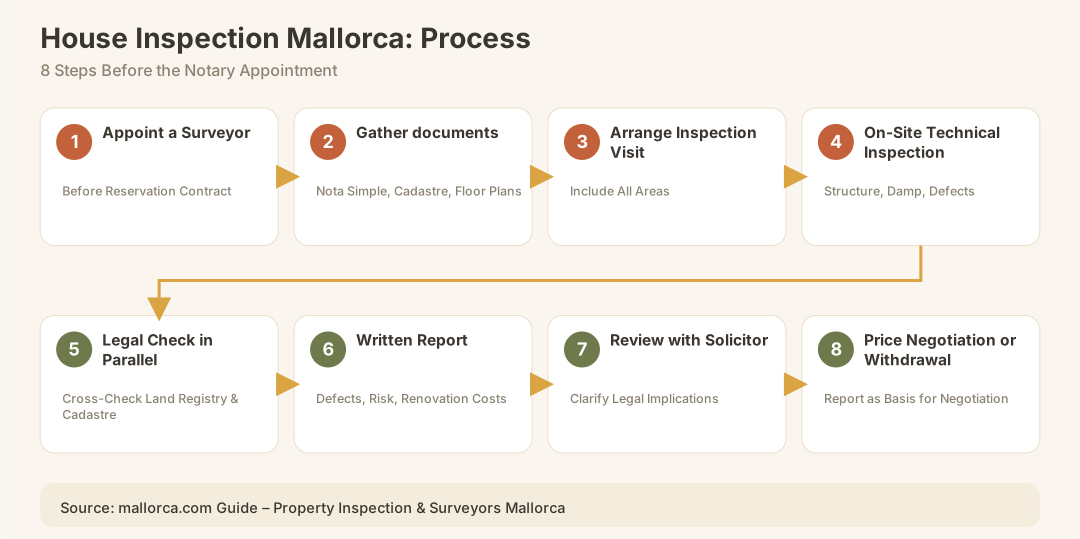
- Engage a surveyor — Before signing the reservation contract; ensure independence (no vested interest in the sale)
- Compile the documents – Nota Simple, cadastral extract, floor plans, existing planning permissions, energy certificate, IEE (if available)
- Arrange the inspection appointment — Ideally without time pressure; include all accessible areas, basement, roof, pool, and outbuildings
- On-site technical inspection — The surveyor checks the structure, damp, installations, and visible structural defects; photographic documentation
- Legality check in parallel — Comparison of the actual built structure with the land registry and cadastre; enquiries with the local authority
- Written report — Summary of defects, risk assessment, estimated renovation costs, recommendation on the purchase price
- Review with a solicitor — Legal implications of the findings; incorporation into the terms of the purchase contract or withdrawal clauses
- Price negotiation or withdrawal – report as the basis for renegotiation or for a justified withdrawal
What to look for when choosing a surveyor
Not everyone who calls themselves a 'surveyor Mallorca' brings the same level of qualification. Pay attention to the following points:
- Independence: The surveyor must have no financial interest in the sale going through – so they must not be tied to the estate agent
- Qualifications: Training as an expert in property valuation or as a building surveyor; recognised certifications (e.g. as aSachverständiger für die Bewertung von bebauten und unbebauten Grundstücken) are a reliable indicator of quality
- Local knowledge: Experience specifically on Mallorca is essential – Balearic building law, local construction materials and the typical defects found in older Mallorcan buildings are highly specific
- Language skills: Important for German-speaking buyers: report in German, communication with Spanish authorities in Spanish
- References: Demonstrable experience with both existing properties and new builds on the island
The most common mistakes when buying property without a surveyor
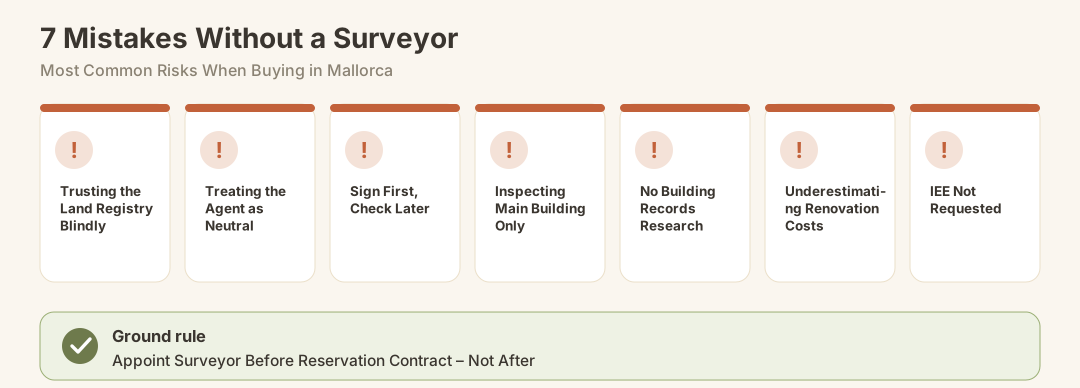
- Trusting the land registry blindly – The land registry extract confirms ownership, but not the legality of all parts of the building
- Treating the estate agent as a neutral party – Estate agents have an interest in the sale; their assessment is no substitute for an independent survey
- Signing quickly, then checking – Once the arras contract has been signed, you will generally forfeit your deposit if you withdraw
- Only inspecting the main building – The pool house, utility room, garage and annexe structures are frequently the problem areas
- No review of planning records at the local authority – Demolition orders are not entered in the land registry
- Underestimating renovation costs – On Mallorca, tradespeople and materials are more expensive than in many other parts of Europe; a surveyor can provide realistic cost estimates
- IEE not requested – For existing buildings above a certain age, the IEE is a mandatory document that provides valuable background information
Special considerations for fincas and properties in suelo rústico
Rural properties on Mallorca – fincas, country houses, estates in suelo rústico – have their own risk profile that goes beyond the technical inspection:
- Well permits: Self-supply of water is common on many fincas – but only legal with a valid concession
- Tramuntana protected area: Particularly strict building regulations apply to properties in the UNESCO World Heritage area Serra de Tramuntana
- Unauthorised structures: Outbuildings, stables or storage buildings were frequently erected without planning permission
- Area discrepancies: The floor area recorded in the land registry sometimes differs considerably from the actual (and approved) area
Tip: Read our guide on Finca Suelo Rústico auf Mallorca and on Schwarzbau legalisieren – both are common follow-up topics after a property inspection.
What comes next? Evaluating the report and next steps
The survey report is not a verdict – it is a tool. Depending on the findings, there are various scenarios:
| Finding | Recommended course of action |
|---|---|
| No significant defects, everything legally registered | Continue progressing the purchase, prepare notary appointment |
| Technical defects with a quantifiable remediation cost | Price negotiation based on the survey findings |
| Illegal structural elements with no prospect of legalisation | Withdrawal prior to signing the arras or price reduction + contractual safeguards |
| Serious structural damage | Reconsider the purchase; obtain a second survey if necessary |
| Demolition order issued by the authorities | In most cases: walk away |
You should absolutely discuss the survey report with your lawyer (Abogado), who can assess the legal consequences and — should you wish to proceed with the purchase regardless — have protective clauses written into the purchase contract.
If everything is in order, you can move on to the remaining steps of the buying process: arranging financing, preparing the money transfer, and coordinating the notary appointment.
- Property purchase: legal process in Mallorca
- Purchase ancillary costs in Mallorca
- Transferring money to Spain
- Planning permission in Mallorca
- Energy certificate in Spain
Checklist: documents for the property inspection
You should obtain or request the following documents from the seller before or at the viewing appointment:
- Nota Simple (current land registry extract)
- Cadastral extract (Ficha catastral)
- Floor plans and building description
- Site plan / cadastral map
- Building permit(s) and approval history
- Licencia de primera ocupación / Cédula de habitabilidad
- Certificado final de obra (for new builds)
- Energy certificate (Certificado de eficiencia energética)
- IEE (Informe de Evaluación de Edificios), if available
- Minutes of the most recent owners' community meetings (for flats)
- Budget plan and reserve fund balance of the owners' community
- Current IBI receipt (paid property tax)
- Evidence of water, electricity and sewage connections
- Any tenancy agreements or existing third-party usage rights
Conclusion: Check before the notary appointment – not regret it afterwards
A property inspection carried out by an independent surveyor is the most effective safeguard when buying real estate on Mallorca. The market is attractive, and so are many of the properties – but the risks posed by illegal constructions, missing permits and hidden defects are real and well documented. Authorities in the Balearic Islands have previously carried out demolition orders.
The cost of a professional inspection is generally modest in relation to the overall investment – and at best it can reduce your purchase price; at worst, it can prevent a costly mistake. Instruct the surveyor before the reservation contract, not after.
Official Sources
- Registro de la Propiedad (Land Registry): www.registradores.org
- Catastro (Cadastral Office): www.sedecatastro.gob.es
- Consell de Mallorca – Urbanisme: www.conselldemallorca.net
- Govern de les Illes Balears – Habitatge: www.caib.es
- Spanish Civil Code (Código Civil), Article 1445 et seq. – Law of Sale and Purchase: www.boe.es
- Agencia Tributaria de les Illes Balears (ATIB): www.atib.es