
Residential tenancy agreements in Mallorca: from advert to addendum
A residential tenancy agreement in Mallorca starts well before it is signed. The listing should make clear whether a house or flat is being offered as a permanent main residence or only for a temporary stay. That distinction determines which protections under Spain’s tenancy law, the Ley de Arrendamientos Urbanos (LAU), apply. Even if you are coming from abroad, you can rent a house in Mallorca; what matters is that the listing and agreement match how you will actually use the property. Here you’ll learn what a useful listing and a straightforward private tenancy agreement should include, how to document furniture and keys, and what to consider regarding the deposit and tenancy term. We’ll also cover questions that often arise later: How do you record a change to the service-charge arrangements? When is an addendum enough, and when should the remaining term of the agreement be reviewed?

Residential tenancy or seasonal let: clarify the purpose first
Under the LAU, a residential tenancy is intended to meet the tenant’s need for a permanent home. A seasonal let, by contrast, is for a temporary stay. The number of months stated in the agreement does not, on its own, determine which category applies; the actual purpose of the rental does.

| Question to ask | Permanent residential tenancy | Seasonal let |
|---|---|---|
| What is the property being rented for? | As a permanent home | For a temporary stay |
| What should the agreement state? | Use as a permanent home | The reason for the temporary stay |
| Is a short tenancy term enough to determine the category? | No | No |
Calling a document a ‘seasonal let’ does not, by itself, turn a permanent home into temporary accommodation. Conversely, if the stay genuinely is temporary, the reason should be stated in the agreement. You can read more in Temporary accommodation in Mallorca.
Note: An eleven-month agreement is not automatically a seasonal let. What matters is the purpose for which the property is actually rented.
Listing a house or flat for rent
If you’re letting a property, the listing should clearly describe what is being offered and how it is intended to be used as a home. This avoids viewings with people looking for a different type of tenancy. If you’re looking to rent, ask explicitly before agreeing whether the property is being let as a permanent main residence.
| Information in the listing | Why it helps before a viewing |
|---|---|
| House or flat and location | The property on offer can be identified |
| Long-term residential tenancy or temporary stay | Prospective tenants can check whether it matches their intended use |
| Monthly rent and specified additional costs | Ongoing costs can be compared |
| Furnished or unfurnished | What will be included at handover becomes clearer |
| Availability | The move-in date can be coordinated with the property's current use |
However, the wording of a listing does not replace the agreement. If the listing, verbal assurances and draft agreement do not match – for example, regarding furniture or additional costs – resolve the discrepancy before signing.
Draw up a simple tenancy agreement between private individuals
For a private residential tenancy agreement, you need clear terms above all. A simple document may be enough; what matters is that both parties agree on the property, its residential use and the payment obligations. You should therefore not adopt a PDF template without checking it, even if it was created on a computer.
- Name the parties: include the full names and addresses of the landlord and tenant.
- Identify the property: clearly describe the address and, where applicable, the flat, floor and any areas included in the tenancy.
- Record the residential use and start date: state that the property is for long-term residential use and give the tenancy start date.
- Set out the payments: list the monthly rent, due date, payment method, deposit and any additional costs the tenant will cover.
- Set out use and condition: check the furniture inventory, maintenance, subletting and arrangements for returning the property.
- Document the handover: keep the agreement and inventory together so it is clear later what was agreed and handed over.
A privately drafted agreement or free template does not override statutory rights under a long-term residential tenancy. A Spanish version may also be useful for later dealings with the authorities; for Registering your residence in Mallorca you should check the requirements of the relevant municipality.
Note: This is not legal or tax advice. An individual assessment is particularly advisable if the contract contains unusual clauses or there is a dispute over how the property is actually used.
Understanding the lease term, deposit and other security
The agreed lease term and the statutory right to extend it are not the same thing. Even if the contract initially specifies a shorter term, a tenant renting a property as their permanent home may be entitled to the extension provided by law.
| Residential tenancy issue | Guidance under the LAU |
|---|---|
| Extension where the landlord is a private individual | Up to a lease term of five years |
| Extension where the landlord is a legal entity | Up to a lease term of seven years |
| Statutory rental deposit | One month’s rent |
| Additional security | No more than two months’ rent |
| Early departure at the tenant’s initiative | After at least six months, with 30 days’ notice; any compensation agreed in the contract should be reviewed |
In the Balearic Islands, the rental deposit for contracts governed by the LAU must be lodged with IBAVI. Both parties should keep records of the payment and lodgement. The difference between a deposit and additional security is explained in the guide to Deposits for rented flats in Spain.
When arranging a long-term residential tenancy, the parties should also agree in advance who will pay any administrative costs and estate agent’s fees. Any service charges should be specified separately in the contract; a blanket clause is of little help here. See also the overview of service charges for a rented flat in Spain.
Document the furniture inventory and handover clearly
“Furnished” says little about which items must still be there when the property is returned. An inventory appendix should list the furniture and appliances provided individually and describe their condition at handover. Add any visible damage to the handover report and record which keys were handed over.
| Part of the documentation | Practical details to record |
|---|---|
| Furniture and appliances | Individual items rather than a blanket description |
| Condition | Visible wear or damage at handover |
| Keys | Which keys were handed over |
| Link to the contract | Clearly link the inventory and handover report to the tenancy |
When the property is returned, these documents can be compared with its condition at that point. That is more useful to both sides than trying to remember a viewing later.
Prepare the contract as a PDF or online?
Whether you write the text yourself, adapt a template or prepare a document digitally, check the content, not just the file format. A PDF is not a separate type of contract. It can bring together a straightforward private tenancy agreement and its appendices, provided the final version is clear to both sides.
Make sure, in particular, that different versions are not circulating. The inventory, service charge agreement and any later additions should be clearly identifiable as part of the agreed contract. An online form is only useful if you do not leave unsuitable standard clauses in place, especially those concerning the property’s use as a home.
Later changes: addendum, appendix or new contract?
If an agreement changes during the tenancy, record what applied before and what will apply from now on. A supplementary agreement is often called an anexo or an adenda is used. In it, identify the parties, the property concerned, the original contract and the specific clause being amended. Both sides should receive the same final version.
| Changes later on | What should be clarified in writing |
|---|---|
| Additional furniture is provided | Add the items and their condition to the inventory |
| Utility and other costs are allocated differently | Specify the costs affected and how they will now be allocated |
| A contract clause changes | Clearly distinguish the old wording from the new |
| Someone else is to become a party to the contract | Do not simply replace a name; check the legal position of everyone involved |
| The agreed term is nearing its end | First check statutory rights to continue the tenancy and the existing contract terms |
A “renewal agreement” is not required every time an agreed term ends: for residential tenancies, statutory rules on continuation may apply first. A subrogation, meaning another person stepping into a party’s position under the contract, is also more than a change of address or name. In such a case, clarify the legal basis before signing a template.
Plan notice and handover in good time
Tenants can end a residential tenancy after at least six months by giving 30 days’ notice. Whether compensation has been agreed for moving out early depends on the contract. The LAU sets different notice periods for landlords and tenants when the statutory continuation period ends, so check the current status of the tenancy before committing to an end date or planning a move.
For the handover, the inventory, recorded condition and keys all need to be accounted for. For a more detailed explanation, see Ending a tenancy agreement in Spain.
Most common mistakes
- Assuming a tenancy is seasonal solely because of its duration: The actual purpose of the tenancy remains decisive.
- Confusing a listing with the contract: Furniture, utility costs and the intended residential use should be clearly set out in the contract.
- Conflating the deposit with additional security: The two should be shown separately.
- Taking on a furnished property without an inventory: Otherwise, there is no shared point of reference when it is handed back.
- Assuming every extension requires a new contract: Check your statutory rights to continue the tenancy first.
- Discussing changes only verbally: A clearly linked addendum prevents conflicting versions.
What happens next?
After signing come the handover, payment of the agreed amounts and – for residential tenancy agreements under the LAU in the Balearic Islands – lodging the deposit with IBAVI. Anyone using the property as their permanent home should then check the local council’s requirements for registering as a resident.
Keep the contract, inventory, handover documents and any later addenda together. If the use of the property changes, additional people are to move in or one party leaves, read the existing agreement first and establish the legal implications of the change rather than simply overwriting an old PDF file.
Checklist before signing
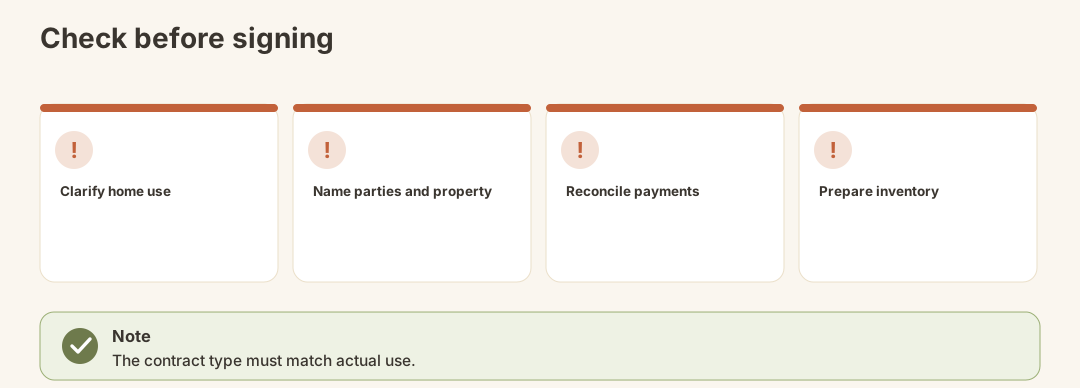
- Does the type of contract match the actual use of the property as a permanent home or for a temporary stay?
- Are the parties and the property clearly identified?
- Do the rent, payment date, additional charges and security arrangements match what was agreed?
- Is an inventory ready if the property is furnished?
- Are the tenancy start date and the rules for handing back the property clear?
- Do both sides have the same final version of the contract and its accompanying annexes?
Conclusion
A good residential tenancy agreement in Mallorca does not need to sound complicated. Above all, it must reflect the actual residential use of the property and make the specific terms verifiable. Establish what use is being offered as early as the listing stage. Record payments, the inventory and the handover clearly in the contract – and document later changes in an addendum clearly linked to it, rather than relying on memory or a template that has been quietly edited.
Official sources
- Boletín Oficial del Estado (BOE) – Ley de Arrendamientos Urbanos (LAU), particularly on residential use, tenancy duration, deposits and termination.
- Govern de les Illes Balears (CAIB) – information on lodging tenancy deposits with IBAVI.