
Buying Property via an SL in Spain: Private Individual or Limited Company?
Anyone buying a property on Mallorca or the Balearic Islands will sooner or later face a central question: do I buy as a private individual – or do I first set up a Spanish private limited company (Sociedad Limitada, or SL for short) and acquire the property through that? The decision has far-reaching consequences for taxation, inheritance, ongoing costs and liability. What was considered an almost universal tax-saving model in the 1990s and early 2000s is today considerably more complex – and simply unattractive for many private buyers. This guide explains both routes in a structured way, provides concrete figures from verified research, and helps you reach a well-informed decision.

Are you considering buying a property in Spain through an SL – and want to know whether that really makes sense in your situation?
- 📩 Submit a personal enquiry — We will connect you with an experienced tax adviser and solicitor on Mallorca
- A full overview of purchase ancillary costs
What is a Spanish SL – and how does the structure work?
The Sociedad Limitada (SL) is the Spanish equivalent of a German GmbH: a limited liability company in which you as a shareholder are only liable up to the capital you have contributed – your personal assets remain untouched. The minimum share capital is 3.000 Euro, the company can be founded by a single person (Sociedad Unipersonal), and you yourself – or a person you appoint – act as director (administrador).
The key distinction: it is not you who owns the property – it is the SL that owns it. You own the company. This separation between owner and property creates legal and tax planning opportunities that do not exist with a direct purchase. At the same time, however, it generates ongoing obligations and costs that do not arise with a private purchase.
Overview of the incorporation steps
- Name reservation with the central commercial register (Registro Mercantil Central): you submit five preferred names and the register checks for any risk of confusion. The certificate issued must be renewed after two months; the name is reserved for a total of 15 months.
- Apply for a NIE for all shareholders (if not already held) at the tax office.
- Bank account to be opened in the name of the future company and the share capital deposited.
- Articles of association to be drafted (a solicitor is recommended).
- Notarial certification of the deed of incorporation.
- Company tax number (CIF/NIF) to be applied for.
- Commercial register entry at the relevant Registro Mercantil.
- Registration with the tax authorities (Hacienda) and, where applicable, for VAT (IVA).
Please note: Registration in the commercial register is mandatory – anyone who fails to do so risks substantial fines.
Purchase ancillary costs compared: SL vs. private individual
One of the biggest differences arises at the point of purchase itself. The taxes and fees payable differ considerably depending on the form of acquisition.
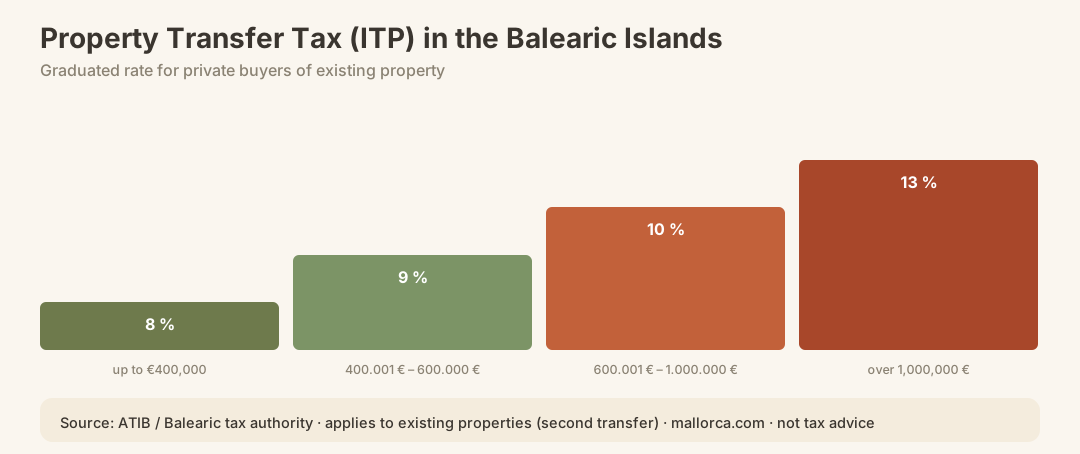
Property transfer tax (ITP) in the Balearic Islands – private individual
| Purchase price tranche | ITP rate (Balearic Islands) |
|---|---|
| up to 400.000 € | 8 % |
| 400.001 € – 600.000 € | 9 % |
| 600.001 € – 1.000.000 € | 10 % |
| over 1.000.000 € | 13 % |
Source: ATIB / Balearic tax authority; rates for existing properties (second transfer).
Acquisition via an SL
If an SL purchases a property, the relevant tax generally applies — either ITP (existing properties) or IVA + AJD (new build). A transfer tax exemption is, according to research, only achievable under very specific conditions and applies essentially to commercially active companies, not to purely asset-holding SL structures.
Please note: The formerly widespread practice of using a so-called share deal (purchasing the company shares rather than the property itself) to avoid transfer tax has been deliberately restricted by the Spanish legislature. Seek advice from a current tax adviser in the Balearic Islands before going down this route.
Ongoing costs of the SL at a glance
| Item | Amount / Frequency |
|---|---|
| Bookkeeping & annual accounts | depending on the firm, typically from around 1.000–2.500 €/year |
| Filing annual accounts with the commercial register | Mandatory, annually |
| IVA advance returns | quarterly |
| Corporation tax return | annually |
| Administration costs (administrador) | variable |
| Ongoing tax advice | depending on the firm |
Actual prices vary depending on the firm and the complexity of the structure; the table shows indicative figures based on real-world practice.
Tax aspects in detail
Corporation tax instead of income tax
Profits — e.g. from rental income or from a subsequent sale — are taxed within the SL at the Spanish corporation tax rate (Impuesto sobre Sociedades). The standard rate is 25 %. For newly established companies, a reduced rate of first two profitable years applies during the 15 %.
For comparison: a private non-resident pays Spanish non-resident tax (IRNR) on rental income from a Spanish property, and a fixed rate on capital gains as well. The exact rates depend on the country of residence and any double taxation agreement (DTA) — more on this in the section on inheritance and sale.
Deemed profit distribution: the Federal Fiscal Court case from 2013
If you as a shareholder use the SL property privately, the German Federal Fiscal Court ruled in 2013 (the so-called 'Mallorca case'): a written tenancy agreement between the company and you as the shareholder must exist on arm's-length terms — otherwise, from a German tax perspective, a deemed profit distribution arises. This has direct consequences for your German tax return. Anyone setting up an SL purely for personal use therefore walks straight into this trap.
Wealth tax and non-resident taxation
Based on the available research, an asset-managing SL can achieve a exemption from Spanish wealth tax (declaration D714) and from non-resident taxation (declaration 210) – but only under certain conditions. These exemptions do not automatically apply to a purely privately used holiday property held within an SL.
You can find more on the topic of wealth tax in the guide Wealth Tax Spain.
Inheritance and gifting: where the SL can (still) be of interest
Historically, inheritance optimisation was the strongest argument for the property SL: instead of inheriting the property directly (with potentially high Spanish inheritance tax), the company shares are inherited instead. This approach is still relevant in certain constellations – but it is no longer a straightforward win by any means.
When the SL structure can make sense from an inheritance perspective:
- For commercially operated Spanish SLs, an inheritance tax exemption of up to 95–99 % on the company shares may be available.
- After the death of the shareholder, selling the property is in principle possible without a land registry transfer, which simplifies the process.
Important caveat: According to the research, the substantial exemption applies to commercially active SLs – not to purely asset-managing ones. Placing a villa that you use privately into an SL and hoping for an inheritance tax exemption is a legally uncertain path.
Note: The Balearic inheritance tax regulations are a subject in their own right. Please refer to our guide on Inheritance & Gifting Balearic.
When the SL still makes sense today – and when it doesn't
The research is clear: what was an almost universal tax advantage up until around 2006 is today simply no longer attractive for many buyers. Here is an honest comparison:
When the SL can make sense
| Scenario | Reasoning |
|---|---|
| Commercial holiday letting (multiple properties, professional operation) | Profits can be retained within the company, corporation tax 25 %, first 2 profitable years 15 % |
| Portfolio investor (multiple properties) | Liability protection, portfolio management, reinvestable profits |
| Commercial use (e.g. hospitality, hotel industry) | Commercially justified structure, inheritance tax exemption potentially applicable |
| Company sale instead of property sale | Tax-optimisable in certain cases – please seek individual advice |
When a direct purchase as a private individual is usually the better option
| Scenario | Rationale |
|---|---|
| Personal use (holiday home, second residence) | Risk of deemed distribution (BFH 2013), ongoing administrative costs with no corresponding tax benefit |
| Single property, no intention to let | Ongoing SL costs outweigh any tax advantage |
| First purchase with no experience in Spain | The complexity of the structure significantly increases the risk of errors |
| Purchase under 500.000 € with clear personal use | SL administrative costs do not pay for themselves |
The historical shift: why the model lost its appeal
Up until around 2006, buyers made extensive use of the SL because the combination of the double taxation agreement (DTA) in force at the time, lower corporation tax for asset-holding companies, and the possibility of share deals without Spanish taxation offered enormous advantages. Specifically:
- Asset-holding SL (passive company, no active business activity): corporation tax on the capital gain where the holding period exceeded one year was at the time only 15 %.
- Private individual as non-resident: Prior to the ECJ discrimination ruling, the non-resident was required to pay tax on capital gains at 35 % — the SL was therefore significantly more advantageous.
- Share deal: When selling the company shares (rather than the property itself), transfer tax could be avoided; under the DTA in force at the time, Spain had no right to tax gains from share deals by German shareholders.
All three advantages have today either disappeared or been significantly curtailed. The standard corporation tax rate now stands at 25 %, the DTA has been revised, and share deal structures used for tax avoidance are actively pursued by the Spanish tax authorities.
The most common mistakes when purchasing property through an SL
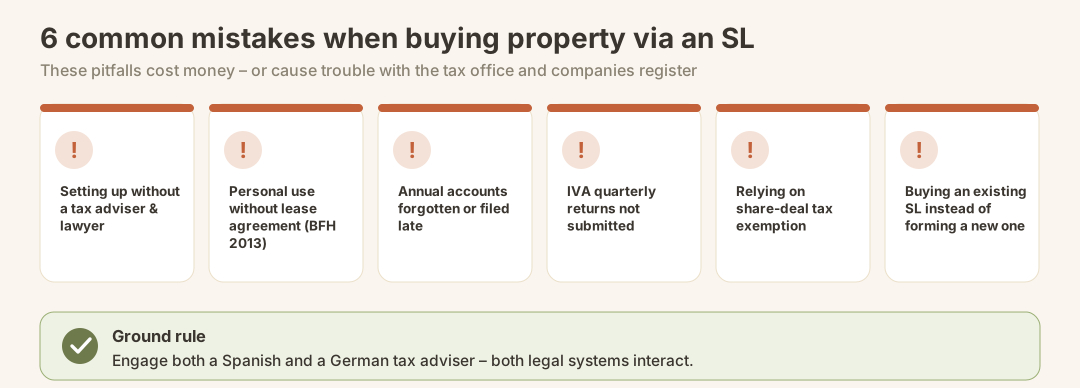
- Setting up an SL without engaging a tax adviser and a lawyer — The structure is too complex for a do-it-yourself approach.
- Using the property personally without a tenancy agreement — Under BFH case law, this gives rise to a deemed distribution.
- Forgetting to file the annual accounts or filing them late — This leads to substantial fines from the Companies Register.
- Failing to submit quarterly IVA returns — These are mandatory even where turnover is nil, once the SL is registered.
- Relying on share deal tax exemption — The loopholes in the old DTA have been closed; without individual tax advice, back payments are a real risk.
- Purchasing an existing SL — Professionals unanimously advise against this, as hidden liabilities are acquired along with it.
- Assuming inheritance tax relief applies to an asset-holding SL — As a rule, this applies only to companies carrying on a trade or business.
- Underestimating the ongoing costs — Bookkeeping, annual accounts, and tax advice all add up year on year; for a single property, this often amounts to 1.500–3.000 € or more.
What comes next? The SL's ongoing obligations
Anyone who opts for the SL structure permanently takes on the following obligations:
| Obligation | Frequency | Consequence of non-compliance |
|---|---|---|
| Bookkeeping (organised) | ongoing | Tax law risks |
| IVA advance return | quarterly | Fines |
| Prepare annual accounts | annually | Fines |
| Submit annual accounts (Registro Mercantil) | annually | Substantial financial penalty |
| Corporation tax return | annually | Back taxes + interest |
| Rental agreement with shareholder (for personal use) | upon use | Deemed distribution (DE) |
Checklist: SL or private individual?
Before you make a decision, work through these points:
- Is this a commercial use (letting as a business model, multiple properties)?
- Is a portfolio build-up planned, where the liability shield of the SL provides a genuine benefit?
- Are you prepared to have annual bookkeeping, annual accounts and tax returns prepared professionally each year?
- Have you factored the ongoing administrative costs into your yield calculation?
- Have you spoken to both a German and a Spanish tax adviser — both countries are relevant?
- Is the inheritance situation clear — and does the inheritance tax exemption for commercial SL shares even a consideration in your situation?
- Have you already understood the Legal process and procedure for buying property?
Conclusion
The Spanish SL is no longer a universal tax-saving model — it may have been in the years before 2006, when different double taxation agreement rules and different tax rates applied. Today, the structure is worthwhile primarily if you are building a commercially oriented, professionally managed property operation: multiple units, active letting, a clear entrepreneurial intent, and you factor in the ongoing costs and obligations of the SL.
For the purchase of a holiday property for personal use, a second home or a single property without a professional letting background, buying directly as a private individual is almost always the simpler, more cost-effective and legally safer choice. The ongoing administrative costs of the SL eat up any potential tax advantage — and the Federal Fiscal Court ruling on constructive dividends makes personal use of an SL-owned property without a properly structured tenancy agreement a genuine risk.
In any case, seek advice from both a Spanish tax adviser and a German tax adviser — both legal tax frameworks interact with one another. And please do so before you buy, not afterwards.
Official sources
- ATIB – Agència Tributària de les Illes Balears (Balearic tax authority, ITP rates): https://www.atib.es
- AEAT – Agencia Estatal de Administración Tributaria (corporation tax, IVA, IRNR): https://www.aeat.es
- Registro Mercantil Central (Companies Register, name reservation): https://www.rmc.es
- BOE – Boletín Oficial del Estado (company law, Ley de Sociedades de Capital): https://www.boe.es
- Gobierno de España – Impuesto sobre Sociedades: https://www.agenciatributaria.es/AEAT.internet/Inicio/La_Agencia_Tributaria/Campanas/IS/IS.shtml