
Claiming Paro in Spain: Eligibility, Amount & Duration 2026
Anyone who loses their job in Spain is generally entitled to what is known as the Paro – the state unemployment benefit, officially called the prestación contributiva por desempleo. The system sounds straightforward enough, but it is full of pitfalls: a single missed deadline or a missing stamp can cost you your entire entitlement. This guide explains how to apply for Paro in Spain, what conditions you need to meet, how much money you will receive and for how long – including all relevant deadlines, authorities, and concrete figures. You will also find out what you specifically need to do as an EU citizen on Mallorca: which office is responsible first, what the SOIB requires of you, and what the difference between SOIB and SEPE is. Being well prepared means securing your benefit without unnecessary delays.

Have you lost your job on Mallorca and are not sure what to do next?
- 📩 Submit a personal enquiry — we will connect you with German-speaking gestorías and employment law experts who can guide you through the application process.
- Taxes as a resident in Spain — how Paro is treated for tax purposes
What is the Paro and who administers it?
The Paro is Spain's contribution-based unemployment benefit. It is administered by the Servicio Público de Empleo Estatal (SEPE) – a national government agency. The SEPE is responsible for processing payments and calculating your entitlement.
On Mallorca and the Balearic Islands, a second authority comes into play: the SOIB (Servei d'Ocupació de les Illes Balears). The SOIB is the regional employment service and your first mandatory port of call, before you can apply for money from the SEPE. Without registering with the SOIB as a jobseeker, nothing will happen at the SEPE.
This two-tier structure is important and is often underestimated by newcomers:
| Authority | Responsibility | Where on Mallorca |
|---|---|---|
| SOIB | Register as a jobseeker, support, further training | Palma (3 offices), Manacor, Inca and others |
| SEPE | Application for unemployment benefit, payment | Palma: Carrer Gremi Forners 14, Polígon Son Castelló |
| SEPE Online | Application via Cl@ve or certificate | sede.sepe.gob.es |
Note: In other regions of Spain the regional authority has a different name – in Andalusia SAE, in Catalonia SOC. The national logic is the same everywhere: first register regionally, then apply nationally.
Requirements: When are you entitled?
Spanish unemployment benefit is an insurance benefit – you only receive something if you have previously paid in. The following conditions must all be met cumulatively:
1. Involuntary unemployment
Your employment relationship must have ended against your will. Typical cases:
- Dismissal by the employer (despido)
- Expiry of a fixed-term contract without renewal
- Reduction of working hours by more than one third
Anyone who resigns voluntarily is generally not entitled to the Paro. There are exceptions – for example in cases of proven harassment or objectively unreasonable working conditions – however these require legal assistance.
2. Minimum contribution period: 360 days in 6 years
You must have contributed for at least the last 6 years a minimum of 360 days into the Spanish social security system (Seguridad Social). The days do not need to be consecutive and can have been accumulated with different employers.
3. Legal residence and work permit
You must be legally permitted to live and work in Spain. As an EU citizen, you will need a valid Residencia registration (NIE). Find out more in our guide to Residencia in Spain.
4. Not yet of retirement age
You must not yet be receiving a regular state pension. Anyone approaching retirement age should keep an eye on the interactions involved – find out more in the guide Applying for a pension in Spain.
The 15-day deadline: the most important date
Please note: From the last day of your employment, you have exactly 15 working days (días hábiles)) to submit your application to the SEPE. Anyone who misses this deadline will lose entitlement days retrospectively – every day of late application reduces your total benefit period accordingly.
Working days in Spain are counted as Monday to Friday, public holidays excluded. Mallorca has Balearic and local public holidays that you must factor in. If in doubt, act a day earlier.
| Contract end date | Latest application date (SEPE) |
|---|---|
| Monday, 3 February | Monday, 24 February (15 working days) |
| Friday, 4 April | Friday, 25 April (note: check Balearic public holidays) |
| Wednesday, 1 October | Wednesday, 22 October |
Step by step: how to apply for Paro on Mallorca
Here is the complete process in the correct order:
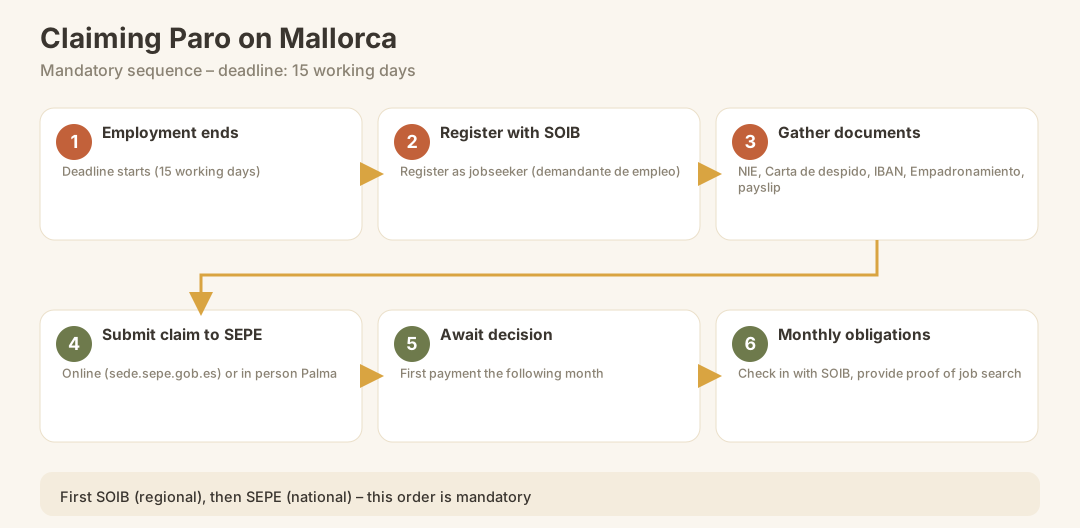
- Day 1: employment ends — the deadline starts running (15 working days).
- As early as possible: visit the SOIB or register online — Register as a jobseeker (demandante de empleo). Without this registration, the SEPE will not accept your application. On Mallorca, SOIB offices can be found in Palma, Inca, and Manacor, among other locations.
- Gather your documents (see the next section).
- Submit your application to the SEPE — in person at the SEPE office in Palma (Carrer Gremi Forners 14) or online via sede.sepe.gob.es using Cl@ve-PIN or a digital certificate. If you do not yet have Cl@ve: Guide to Cl@ve PIN Spain.
- Book a Cita Previa (if attending in person) — make an appointment via the SEPE website or by phone on the national number 900 81 24 00.
- Wait for confirmation — the SEPE will send a written decision; the first payment is usually made in the month following the application.
- Meet your monthly obligations — report regularly to the SOIB, demonstrate active job-seeking, and do not refuse job offers without good reason.
Please note: Anyone who prefers to apply online will need a valid Certificado Digital or an active Cl@ve account.
What documents do you need?
Prepare the following documents before visiting the SOIB or SEPE:
| Document | Details |
|---|---|
| DNI / NIE / Passport | Valid photo identification document |
| Proof of end of employment | Carta de despido (dismissal letter) or contract expiry certificate |
| Social security card | Número de Afiliación a la Seguridad Social |
| Account number (IBAN) | Spanish account preferred; opening a bank account in Spain: this way |
| Empadronamiento certificate | Current registration certificate; Empadronamiento Mallorca |
| Payslips (last few months) | For verification of the contribution base |
| Completed SEPE application form | Modelo de solicitud de prestación por desempleo (on the SEPE website) |
How much is the Paro? Calculation & table
The amount of your Paro depends on your contribution base (base reguladora) which is calculated from the average of your social security contributions over the last 180 contribution days prior to unemployment.
Percentages
| Benefit duration | Percentage of the contribution base |
|---|---|
| First 180 days | 70% of the contribution base |
| From day 181 | 50% of the contribution base |
Upper limits (Topes)
The Paro is subject to upper and lower limits. These limits are based on the Indicador Público de Renta de Efectos Múltiples (IPREM).
| Situation | Maximum amount (monthly) | Minimum amount (monthly) |
|---|---|---|
| Without dependent children | 175% of the IPREM | 80% of the IPREM |
| With one child | 200% of the IPREM | 107% of the IPREM |
| With two or more children | 225% of the IPREM | 107% of the IPREM |
Please note: The exact IPREM value is set annually by the budget law. Check the current amounts directly at sepe.es or with your gestoría.
Worked example (simplified)
Over the last 180 days you earned a gross monthly salary of €1,800 and made contributions accordingly. Your contribution base is approximately €1,800.
- First 180 days: 70% × €1,800 = €1,260 / month (before applying the caps)
- From day 181: 50% × €1,800 = €900 / month
These figures are gross amounts. The SEPE deducts income tax (IRPF) and, where applicable, social security contributions. Paro is treated as taxable income in Spain — for more details see the guide IRPF deductions Balearen.
How long do you receive Paro? The benefit duration
The duration depends directly on how many days you have paid into social security. The formula is linear: more contribution days = longer benefit duration.
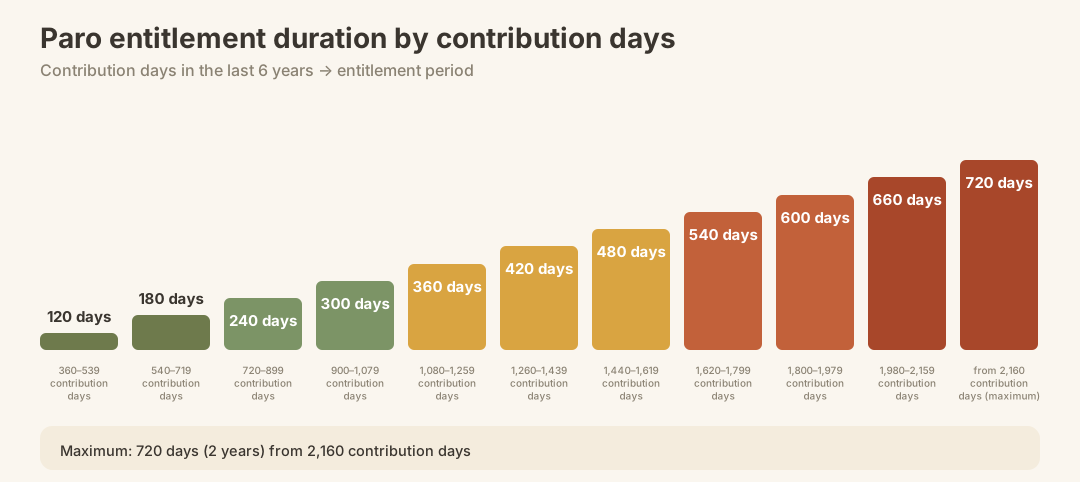
| Contribution days (in the last 6 years) | Entitlement period |
|---|---|
| 360–539 days | 120 days (4 months) |
| 540–719 days | 180 days (6 months) |
| 720–899 days | 240 days (8 months) |
| 900–1,079 days | 300 days (10 months) |
| 1,080–1,259 days | 360 days (12 months) |
| 1,260–1,439 days | 420 days (14 months) |
| 1,440–1,619 days | 480 days (16 months) |
| 1,620–1,799 days | 540 days (18 months) |
| 1,800–1,979 days | 600 days (20 months) |
| 1,980–2,159 days | 660 days (22 months) |
| From 2,160 days | 720 days (24 months / maximum) |
The maximum entitlement period is 720 days (2 years).
Paro and health insurance: what happens to healthcare cover?
Anyone receiving Paro generally remains covered by health insurance through the social security system. The SEPE continues to register you with the Seguridad Social throughout the entitlement period. Once the Paro expires, gaps in cover may arise depending on your situation. Make sure to look into your options in good time – our guide to health insurance in Spain gives you a good overview, and in case of need it is also worth taking a look at private health insurance Spain comparison.
Am I allowed to travel abroad?
A common question: Am I allowed to travel to Germany to visit family while receiving Paro?
The short answer: yes for short trips, but with conditions.
- Short trips (a few days up to a maximum of two weeks) are generally possible, but must be reported to the SEPE in advance.
- In the event of moving abroad or permanently leaving Spain, the entitlement generally lapses.
- Those seeking work in another EU country can, under certain conditions, "take" the Paro abroad for up to three months (exportación de la prestación, form U2/PD U2) – this must also be applied for before departure.
- Important: Any trip that interrupts your availability for the Spanish labour market should be agreed with the SEPE in advance, as otherwise the benefit may be suspended.
Paro for Autónomos: Is there an equivalent?
Self-employed individuals (autónomos) are not part of the regular Paro system, but for some years have had access to the so-called Cese de Actividad – a form of unemployment benefit for the self-employed. The conditions and the amount differ considerably from the employee Paro; among other things, it must be demonstrably shown that turnover has fallen or that the activity has been ceased for economic reasons. Those who were working as an autónomo and are wondering how taxes and social security contributions are connected will find background information in the guide Modelo 303 & 130.
The most common mistakes when applying for Paro
These mistakes will cost you real money – or your entire entitlement:
- Missing the 15-day deadline. Every working day you apply late shortens your total benefit period. There is no grace period.
- SEPE first, then SOIB. The order is mandatory: first register as a jobseeker at regional level (SOIB on Mallorca), then apply nationally with SEPE – not the other way round.
- Missing or out-of-date documents. A missing dismissal letter or an expired Empadronamiento certificate will lead to rejection or delay.
- No Spanish bank account. SEPE generally pays into a Spanish IBAN account.
- Resigning voluntarily without legal advice. Anyone who resigns without first having a legal check carried out to determine whether a special case applies (e.g. serious breach of duty by the employer) loses their entitlement for no good reason.
- Turning down job offers. Anyone who declines a suitable job offer without good reason risks having their benefit stopped.
- Failing to report travel abroad. Any travel that interrupts your availability for the labour market must be communicated to SEPE in advance.
- Undeclared work whilst receiving Paro. Anyone earning undeclared income alongside Paro risks having payments reclaimed and being fined.
What comes next? Subsidio de desempleo
Anyone who has exhausted their maximum Paro entitlement period and meets certain conditions may be eligible for the subsidio de desempleo – a subsequent, tax-funded unemployment assistance benefit paid at a lower level. Since 2025, SEPE has consolidated several former special programmes for older workers into unified benefits. The precise conditions and amounts of the Subsidio depend on age, family situation, and prior entitlements, and should be clarified directly with SEPE or a gestoría.
Anyone with long-term plans in Spain should also keep an eye on their future pension entitlements: Applying for a pension in Spain.
Checklist: applying for Paro on Mallorca
Use this checklist as a quick reference:
- Dismissal letter or proof of contract expiry is available
- NIE / Residencia valid and up to date
- Empadronamiento up to date (recommended no older than 3 months)
- Spanish bank account with IBAN in place
- Most recent payslips (at least 6 months) to hand
- SOIB registration as a jobseeker completed (Step 1!)
- Cl@ve PIN or Certificado Digital activated (for online application)
- SEPE application submitted within 15 working days
- Cita Previa booked with SEPE (if attending in person)
- Obligations during the benefit period understood (reporting dates, job offers)
Conclusion
Spanish unemployment benefit is a genuine social safety net – provided you know how to activate it. The key points at a glance: 360 contribution days within 6 years are the entry requirement, the 15-working-day deadline is absolutely binding, and SOIB must be contacted before SEPE. The amount during the first 180 days of receipt is 70 % of the contribution base, and 50 % thereafter, subject to statutory upper and lower limits. The maximum benefit duration is two years. Anyone who is unsure or does not speak Spanish should not hesitate to engage a gestoría or an employment lawyer – the bureaucratic effort is worthwhile, and mistakes can be costly.
Official Sources
- SEPE – Servicio Público de Empleo Estatal (application, calculation, deadlines): https://www.sepe.es/HomeSepe/prestaciones-desempleo/prestacion-contributiva.html
- SEPE Sede Electrónica (online application): https://sede.sepe.gob.es
- SOIB – Servei d'Ocupació de les Illes Balears (regional employment service Mallorca): https://www.soib.es
- Seguridad Social – Ministerio de Inclusión (social security contributions, Afiliación): https://www.seg-social.es
- BOE – Ley General de la Seguridad Social (statutory basis for unemployment benefit): https://www.boe.es
- SEPE Information Brochure "Working in Spain" (multilingual, incl. German): https://sepe.es/dam/jcr:23bce958-a93d-4def-a0e2-b42a52946b09/TRABALE2002.pdf