
Hiring staff in Spain: contracts, Seguridad Social and costs
Hiring your first employee in Spain is a genuine turning point – the moment a sole-trader operation or holding structure becomes a real business with staff. Spanish employment law is deliberately designed to favour employees: mandatory collective agreements (Convenios Colectivos), high employer contributions to social security, strict rules on fixed-term contracts, and an inspection system that can uncover mistakes years down the line. None of this is insurmountable – but if you approach it with German or British instincts, you are in for costly surprises. This guide explains the types of contract available, how to register correctly with the Seguridad Social, what an employee in Mallorca actually costs, and which mistakes you absolutely must avoid.

What an employee in Spain actually costs
Before you sign the contract, you need the full figure. The rule of thumb is: An employee costs you as the employer 1.30 to 1.35 times the agreed gross salary – and that is before benefits, equipment, or office costs.
The main driver is the employer's social security contribution. On top of that comes mandatory membership of a Mutua (occupational accident and disease insurance) and a contract with an external occupational health and safety provider (Servicio de Prevención Ajeno), which virtually every employer with staff is required to take out.
| Cost component | % of gross salary |
|---|---|
| Gross salary (paid in 14 instalments) | 100 % |
| Employer social security contribution (general regime) | ~29.9 % |
| Mutua (occupational accident and disease insurance) | ~1–4 % (sector-dependent) |
| Occupational health and safety provider (Prevención de Riesgos) | ~0.5–1 % |
| Meal vouchers, private health insurance, etc. (optional but standard in many sectors) | 2–8 % |
| Total employer cost (typical) | 130–140 % |
Practical examples:
| Gross salary/year | Total all-in cost (estimated) |
|---|---|
| 25.000 € | 32.500 – 35.000 € |
| 40.000 € | 52.000 – 56.000 € |
| 60.000 € | 78.000 – 84.000 € |
| 100.000 € | 130.000 – 140.000 € |
One detail that regularly catches UK and US founders off guard: Spanish salaries are paid in 14 instalments – 12 monthly payments plus two bonus payments (typically in July and December, sometimes spread proportionally across monthly payslips). The annual figure remains the same, but the cash-flow timing differs from what you may be used to.
Note: The employee's share of social security contributions is withheld from the gross salary and paid directly to the Tesorería General de la Seguridad Social (TGSS) – this is your obligation as the employer, not the employee's.
Types of contract: what has applied since the 2022 reform
Since the Spanish labour market reform of 2022, the permanent contract (Contrato Indefinido) has been the statutory default. Fixed-term contracts are only permitted for clearly defined exceptions and are automatically converted into permanent positions if the rules are breached. This has direct implications for workforce planning.
| Contract type | Use case | Maximum duration / key feature |
|---|---|---|
| Indefinido (permanent) | Any permanent role, full- or part-time | No end date; standard since the 2022 reform |
| Fijo Discontinuo (permanent seasonal) | Seasonal businesses: hospitality, tourism, agriculture | No fixed end date; employee is called back each season |
| Temporal por Sustitución (cover contract) | Cover for illness, maternity leave, or holiday absence | Duration = length of the absent employee's leave |
| Temporal por Circunstancias de la Producción | Temporary peaks in workload, clearly definable | Max. 6 months, extendable to max. 12 months; must be objectively justified |
| Formación en Alternancia / Práctica Profesional | Apprenticeship or internship with a professional qualification | Own minimum conditions; reduced SS contributions may apply |
The Fijo Discontinuo: particularly relevant on Mallorca
For hospitality and tourism businesses on Mallorca, the Fijo Discontinuo is the smartest response to the island's seasonal structure. You take the employee on permanently but only activate them during the active season — typically April to October. During the off-season the employee pays no contributions, but is entitled to unemployment benefit (SEPE). You retain the employee on your books and avoid the penalty payments that arise under the 2022 reform from repeated fixed-term contracts.
Tip: With every new hire, ask yourself first: is this a permanent need or a clearly defined seasonal one? The answer determines the contract type and, with it, all subsequent steps.
Registering with the Seguridad Social: a step-by-step guide
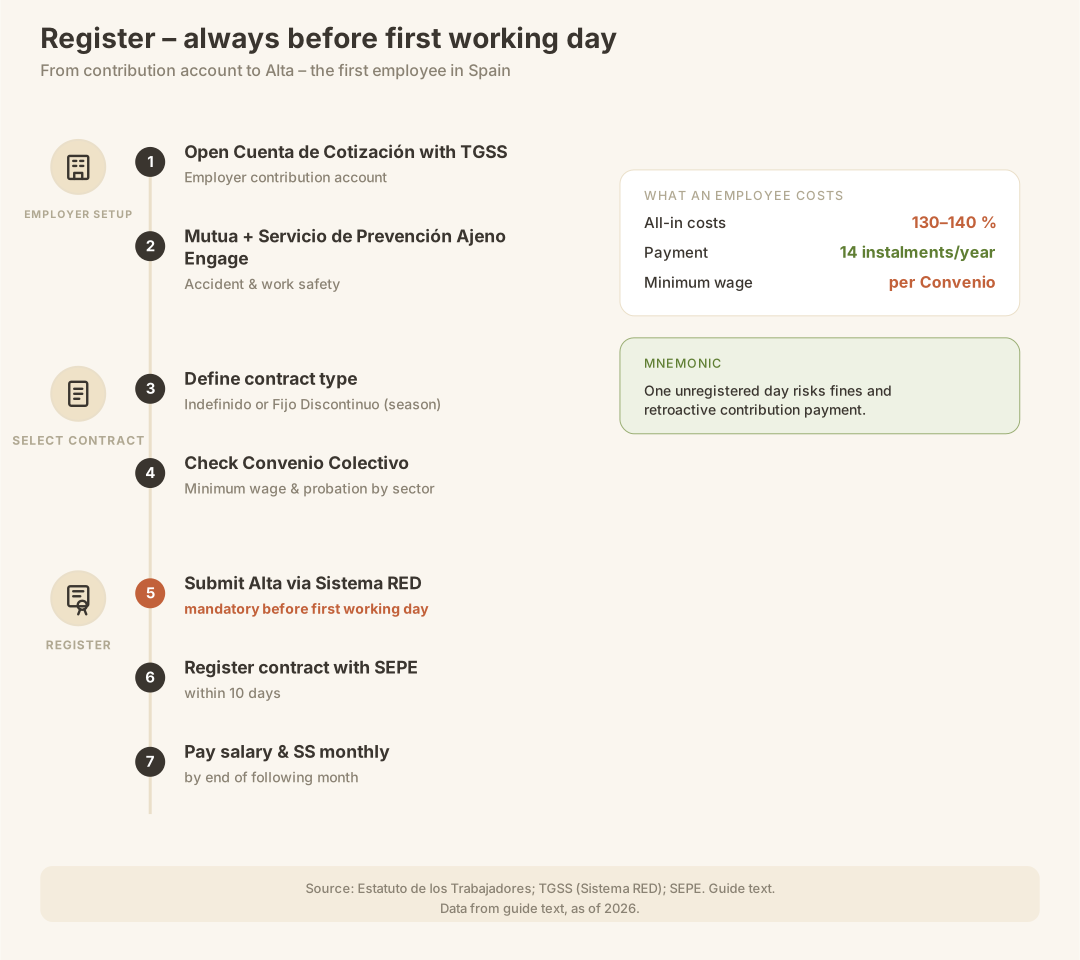
Registering an employee with the Seguridad Social is not optional, but a legal obligation that must be completed before the first working day Anyone who employs a member of staff even a single day without registering them risks substantial fines and the backdated repayment of all contributions.
Requirements for the employer
Before you can register someone, you yourself must be registered as an employer with the Seguridad Social. For this you will need:
- CIF/NIF of your company (Spanish tax identification number of the business)
- Cuenta de Cotización (contributions account with the TGSS) – one-off registration as an employer
- Contract with a Mutua covering occupational accidents and occupational diseases
- Contract with a Servicio de Prevención Ajeno (external occupational health and safety service provider)
Registering an employee: the process
- Check the employee's NIE/DNI – registration is not possible without a valid tax identification number
- Número de Afiliación a la Seguridad Social (NASS) of the employee – obtain this or apply for it for the first time if it does not yet exist
- Alta del trabajador (registration) to be submitted via the Sistema RED (TGSS online system) – before work commences
- Employment contract to be submitted to the SEPE (Servicio Público de Empleo Estatal) no later than 10 days after the contract is signed
- Monthly payslip (Nómina) to be drawn up and social security contributions remitted by the last day of the following month
Please note: The Sistema RED requires an authorised representative (in practice this is handled by the gestoría). Without an active RED access, nothing can effectively be done. An experienced gestoría in Spain is not an option here — it is the standard.
The Convenio Colectivo: Your Invisible Third Contractual Party
Spanish employment law operates on two levels: the statute (Estatuto de los Trabajadores) and the Convenio Colectivo — the sector collective agreement. In practice, the latter is at least as important as the statute itself, because it:
- sets minimum salaries by occupational group (above the national minimum wage)
- defines probationary periods (ranging from 15 days to several months, depending on the category)
- governs holiday entitlements, working hours, and allowances
- specifies redundancy and severance arrangements
On Mallorca, the most relevant Convenios are:
| Sector | Applicable Convenio (examples) |
|---|---|
| Hospitality & Hotels | Convenio de Hostelería de Baleares |
| Retail | Convenio de Comercio de Baleares |
| Cleaning / Domestic Services | Convenio de Limpieza de Baleares |
| Construction | Convenio de la Construcción (national/provincial) |
| Private Households | Sistema Especial para Empleados de Hogar |
Please note: The applicable Convenio is determined by the primary area of activity of your business, not by the individual employee's role. Find out before hiring which Convenio applies — it is binding even if you have not actively signed it.
Probationary period, holiday entitlement and working hours
Probationary period
The probationary period is governed by the applicable Convenio Colectivo. As a general guide from the Estatuto de los Trabajadores:
- Technicians and skilled specialists: generally up to 6 months
- Other employees: generally up to 2 months
During the probationary period, either party may terminate the employment relationship without stating reasons and without severance pay.
Holiday entitlement
The statutory minimum holiday entitlement is 30 calendar days per year. Many Convenios provide for additional holiday days.
Working hours
The statutory standard working week is 40 hours per week. Overtime is capped and must either be compensated financially or offset with time off in lieu. Since 2019, employers have been required to record the daily working hours of all employees (Registro de Jornada) – digitally or on paper, but in an audit-proof manner.
Termination: what a dismissal really costs
Spanish employment law distinguishes between several types of dismissal, each with different financial consequences.
| Type of dismissal | Severance pay | Requirements |
|---|---|---|
| Disciplinaria (conduct-related) | 0 € if the dismissal is upheld | Serious, culpable breach of duty; strict formal requirements |
| Objetiva (operational/personal grounds) | 20 days' salary × years of service | Economic, technical or organisational grounds; 15 days' notice |
| Improcedente (invalid / not upheld) | 33 days' salary × years of service (max. 24 monthly salaries) | Employer may choose between reinstatement and severance pay |
| ERTE (short-time working) | No dismissal; state wage replacement | Economic hardship; application to SEPE |
Please note: A disciplinary dismissal must comply with strict formal requirements (written notice stating the precise allegations, deadlines). A procedural error renders even a substantively justified dismissal automatically "improcedente" – with the corresponding severance costs. Always have dismissals reviewed legally before taking action.
Seguridad Social in detail: contribution rates
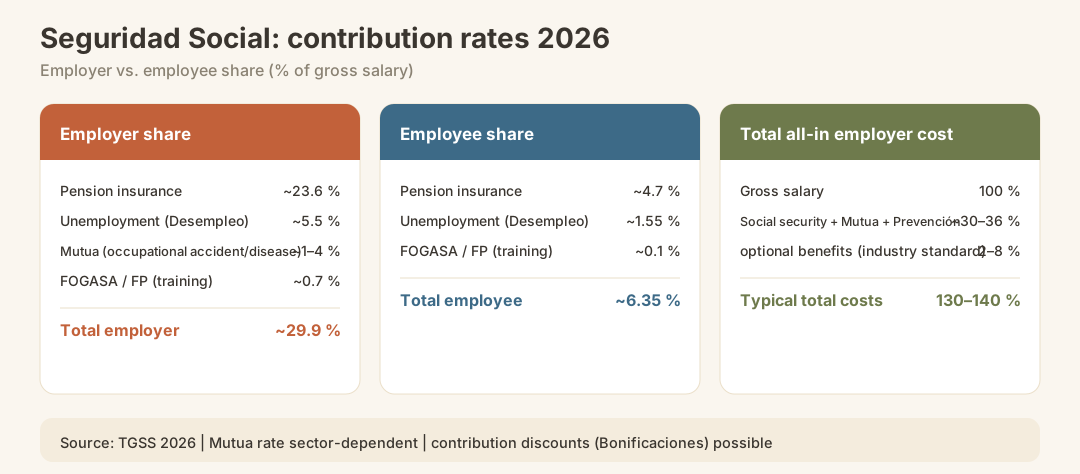
Contributions to the Seguridad Social are compulsory from the first day of employment onwards. They are calculated and remitted on a monthly basis.
| Contribution component | Employer's share | Employee's share |
|---|---|---|
| General pension insurance | ~23,6 % | ~4,7 % |
| Unemployment (Desempleo) | ~5,5 % | ~1,55 % |
| Occupational accident/occupational disease (Mutua) | ~1–4 % (sector-dependent) | — |
| Training fund (FOGASA, FP) | ~0,7 % | ~0,1 % |
| Total (approx.) | ~29,9 % | ~6,35 % |
Contributions are calculated on the basis of the Cotizationsbase (base contribution rate) is calculated based on the actual gross wage and is subject to upper and lower limits that are adjusted annually.
Note: For certain types of contract (e.g. Formación en Alternancia, Fijo Discontinuo in the first season, hiring of long-term unemployed) there are Bonificaciones – state contribution discounts. Have it checked whether you are entitled to these; the savings can be considerable.
Domestic staff and cleaners: The Sistema Especial
If you privately employ a housekeeper, gardener or cleaner in Mallorca, a separate system applies: the Sistema Especial para Empleados de Hogar. Registration is also handled through the TGSS, but with simplified forms and a separate contribution structure. A detailed guide to this can be found in the article Registering domestic staff in Spain.
Foreign employees: What employers additionally need to bear in mind
EU citizens (and Swiss nationals) may be employed in Spain without a work permit. They only require a NIE and, where applicable, a Residencia – but registration with the Seguridad Social follows the same rules as for Spanish nationals.
For non-EU nationals it becomes more complex:
| Situation | Requirement |
|---|---|
| Third-country national without a residence permit | Work permit (Autorización de Trabajo) required; national demand must be assessed |
| Third-country national with a valid residence permit (e.g. Residencia) | Work permit generally not required separately |
| Highly skilled workers (EU Blue Card) | Simplified procedure for shortage occupations |
Note: Always verify the current residence permit and its work entitlement before employing a non-EU national. An unlawful hiring can result in substantial fines.
On the NIE and Residencia: Applying for a NIE Number in Mallorca and Residencia Spain.
Most Common Mistakes with Your First Employee in Spain
These are the mistakes that experienced gestoría offices in Mallorca encounter on a regular basis – and they are costly:
Registering after rather than before the start of employment: Even a single day without registration can trigger fines and back-payments. Registration must be completed before the first working day.
Wrong contract type: A fixed-term contract without a substantive reason has been treated as a permanent position since 2022. If the error is discovered during an inspection, the conversion is automatic and backdated.
Ignoring the Convenio Colectivo: Paying below the minimum wage because you are only familiar with the national SMI (Salario Mínimo Interprofesional) is a classic mistake. The sector collective agreement frequently sets higher thresholds.
Salary calculated in 12 instead of 14 instalments: Dividing the annual salary by 12 and deriving the monthly amount from that significantly underestimates the cashflow requirement.
No Registro de Jornada: The obligation to record daily working hours applies to every business with employees. Missing documentation is a frequent finding during inspections.
Dismissal without legal review: Even clearly justified dismissals must comply with strict formal requirements. A letter bearing the wrong date or lacking grounds for dismissal renders the termination invalid.
Treating domestic help as self-employed: A person working regularly in a household is generally not self-employed and must be registered as an employee.
What comes next? Ongoing obligations as an employer
Registration is only the beginning. As an employer in Spain, you have the following ongoing monthly and annual obligations:
| Obligation | Frequency | Deadline |
|---|---|---|
| Preparing the nómina (payslip) | Monthly | Pay day (as stipulated in the contract) |
| Remitting SS contributions (via Sistema RED) | Monthly | Last day of the following month |
| Remit IRPF withholding (payroll tax) (Modelo 111) | Monthly or quarterly | 20th of the following month (monthly) / 20th after the end of the quarter |
| Annual return for IRPF withholdings (Modelo 190) | Annually | 31 January of the following year |
| Maintain Registro de Jornada | Daily | Ongoing; must be retained for 4 years |
| Document holiday schedule | Annually | Before holiday leave commences |
For guidance on IRPF as a resident, see the guide Taxes as a Resident in Spain.
Autónomo vs. Employee: The Classification Test
A common attempt to save on social security contributions is to treat a staff member as self-employed (autónomo). However, Spanish law looks at the actual nature of the working relationship — not what it is called.
Where the following characteristics apply, the arrangement will generally constitute an employment relationship and must be registered as such:
- The person works exclusively or predominantly for you
- You determine working hours and place of work
- The person uses your equipment and resources
- There is economic dependence
The Inspección de Trabajo reclassifies such arrangements and demands all social security contributions backdated — including interest and penalties. For more on the self-employed situation in Spain: Autónomo in Spain and Cuota Autónomo Spain.
Checklist: Hiring Your First Employee in Spain
Use this list as a checkpoint before the first working day:
- CIF/NIF of the company in place
- Cuenta de Cotización opened with the TGSS
- Contract concluded with Mutua
- Servicio de Prevención Ajeno (occupational health and safety) commissioned
- NIE/NASS of the employee in place
- Type of contract checked (Convenio Colectivo consulted)
- Employment contract drawn up and signed
- Alta del trabajador via Sistema RED before the start of employment submitted
- Employment contract submitted to the SEPE within 10 days
- Registro de Jornada set up
- Nómina system prepared (gestoría or software)
- IRPF withholding calculated and recorded in the system
Conclusion: Hiring in full compliance with the law is worthwhile
Spanish employment law offers strong protections for employees – and that is not a flaw, but a deliberate design. Employers on Mallorca who know the rules and apply them consistently will find a genuinely reliable framework: clear contract structures, predictable cost blocks, and a well-established system for seasonal employment. The biggest risk factor is not the law itself, but navigating it by intuition from within a different legal system. An experienced gestoría in Spain costs a modest monthly fee – and regularly saves many times that amount in fines, back payments, and legal disputes. Factor in employer on-costs from the outset at 1.30 to 1.40, choose the right type of contract for your situation, and always register employees before the first working day.
Official sources
- Estatuto de los Trabajadores (RDL 2/2015): https://www.boe.es/buscar/act.php?id=BOE-A-2015-11430
- Tesorería General de la Seguridad Social (TGSS) – Sistema RED: https://www.seg-social.es/wps/portal/wss/internet/InformacionUtil/44539
- SEPE – Servicio Público de Empleo Estatal (contract registration): https://www.sepe.es
- Reforma Laboral 2022 (RDL 32/2021): https://www.boe.es/buscar/act.php?id=BOE-A-2021-21789
- Labour and Social Security Inspectorate: https://www.mites.gob.es/itss/web/index.html
- AEAT – Modelo 111 and 190 (IRPF withholdings): https://www.agenciatributaria.es
- Special System for Household Employees (TGSS): https://www.seg-social.es/wps/portal/wss/internet/Empresarios/Inscripcion/36537