
Finiquito Spain & Termination: Your Rights at the End of Employment
The Finiquito is the central settlement document in Spain upon the termination of any employment relationship — whether you resign, are dismissed, or a fixed-term contract expires. It lists all outstanding amounts: pro-rata bonus payments, untaken holiday, outstanding salary, and, where applicable, a severance payment (indemnización). Anyone who signs this document without checking it carefully often waives entitlements without realising it. In this guide you will learn how the Finiquito is calculated, which severance rates apply to which type of dismissal, what the notice periods in Spain are, which mistakes you should avoid at all costs — and how you, as a German-speaking expatriate on Mallorca or elsewhere in Spain, can best protect yourself.

What exactly is the Finiquito?
The word "Finiquito" is best translated as final settlement . It is not a synonym for severance pay — that is a common misconception. The Finiquito is the settlement document that must be issued upon every termination of contract, regardless of the reason. It contains all amounts that the employer still owes the employee upon their departure.
The severance payment (indemnización) is a statutory one-off payment that arises only in connection with certain types of dismissal and is shown either within the Finiquito or as a separate item.
| Term | Meaning |
|---|---|
| Finiquito | Final settlement document upon any termination of contract |
| Indemnización | Statutory severance payment (applicable only to certain types of dismissal) |
| Liquidación | Often used as a synonym for Finiquito; covers all outstanding payments |
| Dimisión | Resignation by the employee |
| Despido | Dismissal by the employer |
Please note: If you sign the Finiquito with the addition "en conformidad" (in agreement), you are acknowledging the settlement as complete. If you have any doubts, sign with the addition "no conforme" (not in agreement) — this preserves your right to make further claims at a later stage.
The components of the Finiquito in detail
A correctly issued Finiquito generally contains the following items:
| Item | Description |
|---|---|
| Outstanding wages | All working days not yet paid up to and including the last working day |
| Pro-rata bonus payments (pagas extras) | Standard practice in Spain: 2 bonus payments/year (summer, Christmas); each equivalent to one month's salary, calculated on a pro-rata basis |
| Holiday pay in lieu | Untaken holiday is paid out (basis: 30 calendar days/year) |
| Overtime compensation | If agreed contractually or under a collective agreement and not yet settled |
| Severance pay (where applicable) | The rate varies depending on the type of dismissal (see below) |
Calculation example – holiday pay in lieu: Someone leaving on 1 October under an annual contract will have worked 9 out of 12 months – entitling them to 9/12 of 30 days = 22.5 days' holiday. Untaken days are paid out on the basis of the daily rate.
Calculation example – pro-rata bonus payment: Someone leaving on 30 June who has not yet received the summer paga: (6 months / 12 months) × monthly salary = half a bonus payment.
Types of dismissal in Spain and their severance rates
Spanish employment law recognises several types of dismissal, which differ considerably in terms of procedure, notice periods, and above all the level of severance pay.
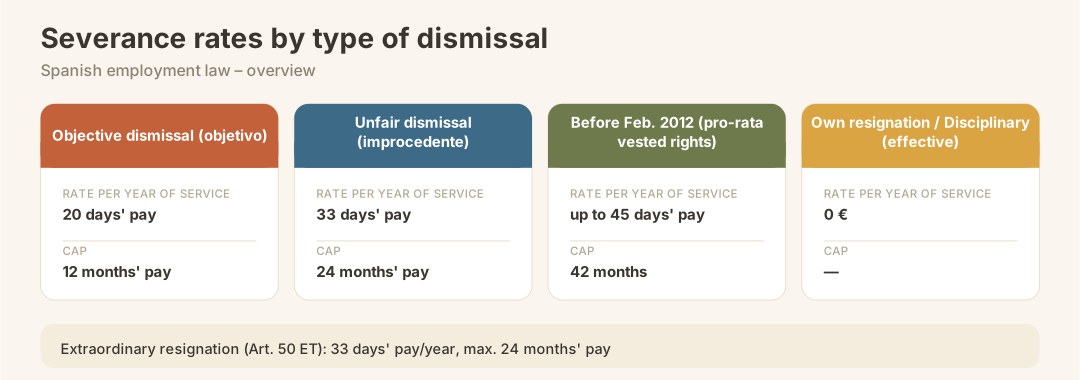
| Type of dismissal | Spanish term | Severance per year of service | Maximum cap |
|---|---|---|---|
| Redundancy / objective grounds (objetivo) | Despido objetivo | 20 days' pay | 12 months' pay |
| Unfair dismissal (improcedente) | Despido improcedente | 33 days' pay | 24 months' pay |
| Dismissal before Feb. 2012 (old, pro-rata acquired rights) | Período anterior a 2012 | up to 45 daily wages | 42 months (transitional rule) |
| Dismissal for serious cause without notice (disciplinario) | Despido disciplinario | €0 (if valid) | — |
| Voluntary resignation (dimisión) | Dimisión | 0 € | — |
| Constructive dismissal (employer at fault) | Resolución causal (Art. 50 ET) | 33 daily wages | 24 monthly wages |
Please note: For periods of service prior to 12 February 2012 the old rate of up to 45 daily wages per year continues to apply — subject to an overall cap of 42 monthly wages. From 12 February 2012 onwards, the new rate of 33 daily wages applies (or 20 for objective dismissal). Both sub-periods are calculated separately and then added together.
Notice periods in Spain 2026
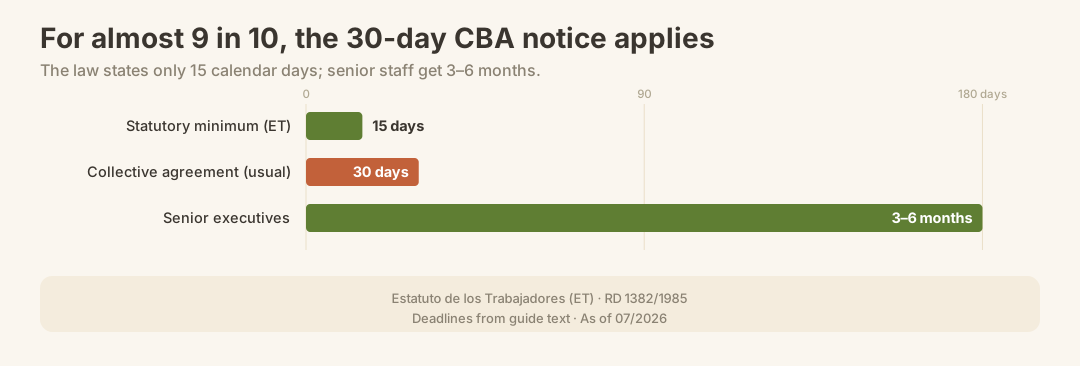
The statutory minimum notice period under the Estatuto de los Trabajadores (ET) is 15 calendar days — and this applies in both directions. That may sound short, but it is merely the legal minimum. Since around 87 % of all employees in Spain are covered by a collective agreement (convenio colectivo), a considerably longer notice period is common in practice.
| Category / Situation | Notice period |
|---|---|
| Statutory minimum (ET) | 15 calendar days |
| Common collective agreement period | 30 days or 1 month |
| Senior executives (Real Decreto 1382/1985) | 3–6 months |
| Redundancy dismissal by employer (objetivo) | 15 calendar days + 1 day/year of service (max. 20 days) paid leave of absence |
| Disciplinary dismissal (employer) | No notice period – immediate effect possible |
What applies if the employer fails to observe the notice period? If the employer dismisses without observing the notice period, they owe a payment equivalent to the missed notice days (payment in lieu of notice, known as "pago sustitutivo"). If the employee leaves without observing the notice period, the employer may claim damages – in practice this is often offset against outstanding holiday entitlements.
Step by step: the process for a termination of employment
Whether you take the initiative or the employer does – this procedure is standard in Spain:
- Written notice: The termination must be given in writing (carta de despido or carta de dimisión). In the case of employer dismissal, the letter must state the reason.
- Notice period runs: Depending on the collective agreement and type of termination, between 15 days and several months.
- Finiquito is prepared: The employer is obliged to hand over the finiquito on the last working day, or at the latest shortly afterwards.
- Check before signing: Verify all items – holiday days, bonus payments, severance pay. If in doubt, consult a solicitor or trade union.
- Sign with reservation: Sign with "no conforme" if you have concerns. This does not block future claims.
- Payment: The employer pays out. If payment is delayed, default interest may accrue.
- Claim before the Labour Court (Juzgado de lo Social): If you consider the dismissal unlawful, you must apply for conciliation (SMAC/SERCLA) within 20 working days – this is a prerequisite for bringing a claim.
Please note: The 20-working-day deadline for challenging a dismissal is a preclusive deadline. Anyone who misses it will generally lose their entitlement.
How severance pay is calculated – concrete examples
The basis of calculation is the so-called daily gross salary (salario diario), which is derived by dividing the total gross annual salary including bonus payments by 365.
Formula for redundancy dismissal (despido objetivo):
Severance pay = daily rate × 20 × number of years of service (max. 12 monthly salaries)
Formula for unfair dismissal (despido improcedente):
Severance pay = daily rate × 33 × number of years of service (max. 24 monthly salaries)
Calculation example:
| Parameter | Value |
|---|---|
| Gross monthly salary (incl. proportional extras) | 2.000 € |
| Gross annual salary | 28.000 € (14 salaries) |
| Daily rate | 28.000 € ÷ 365 = 76,71 € |
| Years of service | 5 Jahre |
| Redundancy severance (20 days) | 76,71 × 20 × 5 = 7.671 € |
| Unfair dismissal (33 days) | 76,71 × 33 × 5 = 12.657 € |
For periods of employment that began before 12 February 2012, the period up to that date is calculated at the old rate (up to 45 days), and the period after at the new rate. Both portions are added together.
Resignation (dimisión): what you are entitled to
Many people assume that resigning means walking away with nothing. That is not quite right. Upon resignation (dimisión) you have no entitlement to severance pay — that is correct. However, you are always entitled to the finiquito covering all outstanding payments:
- All outstanding salary payments up to your last working day
- Proportional bonus payments (pagas extras)
- Compensation for any unused holiday days
- Any overtime pay owed
Exception — constructive dismissal (Art. 50 ET): If your employer seriously breaches their obligations (e.g. non-payment of salary, harassment, significant contractual changes to your detriment), you may pursue a court-recognised constructive dismissal claim. In this case you are entitled to severance pay equivalent to that of an unfair dismissal — i.e. 33 days' pay per year of service.
Disciplinary dismissal (despido disciplinario): what you need to know
A despido disciplinario is the most severe form of employer-initiated dismissal — and the only one in which no severance pay is due, provided the court upholds it as valid. Grounds may include: serious breaches of duty, repeated unauthorised absence, gross misconduct or similar. The employer must provide written reasons for the dismissal.
If you believe the grounds are wrong or disproportionate, you can contest the dismissal. If the labour court recognises the dismissal as improcedente (unlawful), you are entitled to 33 days' wages per year of service – or alternatively to reinstatement, if the employer opts for that.
Important: The 20-working-day deadline for initiating the conciliation procedure applies here too. In this case, always sign the Finiquito with "no conforme".
Special considerations for emigrants and expats on Mallorca
As a non-Spaniard residing on Mallorca or elsewhere in Spain, you have the same employment rights as Spanish nationals – provided you are legally employed and registered with social security. However, certain points are particularly relevant for expats:
NIE number and social security: Without a NIE number and registration with the Seguridad Social, you are not officially employed – with all the consequences that entails for your pension entitlements, health insurance, and of course your Finiquito.
Tax treatment of the Finiquito: Payment of the Finiquito is treated as employment income and is in principle subject to Spanish income tax (IRPF). A statutory redundancy payment within the legally prescribed limits is tax-free up to that threshold – anything beyond it is taxable. You can find further details in the guide on taxes as a resident (IRPF).
Health insurance after leaving your job: If you lose your job, you may also lose access to public healthcare through your employment. Clarify early on how you will remain covered – more on this in the guide on health insurance in Spain.
Collective agreements (convenios colectivos): These are sector-specific – in tourism, hospitality, and construction on Mallorca, separate convenios apply, which often provide more favourable terms than the statutory minimum. Ask specifically about the collective agreement applicable to your sector.
Engaging a gestoría: A Gestoría can help you not only with tax matters but also with reviewing a Finiquito statement – often more quickly and affordably than a solicitor in straightforward cases.
The most common mistakes with the Finiquito
Employment lawyers encounter these mistakes time and again in practice – particularly among expats who are unfamiliar with the system:
- Signing blindly with "en conformidad": You are thereby acknowledging the statement as complete and correct – even if it is not.
- Not checking the holiday entitlement: The remaining entitlement is often stated too low, especially if you leave part-way through the year.
- Forgetting bonus payments: Not every employer correctly itemises the proportional pagas extras.
- Missed the deadline for contesting a dismissal: The 20-working-day deadline for initiating the conciliation procedure (SMAC) is a hard cut-off — after that, contesting the dismissal is generally no longer possible.
- Transitional law 2012 overlooked: For long periods of service that began before February 2012, those affected often miss out on considerable sums because the old rates are not calculated correctly.
- Failed to request written notice of dismissal: Without a carta de despido it is difficult to establish the reason for dismissal and the date with legal certainty.
- Finiquito not claimed promptly: Although there is no rigid deadline for handing it over, the longer you wait, the more difficult enforcement becomes.
What comes after the end of employment? Unemployment benefit (paro) and next steps
After an involuntary job loss, you are entitled in Spain, subject to certain conditions, to unemployment benefit (prestación por desempleo, known as paro). The key points:
- You must have paid at least 360 contribution days into social security within the last 6 years.
- Registration with the SEPE (Servicio Público de Empleo Estatal) must take place within 15 working days of the last working day — otherwise you will lose entitlement days.
- The amount of paro is generally 70 % of the reference salary for the first 180 days, thereafter 50 %.
- If you resign voluntarily (dimisión), there is in principle no entitlement to paro — except in certain circumstances (e.g. extraordinary resignation under Art. 50 ET).
Additional steps after the end of employment:
- Check your residencia status if you are registered as an EU citizen under certain residence permits — more on this under Residencia in Spain
- Clarify your tax situation: the Finiquito must be declared in your tax return (IRPF) — details under Taxes & Finances
Checklist: How to Review Your Finiquito Properly
Go through this list point by point before you sign:
- Are all outstanding salary payments up to and including your last working day included?
- Have the pro-rata bonus payments (pagas extras) been calculated correctly?
- Is the holiday pay shown correctly on the basis of 30 calendar days per year?
- Does the severance amount match the correct daily rate and the number of years served?
- If your employment began before February 2012, has the transitional law been applied?
- Does the document include all additional benefits agreed under the collective bargaining agreement?
- Are you signing under protest ("no conforme") if you are unsure?
- Have you received a copy of the signed Finiquito?
- If you were dismissed by your employer, have you kept the carta de despido?
- Are you keeping track of the 20-working-day deadline for any potential challenge?
Conclusion
The Finiquito is not a mere formality – it is the document that can determine whether you are hundreds or thousands of euros better or worse off. Anyone who understands how it works can respond calmly and confidently: claiming holiday entitlements, double-checking bonus payments, and demanding the correct severance pay. As an expat on Mallorca or elsewhere in Spain, you have exactly the same rights as any other employee – you simply need to know them and act on them. If in doubt, seek guidance from a German-speaking employment lawyer or a gestoría before you sign.
Official Sources
- Estatuto de los Trabajadores (Real Decreto Legislativo 2/2015, de 23 de octubre): https://www.boe.es/buscar/act.php?id=BOE-A-2015-11430
- SEPE – Servicio Público de Empleo Estatal (unemployment benefit, deadlines): https://www.sepe.es
- SMAC – Servicio de Mediación, Arbitraje y Conciliación (conciliation prior to employment tribunal): via the relevant Consell de Treball of the Autonomous Community
- Seguridad Social (social security registration, contribution periods): https://www.seg-social.es
- AEAT – Agencia Tributaria (tax treatment of severance payments, IRPF): https://www.agenciatributaria.es
- Real Decreto 1382/1985 (special regulation for senior employees): https://www.boe.es/buscar/act.php?id=BOE-A-1985-8548