
Pluriactividad Spain: autónomo and employed at the same time
Pluriactividad – or multiple employment in English – means that in Spain you are simultaneously registered as an employee under the Régimen General and as self-employed under the RETA (Régimen Especial de Trabajadores Autónomos), making contributions to both systems. An estimated 269.146 people in Spain find themselves in exactly this situation, and most of them are unaware that they may be entitled to a refund from the Seguridad Social – in individual cases up to €8.600. This guide explains how pluriactividad works legally in Spain, how to register correctly, what social security contributions apply, when and how you can reclaim any surplus, and what you need to bear in mind from a tax perspective – in concrete terms, with figures, and without evasion.

Are you already combining employment with self-employment – or are you planning to?
- 📩 Submit a personal enquiry — individual assessment of your situation by experienced local experts
- Understanding taxes as a resident in Spain — IRPF, deductions and filing obligations at a glance
What is Pluriactividad – and what is it not?
According to the Seguridad Social's definition, pluriactividad exists when a person is compulsorily insured under two different social security regimes at the same time – in practice, as an employee under the Régimen General and as self-employed under the RETA. Both regimes are active and you pay monthly contributions into both systems.
It is important to distinguish this from pluriempleo (multiple employment): with pluriempleo you work for several employers as an employee but remain within the Régimen General throughout. Two regimes versus one regime – that is the crucial difference.
| Term | Regime | Example |
|---|---|---|
| Pluriactividad | Régimen General + RETA simultaneously | Employee by day, issuing your own invoices in the evening |
| Pluriempleo | Régimen General only, multiple employers | Two part-time positions with different companies |
| Autónomo only | RETA only | Fully self-employed, no employment contract |
In principle, the combination is legal and widespread. Spanish law does not provide for any general incompatibility – however, an individual employment contract may contain an exclusivity clause. You must check this in advance.
Please note: Certain professional groups – such as some civil servants – are subject to special incompatibility rules. If you work in the public sector, you will generally require the express authorisation of your employer.
When do you need to register as an autónomo?
The obligation to register with the RETA does not arise from your very first assignment, but rather as soon as you carry out an economic activity on a habitual, personal, direct and self-employed basis in practice, this means: anyone who regularly issues invoices and earns income from doing so must register — regardless of whether they are also employed at the same time.
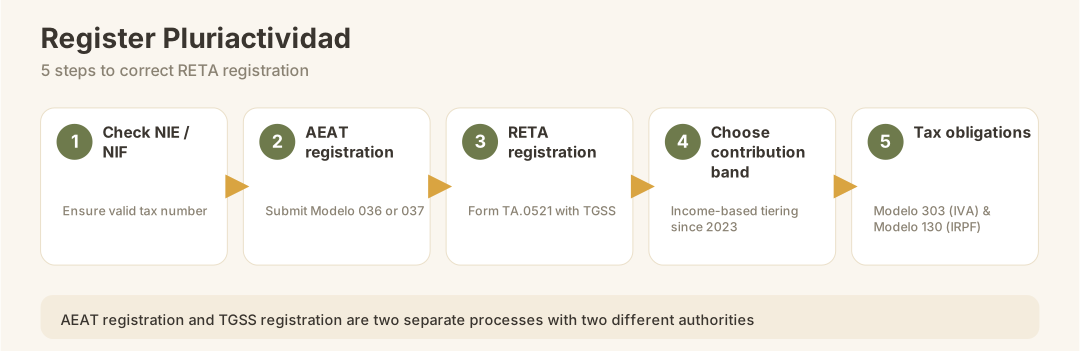
Registration with the RETA alongside existing employed work is done via form TA.0521, which must be submitted to the Tesorería General de la Seguridad Social (TGSS). This can be done online via the Sede Electrónica of the Seguridad Social; you will need your Cl@ve certificate or a digital certificate.
Step-by-step registration for Pluriactividad:
- Check your NIE / DNI and tax registration — you will need a valid tax identification number (NIF); if you do not yet have one, apply for it first
- Register your activity with the Agencia Tributaria (AEAT) — form Modelo 036 or 037 (Censo de Empresarios, Profesionales y Retenedores)
- RETA registration via TA.0521 — with the TGSS, ideally on the day your activity begins or before; retrospective registrations are possible but incur late-payment surcharges
- Choose your contribution band in the RETA — since 2023, the Spanish contribution system has been switched to an income-based tiered structure; you declare your expected net income
- Take on your tax obligations — depending on your activity: quarterly VAT returns (Modelo 303) and IRPF advance payments (Modelo 130 or 131)
Please note: AEAT registration and TGSS registration are two separate processes with two different authorities. Many people make the mistake of completing only one of them.
Social security contributions for Pluriactividad 2026
The new income-based contribution system, introduced gradually since January 2023, also applies to those in Pluriactividad. You pay contributions both under the Régimen General (automatically via your employer) and under the RETA (yourself). When both contribution streams are added together, the total annual burden may exceed the legally stipulated contribution ceiling.
The contribution ceiling 2026
The Seguridad Social sets a maximum contribution base each year. For 2026, this maximum amount stands at 17.323,68 € per year. Anyone in Pluriactividad who, across both schemes over the course of the year, exceeds this amount has overpaid.
| Key figure | 2026 value |
|---|---|
| Annual contribution ceiling (tope máximo) | 17.323,68 € |
| Refund rate upon exceeding the ceiling | 50 % of the surplus amount |
| Maximum theoretical refund | up to 8.600 € |
| Deadline for automatic refund | generally by 30 April of the following year |
Under the law, the refund is supposed to be processed automatically — meaning the Seguridad Social sends you a notice after the end of the year and transfers 50 % of the surplus to you, without you having to take any action. In practice, however, this does not work reliably.
The problem with the automatic refund
A report by the Colegio Oficial de Graduados Sociales de Madrid from February 2026 documents that the Seguridad Social makes errors during the regularisation process for many pluriactive workers: instead of receiving a refund, those affected receive payment demands for amounts sometimes exceeding 2.000 €. According to data from the Asociación de Trabajadores Autónomos (ATA), the vast majority of those entitled to a refund have never received it.
What this means for you: you should not wait passively, but instead actively check your Cotizaciones and, if necessary, lodge an objection yourself.
What to do if the refund fails to arrive or an incorrect notice is issued?
- Gather both Cotizaciones statements (Régimen General from your employer, RETA from the Sede Electrónica)
- Add up the annual totals from both schemes and compare them with the Tope of 17.323,68 €
- If the limit is exceeded: submit a formal application (solicitud de devolución de cotizaciones) to the TGSS
- If an unjustified payment demand is received: observe the deadline for the Recurso de Alzada (objection) — generally 1 month from the date of service
- If necessary: consult a Graduado Social or tax adviser
Please note: The limitation period for refund claims against the Seguridad Social is generally 4 years. Old claims can therefore still be pursued — but only with complete supporting documentation.
Tarifa Plana or Pluriactividad bonus — which is better?
Anyone registering with the RETA for the first time whilst also in employment faces a genuine choice: the standard Tarifa Plana or the specific Bonifikation für Pluriaktive. Both cannot be claimed at the same time.
Tarifa Plana 2026
The Tarifa Plana is a reduced contribution rate for new registrants in the RETA. In 2026, owing to the added Mecanismo de Equidad Intergeneracional (MEI, 0.9 %), it amounts to approximately 88 € per month in the lowest income bracket. The Tarifa Plana applies for 12 months (extendable under certain conditions) and is independent of income.
Pluriactividad reduction
Those who are pluriactive and newly registering with the RETA may instead opt for a contribution reduction tailored specifically to their situation, which is based on the actual hours worked and the concurrent Régimen General contributions.
| Criterion | Tarifa Plana | Pluriactividad reduction |
|---|---|---|
| Who is it for? | All new RETA registrants | Pluriactive workers only (simultaneously RG + RETA) |
| Amount 2026 | approx. 88 €/month | Dependent on income and hours worked |
| Can they be combined? | No – one or the other | No – one or the other |
| Duration | 12 months (extendable if applicable) | Depending on the applicable rules |
| Advantage | Planning certainty, straightforward | Can be more beneficial with high RG contributions |
Which option is more advantageous for you depends on your income mix. If you have a high employed salary and correspondingly high RG contributions, the Pluriactividad reduction is often the better choice, since you are heading towards the cap regardless and can generate a refund in any case.
Tax obligations as a pluriactive worker
On the tax side, pluriactividad initially changes little in terms of the basic principle – you are liable to tax in Spain as soon as you establish your tax residence here (generally from 183 days of stay per year). At that point IRPF (Impuesto sobre la Renta de las Personas Físicas) applies, and both sources of income are added together.
What this means for your tax burden
Your employed income and your self-employed income flow into a income tax return (Renta). This has consequences: high combined income from both sources can push you into a higher progressive tax bracket.
| Income source | Tax treatment |
|---|---|
| Employment income (Rendimientos del trabajo) | Employer deducts withholding tax (retención) |
| Self-employment income (Rendimientos de actividades económicas) | Quarterly advance payments via Modelo 130 |
| IVA on self-employed services | Declare quarterly via Modelo 303 |
| Annual settlement | Annual Renta return (April–June) |
A common mistake: those who already pay withholding tax as an employee assume that covers everything. In fact, as an autónomo you mustadditionally make advance payments (Modelo 130) and remit IVA — insofar as your activity is subject to IVA obligations. Certain freelance activities (e.g. medical, education) may be exempt.
Further reading: IRPF deductions in the Balearic Islands — what you can claim on your taxes as a self-employed person and as an employee.
Social security cover: what do you get for it?
One advantage of pluriactividad is that you build up entitlements in both systems — albeit with certain limitations.
| Benefit | Régimen General | RETA |
|---|---|---|
| Health insurance (Asistencia Sanitaria) | Yes, via employer | Yes, upon proper registration |
| Unemployment benefit (Paro) | Yes, from RG contributions | No (autónomos have no entitlement to Paro from RETA) |
| Sick pay (Incapacidad Temporal) | Yes (from day 4) | Yes (from day 4, if contributions have been made) |
| Pension entitlements | Yes, from RG contributions | Yes, from RETA contributions – these are added together |
| Maternity/paternity | Yes | Yes |
Building up a pension is one of the underrated advantages: you accumulate contribution periods in both schemes, which add up towards your future pension – although there is a maximum limit on what is credited. More on this in the guide Applying for a pension in Spain.
Please note: You only build up entitlement to unemployment benefit (Paro) through your employment relationship. If you lose your salaried job, you can apply for Paro – but if you remain active as an autónomo, this can affect the benefits you receive. More on applying for Paro
The most common mistakes with Pluriactividad
Mistakes cost money – whether through back payments, missed refunds, or fines. Here are the most common pitfalls:
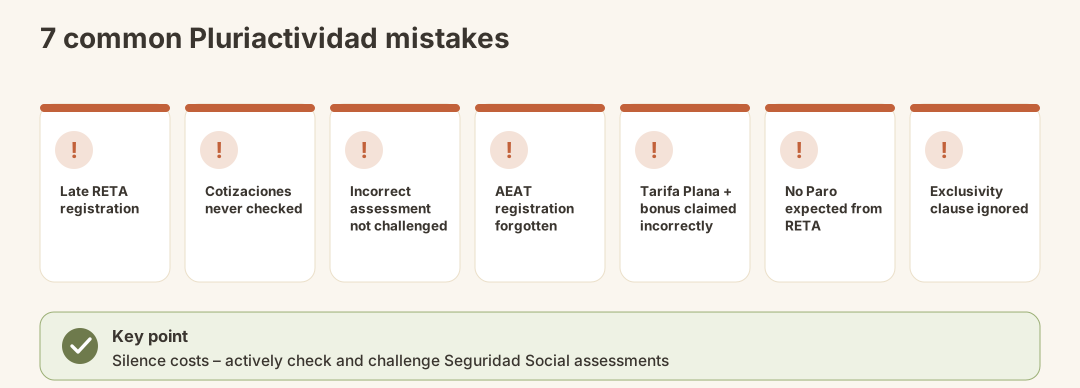
1. Late or missing RETA registration Anyone who registers after commencing their activity will face back payments plus late-payment interest. Registration should take place no later than the first day of trading.
2. No check of cotizaciones at the end of the year Most pluriactive workers never check whether they have exceeded the contribution ceiling – and thereby forfeit their refund.
3. Failure to challenge an incorrect notice from the Seguridad Social According to the report by the Colegio de Graduados Sociales Madrid (February 2026), thousands of pluriactive workers incorrectly receive payment demands instead of refunds. Those who say nothing end up paying.
4. Forgetting to register with the AEAT Tax registration with the Agencia Tributaria (Modelo 036/037) is separate from registration with the TGSS. Many people start with the RETA but forget the AEAT – which leads to problems with VAT (IVA) remittances.
5. Trying to claim the Tarifa Plana and the Pluriactividad bonus at the same time This is not possible. Once you have chosen one, you generally cannot switch.
6. Misconception: no Paro as a pluriactive worker Anyone who believes that paying into both schemes also entitles them to autónomo unemployment benefit is mistaken. The RETA's own protection against loss of income on cessation of activity (cese de actividad) operates independently of your employed status – and has its own eligibility requirements.
7. Ignoring an exclusivity clause in the employment contract Some employment contracts explicitly prohibit competing activities. Overlooking this can lead to employment law consequences.
Particular considerations for EU citizens and expats on Mallorca
Anyone relocating from Germany, Austria, or Switzerland to Mallorca often brings an ongoing employment relationship with them – sometimes as a remote worker for a German employer. This creates a complex interface: where are social security contributions owed? Where is the tax residence?
As a rule of thumb: anyone who moves their tax residence to Spain (Residencia, Empadronamiento, more than 183 days) is generally subject to social security obligations in Spain. For EU citizens, EU Regulation 883/2004 applies, which is intended to prevent double contributions – but its application in individual cases is complex.
Anyone who additionally takes up their own freelance or entrepreneurial activity (e.g. as a consultant, content creator, or landlord subject to VAT obligations) will quickly fall under Pluriactividad.
Key points of contact for expats on Mallorca:
| Authority / Resource | Responsibility |
|---|---|
| Tesorería General de la Seguridad Social (TGSS), Palma | RETA registration, Cotizaciones |
| Agencia Tributaria (AEAT), Palma | Tax registration, Modelo 036/037 |
| Institut Nacional de la Seguretat Social (INSS) | Benefit entitlements, pension information |
| Graduado Social / Asesor Fiscal | Individual advice, refund applications |
Further reading: Applying for Residencia in Spain | Remote work on Mallorca
What comes next? An overview of ongoing obligations
Registration is the first step. After that come regular obligations that you as a Pluriactivo need to keep on top of:
Quarterly (each due by the 20th of the following month):
- Modelo 303 – VAT advance return
- Modelo 130 – IRPF advance payment (estimated annual profit)
- Modelo 115 if applicable (if you rent an office or premises)
Annually:
- Modelo 390 – Annual VAT summary
- Modelo 100 – Income tax return (Renta, April–June)
- Cotizaciones check: compare the annual total of RG + RETA against the Tope
- Modelo 720 if applicable for foreign assets exceeding €50,000
Anyone who misses the deadlines pays surcharges (Recargos): for voluntary late filing up to 3 months after the deadline 5%, up to 6 months 10%, up to 12 months 15%, thereafter 20% plus interest.
Read more: Modelo 303 and 130 as an Autónomo | Taxes as a Resident
Checklist: Setting Up Pluriactividad Correctly
Before you get started, work through this list:
- Employment contract checked for exclusivity clauses
- NIF/NIE in place and up to date
- Empadronamiento completed with the local authority
- Tax registration with AEAT (Modelo 036 or 037) submitted
- RETA registration via TA.0521 with TGSS completed
- Contribution bracket (Tramo) selected under the new income-based system
- Decision made: Tarifa Plana or Pluriactividad bonus
- Accounting system for income/expenses set up
- Quarterly tax deadlines entered in the calendar
- At year end: compile Cotizaciones evidence for RG + RETA and check against the Tope (17.323,68 €)
- Submit refund application with TGSS if applicable
Conclusion
Pluriactividad is legal in Spain, widely practised, and can be well worth it — both financially (refund of excess contributions) and in terms of social security entitlements (pension claims from two systems). The devil is in the detail: registration must be carried out in two separate systems, the contribution ceiling of 17.323,68 € (2026) is not reliably monitored automatically by the Seguridad Social, and erroneous assessments are a documented norm. Anyone who knows their figures, actively checks them, and brings in a Graduado Social when in doubt can reclaim what they are rightfully owed.
For expats on Mallorca, there is an added international dimension: social security obligations, tax residency, and the relationship with a foreign employer must each be assessed on an individual basis. An experienced tax adviser for expats is not a luxury here, but an investment that pays for itself quickly.
📩 Submit a personal enquiry — have your situation reviewed by experts before you register.
Official Sources
- Seguridad Social – RETA and Pluriactividad: https://sede.seg-social.gob.es
- Tesorería General de la Seguridad Social (TGSS) – Form TA.0521: https://www.seg-social.es/wps/portal/wss/internet/Trabajadores/Afiliacion/10817/10819
- Agencia Tributaria (AEAT) – Modelo 036/037: https://www.agenciatributaria.es
- BOE – Ley 20/2007, Estatuto del Trabajo Autónomo: https://www.boe.es/buscar/act.php?id=BOE-A-2007-13409
- Seguridad Social – Contributions and Maximum Cap: https://www.seg-social.es
- AEAT – IRPF Income from Business Activities (Rendimientos actividades económicas): https://www.agenciatributaria.es/AEAT.internet/Inicio/La_Agencia_Tributaria/Campanas/Renta/Renta.shtml