
TIE Card Spain British Citizens: Your Proof of Residence After Brexit
Anyone who was legally living in Spain as a British national before 31 December 2020 enjoys a special protected status: the EU-UK withdrawal agreement – known in English as the Withdrawal Agreement – secures essentially the same rights you had as an EU citizen. The specific proof of this status is the TIE card Spain (Tarjeta de Identificación de Extranjeros, a physical ID card in credit-card format. Without this card you may still technically hold your rights, but you have no reliable proof of them when dealing with authorities, employers or banks. In this guide you will find out exactly who is protected, which two types of card exist, how the initial application and renewal processes work, what documents you need – and the mistakes that British nationals in Mallorca and across the rest of Spain repeatedly make.

Are you a British national in Mallorca and unsure whether your TIE is still current or exactly what status you hold?
- 📩 Submit a personal enquiry — We will clarify your individual situation and point you in the right direction
- All official-authority topics at a glance
What is the Withdrawal Agreement and who is protected?
The withdrawal agreement between the EU and the United Kingdom came into force on 1 February 2020. It protects British nationals and their family members who had established their residence in an EU member state such as Spain before the end of the transition period – that is, before 31 December 2020 – and guarantees them the continued enjoyment of their existing rights: to live, work, study and travel between the UK and the EU.
The crucial point is that these rights are based on life decisions taken before the cut-off date. Anyone who moved to Spain after 31 December 2020, or who wishes to do so, does not fall under the Withdrawal Agreement and must instead apply for a standard third-country visa – such as the Non-Lucrative Visa, the Digital Nomad Visa or the Golden Visa.
Who is specifically covered by the protection?
| Category of person | Protected under the Withdrawal Agreement? |
|---|---|
| British national with Residencia/Green Card obtained before 31.12.2020 | ✅ Yes |
| British national with an A4 certificate (Certificado de Registro) obtained before 31.12.2020 | ✅ Yes |
| British national who moved to Spain only after 31.12.2020 | ❌ No – third-country rules apply |
| Family members (spouse, children, parents) of a protected person | ✅ Yes, subject to certain conditions |
| British national with no prior registration in Spain whatsoever | ❌ No |
Please note: Family members who assert their claim after the cut-off date must satisfy certain requirements under EU law in order for their rights to be secured as well.
The two card types: 5-year and 10-year TIE
Not all TIE cards look the same – and that is no coincidence. The expiry date immediately tells you what residency status you held when the card was issued.
| Card type | Period of validity | Prerequisite | Next step |
|---|---|---|---|
| Temporary TIE | 5 years from the date of issue | Residency status was still temporary at the time of issue | Renewal or upgrade to permanent residency |
| Permanent TIE | 10 years from the date of issue | Already held permanent residency status at the time of issue | Renewal after 10 years |
When does temporary become permanent?
The status of permanent resident begins 5 years from the date on which temporary residency was originally granted – not from the date the TIE card was issued. This is a common misconception: someone who applied for their TIE late may nonetheless have already acquired the right to permanent residency at an earlier point.
First application: how to obtain your first TIE as a Withdrawal Agreement beneficiary
If you do not yet have a TIE but were registered in Spain before 31 December 2020 (green EU citizen card or A4 certificate), you need to convert your old registration into a TIE. Anyone who did not have registration at the time but can demonstrably show they were living in Spain before the cut-off date can, in many cases, still submit a retrospective application – however, a valid reason (razón justificada) is required.
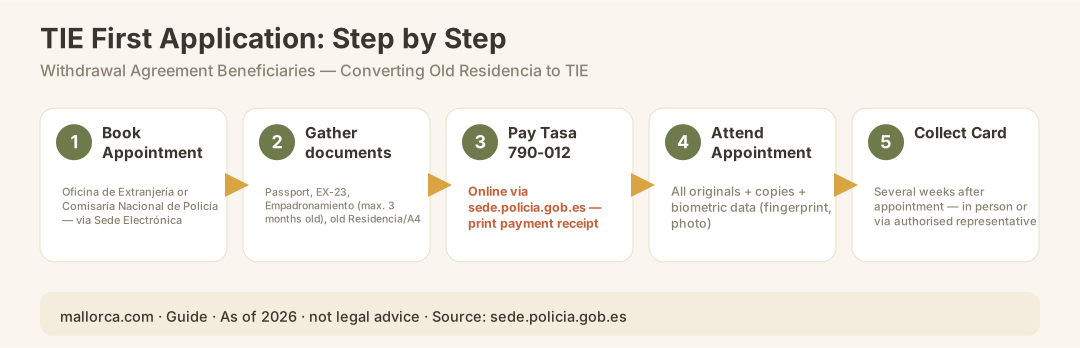
Step by step: first TIE application (Withdrawal Agreement)
- Book an appointment at the relevant Oficina de Extranjería or the Comisaría Nacional de Policía. In Palma de Mallorca this is typically the Comisaría Provincial. Appointments are made through the government portal Sede Electrónica.
- Gather your documents (see the table below).
- Pay the Tasa 790-012 – the administrative fee for the TIE card. You can find the current amount directly on sede.policia.gob.es or via the AEAT, as fees are subject to change.
- Attend your appointment, bringing all originals and copies, and provide your biometric data (fingerprints, photograph).
- Collect your card – usually a few weeks after the appointment, either in person or via an authorised representative.
What documents do you need?
| Document | Details |
|---|---|
| Valid British passport | Original + copy of all relevant pages |
| Previous proof of EU registration | Green Residencia card or A4 certificate (Certificado de Registro de Ciudadano de la UE) |
| Completed application form EX-23 | Specific to Withdrawal Agreement cases |
| Proof of residence | e.g. Empadronamiento certificate (no more than 3 months old) |
| Paid Tasa 790-012 | Receipt of the fee payment |
| Passport photo | Biometric, recent |
Please note: Anyone who did not hold an EU registration certificate at the time and received a 5-year TIE directly upon their initial application will need to provide an additional step at the time of renewal, demonstrating that the conditions for permanent residence have been met. This case is explained further below.
Renewing your TIE: what British nationals under the Withdrawal Agreement need to know
The TIE card itself is merely the physical carrier of your right of residence – the right itself does not automatically expire when the card does. Nevertheless, you should not leave the renewal too late: an expired card can cause considerable problems in everyday life (bank account, employer, travel).
Please note: You will not generally receive an automatic reminder from the authorities. Make a note of the expiry date in your calendar yourself.
Deadline: ideally 60 days before expiry
Apply for the renewal ideally within 60 days before the expiry date of your current card. This is in line with general practice and prevents any gaps. Applying later does not automatically result in the loss of your right of residence, but it can lead to complications.
Renewal: temporary TIE → permanent TIE
When your 5-year TIE expires and you have since lived legally in Spain for 5 years (counted from the date your residence was originally granted), you can upgrade directly to the permanent TIE (10 years). You do not need to apply for a temporary card again.
Renewal: permanent TIE (10 years)
After 10 years, the permanent TIE must also be renewed. Your right of residence itself is unaffected – it is simply a matter of renewing the physical document.
Special case: initial 5-year TIE without a prior green card
Anyone who did not present a green EU citizen card at the time of their initial application but nevertheless received a 5-year TIE will need to provide additional evidence at renewal demonstrating that the conditions for Withdrawal Agreement status were actually met – i.e. that residence prior to 31 December 2020 can be proven. This may require bank statements, tenancy agreements, school certificates, or similar documentation.
Schengen controls and the 90/180-day rule: what applies to you?
A common misconception: British nationals with a valid TIE and Withdrawal Agreement status are not subject to the 90/180-day rule of the Schengen Area when staying in Spain (their country of residence). The Schengen restriction applies to stays in other Schengen countries.
Since Brexit, Spain has been systematically checking at its borders whether British nationals who are not registered in Spain are complying with Schengen entry requirements. Anyone arriving from the UK without a TIE or other proof of residency will be assessed by passport stamps.
In brief:
| Situation | Does the 90/180-day rule apply? |
|---|---|
| British national with TIE (Withdrawal Agreement), residing in Spain | ❌ No |
| British national with TIE, short trip to other Schengen countries | ✅ Yes, for the other countries |
| British national without TIE, holiday trip to Spain | ✅ Yes |
For more information on what applies to British nationals without residency, see our guide to the 90/180-day rule.
Empadronamiento: The Often-Forgotten Obligation
The TIE alone is not enough. As a resident, you are required to register with the relevant town hall (Ayuntamiento) — this is known as Empadronamiento. The registration certificate (Certificado de Empadronamiento) is a mandatory document for many official procedures, including the TIE application itself.
On Mallorca, the relevant Ayuntamiento is responsible — in Palma it is the Ayuntamiento de Palma, in Calvià the local town hall, and so on. The certificate must generally be no more than 3 months old when used for official purposes.
We explain everything on this topic in detail in our Empadronamiento Mallorca guide.
Most Common Mistakes When Applying for the TIE as a British National
The same stumbling blocks come up time and again in practice on Mallorca and in other Spanish provinces:
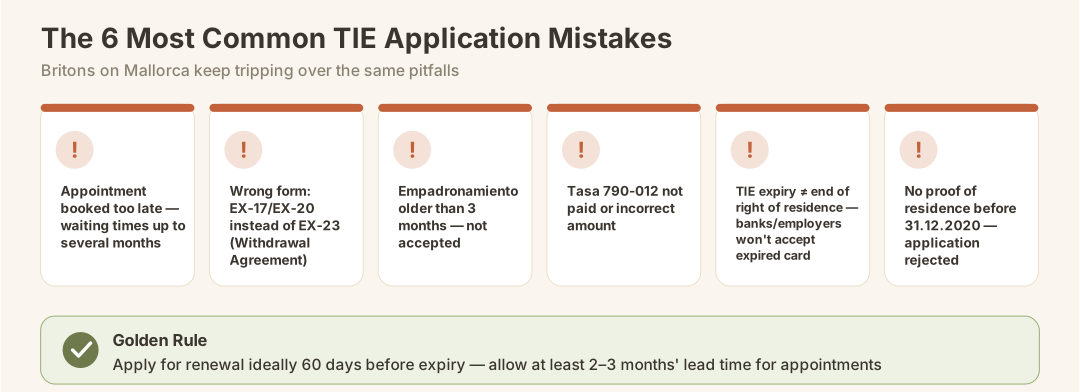
Booking an appointment too late. Waiting times at the Oficina de Extranjería can be several weeks or even months depending on the season. Start looking for an appointment at least 2–3 months before your card expires.
Using the wrong application form. For Withdrawal Agreement cases, the applicable form is EX-23, not the EX-17 or EX-20, which are used for other foreigners. Using the wrong form will result in the appointment being rejected.
Empadronamiento certificate is out of date. Many people bring a certificate that is more than 3 months old — this will not be accepted.
Tasa not paid or incorrect amount. The fee must be paid before the appointment and proof of payment must be brought along. Online payment via the official website is possible.
Confusion between TIE expiry and right of residence. The right of residence does not automatically expire with the card — however, banks, employers and sometimes border controls will not accept an expired TIE as proof.
No proof of residence before the cut-off date. Those who did not hold a green registration certificate must provide alternative evidence that they were resident in Spain before 31 December 2020. Without this proof, the application may be rejected.
NIE number missing or unknown. The TIE displays your Spanish foreigner identification number (NIE). Anyone who does not know their NIE should clarify this beforehand. More on this: NIE Number Mallorca.
What comes next? Rights and obligations with the TIE
A valid TIE is the key to many further steps in Spain:
- Tax obligations: Anyone who lives in Spain for more than 183 days per year is considered a tax resident and must file an income tax return (IRPF). More on this: Taxes as a Resident
- Health insurance: As a resident, you are generally entitled to access public healthcare — where applicable via the S1 form from the UK. Read more: S1 Form Spain
- Vehicle: Your British driving licence remains recognised under the Withdrawal Agreement, but must generally be exchanged after a certain period. Details: Exchanging Your Driving Licence
- Bank account: The TIE is essential as proof of identity when opening a bank account. Opening a Bank Account in Spain
- Asset declaration: Anyone holding assets abroad (including in the UK) above certain thresholds must be aware of the Modelo 720. Modelo 720
Checklist: Applying for or renewing the TIE
- Expiry date of the current TIE (or green card) checked
- Appointment booked at the Oficina de Extranjería or Comisaría Nacional de Policía (at least 2–3 months in advance)
- Form EX-23 fully completed
- Valid British passport (original + copy)
- Previous proof of residence (green card / A4 certificate) or other evidence predating 31.12.2020
- Current Empadronamiento certificate (no more than 3 months old)
- Tasa 790-012 paid, proof of payment printed out
- Recent biometric passport photograph
- NIE number known and correct
- Upon renewal: temporary or permanent status checked (5 years since initial grant?)
Conclusion
For British nationals on Mallorca and throughout Spain, the TIE card is more than a piece of plastic — it is physical proof of a legally complex yet well-protected status. The Withdrawal Agreement safeguards you for life, provided you continue to meet the requirements and actively maintain your status. That means: renewing your card on time, keeping your empadronamiento up to date, and knowing which forms you need. Anyone who has these basics under control can live on the island with full legal certainty — without the bureaucratic surprises that catch other newcomers off guard.
If you have any doubts about your specific status, it is worth visiting a gestoría or speaking directly with the Comisaría.
Official Sources
- EU–UK Withdrawal Agreement: https://eur-lex.europa.eu/legal-content/EN/TXT/?uri=CELEX:12019W/TXT%2802%29
- European Commission – Citizens' Rights under the Withdrawal Agreement: https://commission.europa.eu/strategy-and-policy/relations-united-kingdom/eu-uk-withdrawal-agreement/citizens-rights-0_en
- Spanish Ministry of Foreign Affairs – TIE information page: https://www.exteriores.gob.es
- Sede Electrónica de la Policía Nacional (appointment booking, forms, Tasa 790): https://sede.policia.gob.es
- ATIB (Agència Tributària de les Illes Balears): https://www.atib.es
- AEAT (Agencia Estatal de Administración Tributaria): https://www.aeat.es