
Fines in Spain: paying a Multa, lodging an appeal, and understanding the points system
A fine in Spain can catch you out faster than you think – driving too fast on the motorway, briefly holding your phone, an unfamiliar parking regulation in Palma de Mallorca. Anyone who knows the rules of the Spanish road traffic authority DGT will, if in doubt, pay only half, lodge an objection within the deadline, or avoid a penalty notice showing up years later via cross-border enforcement in Germany. This guide explains how the three categories of offence work, what specific amounts appear in the Spanish fine schedule, how the Spanish points system is structured, how to pay online or by bank transfer, when and how an appeal makes sense – and what happens if you simply do nothing.

Have you received a fine from Spain and are not sure how to proceed?
- 📩 Submit a personal enquiry — We connect you with experienced lawyers and tax advisers in Mallorca
- Cars & Transport in Mallorca – all guides
The three offence categories of the DGT
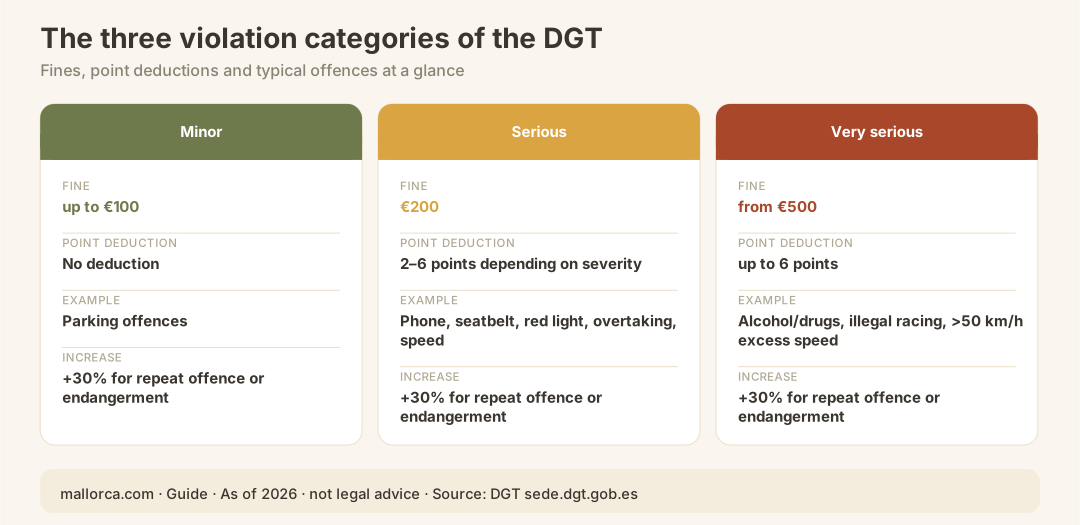
Spanish road traffic law does not apply flat-rate amounts to individual cases, but instead uses a three-tier penalty system. The responsible authority is the Dirección General de Tráfico (DGT), comparable to the German Federal Motor Transport Authority, but with significantly broader enforcement powers.
| Category | Examples | Fine |
|---|---|---|
| Minor | Most parking offences | up to €100 |
| Serious | Speeding, running a red light, overtaking offences, using a phone while driving, no seatbelt | €200 |
| Very serious | Drink/drug driving, illegal racing | from €500 |
Please note: In the case of repeated offences or an additional specific risk to other road users, the fine may be increased by 30 per cent.
The category determines not only the monetary amount, but also whether points are deducted from your Spanish driving licence account (more on this below).
Spanish fine schedule: a summary of specific amounts
The following table summarises the most common offences encountered in practice – particularly relevant for newcomers to Mallorca or holidaymakers travelling by hire car or their own vehicle.
| Offence | Fine |
|---|---|
| Speeding > 20 km/h | from €100 |
| Speeding > 50 km/h | from €600 |
| Running a red light | from €200 |
| Overtaking offences | from €200 |
| Parking offence | up to €200 |
| Mobile phone at the wheel | from €200 |
| Seatbelt not worn | from €200 |
| Drink-driving | from €500 |
| Warning vest not carried | up to €90 |
Please note: For speeding offences, the fine increases considerably depending on the degree of excess and the type of road – up to €600 for the most serious category. The DGT brochure in German lists the exact thresholds in table form (see the sources section).
For drivers who do not yet hold a Spanish licence: traffic fines in Spain have no effect on the Flensburg penalty points record in Germany. They are entirely separate systems.
The Spanish points system – how the "carnet por puntos" works
Spain has its own driving licence points system, which is fundamentally different from the German model in Flensburg: in Spain, every licence holder starts with a points balance and loses points for offences. Anyone who loses all their points temporarily loses their licence.
| Category | Starting points |
|---|---|
| New drivers (less than 3 years' licence) | 8 points |
| Experienced drivers | 12 points |
Points are deducted for serious and very serious offences. The exact number of points deducted depends on the offence. Examples from the DGT table:
| Offence | Points deducted |
|---|---|
| Speeding (serious, fine €300) | 2 points |
| Speeding (serious, fine €400) | 4 points |
| Speeding (serious, fine €500) | 6 points |
| Very serious excess (> 50 km/h over the limit), alcohol, drugs | 6 points |
Anyone who has used up all their points must serve a disqualification period and then attend an awareness course before their licence is returned. Conversely, points can be regained after several years without any offences.
Note for residents: As a resident holding a Spanish licence, you are directly subject to the Spanish points system. On the subject of exchanging your licence, see also our guide to exchanging your driving licence in Spain.
How you receive the fine – and why you must act
Anyone stopped at a police checkpoint and cannot prove residency in Spain, must pay or deposit the fine immediately on the spot in order to be allowed to continue driving. Alternatively, the full amount can be deposited as a security payment, and the proceedings then continue as normal.
Anyone who is resident in Spain or whose vehicle is registered to a Spanish address will generally receive the penalty notice by post. The DGT sends out the notices. If the post cannot be delivered – for example because no Spanish address is on record or the notice comes back undeliverable – the fine will be published in the Tablón Edictal de Sanciones de Tráfico (TESTRA). This publication is legally deemed to constitute delivery.
Here is how to check whether you have any outstanding fines:
- Go to sede.dgt.gob.es
- Select "¿Tienes alguna multa?" (Do you have a fine?)
- Open the "Tablón Edictal – TESTRA" tab
- Enter your number plate or your NIE
- With a digital certificate you will receive more complete information
Please note: If a fine has been served via TESTRA and you have not received anything by post, the deadline for lodging an appeal still begins to run. Checking the portal regularly is therefore strongly recommended – especially if you have only recently registered in Spain.
You can find more information about registering in Spain and how it relates to your postal address in the guide to Empadronamiento auf Mallorca.
The 50 per cent discount: the most important rule when it comes to fines in Spain
This is the rule you should remember above all else: If you pay the fine within 20 days of delivery, you receive a 50 per cent discount. This applies to almost all administrative offences. A €200 notice will then cost you only €100, and a €600 notice only €300.
The 20-day period runs from the date of the notice (in the case of an on-the-spot check) or from the delivery of the notice by post or TESTRA. Once the reduced amount has been paid, the proceedings are closed – however, you thereby waive any right of appeal.
| Time of payment | Amount payable |
|---|---|
| Within 20 days | 50% of the fine |
| After the discount period has expired | 100% of the fine |
| After enforcement proceedings have been initiated | 100% + enforcement costs |
How to pay a Spanish fine – step by step
You have several options for settling a fine from Spain:
Option A: Online via the DGT portal
- Go to sede.dgt.gob.es/es/multas/
- Select the payment option and enter the details from your notice
- Pay by credit card or via a linked bank account
- Keep the payment receipt
Option B: Bank transfer You can obtain the bank details of the relevant authority directly by telephone. The DGT does not issue a standardised IBAN for this purpose, as different authorities are responsible depending on the offence.
Option C: In person in Spain Cash or card payment is possible at many bank branches as well as at the relevant traffic authority.
Note: The easiest way to pay from Germany is via the DGT's online portal. The German Consulate General in Barcelona and the Consulate in Palma both point to exactly this route.
Appealing against a fine notice – is it worth it?
Yes – but only under certain conditions. If you believe that the offence did not take place, that the notice was assigned to the wrong vehicle or driver, or that the proceedings contain procedural errors, you can lodge an appeal.
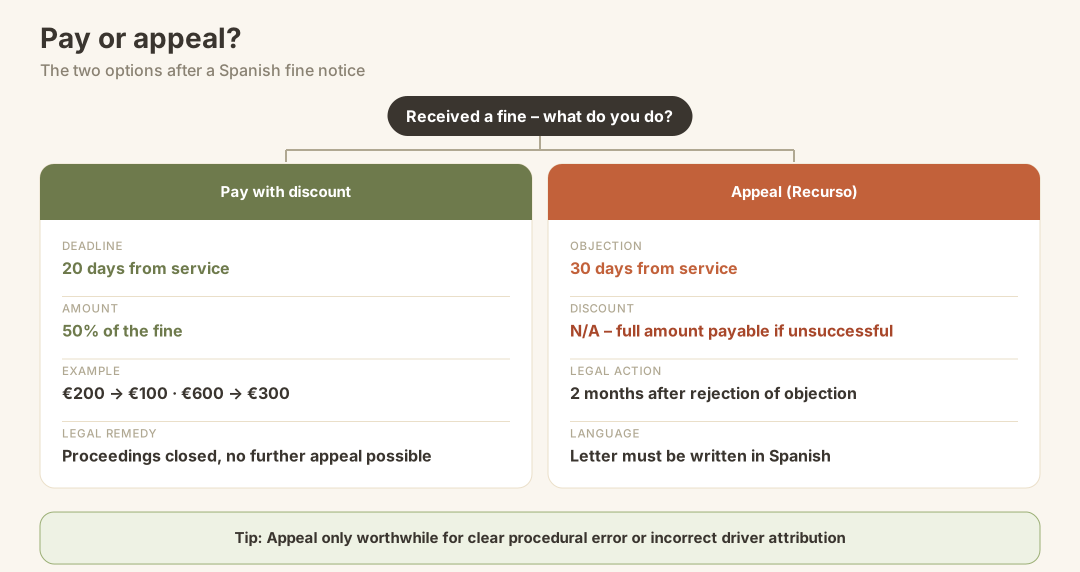
Important: Anyone who lodges an appeal loses the 50 per cent discount. If successful, you pay nothing at all; if unsuccessful, you pay the full amount.
Deadlines and procedure:
| Step | Deadline | Authority |
|---|---|---|
| Alegaciones (informal submission) at a roadside check | 20 days from the notice | Issuing authority |
| Recurso de reposición (formal objection) following service of the notice | 30 days from service | DGT or issuing authority |
| Recurso contencioso-administrativo (administrative court action) | 2 months after rejection of the objection | Administrative court |
The letter of appeal must be written in Spanish. It is advisable to engage a solicitor specialising in traffic law – particularly when penalty points or large sums are involved.
Caution: Fine notices served via TESTRA because no current address was registered are considered to have been validly served. In such cases, the deadline for appeal runs from the date of the TESTRA publication.
Enforcement in Germany – the EU agreement
Many people believe a Spanish fine can simply be ignored once they are back in Germany. This is a misconception. Spain makes use of EU Directive 2015/413 of 11 March 2015, which allows all member states to query vehicle keeper information across borders and to send notices to other EU countries.
On this basis, a Spanish fine can also be enforced in Germany. The key details are as follows:
| Provision | Detail |
|---|---|
| Minimum amount for cross-border enforcement | 70 Euro |
| Legal basis | Framework Decision 2005/214/JI of the EU |
| Vehicle Keeper Enquiry | Facilitated by EU Directive 2015/413 |
| Violations for which Spain actively sends notices abroad | Speeding, running red lights, alcohol/drugs, seatbelts, mobile phone use, running stop signs, and others |
Caution: Do not ignore any notice where the amount exceeds 70 Euro. Enforcement will follow – typically via the German Federal Motor Transport Authority, which passes on vehicle keeper data.
Particularities on Mallorca and the Balearic Islands
The traffic regulations on Mallorca are identical to those on the Spanish mainland – the same DGT rules apply. There is no independent Balearic traffic legislation for motor vehicles.
What may differ is local enforcement: Within towns such as Palma de Mallorca, Sóller, or Alcúdia, the local police (Policía Local) are responsible for parking violations and offences within the urban area. The Guardia Civil monitors country roads and motorways. On the island's autovías, speed checks by fixed and mobile cameras are commonplace.
On Mallorca, as throughout Spain, the following also applies:
- Blood alcohol limit: 0,5 per mille in general; 0,3 per mille for novice drivers (first two years) and professional drivers
- High-visibility vest requirement: In the event of a breakdown or accident, if you are outside the vehicle on the carriageway, wearing a high-visibility vest is compulsory; failing to carry one can result in a fine of up to 90 Euro
- Spare fuel canister: Carrying fuel in spare canisters is prohibited in Spain
If you have registered your vehicle on Mallorca or are planning to do so, read our guide on registering a car in Spain as well as on car insurance in Spain.
Most common mistakes when dealing with Spanish fines
These are mistakes we see time and again – and they needlessly cost money or cause stress:
Missing the 20-day deadline: The 50% discount is forfeited irrevocably. As soon as the notice arrives in your letterbox, you should act immediately.
Not knowing about TESTRA: Anyone who does not have a registered address in Spain, or fails to keep it up to date, will miss notifications via the electronic official gazette – yet the deadlines still run.
Filing an appeal without a solicitor: Formal errors in the appeal letter mean the appeal may be deemed out of time or insufficiently substantiated. This results in the full amount being due.
Believing Germany will not enforce: From 70 Euro upwards, cross-border enforcement is possible and is actively pursued.
Vehicle registered in someone else's name but driven by you: In Spain, liability falls initially on the registered keeper. The keeper may be required to identify the actual driver. Failure to do so risks a separate sanction.
Cash payment on the spot without a receipt: Always insist on a written proof of payment stating the fine reference number.
Checklist: What to do after receiving a fine in Spain?
- Note the date of delivery (this is when the 20-day discount period begins)
- Read the penalty notice in full and check the category of offence
- Decide: Pay (with discount) or appeal (full amount at risk, no discount)
- When paying: Online via sede.dgt.gob.es or bank transfer
- Keep proof of payment (for at least 3 years)
- If appealing: instruct a solicitor with knowledge of Spanish
- Check TESTRA regularly if you do not have a registered Spanish address
- Keep your empadronamiento up to date so that notices can be delivered to you
What comes next? Driving licence, insurance and Residencia
A fine is usually a one-off matter. However, anyone who lives or is planning to live on Mallorca should understand the broader context:
- Spanish driving licence: Residents are required to exchange their foreign driving licence. After that, the Spanish points system applies directly. → Exchanging your driving licence in Spain
- Motor insurance: Valid Spanish third-party liability insurance is compulsory. Additional penalties apply for non-compliance. → Motor insurance in Spain
- ITV (vehicle inspection): Driving without a valid ITV certificate also risks a fine. → ITV Mallorca
- Residencia: Anyone registered as a resident has a Spanish delivery address and will receive fine notices correctly. → Residencia Spain
Summary
A fine in Spain is nothing to panic about – as long as you know the rules of the game. The most important lever is the 50 per cent discount for payment within 20 days: missing that would simply be costly. The Spanish points system is entirely separate from the German Flensburg system, but it is very real for residents holding a Spanish driving licence. And anyone who thinks they can simply ignore a parking or traffic ticket from Spain will sooner or later be caught out by EU cross-border enforcement. Know the deadlines, use the DGT portal, and seek legal advice if in doubt.
Official sources
- DGT – Dirección General de Tráfico (fines, payment, TESTRA): sede.dgt.gob.es/es/multas/
- DGT brochure in German (traffic regulations, fine schedules): dgt.es – PDF Deutsch
- German Federal Foreign Office – traffic offences in Spain: spanien.diplo.de/es-de/service/2551542
- EU Directive 2015/413 on the cross-border exchange of information relating to road safety offences: eur-lex.europa.eu
- Council Framework Decision 2005/214/JHA on the application of the principle of mutual recognition to financial penalties: eur-lex.europa.eu