
ITV on Mallorca: Roadworthiness Test, Intervals, Price and cita previa
The ITV (Inspección Técnica de Vehículos) is the Spanish vehicle roadworthiness test, the equivalent of the German TÜV. Anyone driving a car on Mallorca cannot avoid it: once your vehicle reaches the prescribed age, you must take it for an ITV check at regular intervals, or you risk a fine and, in the event of an accident, problems with your insurance. The good news: Mallorca has the lowest ITV rates in the whole of Spain, five modern testing stations, and, since 2025, significantly shorter waiting times. In this guide you will find out when your ITV is due, what it costs, how to book an appointment (cita previa), and what you need to pay particular attention to as an expat or if you have an imported vehicle.

What is the ITV and why is it compulsory?
The ITV is the legally required technical vehicle inspection in Spain, governed by Real Decreto 920/2017. It checks whether your vehicle is roadworthy and meets emissions limits — functionally exactly what you know from Germany as the "TÜV" (technical inspection) combined with an emissions test.
On Mallorca, responsibility does not lie with private testing organisations such as TÜV or DEKRA, but with theConsell de Mallorca. The island government took over operations in 2020 and awarded a concession to a contractor (Itevebasa/Grupo somos ITV). This has had two noticeable consequences: rates have been the lowest in the whole of Spain since 2020, and the service is managed centrally via the portal itv.mallorca.es.
If you pass the ITV, you receive an inspection report (informe) as well as a sticker (pegatina) for the windscreen and a stamp in your vehicle registration document (tarjeta ITV). Only then are you legally permitted to continue using your vehicle on the road.
What the ITV specifically checks:
- General vehicle condition and safety components
- Braking system and braking performance on the test bench
- Lighting and electrical system
- Tyres, suspension, and bodywork
- Exhaust emissions (emissions check)
- Vehicle identification number (número de bastidor), registered modifications (reformas), and mandatory markings
How often do you need to go to the ITV? Intervals by vehicle type and age
The inspection interval depends on vehicle type and age, calculated from the date of first registration (primera matriculación) shown on your permiso de circulación. For a standard passenger car (category M1, up to 9 seats) the rule is: first inspection after 4 years, then every 2 years until the vehicle is 10 years old, and annually thereafter.
| Vehicle type | Exempt up to ... years | Interval thereafter |
|---|---|---|
| Passenger car / motorhome (M1) | exempt up to 4 years | 4–10 years: every 2 years · from 10 years: annually |
| Motorcycle / quad (category L) | exempt up to 4 years | from 4 years: every 2 years |
| Moped / light motorcycle (ciclomotor, up to 50 cm³) | exempt up to 3 years | from 3 years: every 2 years |
| Van / light goods vehicle up to 3,500 kg (N1) | exempt up to 2 years | 2–6 yrs: every 2 yrs · 6–10 yrs: annually · from 10 yrs: every 6 months |
| Classic vehicle (vehículo histórico) | – | up to 40 yrs: every 2 yrs · 40–45 yrs: every 3 yrs · 45–60 yrs: every 4 yrs · over 60 yrs: no compulsory ITV |
Note on motorcycles: In legislation, the motorcycle category L is defined by vehicle type rather than engine displacement. In practice: motorcycles over 50 cm³ (motorbikes, trikes, quads) are exempt for up to 4 years and are due every 2 years thereafter; light motorcycles up to 50 cm³ (ciclomotores, L1e) are exempt for up to 3 years and are likewise due every 2 years thereafter.
Classic vehicles over 60 years: Since the new Reglamento de Vehículos Históricos (in force since 1 October 2024), vehicles classified as historic that are older than 60 years are exempt from the periodic ITV exempt. An inspection is then only possible on a voluntary basis.
How to find your next ITV date:
- Check the date of first registration in the permiso de circulación (or on the vehicle registration document under "próxima inspección").
- Apply the interval rule for your vehicle type (cars: first ITV after 4 years).
- Alternatively, you can look up the exact due date in the electronic DGT file (sede electrónica DGT).
A car first registered in 2022 must therefore have its first ITV in 2026. Important: You may take the test up to 30 days before the due date without losing validity – the new interval still runs from the original due date.
ITV stations on Mallorca
The Consell de Mallorca operates five permanent stations distributed across the island. Since the opening of the Calvià station in January 2025 and the doubling of monthly appointment slots, waiting lists have fallen sharply – according to the Consell, at the start of 2026 an appointment can sometimes be obtained within three days, and in Calvià practically the following day.
| Station | Location / Address | Telephone | Note |
|---|---|---|---|
| ITV Palma I (Son Castelló) | Polígono Son Castelló, C/ Gremi de Sucrers i Candelers 2, 07009 Palma | 971 75 75 57 | Largest station, close to the city |
| ITV Palma II (Can Pastilla) | Can Pastilla, near the airport | via central booking | Convenient for the south-east of Palma |
| ITV Calvià | Polígono Son Bugadelles, C/ Son Thomas 6, 07181 Calvià | 871 55 07 69 | New (2025), shortest waiting time, ideal for the south-west (Andratx, Portals, Santa Ponça) |
| ITV Inca | Carretera Palma–Alcúdia, Km 30, 07300 Inca | 971 50 58 12 | Centre/north of the island |
| ITV Manacor | Manacor (east of the island) | via central booking | For the east/Llevant (Artà, Felanitx, Portocristo) |
Regular opening hours are Monday to Friday from 6:00 to approximately 21:15. Reduced summer hours apply in July and August (approximately 7:00 to 14:50). Choose the station closest to where you live – those in the south-west usually go to Calvià, and those in the east to Manacor. You can find up-to-date addresses and telephone numbers at any time on itv.mallorca.es.
The process and cita previa: how to book your appointment
For the periodic ITV, a pre-booked appointment (cita previa) is mandatory – you will not be seen without one. Booking is free of charge and takes just a few minutes.
- Book an appointment. Online via itv.mallorca.es or citaprevia.somositv.com or by telephone on 871 57 55 44 (Mon–Fri 9am–9pm, Sat 9am–2pm). Enter your registration plate (matrícula), vehicle type and autonomous community and you'll immediately see the next available appointments.
- Select a station and time slot. You can freely choose between the five stations and rebook an already-scheduled appointment online to a different station at a later date.
- Have your documents ready. You'll need to bring the permiso de circulación (registration certificate) and tarjeta de inspección técnica (vehicle card). For some vehicles, the most recent ITV report is also helpful.
- Arrive on time. Don't arrive too early; a delay of up to 30 minutes is tolerated, after which the appointment lapses and you'll need to rebook.
- Go through the inspection. You drive through the inspection lane yourself whilst the technician checks the brakes, lights, emissions, chassis number and safety components.
- Pay and receive your result. The fee is settled on-site by card (no cash). If you pass, you'll receive a sticker and an entry on your vehicle record.
The result can be favorable (passed, possibly with minor defects), desfavorable (serious defect, re-inspection required) or negativa (dangerous defect, driving ban).
Please note: For imports and non-periodic procedures (e.g. following a modification), a standard online cita previa is not required — these are handled directly through the ITV service of the Consell de Mallorca.
How much does the ITV cost in Mallorca?
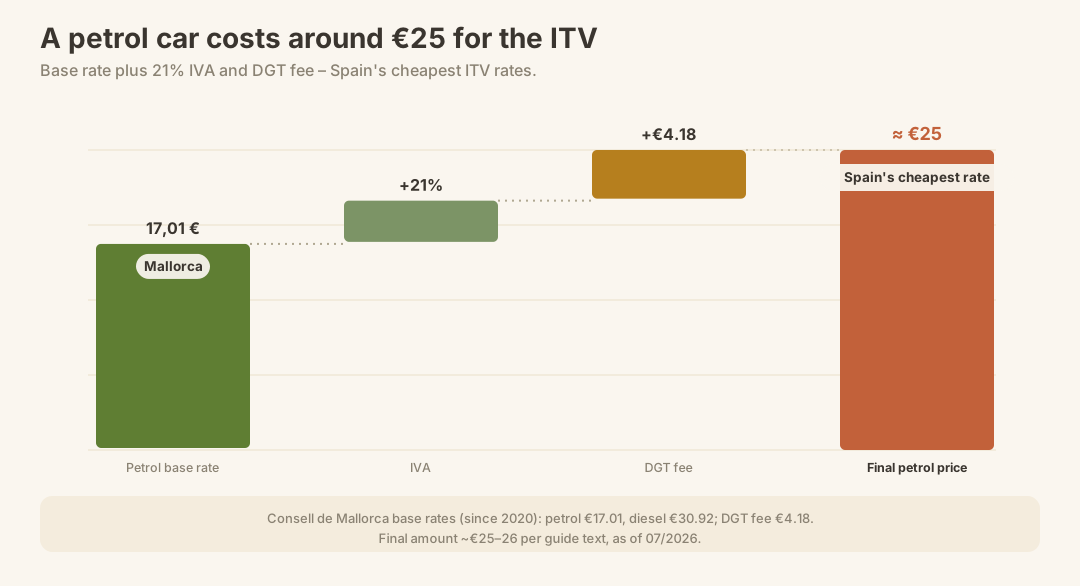
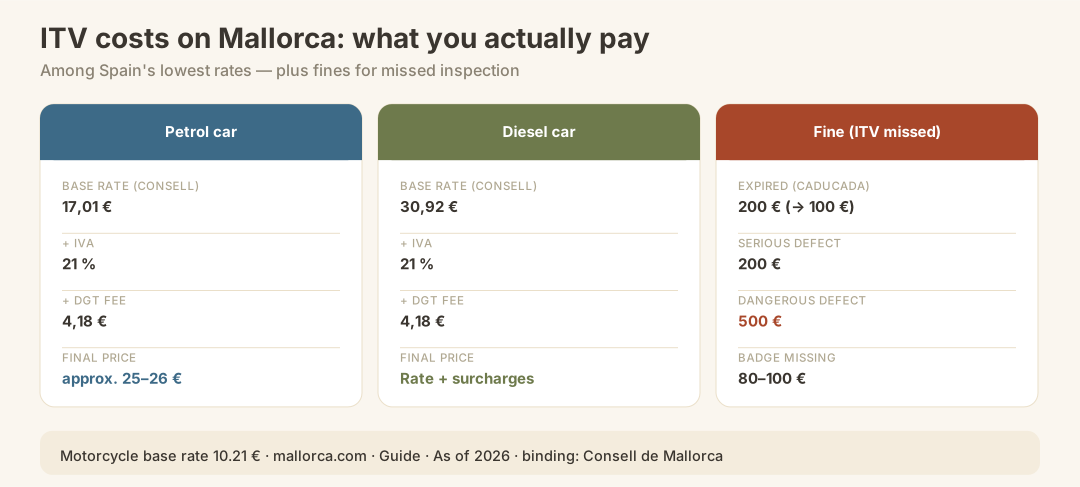
Mallorca has the lowest ITV rates in the whole of Spain — unchanged since 2020 at 17,01 € for petrol vehicles and 30,92 € for diesel. The following amounts set by the Consell de Mallorca represent the base rate; Spanish VAT (IVA, 21 %) and the DGT traffic levy (4,18 €) are added on top. In reality, you'll pay around 25–26 € for a petrol car, rather than the frequently cited average of over 40 € on the mainland.
| Vehicle | Base rate Mallorca | Comparison (expensive regions) |
|---|---|---|
| Petrol car (catalizado) | 17,01 € | up to over 50 € (e.g. Madrid) |
| Diesel car | 30,92 € | up to ~66,02 € (Madrid) |
| Motorcycle / moped | 10,21 € | several times higher on the mainland |
| Petrol car Menorca (comparison) | 25,55 € | – |
Practical money-saving tip for expats: Getting a car purchased in Germany through the ITV in Mallorca is considerably cheaper than a TÜV appointment in Germany. The low rates are a deliberate policy decision to ensure no one skips the mandatory inspection on cost grounds.
Note on rate stability: The Mallorca figures (17,01 €/30,92 €) have been confirmed as unchanged since 2020. Across Spain, however, the officially set maximum rates may rise in line with inflation (IPC) — the current figures published by the Consell de Mallorca are always binding.
What is checked during the ITV?
The inspection usually takes 20–40 minutes for a standard car. The technician works through a standardised checklist (Manual de Procedimiento de Inspección). The main inspection points are:
- Identification: Cross-checking the chassis number (bastidor) and registration plate against the documents, verification of any registered modifications (reformas).
- Brakes: Braking performance and evenness on the roller test bench, handbrake.
- Lighting: Headlight alignment, all lights, indicators, brake light.
- Axles, steering, suspension: Play, shock absorbers, tyre condition and tread depth.
- Bodywork and underside: Sharp edges, rust on load-bearing parts, exhaust mounting.
- Emissions: Exhaust measurement (petrol/diesel), noise levels.
- Visibility and safety: Windscreen, mirrors, seatbelts, horn.
Most common reasons for failing:
- Defective or incorrectly adjusted lighting – the classic one, often just a blown bulb.
- Worn tyres below 1,6 mm tread depth or with damage.
- Excessive emissions, particularly on older diesels.
- Unregistered modifications (towbar, alloy wheels, tuning) without legalisation.
- Brake problems due to worn pads or uneven braking performance.
Tip: A quick pre-check at the garage (Pre-ITV) – lights, tyres, brakes, fluids – will save you the cost of a re-test.
ITV caducada: Fines and consequences for an expired test
Anyone driving with an expired or failed ITV risks a fine – and, in the worst case, far worse. Responsibility rests solely with the registered keeper, who must keep track of the due date.
| Situation | Fine | Additional consequences |
|---|---|---|
| ITV expired (caducada) | 200 € | grave; possible confiscation of the registration document, deadline to rectify |
| ITV desfavorable (serious defect) | 200 € | only the journey to the garage permitted; 2 months to carry out repairs + re-test |
| ITV negativa (dangerous defect) | 500 € | muy grave; driving ban, immobilisation, towed away |
| Sticker not visible | 80–100 € | must be affixed to the bottom right of the windscreen |
Important to know:
- No penalty points: An expired ITV does not result in penalty points (Spain operates a points-based licence system), but solely in a monetary fine.
- Early-payment discount: The €200 fine can usually be halved to €100 if paid promptly (pronto pago). The €500 fine for a negativa is not reducible.
- Driving to the station: In practice it is tolerated to drive directly from your home to the ITV station with a confirmed cita previa, even if the ITV has expired. There is no explicit statutory provision for this — so always bring proof of your appointment, and clarify any doubts with the station in advance.
What happens to your insurance?
An expired ITV is often linked to the blanket statement that 'insurance won't pay' — but that is a legal oversimplification. Here is what actually applies:
- Third-party liability (responsabilidad civil obligatoria): Compulsory third-party liability continues to compensate injured third parties in all cases, even with an expired ITV. By virtue of the so-called cláusula de inoponibilidad, the insurer cannot use the missing ITV as a defence against the other party. However, the insurer may exercise the derecho de repetición against you as the registered keeper (i.e. seek reimbursement) — but only if a causal link between the technical defect or missing ITV and the accident is proven.
- Comprehensive cover (daños propios): The picture here is less favourable. For damage to your own vehicle, comprehensive cover may lapse in full or in part if the ITV was expired or had received a negativa.
The financial risk therefore lies less in the fine itself than in the potential right of recourse and the loss of comprehensive cover. Always keep your ITV up to date.
ITV for imported and foreign vehicles
Anyone who lives permanently in Mallorca (tax residence in Spain) must re-register a vehicle brought from Germany or another EU country onto Spanish plates — as a rule within 30 days of taking up residence (empadronamiento or obtaining residencia). Non-residents may drive on foreign plates for up to six months. The ITV is the central technical step in the re-registration process, even if the vehicle was recently inspected in its country of origin.
How the ITV works for an imported vehicle:
- Gather your documents. You will need the foreign permiso de circulación, the EU Certificate of Conformity (COC, certificado de conformidad), the purchase contract or invoice, and the keeper's DNI/NIE.
- Book an appointment directly with the ITV service. For imports there is no standard cita previa via the online portal — these procedures are handled by the ITV service of the Consell de Mallorca directly through an administrative process (expediente).
- Technical inspection. The station physically inspects the vehicle and issues the ficha técnica in Spanish format (tarjeta ITV española). For vehicles without an EU COC, an additional abbreviated technical report (ficha reducida) from an approved engineer is required.
- Taxes and registration. With the Spanish ITV card you proceed to the tax authority (impuesto de matriculación, between 0–14.75% depending on CO₂ emissions) and finally to the DGT, which issues the Spanish number plates.
Typical cost range for an import: ITV inspection €40–100, ficha reducida/homologation €100–400, DGT registration fee approximately €100, impuesto de matriculación 0–14.75% based on CO₂, plus €150–300 for a gestoría.
For vehicles from outside the EU the process is more involved: customs clearance (DUA), possible import duties and an individual homologation are required, which can take several weeks. In most cases it is worth engaging a gestoría to handle the paperwork.
What comes next? Your next steps with your car on Mallorca
Passing the ITV is usually just one piece of the puzzle when you're organising your life on Mallorca. These topics are directly connected:
- NIE number: Without the foreigner identification number, re-registration and tax matters won't get very far. → Applying for your NIE number on Mallorca
- Empadronamiento: Registering your residence at the town hall is a prerequisite for many official procedures and determines when the 30-day deadline for re-registering your vehicle begins. → Empadronamiento on Mallorca
- Moving abroad – general guidance: A comprehensive overview of registrations, authorities and deadlines can be found in the → Expat relocation guide.
Checklist: Ready for the ITV
- Due date checked on the permiso de circulación or via the DGT
- cita previa booked via itv.mallorca.es or by phone on 871 57 55 44
- permiso de circulación and tarjeta ITV to hand
- Lights, tyres (≥ 1,6 mm), brakes and wipers briefly checked beforehand
- Modifications (tow bar, etc.) entered in the vehicle documents and legalised
- Card payment ready (no cash accepted)
- For imports: COC, purchase contract, NIE and original documents complete
Conclusion
The ITV on Mallorca is more straightforward than many newcomers to the island fear: the intervals broadly mirror those of the German TÜV (first inspection at 4 years, then every 2 years, annually from 10 years onwards), the fees are the lowest in Spain, and through the Consell de Mallorca portal you can usually get an appointment quickly thanks to five inspection stations. Three things matter: book in good time (cita previa is mandatory), keep an eye on your due date — an expired ITV carries a fine of 200 € and can jeopardise your comprehensive insurance cover in the event of a claim — and, for an imported vehicle, factor in the ITV as a mandatory step in the re-registration process. If you keep your car well maintained and do a quick pre-check of your lights and tyres, you'll almost always pass first time.
Official sources
- Consell de Mallorca – ITV (official website, cita previa, stations)
- ITV Mallorca appointment booking (itv.mallorca.es)
- Real Decreto 920/2017 – ITV regulation (BOE)
- Itevebasa – ITV stations Baleares (addresses, opening hours)
- Administración General del Estado – re-registration of EU vehicles
This guide is intended for general orientation purposes only and does not replace legal, tax or traffic advice. ITV fees, intervals and fines are subject to change; the information provided by the Consell de Mallorca, the DGT and the applicable legislation is always binding. For vehicle imports and re-registration, the assistance of a gestoría is recommended. Information current as of: 2026.
Overview: Which authority requires which appointment and how to book it is covered in our Cita Previa guide for Mallorca.