
Car Insurance in Spain: Obligations, Cover & V16 Warning Light 2026
Anyone driving a car in Mallorca or on the Spanish mainland faces two important topics in 2026: the legally required motor insurance in Spain and a new safety regulation that has been in force since the start of the year. Motor insurance in Spain works similarly to the system in Germany – third-party liability, partial cover, and fully comprehensive – but has its own rules, different providers, and a few nuances that new residents and expats should be aware of. At the same time, the Spanish traffic authority DGT abolished the classic warning triangle on 1 January 2026 and replaced it with the V16 warning light. This guide explains what insurance obligations apply to your vehicle registered in Spain, what levels of cover are available, what the V16 light does and how it works – so that you can drive on Mallorca's roads legally and with confidence.

Why you need local motor insurance in Spain
Once you are registered as a resident in Spain and have a vehicle on Spanish number plates, your German motor insurance policy ceases to be valid. All vehicles used by residents in Spain must be registered in Spain – and require a valid Spanish motor insurance policy.
This also applies in Mallorca, where many expats initially want to continue driving their German car. After obtaining Residencia and re-registering the vehicle, the existing German policy generally no longer remains in force – at the latest by that point you must take out Spanish insurance.
Please note: Anyone travelling through Spain purely as a tourist with German number plates and a German registered address remains covered by their German policy. The obligation to switch applies only once you change your place of residence and re-register the vehicle.
The three levels of cover at a glance
The Spanish insurance system has the same three basic levels as the German one, but uses Spanish names and in some cases offers slightly different scope of cover.
| Level of cover | Spanish term | What is covered |
|---|---|---|
| Third-party liability | Seguro de Responsabilidad Civil | Personal injury & property damage to third parties; statutory minimum cover |
| Partial cover | Seguro a Terceros Ampliado / Completo | Third-party liability + fire, theft, glass breakage |
| Fully comprehensive | Todo Riesgo | All of the above + own-fault damage, vandalism, natural events |
Third-party liability insurance (Seguro de Responsabilidad Civil) is a legal requirement in Spain – no vehicle is permitted to take part in road traffic without it. It covers personal injury including medical costs, disability pensions and pain and suffering payments, as well as damage to third-party vehicles or property (e.g. crash barriers).
Partial cover extends this protection to include fire, theft of the entire vehicle, and glass breakage – such as a cracked windscreen, which occurs more frequently in Mallorca on rural roads due to the rougher road surfaces than in German towns.
Fully comprehensive cover (Todo Riesgo) additionally covers own-fault accidents, vandalism, and natural events. This level of cover is particularly recommended for newer or higher-value vehicles.
Additional benefits: what Spanish policies often include
Many Spanish motor insurance policies – particularly those aimed at expats – bundle in practical additional benefits that in Germany frequently cost extra or are not standard.
| Add-on | Typical availability |
|---|---|
| Breakdown assistance (24/7, nationwide) | often already included in basic tariffs |
| Breakdown assistance across Europe | usually in higher-tier tariffs |
| Replacement vehicle during repair | from partial cover level upwards |
| Legal protection (traffic law) | as an optional add-on or included |
| Driver accident insurance | as an optional add-on |
| Claims management & claims reporting | with specialist brokers |
| German-speaking customer service | with providers catering to expats |
The 24/7 breakdown service is particularly valuable on Mallorca: remote fincas or winding mountain roads in the Tramuntana range are not places where you want to wait hours for help.
Differences from German motor insurance
Anyone moving from Germany to Mallorca will notice that the Spanish system is structurally similar, but not identical.
| Feature | Germany | Spain |
|---|---|---|
| Compulsory insurance | Third-party liability | Third-party liability (Responsabilidad Civil) |
| No-claims discount | transferable nationwide, system regulated by law | less standardised; transfer from Germany is possible but not guaranteed |
| Green Card | EU standard | EU standard |
| Proof of insurance upon registration | Mandatory | Mandatory |
| Change of number plates upon relocation | not required | Vehicle must be re-registered with Spanish number plates |
Please note:Your no-claims bonus accumulated in Germany cannot be transferred automatically on a one-to-one basis. Some brokers who specialise in expats can submit a certificate of your German insurance history — whether and to what extent a provider will recognise this varies. Ask explicitly before you sign a policy.
The V16 Warning Light: What Applies from 1 January 2026
Since 1 January 2026 the Spanish road traffic authority DGT has abolished the warning triangle for vehicles registered in Spain. What is now compulsory is the so-called V16 warning light — a compact, amber flashing all-round light with a magnetic base that is attached to the roof of the vehicle.
The legal basis for this regulation is Real Decreto 159/2021, which prepared the phased introduction of the light and came into force on 1 January 2026.
Why Was the Warning Triangle Abolished?
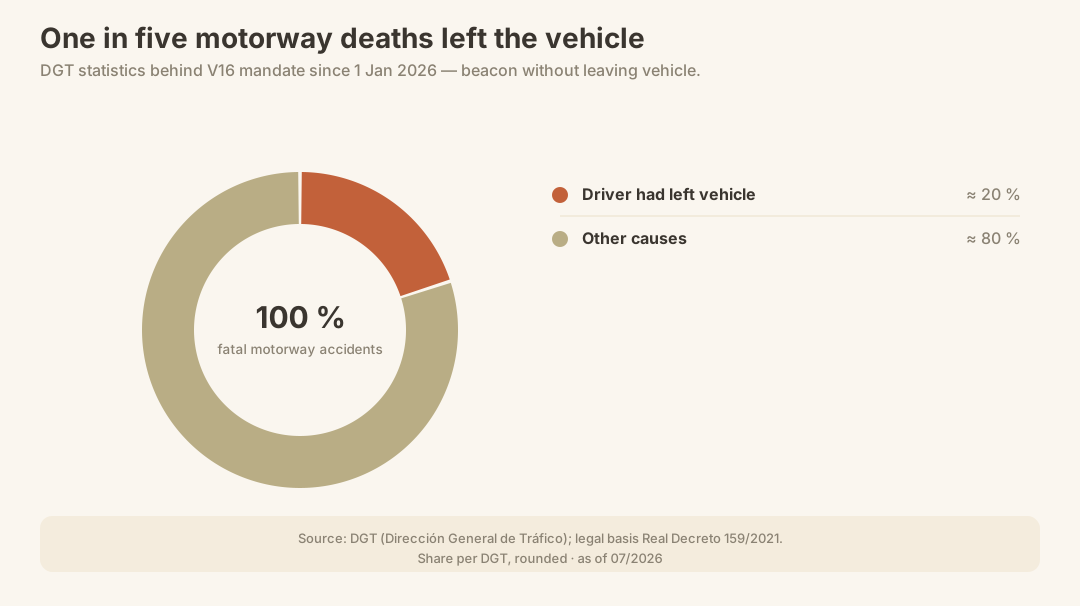
The DGT justifies the move with safety data: according to the authority, around 20 % of all fatal motorway accidents are attributable to situations in which drivers have left their vehicle — often to place a warning triangle. The risk is particularly high in poor visibility, at night, or in heavy traffic.
The V16 light solves this problem: it can be placed on the roof from inside the vehicle without leaving the vehicle.
Technical Requirements of the V16 Light
| Property | Requirement |
|---|---|
| Visibility | 360°, at least 1 km |
| Mounting | Magnetic base (for vehicle roof) |
| Power supply | Battery-operated (independent of the vehicle's electrical system) |
| Colour | Amber flashing |
| Storage location | recommended: glove compartment (within easy reach) |
| Approval | DGT approval required |
Newer models may be connected and able to automatically transmit the precise location of the broken-down vehicle to the relevant authorities and emergency services via GPS. Whether this feature is mandatory for all approved models should be verified against the current DGT approval list.
Note: Not every light available in shops is automatically DGT-approved. When purchasing, look out for the official DGT approval number. A light without a valid approval is legally considered non-existent.
Does the V16 Requirement Also Apply to Your German Car?
This is a question many people ask who are driving to Mallorca with their German vehicle or have not yet re-registered it.
| Vehicle situation | V16 requirement? | Warning triangle permitted? |
|---|---|---|
| Vehicle registered in Spain | Yes, from 1.1.2026 | No, no longer permitted |
| German vehicle (foreign registration) | Currently no requirement | Yes, still permitted |
| Hire car in Spain | Yes (hirer's obligation) | No |
For vehicles with foreign (e.g. German) registration there is currently no requirement to carry a V16 light — the warning triangle remains permitted for them. However, anyone who travels frequently in Spain would be well advised to carry a V16 light on a voluntary basis. In the event of a breakdown, it is more practical and safer than the triangle.
Hire cars in Spain must have the V16 light on board — this is the hire company's obligation. As a driver, you should check at vehicle handover that the light is present and DGT-approved.
Step by step: how to re-register your vehicle in Spain and insure it
If you are relocating your primary residence to Mallorca, the process typically runs as follows:
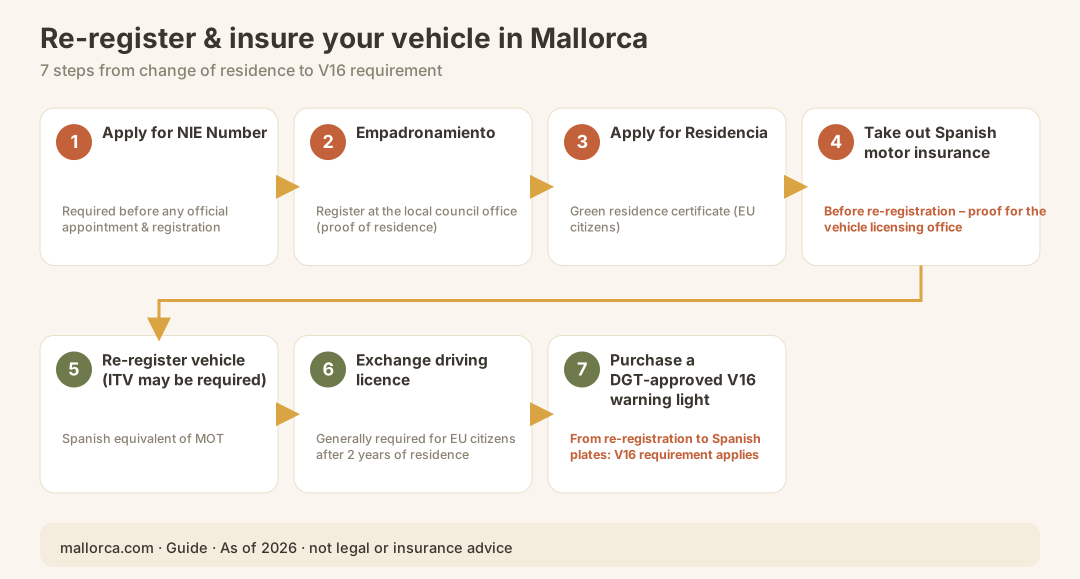
- Apply for your NIE number — without a NIE number you can neither open a bank account nor re-register a vehicle.
- Empadronamiento (registration with the local council office) — proof of residence required for many dealings with the authorities.
- Residencia application — EU citizens receive the green certificate of residence (Certificado de Registro de Ciudadano de la UE).
- Take out Spanish motor insurance — before re-registration, so that you can present proof of insurance at the vehicle licensing office.
- Re-register the vehicle (ITV inspection may be required) — the Spanish equivalent of the German Hauptuntersuchung. More on this in the guide to ITV on Mallorca.
- Transfer your driving licence — generally required for EU citizens after two years of residence in Spain.
- Purchase a V16 light — once the vehicle has been re-registered on Spanish number plates, the V16 requirement applies.
What to do in the event of a breakdown or accident on Mallorca?
In the event of a breakdown (vehicle registered in Spain):
- Switch on your hazard warning lights — immediately.
- Park the vehicle safely (preferably on the hard shoulder or behind the crash barrier).
- Place the V16 light on the roof through the window – without getting out.
- Put on your high-visibility vest before leaving the vehicle – the high-visibility vest is still required in Spain if you need to get out.
- Call breakdown service/insurance.
In the event of an accident:
- Call the police (112) if there are personal injuries.
- Fill in the European Accident Report (Parte Amistoso) – this is just as common in Spain as it is in Germany.
- Take photos of the accident, the vehicles, and number plates.
- Notify your insurance as quickly as possible – many policies have short reporting deadlines.
Please note: The high-visibility vest is still required in Spain even after the introduction of the V16, if you need to leave the vehicle. It is not a substitute for the V16 light, but an additional obligation.
The most common mistakes with car insurance on Mallorca
Those who have just moved to the island often fall into the same traps:
1. Driving on a German policy for too long After changing your place of residence and re-registering your vehicle, the German policy is generally no longer valid. In the event of a claim, this can become very costly.
2. Not documenting the no-claims bonus Ask your German insurer for a certificate confirming your claim-free years before you cancel. Without proof, you will start in Spain as a new driver.
3. Cheap policy without breakdown cover On Mallorca – with its mountain roads, remote fincas, and sometimes poorly lit country lanes – you should not go without a 24/7 breakdown service.
4. Forgetting the V16 light after re-registration Anyone who re-registers their vehicle on Spanish number plates is immediately subject to the V16 requirement. You should not wait until a breakdown to look for the light.
5. Buying a non-approved V16 light Make sure the device has DGT approval. A light without valid approval is treated as if it were not present at all.
6. Looking only at the price Spain has many affordable providers, but the quality of claims management and customer service varies considerably. On Mallorca, German-speaking brokers are a real advantage if you would prefer not to negotiate in Spanish when making a claim.
Checklist: car insurance & V16 on Mallorca
- NIE number obtained
- Empadronamiento completed
- Residencia applied for or granted
- No-claims certificate obtained from German insurer
- Spanish car insurance taken out (at least third-party liability)
- Proof of insurance available for the registration office
- Vehicle re-registered on Spanish number plates (including ITV if required)
- DGT-approved V16 warning light purchased and kept within easy reach in the vehicle
- High-visibility vest in the vehicle (still required)
- European Accident Report (Parte Amistoso) in the glove compartment
What comes next?
Those who settle in on Mallorca will find further insurance matters to address after sorting out car insurance: private health insurance is advisable for many residents or even a prerequisite for certain visas. You should also check whether your contents and buildings insurance complies with the Spanish legal framework.
From a tax perspective, things become relevant at the latest when you, as a resident, submit your first IRPF income tax return or register as autónomo (self-employed). All of this is interconnected – and those who plan ahead avoid costly corrections later.
Useful next steps:
- Converting your driving licence in Spain
- ITV (vehicle inspection) in Mallorca
- Health insurance in Spain
- Taxes as a resident (IRPF)
Conclusion
Car insurance in Spain follows a clear logic: third-party liability is compulsory, everything beyond that is a matter of weighing up your options. For residents in Mallorca, the rule is: once you change your place of residence and re-register your vehicle, your German policy ceases to apply – you'll need Spanish insurance before you visit the vehicle registration office. At the same time, the DGT has abolished the warning triangle for vehicles registered in Spain as of 1 January 2026: the V16 warning light is now mandatory. It is more compact, safer, and can be attached to the roof of your vehicle without getting out of the car. Anyone who sorts both – the right policy and a DGT-approved warning light – early on can drive around Mallorca with complete peace of mind.
Official sources
- DGT – Dirección General de Tráfico (Spanish road traffic authority): https://www.dgt.es
- Real Decreto 159/2021 – the legal basis for the introduction of the V16 warning light: published in the BOE (Boletín Oficial del Estado), https://www.boe.es
- ADAC – information on the V16 regulation in Spain: https://www.adac.de/news/reise-spanien-warndreieck-blinklicht
- BOE – Boletín Oficial del Estado (Spain's official legal gazette): https://www.boe.es