
Buying a used car in Mallorca: NIE, ITP, DGT report and transfer
Anyone living permanently on Mallorca or planning an extended stay will quickly find that having a car is virtually unavoidable. The south-west of the island, the Tramuntana hinterland, the scattered villages – without your own vehicle, daily life becomes a logistical puzzle. Buying a used car on Mallorca is actually not as complicated as it might seem at first glance. That said, there are small pitfalls lurking at every step: taking over a car with outstanding debts, missing the ITP deadline, forgetting the DGT report – all classic beginner's mistakes that can be avoided with a bit of preparation. This guide walks you through everything from your first call to the seller to a clean registration in your name: documents, taxes, dealings with the authorities, real costs, and the right order to do things.
Who is allowed to buy a car on Mallorca?
The short answer: almost anyone. Both residents and non-residents can legally purchase a vehicle in Spain and register it in their name. The one hard requirement is a valid NIE number (Número de Identificación de Extranjero). Without an NIE, neither the transfer of ownership at the DGT nor taking out a Spanish motor insurance policy is possible.
If you already own a property on Mallorca, you will generally have your NIE already. Anyone who doesn't yet have one can apply at the National Police Headquarters in Palma or through the Spanish consulate in their home country. A gestoría can also handle this on your behalf.
| Type of buyer | NIE required? | Particulars |
|---|---|---|
| EU resident with a registered address on Mallorca | Yes | Vehicle may need to be re-registered within 30 days |
| EU non-resident (holiday property) | Yes | Registration to a Spanish address required |
| Non-EU foreign national | Yes | Additionally, a valid residence document is required |
Please note: Having an NIE alone does not make you a tax resident. For information on what tax obligations you have in Spain, read our guide on taxes as a resident.
Where to find a used car on Mallorca
The market on the island is well stocked. You have three fundamentally different routes:
Buying from a dealer provides legal certainty: at least one year's statutory warranty, a (generally) technically inspected vehicle, and the dealer often handles the gestoría formalities on your behalf. Prices are correspondingly higher. Local platforms such as cochesmallorca.com or autocasionmallorca.com offer a clear overview of the island's listings.
Private purchase is cheaper but requires more initiative on your part. Platforms such as mallorca-zero.com or Wallapop regularly list private offers. Here the DGT-Informe (more on that shortly) is absolutely indispensable, and you should have the car checked by an independent garage before buying.
Ex-rental vehicles (e.g. from OK Mobility in Son Castelló) are a third option: well-maintained fleet cars with a complete service history, often at attractive prices.
| Purchase route | Advantage | Risk | Gestoría included? |
|---|---|---|---|
| Dealer | Warranty, inspected | More expensive | Often yes |
| Private | Lowest price | No warranty entitlement | No – arrange yourself |
| Ex-fleet / rental | Good history | Limited selection | Depends on the provider |
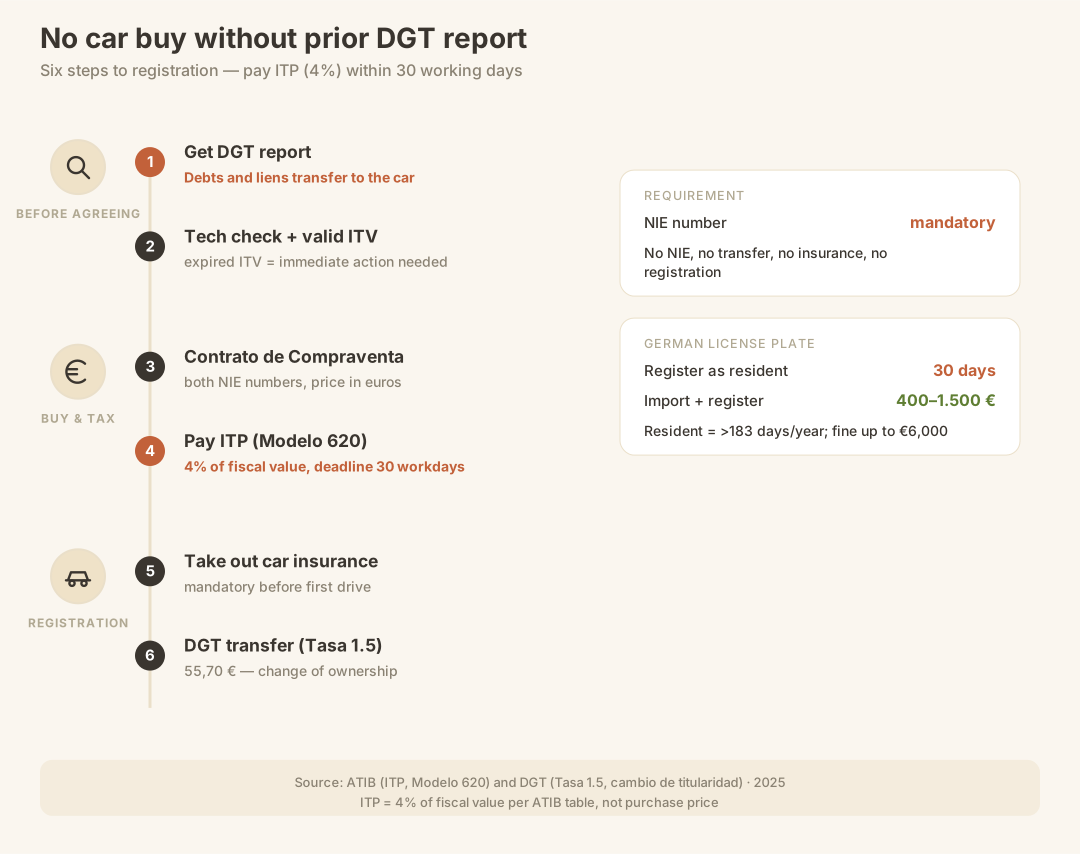
Step 1: Obtain the DGT-Informe – before you commit
The most important check before any private used-car purchase on Mallorca is the Informe de Vehículo from the DGT (Dirección General de Tráfico). This document shows you:
- the registered keeper (does the person in front of you actually match?)
- whether the vehicle is encumbered with liens or debts (cargas y gravámenes)
- the current registration status
- whether the vehicle has been reported stolen
- the date of the last ITV inspection (roadworthiness test)
You can retrieve the Informe online via the official DGT website (sede.dgt.gob.es) – you will need the registration plate and the vehicle identification number (VIN/chassis number). A gestoría or legal service provider can also take care of this on your behalf.
Warning: Never purchase a private vehicle without having first seen the DGT Informe. Outstanding debts or an enforcement order transfer with the vehicle to you – not back to the previous owner.
Step 2: Check the Technical Condition
When buying from a dealer, statutory warranty obligations apply. When buying privately, they do not. Have the vehicle inspected by a garage you trust before committing to the purchase. Pay particular attention to:
- Validity of the ITV (roadworthiness certificate) – an expired ITV means immediate action is required
- Does the mileage add up? Is a service history available?
- Accident history (Carfax and similar services are rarely used in Spain – rely on the garage inspection instead)
- Tyre condition, brakes, bodywork
We have a dedicated guide covering the ITV on Mallorca – what it costs, where to have it done, and how the inspection intervals work: ITV on Mallorca (TÜV).
Step 3: The Purchase Agreement (Contrato de Compraventa)
In a private sale, you both sign a written Contrato de Compraventa. The contract should include at minimum:
- Full details of both parties (including NIE numbers)
- Vehicle details: make, model, registration plate, VIN, date of first registration
- Agreed purchase price in euros
- Location and date of handover
- Signatures of both parties
You also declare the agreed purchase price in the tax return; however, the tax authority (ATIB) applies its own valuation tables when calculating ITP – more on that in a moment.
Standard templates for the Contrato de Compraventa are available on the ATIB website or from any gestoría.
Step 4: Paying ITP – the Tax on Used Vehicles
This is the item many people underestimate. When purchasing a used vehicle from a private individual (not from a business), you as the buyer are required to pay the Impuesto de Transmisiones Patrimoniales (ITP). The Balearic Islands apply a tax rate of 4 % of the vehicle's assessed fiscal value.
Important: What counts is not the purchase price you and the seller have agreed, but rather the Fiscal value, which the ATIB (Agència Tributària de les Illes Balears) determines in its valuation tables — depending on vehicle type, year of manufacture, and engine specification. If your purchase price is below this fiscal value, the ATIB table applies. If it is higher, the actual purchase price is used.
| Example vehicle | Fiscal value according to ATIB | ITP (4 %) |
|---|---|---|
| Older small vehicle (low residual value) | approx. 1.130 € | approx. 45 € |
| Mid-range, 5–8 years old | varies by model | varies |
| Newer SUV, 2–3 years old | significantly higher | correspondingly higher |
Deadline: You have 30 working days from the date of purchase to pay the ITP. The form is called Modelo 620 (for vehicles sold between private individuals in the Balearic Islands) and is submitted to the ATIB.
The ATIB has offices in Palma as well as further service points across the island. Payment online is possible via the ATIB website, provided you have a Certificado Digital or Cl@ve PIN.
Please note: When purchasing from a dealer (empresa), ITP is not applicable — instead, IVA (VAT) applies. For certified used vehicles from a dealer, IVA is generally already included in the price.
Step 5: Pay the DGT fee and apply for the transfer of ownership
Once you have paid the ITP, the next step is the actual transfer of ownership (cambio de titularidad) with the DGT. For this you pay the Tasa 1.5 of the DGT, which currently amounts to 55,70 € (as of 2025).
You will need the following documents for the transfer:
- Completed DGT form (Solicitud de Cambio de Titularidad)
- Contrato de Compraventa (signed)
- Original vehicle registration document (Permiso de Circulación) from the previous owner
- Vehicle technical data sheet (Ficha Técnica)
- ITP proof of payment (Modelo 620, stamped by the ATIB)
- Valid proof of motor insurance in your name
- Copy of your NIE document and ID
- Proof of payment of the DGT Tasa 1.5
The DGT office responsible for Mallorca is located in Palma. For appointments via the Cita Previa system, we recommend our guide on Cita Previa Extranjería.
What a gestoría costs – and when it's worth it
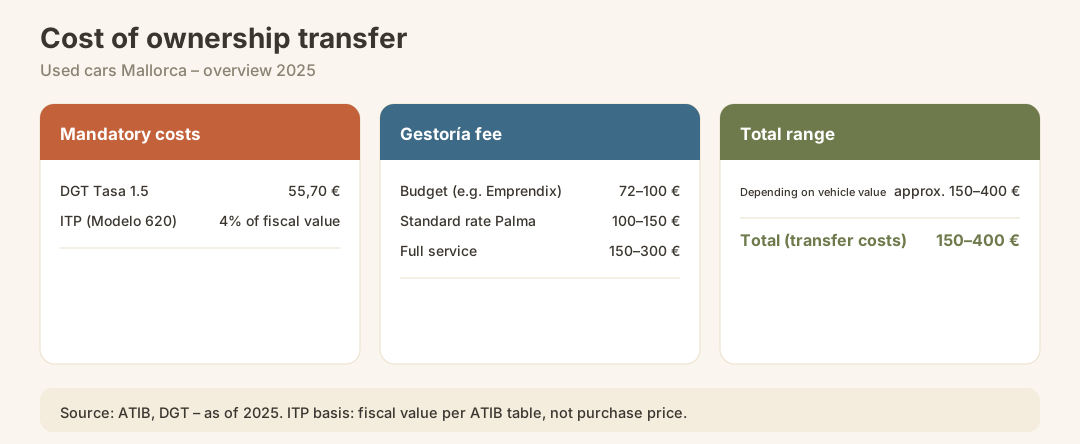
A gestoría handles the tax forms, the DGT application, appointment scheduling and communication with the authorities on your behalf. Prices on Mallorca vary depending on the provider:
| Service provider | Gestoría fee |
|---|---|
| Budget gestoría (e.g. Emprendix, Palma) | approx. 72–100 € |
| Mid-market level Palma | 100–150 € |
| Full-service gestoría (incl. tax, DGT, insurance coordination) | 150–300 € |
Total costs of ownership transfer at a glance:
| Cost item | Amount |
|---|---|
| DGT Tasa 1.5 | 55,70 € |
| ITP (Modelo 620), Balearic Islands | 4 % of the fiscal value (ATIB table) |
| Gestoría fee | 72–150 € depending on provider |
| Total range | approx. 150–400 € depending on vehicle value and chosen route |
Doing it yourself is possible if you speak Spanish to an administrative level and are familiar with DGT processes. For most newcomers to Mallorca, using a gestoría is worthwhile for the simple reason that a mistake on a form or a missed deadline will cost more than the fee.
Car insurance: compulsory before the first kilometre
Before you take possession of the car after purchase, you need a valid Spanish third-party motor insurance in your name. This is non-negotiable – without valid insurance there is no registration, and driving without insurance is a serious offence.
The insurance must be taken out before the first journey, not just at the point of the DGT transfer. Many insurers issue immediate confirmation of cover by email. You can find everything about rates, provider comparisons, and the difference between third-party, partial, and fully comprehensive cover in Mallorca in our guide to car insurance in Spain.
Special case: buying a car with German number plates
Vehicles with still-valid German (or other foreign) number plates regularly circulate on Mallorca. The rule here is: anyone who is a resident (more than 183 days per year on the island) and buys or already owns such a vehicle must re-register it within 30 days on Spanish plates. Ignoring this risks fines of up to 6.000 €.
The import and re-registration process is considerably more involved than buying a local second-hand car: ITV homologation, potentially IEDMT (registration tax depending on CO₂), DGT re-registration – the whole package typically costs between 400 € and 1.500 €, depending on the age of the vehicle and its emissions. More on this in our guide to importing and re-registering a car.
The most common mistakes when buying a second-hand car in Mallorca
- No DGT report obtained before purchase – you take on the car along with any debts or liens.
- Missing the ITP deadline – the 30 working days run from the date of purchase; late submissions incur surcharges.
- Purchase price understated in the contract – the ATIB checks against its own valuation tables; a contract price that is too low may be treated as tax evasion.
- No insurance before taking possession – technically illegal from the very first metre.
- ITV out of date – a car with an expired ITV may not be driven on public roads.
- Original documents incomplete – if the Permiso de Circulación is missing in its original form, it will block the entire transfer process.
- NIE not to hand – without an NIE there is no transfer, no insurance policy, and no registration.
What comes next? Driving licence, empadronamiento, and more
Once the car is registered in your name, you have completed the most important step. Anyone new to the island should address the following steps at the same time:
- Empadronamiento (registering your residence with the local council) – a prerequisite for many further dealings with the authorities: Empadronamiento on Mallorca
- Residencia – apply if you are staying permanently: Residencia in Spain
- Transfer your driving licence – your EU driving licence remains valid; a voluntary exchange is possible at any time: Transferring your driving licence in Spain
- IVTM (vehicle tax, Spanish: Impuesto sobre Vehículos de Tracción Mecánica) – collected annually by the council in which the vehicle is registered. The amount varies depending on the council and engine output (bhp/kW).
Checklist: buying a used car on Mallorca
- NIE number in place
- DGT Informe (Informe de Vehículo) obtained – no outstanding debts
- Technical inspection carried out by an independent garage
- Contrato de Compraventa drawn up and signed
- ITV validity confirmed
- Motor insurance taken out in my name (before driving for the first time)
- Modelo 620 (ITP) completed and submitted to the ATIB (deadline: 30 working days)
- DGT Tasa 1.5 (55,70 €) paid
- DGT transfer application submitted (in person or via gestoría)
- New Permiso de Circulación received and kept safe
Summary
Buying a used car on Mallorca is no dark art – but it does follow its own logic. The four most important rules to remember: never buy without a DGT Informe, never drive without insurance, pay the ITP within 30 working days and for most people a good gestoría is worth more than it costs. Anyone who follows these basic rules will be driving around the island cleanly and legally in their own Spanish vehicle within a few weeks of deciding to buy – and will generally have spent significantly less money than they would have on a comparable new car in Germany.
Official Sources
- ATIB – Agència Tributària de les Illes Balears (ITP tables, Modelo 620): www.atib.es
- DGT – Dirección General de Tráfico (Vehicle Report, Tasa 1.5, Change of Ownership): sede.dgt.gob.es
- BOE – Boletín Oficial del Estado (Law on Traffic, Motor Vehicle Circulation and Road Safety): www.boe.es
- BOIB – Butlletí Oficial de les Illes Balears (Balearic tax legislation): www.boib.es