Registering Domestic Help in Spain: Employing an Empleada de Hogar Legally
Anyone employing a cleaner, housekeeper, nanny or gardener on Mallorca or elsewhere in Spain is legally an employer – with all the responsibilities that entails. This may sound bureaucratic, but it is well regulated: the registering household staff in Spain process has, since the 2012 reform, been governed by a dedicated special employment relationship (relación laboral especial del servicio del hogar familiar), defined in Real Decreto 1620/2011. Since 2019, domestic employees have been progressively brought into line with general employees under the social security system. There is no German-style mini-job model with flat-rate low contributions in Spain. This guide takes you through registration, contracts, contributions and the most common pitfalls step by step – so that you and your employee are on the right side of the law.

You want to register a housekeeper or nanny legally and don't know where to start?
- 📩 Submit a personal enquiry — We will connect you with a vetted gestoría on Mallorca
- An overview of all official registration topics
What is the 'empleada de hogar' – and who does the law apply to?
Spanish employment law uses the term servicio del hogar familiar to cover all activities carried out within a private household by someone who is not a member of the family. Under Real Decreto 1620/2011, this includes:
- Cleaning and housekeeping (in whole or in part)
- Childcare and care of family members
- Gardening on private property
- Driving a vehicle for private purposes
- Similar household-related services
The employment relationship applies regardless of how many hours per week are worked. Whether it is two hours of cleaning on a Monday or a full-time live-in nanny – as soon as someone regularly works in a private household for remuneration, you as the householder are an employer within the meaning of Spanish employment law.
Please note: Registering the household employee as self-employed (e.g. as an autónoma) does not fundamentally change this classification, as long as the work is in practice subject to your direction and takes place in your private household. Do not be reassured by apparent workarounds.
Legal background: What has changed since 2012 and 2019
Prior to the reform, domestic employees were placed at a significant disadvantage compared with other workers. Since then, they have been progressively brought into line with the general social security system.
| Period | Regulation |
|---|---|
| Until 2012 | A separate, heavily restricted special scheme (REEH) |
| From 2012 | Integration into the Régimen General de la Seguridad Social (special provisions retained) |
| From 2013 | New contribution obligation for all domestic employees regardless of hours worked |
| From 2019 | Full alignment of contribution calculations with those of other employees; departure from the previous flat-rate contribution system |
The key point: there is no de minimis threshold. Anyone who cleans or provides childcare for even just a few hours per week must be registered.
Step by step: how to register a domestic employee in Spain
What you need as an employer beforehand
Before you can register anyone, you must yourself be registered with the social security authority:
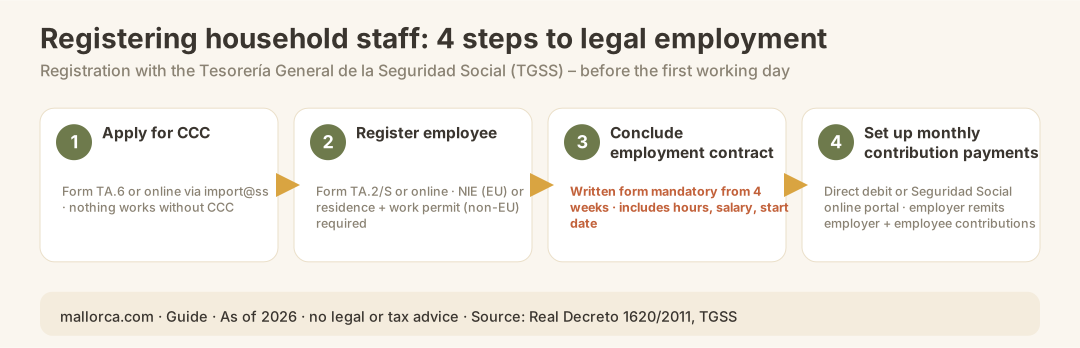
- Apply for a Código Cuenta Cotización (CCC) at the Tesorería General de la Seguridad Social (TGSS). This is your employer registration number – nothing can proceed without it.
- You will need a valid digital certificate or access via Cl@ve Permanente.
- A bank account from which social security contributions will be collected by direct debit.
- The employee's identification details (NIE, identity card or passport depending on country of origin).
What documents your employee needs to bring
| Employee's country of origin | Required documents |
|---|---|
| Spanish nationals | DNI, social security number |
| EU/EEA/Switzerland | NIE number + identity card or passport |
| Non-EU | Temporary residence permit with work authorisation or long-term residence permit |
Note: Anyone from an EU country may work in Spain as soon as they have an NIE. Those who do not yet have one must apply for it first – find out how to apply for an NIE on Mallorca here.
The registration process: step by step
- Apply for a CCC (form TA.6 or online via import@ss, the TGSS platform)
- Register the employee in the system as a worker (form TA.2/S or online)
- Draw up an employment contract – in writing if the engagement lasts longer than four weeks (more on this below)
- Set up monthly contribution payments via direct debit or through the Seguridad Social online portal
Registration must take place before the employee begins work – not retrospectively.
The employment contract: when it must be in writing
According to Real Decreto 1620/2011, a written employment contract is required when the employmentlasts longer than four weeks or when either party expressly requests one. For occasional individual hours, a verbal agreement is theoretically sufficient — in practice, however, a written contract is always advisable, as it is the only reliable basis in the event of a dispute.
A contract for domestic staff should contain at least:
- Full personal details of both parties
- Type of work (cleaning, childcare, care work, etc.)
- Place of work (private address)
- Working hours (hours per week or month)
- Agreed gross salary
- Start date and, if applicable, end date of the contract
- Provisions regarding accommodation and meals, if applicable (e.g. for live-in domestic helpers)
Social security contributions: what you need to pay each month
Since the equalisation in 2019, the contribution calculation is based on the domestic worker's actual income. The exact level of contributions depends on the salary band (tramo salarial) and is updated annually.
As a general rule: the total contribution consists of an employer's contribution and an employee's contribution. The employer remits both and deducts the employee's share from the wages.
| Contribution type | Party | Note |
|---|---|---|
| Health insurance (asistencia sanitaria) | employer / employee respectively | Included in the general contribution rate |
| Unemployment insurance | Employer + employee | Applicable to domestic staff since 2022 |
| Pension insurance | Employer + employee | Full equalisation since 2019 |
| Accident insurance (AT/EP) | predominantly employer | Compulsory |
| FOGASA (insolvency fund) | Employer | Compulsory |
Please note: The specific percentages are adjusted annually by the TGSS. Have the current rates calculated by a gestor or directly via the Seguridad Social website (import@ss) — estimates found online can be dangerously misleading.
Minimum wage and holiday entitlement: what you must pay
The Spanish Salario Mínimo Interprofesional (SMI) also applies to domestic workers. In addition, the provisions of Real Decreto 1620/2011 govern holiday entitlement and bonus payments.
| Benefit | Regulation |
|---|---|
| Minimum wage | SMI applies in full (adjusted annually) |
| Annual leave | At least 30 calendar days per year |
| Bonus payments | 2 bonus payments per year (may be spread across the monthly salary) |
| Notice period | Depending on length of employment and contract type |
| Termination without cause | Possible, but linked to a severance entitlement |
Au pairs in Spain: a special case
The au pair arrangement is not a standard employment relationship. An au pair lives with the host family, assists with childcare and light household duties, and receives board, lodging, and pocket money in return. In exchange, the au pair is expected to learn the language and culture of the host country.
Key conditions for au pairs in Spain:
- An au pair from an EU country does not require a specific work permit, but does need a NIE.
- The au pair arrangement is not registered with the Seguridad Social as a standard employment relationship — there is no regular employment contract in the legal sense.
- The pocket money is not a wage — it should, however, be agreed in writing.
- The host family provides accommodation and full board.
- It is advisable to take out health insurance for the au pair if no other cover exists — see the guide on health insurance in Spain.
Please note: Anyone who effectively uses an au pair as a full-time nanny (fixed working hours, high number of hours, primarily childcare with no cultural exchange element) is on legally shaky ground. If in doubt, the arrangement should be structured as a regular domestic employment relationship.
Engaging staff through an agency or gestoría: the alternative
Those who wish to avoid the administrative burden can employ a domestic worker through a licensed agency or temporary employment agency (empresa de trabajo temporal). In this case, the agency is the formal employer and handles all social security administration.
Advantages:
- No need for your own CCC
- The agency handles social security and payroll
- Less liability risk for the household
Disadvantages:
- Higher costs (agency fee)
- Less direct control over the selection
- Not ideal for very individual or long-term arrangements
Another option: the housekeeper is registered as an autónoma (self-employed person) and issues you an invoice. This is legally possible if the work is genuinely independent, carried out for multiple clients, and without fixed instructions being given. However, for a housekeeper who works exclusively for you, this model is legally risky from an employment law perspective and is scrutinised closely by labour and social security authorities.
Tax aspects for the employer
As a private employer in Spain, you have no direct way to deduct the cost of a housekeeper for tax purposes in the way that is possible in Germany. Spanish tax law makes no equivalent provision for private individuals regarding general domestic help.
The only relevant exception: if you are dependent on home care for medical reasons, certain care costs may under some circumstances be tax-deductible — however, this is a special case that should be clarified separately with a tax adviser.
Please note: As a Spanish tax resident, you pay IRPF on your worldwide income. Our guide on taxes as a resident (IRPF).
Most common mistakes — and how to avoid them
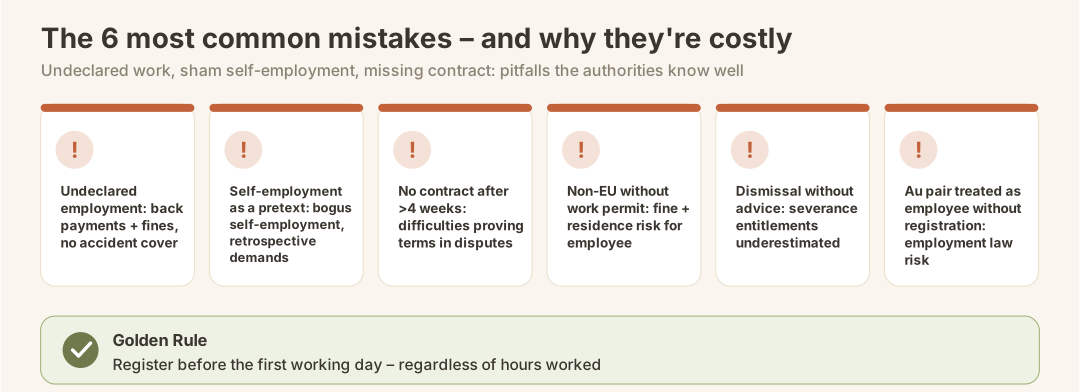
| Mistake | Consequence | How to avoid it |
|---|---|---|
| Employing a housekeeper off the books | Back payments for social security contributions + fines, no accident cover | Register before the first working day |
| Using self-employed status as a pretext | Bogus self-employment, retrospective back-payments | Only treat genuine autónoma arrangements as such |
| No written contract for work lasting >4 weeks | Difficulties of proof in the event of disputes | Always put it in writing, even for part-time arrangements |
| Hiring a non-EU national without a work permit | Fine for the employer, risk to the employee's right of residence | Check residence status in advance |
| Dismissal without taking advice | Severance entitlements underestimated | Engage a gestor or lawyer |
| Treating an au pair as an employee without registering them | Employment law risk | Define and document the arrangement clearly |
What comes next? Ongoing obligations as an employer
Registration is the first step – after that, the day-to-day operation begins:
- Monthly payroll processing and contribution payments via the TGSS (automatic direct debit possible)
- Payslips (nómina) to be issued and signed monthly
- Sick notes (partes de baja) to be forwarded correctly
- Approve and document holiday in writing
- Upon termination: deregistration with the TGSS within the statutory deadline
A reliable Gestor (tax adviser/accountant) can handle the monthly administration – exact costs vary depending on the Gestor and scope of services; it's best to enquire directly.
Checklist: Legally registering a domestic worker in Spain
- Employee's NIE available (EU) or residence/work permit (non-EU)
- Own Código Cuenta Cotización (CCC) applied for with the TGSS
- Digital certificate or Cl@ve Permanente in place
- Bank account details for direct debit on file
- Employee registered in the system before their first working day
- Written employment contract drawn up (mandatory at the latest after 4 weeks)
- Payslip (nómina) prepared for each month
- Holiday and sickness arrangements recorded in writing
- Monthly contribution payments set up
- Gestor commissioned for ongoing administration (recommended)
Conclusion
Legally employing a domestic worker, cleaner, or nanny in Spain is not a bureaucratic nightmare – but it is a genuine employment relationship with genuine obligations. Anyone who ignores this risks painful back payments and – more seriously – leaves their employee without health insurance, pension entitlement, or accident cover. Registration via the TGSS can be done online, a good Gestor will take the ongoing administration off your hands, and the monthly effort is manageable. Start in good time, document everything in writing, and as an employer on Mallorca you will have a solid, legally sound foundation.
Official sources
- Real Decreto 1620/2011 – Regulation of the special employment relationship in private households: https://www.boe.es/buscar/act.php?id=BOE-A-2011-17975
- Tesorería General de la Seguridad Social (TGSS) – Registration, CCC, contributions: https://www.seg-social.es
- import@ss – Online portal of the Seguridad Social for employers: https://importass.seg-social.es
- Ministerio de Trabajo y Economía Social – Information on the household employment regime: https://www.mites.gob.es
- Agencia Tributaria (AEAT) – Tax obligations as an employer: https://www.agenciatributaria.es