
Pareja de Hecho in the Balearic Islands: registered partnership step by step
Anyone living together on Mallorca, Menorca, Ibiza or Formentera without getting married can have their relationship officially registered as a Pareja de Hecho – officially called "pareja estable" in the Balearics. This grants rights similar to marriage in many areas, such as inheritance, hospital visitation rights or custody matters, without you having to marry. For binational couples where one partner does not hold EU citizenship, registration is also often the gateway to a residence permit as a family member of an EU citizen. In this guide you'll learn what requirements the Balearic Registro de Parejas Estables demands, which documents and fees are involved, how the application process with the CAIB (Consell de les Illes Balears) actually works, and where the typical pitfalls lie.

What is a Pareja de Hecho in the Balearics?
In Spain, registered partnerships are not regulated uniformly nationwide but are a matter for the autonomous regions – which is why the name and details vary depending on where you live. In the Balearics, the institution is officially called "pareja estable", enshrined in law under Ley 18/2001, de 19 de diciembre, de Parejas Estables (BOIB No. 156 of 19.12.2001, BOE No. 14 of 16.01.2002, in force since 19.01.2002). Other regions use different terms: in Andalusia, the Canaries, Cantabria, Extremadura and the Basque Country it's called "parejas de hecho", in Catalonia "uniones estables de pareja", and in Madrid and Valencia "uniones de hecho". Legally, it all comes down to the same basic principle everywhere: two people – of the same or different sexes – have their stable life partnership officially registered without adopting the marital status of "married".
On the Balearics, responsibility for maintaining the register lies with the Conselleria de Familias, Bienestar Social y Atención a la Dependencia. The procedure was reformed and simplified in several respects by Decreto ley 4/2022 of 30 March 2022 – the requirements described here have applied since 31 March 2022.
Requirements for registration
For a couple to be entered in the Balearic register as a pareja estable, both partners must simultaneously fulfil several conditions. The most important – and in practice the most demanding – is proof of a shared residence for at least one year via Empadronamiento.
| Requirement | Specific condition |
|---|---|
| Residence (vecindad administrativa) | Both partners must be registered (padrón) in a municipality in the Balearics |
| Cohabitation | At least 12 months of uninterrupted cohabitation at a shared address, proven via the Empadronamiento |
| Marital status | Neither partner may be married |
| Kinship | No direct-line relationship (blood relationship/adoption) and no collateral line up to the 3rd degree |
| Existing partnership | Neither partner may already be registered as a pareja estable with another person |
Note: Proof of residential address is verified exclusively via the municipal register. Without continuous empadronamiento for both names at the same address, the application will not be accepted – find out in advance about the process of empadronamiento in Mallorca.
There is no maximum deadline within which the application must be submitted after the requirements have been met – the register is designed as an open register, into which entries can be made at any time once the conditions are fulfilled.
Which documents and fees are required?
The registration application consists of an official form as well as a sworn declaration regarding marital status. Both forms are provided for download on the CAIB portal.
| Document | Purpose |
|---|---|
| Solicitud de inscripción | Official registration application with details on both partners |
| Declaración responsable de Estado civil | Sworn declaration that neither partner is married |
| Proof of empadronamiento | Evidence of at least 12 months of joint residence |
| Modelo 046 (DUI-046) | Proof of payment of the processing fee |
The processing fee for registration in the Registro de Parejas Estables currently amounts to 21,56 €, as set out in the Balearic budget law for 2019. Payment is made via the Modelo 046 form (Concepto 6024), which can be filled in online and either paid directly by telematic means or printed out and settled at a cooperating bank.
Attention: For foreign documents – such as birth certificates or proof of marital status from Germany, Austria or Switzerland – the authorities frequently require an apostille as well as a sworn translation into Spanish. Allow sufficient lead time for this and, if necessary, contact a sworn translator in Mallorca.
Step by step: how the registration process works
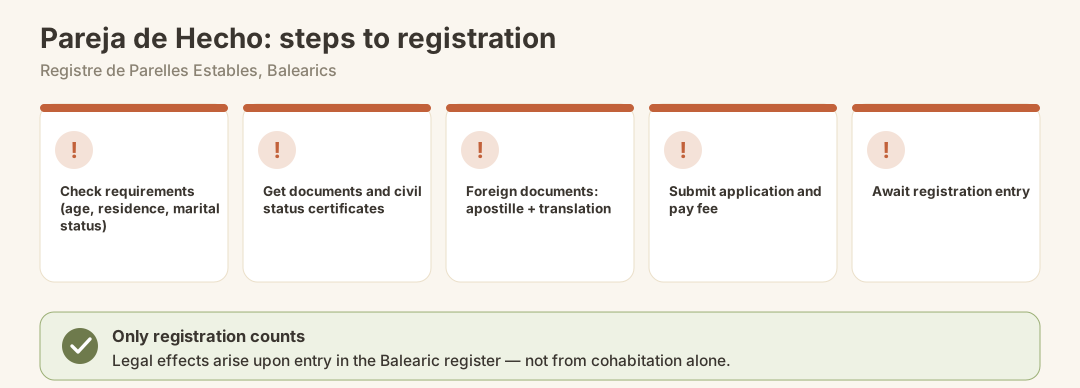
- Secure empadronamiento: Both partners must be registered at the same address in a Balearic municipality for at least 12 consecutive months before submitting the application makes sense.
- Download forms: Obtain and fill in the Solicitud de inscripción and Declaración responsable de Estado civil from the CAIB website.
- Pay the fee: Fill in Modelo 046 online and pay the fee of 21,56 € telematically or at a bank.
- Compile documents: Have foreign certificates apostilled where applicable and sworn-translated.
- Submit the application: Either electronically (with digital certificate, DNIe or Cl@ve permanente), in person at a registry office of the regional administration, the state administration or the municipalities, or by post in an open envelope.
- Await confirmation: After review by the Conselleria de Familias, Bienestar Social y Atención a la Dependencia, the entry is made in the register.
The application can also be submitted by an authorised person – practical if one partner is still in Germany or if the formalities are to be delegated to a Gestoría or a lawyer.
Processing time, deadlines and "silencio administrativo"
Neither the Parejas Estables law nor the accompanying decree sets its own processing deadline. Therefore, the general Balearic administrative procedure law applies subsidiarily (Ley 3/2003, de 26 de marzo, de Régimen Jurídico de la Administración de la Comunidad Autónoma de las Illes Balears), which provides for a maximum period of six months for the decision and notification.
| Procedural feature | Regulation |
|---|---|
| Maximum processing time | 6 months (subsidiary under Ley 3/2003) |
| Silencio administrativo | Negative – if there is no response within the deadline, the application is deemed rejected |
| Legal recourse | The decision concludes the administrative process (fin de la vía administrativa) |
| Application initiation | Only upon request (instancia de parte), not an ex officio procedure |
Note: "Silencio administrativo negativo" means: if nothing happens within the deadline, your application is deemed rejected – unlike procedures with positive silence. Therefore, allow sufficient time buffer if the registration is needed for a visa or a residence card.
Pareja de Hecho vs. marriage: what's the difference?
Many couples wonder whether the effort for the pareja estable is even worth it, or whether getting married isn't the simpler route. Both options have different requirements and legal consequences.
| Aspect | Pareja de Hecho (Balearic Islands) | Marriage (Matrimonio) |
|---|---|---|
| Requirement | 12 months of living together + residence in the Balearic Islands | No waiting period, but civil/church marriage procedure required |
| Regulation | Regional (autonomous community) | Nationally uniform (civil law) |
| Fee | 21,56 € registration fee | Varies depending on registry office/ceremony |
| Dissolution | Less formal removal from the register possible | Formal divorce required |
| Recognition abroad | Not automatically recognised as equivalent everywhere | More widely recognised internationally |
Anyone considering a wedding on the island will find additional information in the guide Getting married on Mallorca.
Rights and obligations after registration
After registration, partners are treated equally to married couples in many, but not all, areas. Registration often has a positive effect on inheritance tax in particular, as registered couples are treated the same as married couples for tax purposes in some situations – whereas unmarried couples without pareja estable status face significantly higher tax burdens in the event of inheritance. You can read more about this in the guide Inheritance from Germany in Spain.
Equal treatment is not complete in every area: in 2025, Spain's Constitutional Court ruled in a case from Mallorca that surviving partners of a pareja de hecho can, under certain circumstances, still be denied a widow's/widower's pension – an area where the pareja estable is not fully equated with marriage under the law. In an individual case that became known in 2023, a female judge was also granted several days of paid special leave for registering as a pareja de hecho for the first time – however, whether and to what extent such an entitlement exists depends on the respective collective agreement or employment relationship and cannot be generally applied to all employees.
Note: Since case law and social security practice in this area continue to evolve, it is worth seeking individual advice from a lawyer on Mallorca.
Pareja de Hecho and right of residence for non-EU partners
For binational couples where one partner does not hold EU citizenship, registered partnership is often the most practical way to enable the non-EU partner to obtain a residence permit as a family member of an EU citizen. Important: both partners first need a Spanish tax and identification number (NIE) before contractual and administrative steps such as a rental agreement, empadronamiento or bank account become possible. Find out about the general process in good time at Residencia in Spain as well as about the relevant deadlines at Visa & Residency.
Non-working emigrants also generally need private health insurance with no excess and no waiting periods for the Residencia – you can find details in the guide Health insurance Spain.
Most common mistakes
- Empadronamiento too late or incomplete: If the registered address is interrupted or the residential address changes within the 12-month period, the period practically starts again from scratch.
- Missing apostille on foreign documents: German birth or civil status certificates are often rejected without an apostille and a sworn translation.
- Confusion with other regions: Anyone previously registered in another autonomous community may first need to be deregistered there before registration in the Balearic Islands is possible.
- Missing proof of payment: Without proof of payment via Modelo 046, the application will not be processed.
- Confusion with marriage regarding pension matters: Assuming that a pareja estable is in every case equivalent to a marriage can lead to disappointment on matters such as widow's/widower's pension.
What comes next?
After successful registration, you should carefully keep the confirmation from the register – it is regularly required as proof for future administrative matters (residence card, inheritance issues, custody questions). Binational couples planning to jointly purchase or rent out a property will find additional information in the guide Buying and selling second-hand property in Mallorca. After registration, it's also worth taking a look at your personal situation as a resident for tax purposes, for instance under Taxes as a resident.
Checklist: Registering a Pareja de Hecho in the Balearic Islands
| Step | Done? |
|---|---|
| Both partners registered at a shared address for at least 12 months | ☐ |
| Solicitud de inscripción and Declaración responsable completed | ☐ |
| Foreign documents provided with apostille and sworn translation | ☐ |
| Fee paid via Modelo 046 (21.56 €) | ☐ |
| Application submitted online, in person or by post | ☐ |
| Confirmation/registration certificate archived after processing | ☐ |
Conclusion
Registering as a Pareja de Hecho in the Balearics is a manageable but strictly formal administrative procedure: without continuous empadronamiento for 12 months, correctly certified documents and payment of the 21,56 € fee, nothing will proceed. Those who meet the requirements benefit from an extensive – if not in every detail complete – legal equivalence to married couples, for example with regard to inheritance tax. Especially in binational constellations with a non-EU partner or foreign documents, it is worth seeking legal advice early on to avoid delays caused by missing apostilles or translations.
Official sources
- Registro de Parejas Estables (procedure, CAIB): https://www.caib.es/seucaib/es/tramites/tramite/6958
- Ley 18/2001, de 19 de diciembre, de Parejas Estables (BOE, consolidated version): https://www.boe.es/buscar/act.php?id=BOE-A-2002-917
- Decreto ley 4/2022, de 30 de marzo (BOE): https://www.boe.es/buscar/doc.php?id=BOE-A-2022-9389
- Decreto 112/2002, de 30 de agosto (establishment of the Registro de Parejas Estables): https://www.siis.net/documentos/legislativa/13372.pdf
- Ley 39/2015, de 1 de octubre, del Procedimiento Administrativo Común: https://www.boe.es/buscar/doc.php?id=BOE-A-2015-10565
- Ley 3/2003, de 26 de marzo, de Régimen Jurídico de la Administración de la CAIB (BOIB): http://boib.caib.es/pdf/2003044/mp32.pdf
- Modelo 046 (ATIB, fee payment): http://www.atib.es/ta/modelos/modelo.aspx?m=046&idconcepto=6024