
Hospital Mallorca: public, private, A&E overview
Anyone living on Mallorca or staying for a longer period should know which hospital is responsible in an emergency – before it actually matters. The island has a two-track system: four public hospitals run by IB-Salut, as well as several private clinics such as Quirónsalud, Juaneda or Clinica Rotger. For residents, the place of residence determines which public hospital is responsible; however, in an emergency, everyone is admitted anywhere. This guide explains the four healthcare sectors, lists addresses and phone numbers of the most important hospitals, shows when a private clinic is worthwhile, and answers the most common questions about A&E, costs and access to the Spanish healthcare system for foreigners.

The dual system: public vs. private
Like the whole of Spain, Mallorca has a two-track healthcare system. Both pillars operate at a high standard, but follow different logic. The public system is run by the Balearic health service IB-Salut (Institut Balear de Salut, Catalan: Servei de Salut de les Illes Balears) and is part of the Spanish National Health System (Sistema Nacional de Salud). Those insured through it generally pay nothing for GP visits, A&E and inpatient treatment – only medication may involve a co-payment. Access always runs through the responsible health centre (Centro de Salud) at the place of residence, which refers patients to specialists or hospitals as needed.
The private sector complements this system and scores with shorter waiting times, more personal care, multilingual staff and single rooms. Payment is made either directly or via private health insurance, which in Spain, depending on age and tariff, usually costs between €50 and €200 per person per month. For many international residents and retirees who value discretion and treatment in their own language, the private option is the first choice.
| Feature | Public (IB-Salut) | Private (Quirónsalud, Juaneda etc.) |
|---|---|---|
| Cost for insured persons | generally free, possible co-payment for medication | via supplementary insurance or self-payment |
| Access | via assigned Centro de Salud at place of residence | direct, usually without prior referral |
| Language | Spanish/Catalan, interpreters at major hospitals | often German, English, other languages |
| Waiting time for specialist appointments | sometimes longer | generally short |
| Typical clientele | Residents with Spanish social security, EU citizens with EHIC | Privately insured, self-payers, many expats |
Note: In a medical emergency, every patient is admitted in Spain – regardless of whether they are publicly or privately insured, and regardless of place of residence.
The four healthcare sectors – which hospital is responsible for you?
For public healthcare provision, the island is divided into four healthcare sectors (sectores sanitarios). As with the allocation to Centros de Salud, place of residence determines which hospital is responsible for residents. Holidaymakers with only statutory insurance simply go to the nearest public hospital; those with private insurance covering treatment abroad can also use private clinics regardless of their place of residence.
| Sector | Responsible hospital | Approximate region |
|---|---|---|
| Sector Ponent | Hospital Universitari Son Espases | Palma and surrounding area |
| Sector Migjorn | Hospital Universitario Son Llàtzer | Migjorn area, south of the island |
| Sector Tramuntana | Hospital Comarcal de Inca | Inca and Tramuntana area |
| Sector Llevant | Hospital de Manacor | Manacor and eastern part of the island |
Please note: This allocation applies to regular, scheduled care. In an acute emergency, proximity counts, not the assigned sector – every public hospital admits every patient.
The public hospitals in detail
In August 2025, a total of 10,730 full-time staff worked in the island's four public hospitals, including 1,648 doctors and 6,468 nursing staff. In addition, 537 medical students completed their training there – an indication of the size and academic standing of the system, particularly at Son Espases.
Hospital Universitari Son Espases (HUSE) is the reference hospital of the Balearic Islands and is located on the outskirts of Palma, behind the Via de Cintura in the direction of the Balearic University UIB. It has around 707 beds, making it the largest public hospital on the island, and covers virtually all specialities, from cardiology to oncology to neurology. It is also considered one of the most modern hospitals in the Mediterranean region.
Hospital Universitario Son Llàtzer serves the Sector Migjorn and is located on the Carretera de Manacor. It is also a university hospital with a broad range of services.
Hospital de Manacor is responsible for the Sector Llevant, i.e. the east of the island around Manacor, and has its own accident and emergency department for urgent cases.
Hospital Comarcal de Inca covers the Sector Tramuntana in the north and north-west of the island.
| Hospital | Address | Main switchboard | Website |
|---|---|---|---|
| Hospital Universitari Son Espases | Ctra. de Valldemossa, 79, 07010 Palma | +34 871 205 000 | hospitalsonespases.es |
| Hospital Universitario Son Llàtzer | Ctra. de Manacor, km 4, Palma | +34 871 202 000 | hsll.es |
| Hospital de Manacor | Ctra. Manacor–Alcúdia, s/n, 07500 Manacor | +34 971 847 000 | — |
| Hospital Comarcal de Inca | Inca (Sector Tramuntana) | via central IB-Salut switchboard | ibsalut.es |
Note: At Son Espases there are additionally separate numbers for patient services (+34 871 205 817 / +34 971 205 019) and admissions/visits (+34 871 909 871). At Hospital de Manacor, the accident and emergency department can be reached on +34 971 847 060, and the general patient service on +34 971 847 024.
Accident and emergency: Where to go in a medical emergency?
Throughout Spain – as in the entire EU – the single emergency number 112 for all emergencies: medical emergencies, accidents, hazardous situations. Calls are free of charge and work even from mobile phones without an active SIM card, without network coverage, or with a locked device. The operator can also assist in English.
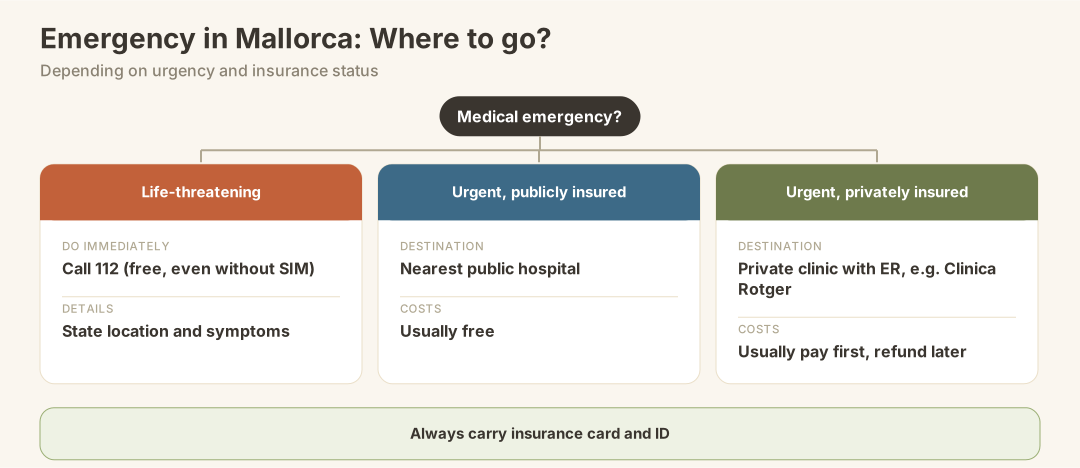
For acute cases: those with public insurance should go to the nearest public hospital, regardless of their own sector. Those with private insurance can also go to a private emergency department. In the centre of Palma, the Clinica Rotger (Quirónsalud) is the only private centre with its own emergency department for adults and children, open 365 days a year, around the clock.
- In case of acute danger to life: call 112, and state your location and symptoms.
- For urgent but not life-threatening needs: head to the nearest public hospital or, with appropriate insurance, a private clinic with an emergency department.
- Bring your insurance card (EHIC, the Spanish Tarjeta Sanitaria, or a private policy card) and an identity document.
- After initial treatment: if necessary, consult your own insurer regarding cost coverage or reimbursement.
Please note: Those who only have private insurance and visit a public hospital generally have to pay for treatment themselves and then apply for reimbursement from their own insurer.
Private hospitals and clinics
The private sector in Mallorca is well developed, especially around Palma. Among the best-known facilities are the clinics of the Quirónsalud group (including Clinica Rotger in the centre of Palma and Hospital Quirónsalud Palmaplanas), as well as the Juaneda group with several locations. There are also smaller facilities such as Hospital General de Muro or local health centres, which, especially in tourist areas, tend to have German- or English-speaking staff.
| Clinic/Group | Location/Focus | Special feature |
|---|---|---|
| Clinica Rotger (Quirónsalud) | Centre of Palma | the only private 24-hour emergency department in the city centre, for adults and children |
| Hospital Quirónsalud Palmaplanas | Palma | wide range of specialities, part of the Quirónsalud group |
| Hospital Juaneda | Palma and other locations | long-established private clinic group in Mallorca |
| Hospital General de Muro | Muro (north of the island) | local private care away from Palma |
| Centro Médico Porto | Porto region | outpatient basic medical care |
Specialist publications such as Newsweek's "World's Best Hospitals" ranking also assess Spanish institutions each year, though data specific to the Balearics is limited – for a reliable assessment of individual clinics, it's always worth taking a direct look at the specialist department and local personal recommendations.
access to the public system for foreigners
Whether you have free access to IB-Salut depends on your residency status. EU citizens who register as residents and are enrolled in the Spanish social security system – for example through employment or as an autónomo – are fully entitled to public healthcare, just like Spanish nationals. Non-EU citizens with a Spanish work permit and corresponding social security contributions generally have equivalent access.
Holidaymakers or short-term visitors who only hold a European Health Insurance Card (EHIC) can also use public hospitals – treatment is then free or heavily subsidised. For residents, the first step is usually registering with the town hall (empadronamiento) and clarifying social security status before the relevant health card is issued.
- Complete the empadronamiento (registration certificate) with the local council.
- Clarify residencia or social security status – as an employee, autónomo, or via an S1 form for pensioners from other EU countries.
- Find the relevant Centro de Salud in your area of residence and apply for the health card there.
- If needed: take out private supplementary insurance in parallel to bridge waiting times.
You can find more on the individual steps in our guides to residencia, empadronamiento and on the S1 form for pensioners.
Costs & private health insurance
For those covered under the Spanish statutory system, treatment in public hospitals is generally free, aside from possible co-payments for medication. Those with private insurance or paying out of pocket at a private clinic pay for treatment directly and settle with their own insurer either in full or in part, depending on the policy.
| Model | Typical costs | Important to know |
|---|---|---|
| Public (IB-Salut) with social security | free, possible medication co-payment | access via assigned Centro de Salud |
| EHIC (EU short stay) | free or heavily subsidised | intended only for temporary stays |
| Private health insurance | approx. €50–200/month per person, depending on age | free choice of hospital, short waiting times |
| self-payer without insurance | full treatment costs | payment usually due immediately, no automatic reimbursement |
Note: Anyone emigrating as a non-EU citizen or as an autónomo should check early on whether private health insurance is mandatory for the residence permit. Details on this can be found in the guide Health insurance in Spain.
Centros de Salud – the basic health centres
In addition to the large hospitals, there are around 20 Centros de Salud on Mallorca that provide basic medical care. They are the first point of contact for GP appointments, minor treatments and referrals to specialists or hospitals. Which Centro de Salud is responsible depends – just as with hospitals – on the registered place of residence. Interpreters are also available at the large hospitals, so patients without Spanish language skills can be treated as well.
Most common mistakes
Many newcomers underestimate how strongly the place of residence determines responsibility, and are surprised when a specialist appointment doesn't take place at the nearest hospital, but at the "correct" sector hospital. Another classic mistake: privately insured people go to a public hospital in an emergency and automatically expect the private insurance to cover the costs – in fact, they usually have to pay themselves first and apply for reimbursement separately. Also common: the EHIC is confused with full overseas health insurance, even though it is only intended for temporary stays and not for permanent residence. And finally, some forget that assignment to a health sector only fully takes effect after empadronamiento and clarification of social security status.
What comes next?
Once place of residence, residencia status and social security have been clarified, registration with the responsible Centro de Salud follows, along with the issuing of the health card. At the same time, it's worth deciding whether private supplementary insurance makes sense – for example, to reduce waiting times for specialists or to access multilingual staff. Anyone working as an autónomo should also check how social security contributions and health insurance can be sensibly combined.
Checklist: Hospital Mallorca
- Empadronamiento (registration certificate) completed at the town hall
- Residencia or social security status clarified
- Responsible Centro de Salud and associated health sector determined
- Address and emergency number of the responsible public hospital noted
- 112 saved on your phone
- Decision made on private supplementary insurance
- If needed: preferred private clinic with German- or English-speaking staff researched
Conclusion
With its four public hospitals under IB-Salut and a well-developed private sector, Mallorca offers a solid, dual-track healthcare system. Anyone who, as a resident, knows which health sector their place of residence is assigned to, and at the same time clarifies whether private supplementary insurance makes sense, is well prepared in an emergency. In an acute emergency, only one thing matters anyway: call 112 – the nearest hospital will admit anyone, regardless of insurance and place of residence.
Official sources
- IB-Salut (Institut Balear de Salut) – Health sectors: https://www.ibsalut.es/es/servicio-de-salud/organizacion/ordenacion-sanitaria-territorial/sectores-sanitarios/sector-sanitario-de-llevant
- Hospital Universitari Son Espases: https://www.hospitalsonespases.es/
- Hospital Universitario Son Llàtzer: http://www.hsll.es
- U.S. Embassy Spain – Medical Information Balearic Islands (PDF): https://common.usembassy.gov/wp-content/uploads/sites/58/2024/01/Medical_Information_Balearic_Islands2.pdf
- Clinica Rotger Quirónsalud – Emergency department: https://www.clinicarotger.com/de/spezialitaten-clinik-rotger-krankenhaus-mallorca/notaufnahme-clinica-rotger
- Newsweek – World's Best Hospitals 2026, Spain: https://rankings.newsweek.com/worlds-best-hospitals-2026/spain