
Healthcare system Spain: Seguridad Social, private or both
Anyone moving permanently to Mallorca or mainland Spain sooner or later runs into the same question: how does the healthcare system in Spain actually work, and do I need private health insurance as well? The short answer: Spain operates a dual system consisting of the state-run Sistema Nacional de Salud (SNS) – administered in the Balearics by IB-Salut – and a well-developed private sector. Which access route applies to you depends on whether you're employed, self-employed, retired, or economically inactive. In this guide, you'll learn which of the four access routes to the Seguridad Social applies to you, what the S1 form and the Convenio Especial cover, which private insurers are common, and why the order of your decisions can prove costly in the long run if you move back to Germany.

Health insurance in Spain
Explanation
The calculator identifies your access route. Public insurance routes are not freely interchangeable options.
Explanation
Completed years on the reference date.
Explanation
Have you lived continuously in Spain for at least twelve months immediately before applying?
Explanation
The municipal population register is called the Padrón. Are you currently registered in the municipality where you are applying?
- Monthly cost of your route
- €60.00
- Your route
- Convenio especial (special agreement with the health service)You can apply · Art. 3 a)–c), Art. 4.4 RD 576/2013
Do you have another public healthcare entitlement?: No
Legal status: 1 January 2026
This calculation is provided for guidance only and is not a substitute for tax or legal advice in specific cases.
The dual system: SNS and IB-Salut in the Balearics
The Spanish healthcare system rests on two parallel pillars. The public pillar, the Sistema Nacional de Salud (SNS), is coordinated at national level but administered regionally. In the Balearics, the Institut Balear de Salut (IB-Salut) takes on this task. The system is funded through social security contributions and general tax revenue, and the quality of care is consistently regarded as among the best in Spain. Alongside this, an established private sector exists with its own clinics, specialists and insurers, which particularly stands out when it comes to waiting times and language barriers.
For you as a newcomer, this means you don't necessarily have to choose between the two worlds. Many residents combine the free or low-cost public basic care with a lean private supplementary policy for faster specialist appointments or dental treatment.
| Feature | Public (SNS/IB-Salut) | Private |
|---|---|---|
| Access | Via Seguridad Social, S1 or Convenio Especial | Direct contract, regardless of status |
| Cost | Funded through contributions or a flat-rate contribution | Monthly premium depending on age/cover |
| Waiting times | Sometimes longer, especially for specialists | Usually significantly shorter |
| GP principle | Yes, PAC/Centro de Salud as first point of contact | Usually free choice of doctor |
| Language | Predominantly Spanish/Catalan | Often multilingual staff |
Note: EU citizens are generally entitled to medically necessary emergency care in Spain regardless of insurance status – even without full registration in the system.
Who has access to the public system? The four routes into the Seguridad Social
Access to the Seguridad Social – and therefore to free public healthcare – depends on your personal status. Broadly speaking, four routes can be distinguished, each requiring different documents and registration procedures.
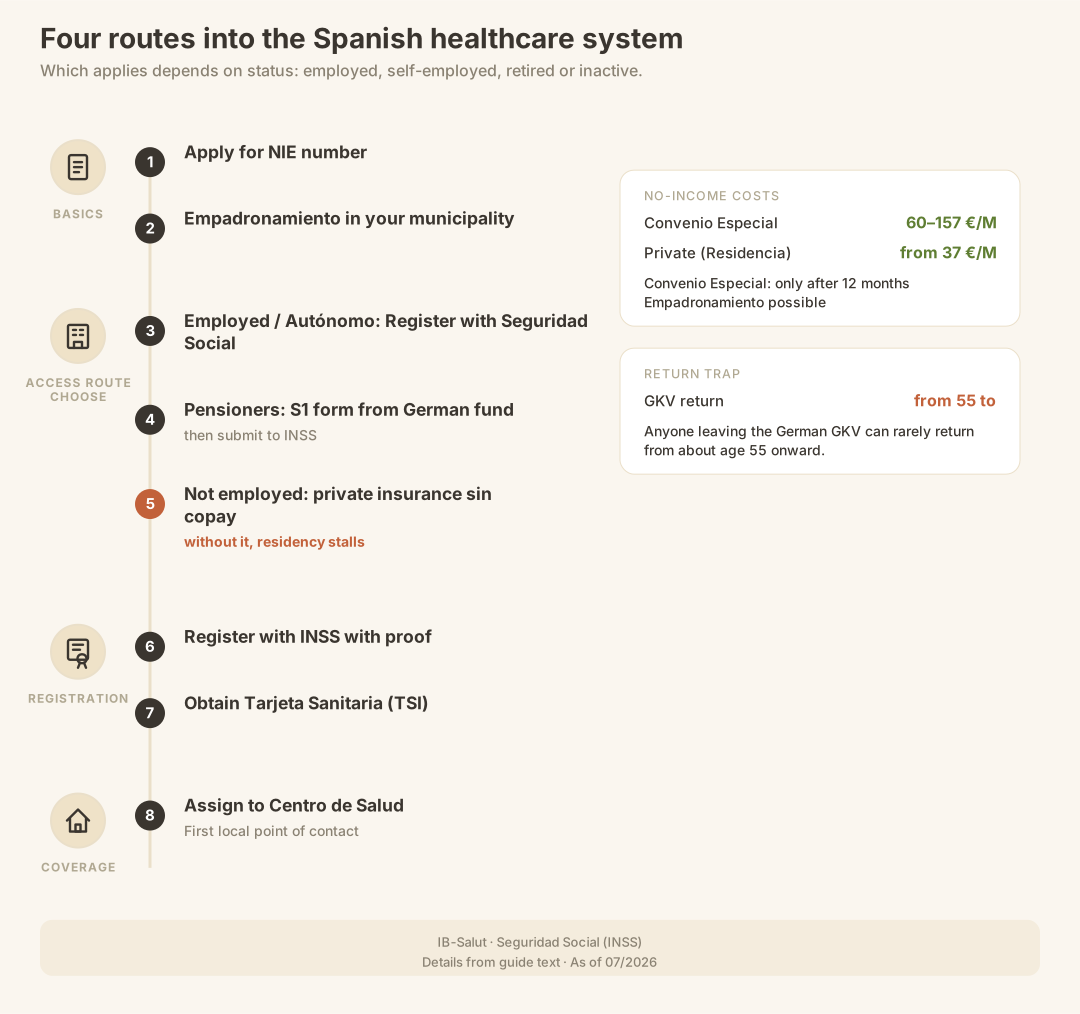
| Status | Route of access | Most important document |
|---|---|---|
| Employee with a Spanish employment contract | Automatic via employer registration | Social security number (Seguridad Social) |
| Self-employed person (Autónomo) | Own registration with the Seguridad Social | Alta as an Autónomo |
| Retiree with a foreign pension | S1 form from the home-country health insurance provider | S1 + registration with the INSS |
| Economically inactive persons without a pension | Convenio Especial or mandatory private insurance | Empadronamiento (12 months) |
Employees and self-employed people receive full access to public healthcare regardless of income, as soon as they are properly registered with the Seguridad Social. If you work as an Autónomo, it's worth taking a look at our guide on bookkeeping for Autónomos, since social security contributions are directly linked to your registration. Anyone who continues to work remotely from Germany for a foreign employer should also check the rules on Pluriactividad, as this can result in different insurance obligations.
EHIC/GHIC: What the European Health Insurance Card actually covers
The European Health Insurance Card (EHIC), or its British equivalent (GHIC), is intended for short stays – holidays, business trips, temporary visits. It covers medically necessary treatment during a time-limited stay, but it does not replace permanent registration in the Spanish system. Anyone who moves to Mallorca on a permanent basis must integrate into the Spanish system, either publicly or privately.
Please note: The EHIC is explicitly not a substitute for health insurance in the case of a permanent relocation. Many emigrants underestimate this difference and find themselves without valid proof of insurance when applying for their Residencia.
For full integration into the Spanish system, you'll need, depending on your status, the S1 form (retirees) or standard registration through your employer or as an Autónomo. You'll then receive the Tarjeta Sanitaria Individual (TSI), the Spanish health card, which gives you access to GPs (Centro de Salud) and hospitals.
Retirees in Spain: the S1 form
If you receive your pension entirely from Germany and move to Spain, you generally remain within the German pension insurance system, but you'll still need a Spanish health card. The route to obtaining it is via the S1 form: you apply for it through your German health insurance provider, submit it to the Spanish INSS (Instituto Nacional de la Seguridad Social), and receive your Tarjeta Sanitaria through this process. If, however, you worked in Spain for more than a year, part of your pension may also come from Spain – in which case a different authority may be responsible.
You can find details on the application process, the authorities involved and possible pitfalls in our separate guide on S1 form. Anyone who has not yet applied for a Spanish pension should also look into the process for pension in Spain as well as the taxation of German pensions in Spain, since both topics are closely linked to the health insurance question.
Non-working residents: Convenio Especial and mandatory insurance for the residencia
If you are neither employed nor self-employed nor a pensioner with S1 entitlement, two options remain: the Convenio Especial or private health insurance. The Convenio Especial is a voluntary state health insurance scheme for residents without employment. The usual requirement is an empadronamiento of at least 12 months in the relevant municipality; costs range roughly between 60 and 157 euros per month, depending on age.
Important for anyone who has no access to the public system through work, S1 or Convenio Especial: to apply for the residencia as a non-working resident, the authorities generally require private health insurance with no co-payment (sin copago) and no waiting periods. Standard travel health insurance is usually not sufficient for this.
| Criterion | Convenio Especial | Mandatory private insurance (residencia) |
|---|---|---|
| Requirement | 12 months' empadronamiento | No minimum stay required |
| Cost | approx. 60–157 €/month depending on age | From approx. 37 €/month, depending on age |
| Co-payment | None | None (requirement for residencia) |
| Access to | Public system (SNS/IB-Salut) | Private network |
You can read more about the requirements and the application process in our guide to residencia in Spain as well as to empadronamiento, which forms the formal basis for many of these applications.
Private health insurance: providers, costs, benefits
Even if you have access to the public system, many expats opt for supplementary private insurance – due to shorter waiting times, free choice of doctor, and multilingual staff. Two of the most common providers for international clients in Spain are DKV and Sanitas.
| Provider | Starting price (approx.) | Special feature |
|---|---|---|
| DKV | from approx. €37/month | Wide network, popular among expats |
| Sanitas | from approx. €65/month | Large hospital network, established brand |
The actual costs depend heavily on age, pre-existing conditions, and the chosen scope of cover – a general comparison cannot replace an individual quote request. Anyone who also needs dental care should specifically ask about corresponding add-on modules, as basic tariffs often do not cover this.
Note: Without valid insurance – public or private – you generally have to pay for private treatments in Spain upfront. This also applies to those with statutory insurance who visit a private doctor or private clinic.
Public vs. private: practice, waiting times and quality in everyday life
In practice, the two systems differ mainly in speed and structure. The public system operates on a classic GP principle: every initial consultation goes through the relevant health centre (Centro de Salud or PAC), from where referrals to specialists are made if needed. Freely switching the assigned doctor is often not straightforward.
Private clinics, on the other hand, generally offer faster access to specialists and more flexible appointment scheduling, but without an insurance contract they often require payment in advance. For many newcomers, the combination of basic public cover and a lean private supplementary policy is therefore the most practical approach – especially in the initial phase, when language skills and local knowledge are still limited.
Registration step by step: from registration to the Tarjeta Sanitaria
- Apply for the NIE number and Empadronamiento in your municipality of residence.
- Depending on status: register as an employee/autónomo with the Seguridad Social, apply for the S1 form from the German health insurer (pensioners), or take out a Convenio Especial/private insurance (non-working individuals).
- Registration with the INSS along with the corresponding documents.
- Issuance of the Tarjeta Sanitaria Individual (TSI), the Spanish health card.
- Assignment to a Centro de Salud near your home as the first point of contact.
Note: Digital access is helpful for many administrative procedures in this process. Find out in advance about the Certificado Digital in order to handle appointments and applications online.
Returning to Germany: the age trap from 55
A point that is often overlooked when planning insurance: anyone who has once deregistered from the statutory health insurance (GKV) in Germany and later wants to return can practically no longer switch back into the GKV from around the age of 55. This particularly affects emigrants who insure themselves exclusively privately in Spain and want to keep the option of returning open. Anyone considering this step should think through the long-term consequences early on, not just shortly before the planned return.
Most common mistakes
- The EHIC/GHIC card is confused with permanent cover – it only applies to temporary stays.
- Missing private insurance without excess/deductible leads to delays in the residencia application.
- The Convenio Especial is applied for without meeting the 12-month Empadronamiento requirement.
- Retirees apply for the S1 form too late and are left without cover in the meantime.
- The consequences of leaving statutory health insurance (GKV) for a later return from age 55 are not considered.
- Private treatments are used without prior cost clarification and then have to be paid for in full upfront.
What comes next?
Once basic cover is in place, it's worth looking at related topics: the tax treatment of your stay as Taxes as a resident, the question of the 90/180-day rule for non-permanent stays, and – if you work as a self-employed person (autónomo) – the ongoing reporting obligations relating to Modelo 303 and 130. For families with children, the guide on School in Mallorca is also relevant, as school and health registration processes often coincide in time.
Checklist: Organising health insurance in Spain
- NIE number and Empadronamiento applied for
- Personal status clarified: employed, autónomo, retiree or economically inactive
- Suitable access route chosen: Seguridad Social, S1 form or Convenio Especial
- Private insurance without excess/deductible taken out for the residencia if needed
- Tarjeta Sanitaria applied for and responsible Centro de Salud identified
- Consequences of a possible exit from statutory health insurance (GKV) for a later return considered
- Supplementary private insurance checked (e.g. for dental treatment)
Conclusion
The healthcare system in Spain is convincing with solid public basic care via SNS and IB-Salut, but requires expats to have clear categorisation: employees and self-employed people get access via the Seguridad Social, retirees via the S1 form, and non-working individuals via the Convenio Especial or compulsory private insurance. Those who plan ahead avoid gaps in cover, delays with the residencia, and costly surprises in the event of a possible later return to Germany. The combination of a public base and a lean private supplementary policy has proven to be a practical middle ground for many expats.
Official sources
- Institut Balear de Salut (IB-Salut) — https://www.ibsalut.es
- Seguridad Social / Instituto Nacional de la Seguridad Social (INSS) — https://www.seg-social.es
- Ministerio de Sanidad (Spanish Ministry of Health) — https://www.sanidad.gob.es
- European Commission — European Health Insurance Card (EHIC) — https://europa.eu/youreurope/citizens/health/unplanned-healthcare/temporary-stays/index_de.htm