Anyone moving to Spain and working there quickly encounters a tax system with progressive rates of up to 47 % on worldwide income – even higher depending on the region. The Beckham Law Spain, officially the Régimen Especial para Trabajadores Desplazados (RETD), changes that fundamentally: qualifying newcomers pay a flat rate of 24 % on Spanish employment income up to 600.000 €, while foreign income remains essentially tax-free in Spain for the duration of the regime. The regime applies for the six tax years from the date of arrival and was most recently significantly modernised by the Startup-Gesetz Ley 28/2022 (in force from January 2023) and Real Decreto 1008/2023. This guide explains who qualifies, how the application process works, where the real pitfalls lie – and why the application deadline is the most common mistake when relocating to Mallorca or other Spanish regions.
Does the Beckham Law suit your income structure and relocation plans?
📩 Submit a personal enquiry — We assess your situation free of charge and connect you with suitable tax advisers in Mallorca
Background: Why does the Beckham Law exist at all?
Spanish income tax law follows the worldwide income principle. Anyone who is tax-resident in Spain must in principle declare all income worldwide and pay tax up to the top rate. The combined national and regional rate in 2025/2026 stands at 47 % in Madrid, and in the Comunitat Valenciana even up to 54 %. For professionals from countries with lower top rates, this was a massive deterrent.
The impetus for the regulation came from the transfer of David Beckham to Real Madrid in 2003: in order to make Spain tax-attractive for international top talent, a political debate arose about a flat-rate non-resident taxation model for relocated employees. The result was Royal Decree 687/2005, which introduced this model for the first time. Sportspeople are explicitly excluded today – the nickname of the law stuck nonetheless.
The regime is now legally enshrined in Artikel 93 LIRPF (Ley 35/2006). The reform under Ley 28/2022 (Startup Law) significantly expanded it from January 2023: the prior-residence waiting period was reduced from 10 to 5 years, remote workers and digital nomads were explicitly included, and family reunification was made easier.
Who qualifies? The requirements in detail
The basic requirements apply cumulatively – all points must be met.
Criterion
Requirement 2026
Prior residence
No Spanish tax liability in the last 5 years before relocation
Reason for relocation
Employment contract with a Spanish company or secondment by a foreign employer
Place of activity
Main activity physically in Spain; up to 15 % of activity abroad tolerated
Director
Possible, provided no controlling interest (i.e. not a majority shareholding) in the company
Remote Workers / Nomads
Possible since 2023 with a valid Spanish Digital Nomad Visa
Application deadline
Submission within 6 months of registering with Social Security – absolute, no extension
Minimum income
No statutory minimum; practically worthwhile from a medium to high income
Important: The 6-month deadline is the most common reason for losing the entire regime. Anyone who misses it cannot reapply until after a further waiting period of 5 years at the earliest. There are no exceptions and no extensions.
Who is expressly excluded?
Professional sportspeople (since the legislative amendment)
Persons who earn income through a permanent establishment abroad
Majority shareholders of their own company (control in the tax law sense)
Persons who have been tax-resident in Spain within the last 5 years
The tax advantages: what the regime actually offers
Flat rate instead of progression
The core element: Spanish employment income is taxed at a uniform rate of 24 % up to €600,000 Amounts exceeding this are subject to the rate of 47 % – but only on the excess portion.
Type of income
Taxation under Beckham Law
Taxation under the standard regime
Salary / employment income (Spain) up to €600,000
24 % flat
19–47 % progressive (+ regional component)
Salary / employment income (Spain) over €600,000
47 % on the excess amount
47 % + possible regional surcharge
Foreign salary (employer abroad)
In Spain generally tax-exempt
Worldwide income → full progression
Foreign dividends, interest, capital gains
In Spain generally tax-exempt
Capital gains: 19–28 %
Rental and property income Spain
Special arrangements possible
Included in IRPF
Assets held abroad (Modelo 720)
No declaration requirement during the regime
Reporting obligation from €50,000 per category
Modelo 151 instead of IRPF
Those taxed under the Beckham Law submit Modelo 151 — a simplified tax return for impatriates — rather than the standard IRPF form. This significantly reduces complexity.
No joint assessment
One important drawback: under the Beckham Law, joint assessment with a spouse is not possible. Anyone relocating with a family where the partner also has relevant income must factor this into their overall planning.
No standard deductions
Those using the regime cannot, as a rule, claim the deductions available under standard IRPF (pension contributions, personal allowances, child tax credits, etc.). For high earners, the advantage of the lower tax rate nonetheless outweighs this.
Tax rates compared head-to-head: Beckham vs. standard taxation
A concrete worked example based on research sources:
Annual income (gross, Spain)
Effective tax — Beckham Law
Effective tax — IRPF (Madrid, estimated)
Saving (rounded)
80.000 €
approx. €19,200
approx. €29,000–33,000
approx. €10,000–14,000
150.000 €
approx. €36,000
approx. €60,000–66,000
approx. €24,000–30,000
300.000 €
approx. €72,000
approx. €130,000–141,000
approx. €58,000–69,000
600.000 €
approx. €144,000
approx. €273,000–282,000
approx. €129,000–138,000
Please note: The IRPF figures are approximate values based on research (top rate Madrid 47%, Valencia up to 54%). Your specific situation depends on region, deductions, and income structure. These figures should always be reviewed by a qualified tax adviser.
Eligible groups in detail
Employees with a Spanish employment contract
The classic case: you are taken on by a Spanish company or transferred to Spain within an international group. The prerequisite is a clearly documented link between the relocation and the commencement of employment.
Seconded Employees (Détachés)
International corporations second executives to Spanish locations. This constellation also qualifies, provided the employer does not establish a permanent establishment abroad for the individual.
Managing Directors and Board Members
Since the reform introduced by Ley 28/2022, managing directors and board members may also use the regime – however, only if they hold no controlling interest in the company. What exactly "controlling" means must be clarified on a case-by-case basis; the tax authority (AEAT) has published consultative resolutions on this matter.
Remote Workers and Digital Nomads
Also new since 2023: anyone who enters Spain on a Digital Nomad Visa and works for a foreign company may apply for the Beckham Law. This is particularly relevant for Mallorca and the other Balearic Islands, where this group is growing strongly.
Family Members
Spouses and children under 25 years of age, as well as dependent parents, may be included under certain conditions – provided they relocate together within the first year of the regime and themselves earn qualifying income.
Step by Step: How the Application Works
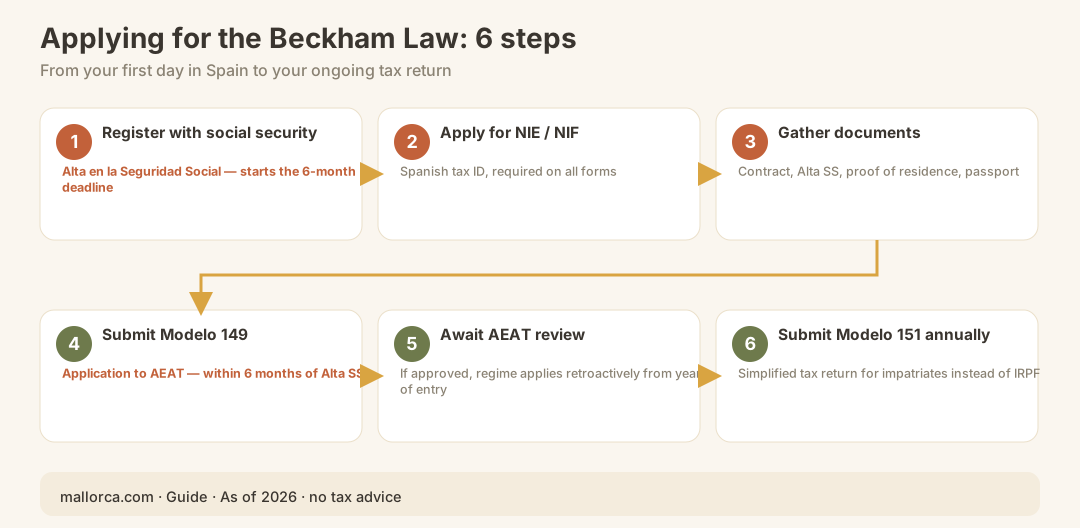
Social security registration in Spain (Alta en la Seguridad Social) – this moment starts the 6-month deadline.
Submit Modelo 149 – this is the official application for admission to the special regime. Submission to the competent Agencia Tributaria.
Review by the AEAT – the authority confirms or rejects the application. If accepted, the regime applies retroactively from the year of arrival.
Annual tax return via Modelo 151 throughout the entire duration.
Required Documents (typical requirements)
Document
Purpose
Employment contract or secondment letter
Proof of reason for relocation
Proof of social security registration (Alta SS)
Start of deadline
NIE / NIF
Mandatory detail on all forms
Proof of previous residence abroad
Proof of 5-year non-residency
Tax records from the country of origin
Supplementary documentation
Copy of passport
Identification
Please note: The exact documentation requirements of the AEAT may vary on a case-by-case basis. A tax adviser can check whether the documents are complete before submission.
Duration and what happens afterwards
The regime runs for the year of arrival plus five full calendar years – typically six tax years in total. Anyone arriving in early 2024 is covered until the end of 2029.
Once the regime expires, you automatically revert to standard IRPF taxation on worldwide income. This requires advance planning:
Foreign assets and foreign income will then need to be restructured
The Modelo 720 reporting obligation applies in full from that point onwards
Pensions, ETF portfolios, and corporate structures abroad should be reviewed from a tax perspective no later than 12 months before expiry
Double taxation agreements: limited applicability
A frequently overlooked disadvantage: those making use of the Beckham Law are treated as Spanish non-residents for tax purposes – yet are legally tax residents. This means that double taxation agreements (DTAs) are generally not applicable in the usual way. In practice, this can mean:
The country of origin (e.g. Germany) may continue to tax certain income if it does not recognise Spanish status as full tax residency
The Beckham Law protects against Spanish tax on foreign-source income – but does not automatically protect against taxation in the country of origin
For German-speaking newcomers, it is therefore essential to clarify the position under the DTA between Germany and Spain
Important: Before relocating, have a tax adviser check whether you will remain liable to tax in Germany (Austria, Switzerland) after your departure – for example through exit taxation on GmbH shareholdings or income tax on pension payments.
The most common mistakes with the Beckham Law
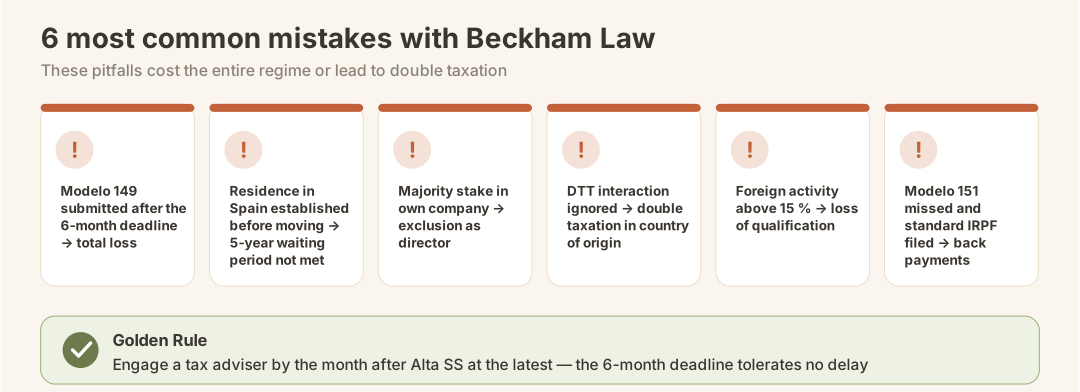
Mistake
Consequence
Application (Modelo 149) submitted after the 6-month deadline
Complete loss of the regime, no reinstatement possible
Tax residency in Spain established too early, prior to relocation
5-year waiting period not met → application rejected
Majority shareholding in one's own company
Exclusion as a director
DTA interaction ignored
Double taxation in the country of origin
Expectations too high regarding pure investment income in Spain
Spanish capital and property income is subject to its own rates
Joint assessment planned
Not possible under the regime
Forgetting to file Modelo 151 instead of standard IRPF
Incorrect tax return, back payments and penalties
Foreign activity exceeding 15 %
Loss of eligibility
Beckham Law and the Self-Employed (Autónomo)
The self-employed (Autónomos) are generally more difficult to qualify. The 2022 reform brought openings — particularly for digital nomads and freelancers holding a Digital Nomad Visa. Those operating as Autónomo and working for a foreign company may qualify under certain circumstances; those primarily serving Spanish clients will find it harder. The precise boundaries are subject to ongoing case law.
Mallorca is one of the most popular destinations for newcomers looking to take advantage of the Beckham Law. In tax terms, the same national rules apply to the RETD throughout the Balearic Islands — the flat tax rate of 24 % is uniform across the country. However:
The standard top IRPF rate in the Balearic Islands is higher than the Madrid level, which makes the relative advantage of the Beckham Law even greater on the islands
The regional Agencia Tributaria de les Illes Balears (ATIB) is responsible for certain regional taxes, but not for the RETD — this falls under the national AEAT
Those buying or renting in Mallorca must additionally apply for Residencia and empadronarse — both are required regardless of tax status
What Comes Next? Tax Planning for Year 7
The end of the regime deserves the same care as the entry into it. Those who prepare in good time can ease the transition to standard IRPF taxation:
Structuring overseas accounts and portfolios: From Year 7 onwards, full worldwide income taxation applies, along with the Modelo 720 reporting obligation
Leaving Spain: If you move on after six years, exit tax obligations may arise
Continuing as a regular resident: Transition into the standard IRPF system with all its obligations and deduction options
Retirement planning: Retirees in Mallorca are subject to their own double taxation agreement rules; the Beckham Law is generally not suitable for purely pension-based income
Checklist: Applying for the Beckham Law — Don't Miss Anything
No Spanish tax liability in the last 5 years
Employment contract / letter of assignment is in place or Digital Nomad Visa has been applied for
Registered with Social Security (Alta SS) – Deadline noted
Tax adviser engaged – at the latest in the month following Alta SS
Modelo 149 prepared and submitted on time (within 6 months)
Documents complete (contract, proof of residence, passport)
Double taxation agreement (DTA) check with country of origin (Germany / Austria / Switzerland) completed
No controlling shareholding in own GmbH / SL – have this reviewed
Familia: family members registered in the first year
Modelo 151 noted for first tax return
Planning horizon for year 7 (Modelo 720, transition to worldwide income taxation) kept in mind
Conclusion: Who really benefits from the Beckham Law?
The Beckham Law Spain is one of the most attractive expat tax regimes in Europe – provided you meet the requirements and submit your application on time. The benefit is greatest for:
Highly paid employees and executives with a Spanish employment contract
Remote workers with a foreign client and a Digital Nomad Visa
Posted group employees with a clear secondment structure
Individuals with significant foreign income or overseas portfolios that are to remain tax-free in Spain
It is less suitable for: sole traders whose clients are predominantly based in Spain, majority shareholders of their own company, retirees (different DTA rules apply here), and individuals who primarily generate Spanish capital or property income.
The crucial step: seek qualified tax advice before relocating – both in Spain and in your country of origin. The 6-month deadline allows no delay.
📩 Submit a no-obligation enquiry now – we connect you with experienced tax advisers on Mallorca who will guide you through the Beckham Law application.
Modelo 149 (application for admission to the special regime): available via the AEAT online portal
Modelo 151 (tax return under the RETD): available via the AEAT online portal
Agencia Tributaria de les Illes Balears (ATIB) – For Balearic regional taxes (not RETD): https://www.atib.es/
What is the Beckham Law?
The Beckham Law is a special Spanish tax regime for relocated employees and skilled professionals (officially: Régimen Especial para Trabajadores Desplazados, RETD), governed by Artículo 93 LIRPF. It allows Spanish employment income to be taxed at a flat rate of 24 % instead of the progressive standard rate of up to 47 % — and generally exempts foreign-source income from Spanish tax.
How long does the Beckham Law apply?
The regime applies for six tax years: the year of arrival plus the five following calendar years. After that, the standard Spanish income tax on worldwide income automatically takes effect.
What does applying for the Beckham Law cost?
There is no government application fee. Costs arise from tax adviser and legal fees for preparing and submitting Modelo 149 — these vary depending on the provider and complexity of the case.
Can I use the Beckham Law as a self-employed person?
Generally difficult, but possible since the 2023 reform for digital nomads holding a valid Digital Nomad Visa who work for foreign clients. Those who primarily serve Spanish clients or hold a controlling interest in their own company are generally excluded.
What happens if I miss the 6-month deadline?
The entitlement lapses completely and irrevocably. There is no reinstatement or extension. You can apply for the regime again at the earliest after a new 5-year period of non-residency.
Do I need to file a Modelo 720 declaration under the Beckham Law?
No. As long as you are taxed under the RETD, you are exempt from the Modelo 720 reporting obligation for overseas assets. However, from the first year after the regime ends, the reporting obligation applies in full.
Does the Beckham Law also apply to my family?
Yes, spouses, children under 25 years of age, and dependent parents can be included under certain conditions — they must relocate together during the first year of the regime and must themselves earn qualifying income.
Can I file a joint tax return with my partner under the Beckham Law?
No. Joint assessment (declaración conjunta) is expressly not permitted under the Beckham Law regime. Both partners must file separate tax returns.