
Keeping a horse on Mallorca: buying a finca, importing a horse, and a full cost overview
Anyone who loves horses and dreams of a life by the Mediterranean will sooner or later find themselves on Mallorca. The island is considered the location with the highest density of horses among all Mediterranean islands – and for good reason: the mild year-round climate, the expansive finca landscapes in the interior, and a well-established equestrian and competition culture make it a genuine hotspot for horse owners. This guide explains what to look for when buying a suitable finca, what you need to bear in mind when importing your horse, what ongoing costs are realistic, and what official obligations await you. You'll find concrete figures, typical locations, and an honest assessment of the most common mistakes – so that your dream of keeping horses on Mallorca doesn't fall apart over the details.
Are you planning to buy an equestrian property or import your horse and want to know what applies to your specific situation?
- 📩 Submit a personal enquiry — individual advice on finca purchases, permits, and import procedures
- Everything on the topic of pets & animals on Mallorca
Why Mallorca is so attractive for horse owners
Among all Mediterranean islands, Mallorca has the highest concentration of horses. This is not solely down to the climate, but to a combination of mutually reinforcing factors: generous landholdings in the interior, a strong tradition of horse racing, and a growing infrastructure of competition venues, livery stables, and specialist vets. The gentle rolling hills around Llucmajor, Manacor, Costitx, and Inca offer expansive pastures and peaceful bridleways that are simply hard to beat for many horse owners from central Europe.
In practical terms, the Mediterranean climate means: long summers with temperatures between 25 and 35 degrees, mild winters rarely dropping below 5 degrees, and a rainy season mainly in autumn. Horses on Mallorca can be kept outdoors considerably longer than in Germany, Austria, or Switzerland – which reduces stable costs and generally benefits the animals' wellbeing. At the same time, paddocks and pastures need shade in high summer, and a reliable supply of drinking water is essential – on an island, a planning factor that should not be underestimated.
The equestrian scene has become considerably more professional in recent years. There are competitions at national and international level, riding schools for beginners and more advanced riders, and livery stables that meet international standards. Horse owners from Germany, Switzerland, and the United Kingdom will find a well-established community on the island.
Finding the right finca: locations, sizes, and facilities
Which regions are best suited?
Not every part of the island is equally well suited to keeping horses. The topographically flatter and more open areas in the interior and the south are clearly preferred.
| Region | Characteristics | Suitability for Keeping Horses |
|---|---|---|
| Llucmajor | Flat hinterland, large plots, good transport links | Excellent |
| Manacor | Rural, many existing fincas with stabling | Excellent |
| Costitx | Quiet, traditional, close to the geographical centre | Good |
| Inca / surroundings | Agriculturally oriented, good infrastructure | Good |
| Pollença / Alcúdia | Attractive locations, but proximity to the Tramuntana makes grazing more difficult | Conditional |
| Sóller / Tramuntana | Steep slopes, little grazing land | Less suitable |
What must the property offer?
Several factors are crucial for keeping horses on a finca in compliance with planning regulations:
- Plot size: As a rule, a plot in the rural land zone (suelo rústico) is required for private stabling and paddocks. Minimum sizes depend on the municipality and the intended use. For a professional equestrian facility, you should realistically plan for several hectares.
- Existing planning permission for stable buildings: Older fincas often have stable buildings without modern planning permission. It is essential to have the legality checked before the purchase contract is signed.
- Water supply: A private well (pozo) is commonly found in rural areas and is important for keeping horses — have the capacity and quality checked.
- Power supply:Photovoltaic systems are common and practical on new fincas; grid connections in rural areas can sometimes be weaker.
Price guidance: What do equestrian properties cost?
The price range is enormous. A concrete example from our research: a newly built finca in Llucmajor with approximately 61.890 m² of land, 605 m² of living space, a riding arena (30 × 70 m), a round pen (20 m diameter), paddock boxes, a saltwater pool (4 × 22 m), and high-quality interior fittings was listed at 6.300.000 Euro (built 2025). At the other end of the spectrum, existing fincas with more basic stable buildings are available from around 500.000 Euro, although renovation requirements can push the final price up considerably.
| Type | Plot size (approx.) | Price guidance |
|---|---|---|
| Basic finca with stable building (existing stock) | from approx. 1–2 ha | from approx. 500.000 € |
| Finca with developed stabling and paddocks | 2–5 ha | approx. 800.000–2.500.000 € |
| Professional equestrian facility / newly built finca | 5–10+ ha | from approx. 3.000.000 € |
| Luxury equestrian property with riding arena, pool, and full facilities | 6+ ha | 5.000.000 € and above |
Please note: Prices are indicative market values based on the research available and may vary considerably depending on location, condition, and specification. Always have current listings reviewed by a local estate agent and a solicitor.
The purchase process and ancillary costs when buying a finca
Buying a property on Mallorca follows a set process. As a buyer you will need a NIE number, a Spanish bank account, and as a rule a solicitor and a gestoría.
Steps in the property purchase process
- Apply for a NIE number – without one, no purchase is possible (NIE-Nummer Mallorca)
- Open a Spanish bank account (Bankkonto in Spanien eröffnen)
- Reservation contract (contrato de arras) – secures the property, typically with a 10 % deposit
- Due Diligence – Land Registry check, legal verification of all buildings, water rights, encumbrances
- Notary appointment and notarisation (escritura pública)
- Land Registry entry and taxes
Additional costs when purchasing
When purchasing an existing property on Mallorca, property transfer tax (ITP – Impuesto sobre Transmisiones Patrimoniales) applies. The Balearic Islands have their own tax rates, applied on a sliding scale according to the purchase price. In addition, there are notary fees, Land Registry fees, and legal costs.
| Cost item | Indicative value |
|---|---|
| ITP (Balearic property transfer tax, sliding scale) | tiered according to purchase price; consult your solicitor/ATIB for current rates |
| Notary fees | approx. 0,5–1 % of the purchase price |
| Land Registry fees | approx. 0,1–0,5 % |
| Solicitor / Gestoría | approx. 1–2 % (recommended) |
| Total additional costs (indicative) | approx. 10–15 % of the purchase price |
Please note: The precise Balearic ITP rates change from time to time. Have the currently applicable rates confirmed by your solicitor, your Gestoría or directly by the ATIB before contracts are exchanged.
Anyone who does not yet have residencia on Mallorca will, as a non-resident, be subject to ongoing non-resident tax after the purchase (non-resident tax Spain). Those who register permanently become residents and are subject to standard income tax (taxes as a resident (IRPF)).
Permits and regulations for keeping horses
Horses are classed as working animals in Spain. Keeping them on a finca in a rural area (suelo rústico) is generally permitted, but is subject to conditions that may vary depending on the local authority.
What do you typically need?
- Approval of permitted use: Stable buildings in rural areas require planning permission (licencia de obras) if they are newly built or substantially altered. For existing buildings, always verify their legal status.
- Registration with the Consell de Mallorca or the local municipality: The use of a finca for keeping horses may be subject to a notification requirement, particularly if feed is sold, riding lessons are offered, or horses are taken in as livery — this then constitutes a commercial activity with its own set of requirements.
- Sanitary and veterinary requirements: Stables must meet minimum standards regarding space, ventilation, and hygiene. The relevant veterinary authority of the municipality or the Consell de Mallorca is the point of contact for these matters.
- Water rights: Private wells on rural properties are subject to regulation by the competent water authorities of the Balearic Islands. Wells must generally be registered.
Please note: If you wish to operate a professional riding school, a livery yard, or offer riding lessons for payment on your finca, this constitutes a commercial activity. You will need a licence, possibly autónomo status, and additional permits. This is a subject in its own right — seek legal clarification in advance.
Importing a horse to Mallorca: step by step
Importing a horse from Germany, Austria, or Switzerland to Mallorca is a logistical and bureaucratic undertaking that requires careful preparation. Since Mallorca is part of Spain and therefore part of the EU, different (and simpler) rules apply to horses coming from other EU member states than to imports from third countries such as Switzerland.
Transport within the EU (e.g. from Germany or Austria)
| Requirement | Details |
|---|---|
| Equine passport (EU horse passport) | Mandatory — must accompany the horse at all times |
| Health certificate (official veterinary certificate) | Required for movement within the EU |
| TRACES notification | Electronic pre-notification in the EU trading system for live animals |
| Identification (microchip) | Mandatory for all equines in the EU |
| Vaccination record (in particular Equine Influenza) | Recommended/required depending on country of origin and destination |
| Entry via an approved border inspection post | To be observed when transporting by ferry via mainland Spain to Mallorca |
Transport from Switzerland (third country)
As Switzerland is not an EU member state, stricter import regulations apply:
- Official animal health certificate in accordance with the EU template
- Pre-notification and inspection at an approved EU border inspection post (BIP)
- Quarantine may be required – check the current animal disease status beforehand
- TRACES pre-notification by the importing animal keeper
Please note: Requirements for imports from third countries are subject to change. Before transporting your horse, obtain up-to-date information from the competent veterinary authority and the Spanish authority (Ministerio de Agricultura, Pesca y Alimentación).
Registration in Mallorca after arrival
Once the horse has arrived in Mallorca, local registration is required:
- Registration with the Registro de Explotaciones Ganaderas – premises registration number (REGA) for the finca where the horse is kept
- Animal health record book (Libro de Explotación) to be maintained
- Update of the equine passport with the new Spanish keeper's address
- Notification to the Servicio de Ganadería of the Balearic Islands (Conselleria d'Agricultura, Pesca i Alimentació)
Ongoing costs: what does keeping a horse in Mallorca really cost?
Ongoing costs are a central issue that many prospective horse owners underestimate. They depend greatly on whether you keep your horse on your own finca or put it in a livery yard.
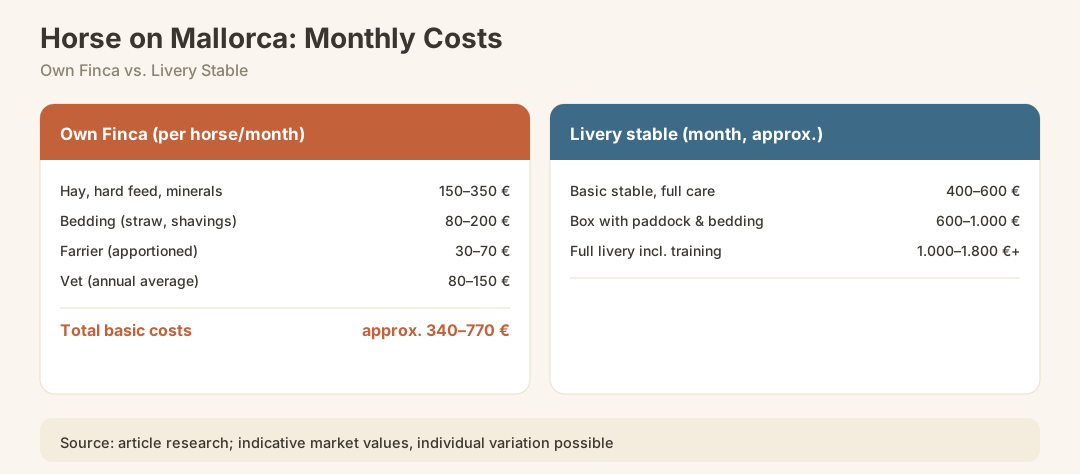
Own finca: cost overview
| Cost item | Indicative figure per month |
|---|---|
| Hay, hard feed, minerals | approx. €150–350 per horse |
| Bedding (straw, shavings) | approx. €80–200 per horse |
| Farrier (every 6–8 weeks) | approx. €50–120 per visit, equating to approx. €30–70/month |
| Vet (routine vaccinations, dental check, worming) | approx. €80–150 per horse/month (annual average) |
| Water consumption – stable and paddock | variable, depending on well/mains connection |
| Stable care / staff (if not self-managed) | variable depending on hourly rate and workload |
| Insurance (accident, liability) | variable depending on coverage amount and provider |
Note: Staff costs on Mallorca are subject to Spanish minimum wage regulations and social security contributions. Anyone employing a stable hand must register them correctly with the Seguridad Social.
Livery yards: what does the market offer?
For horse owners who do not (yet) have their own finca or who want their animal professionally cared for, there are specialist livery yards on Mallorca. An establishment such as Paradise Ranch Mallorca, for example, advertises air-conditioned stables, individual paddocks, a professional team and a concept focused on animal welfare. Concrete price lists are generally not publicly available on such platforms — a direct enquiry is worthwhile.
| Livery package | Price guide (per month, approx.) |
|---|---|
| Basic stable, essential care | from approx. 400–600 € |
| Stable with paddock, hay, bedding changes | approx. 600–1.000 € |
| Full livery incl. training, veterinary coordination | approx. 1.000–1.800 € and above |
These figures are indicative market values. Actual prices vary considerably depending on the facility, location and individual package.
Planning and building your own stable: what is permitted?
Anyone wishing to build a new stable facility on an existing finca will quickly encounter the topic of planning law on rural land (suelo rústico). As a general rule:
- New builds on suelo rústico are heavily restricted. Agricultural buildings and stable buildings can be granted planning permission under certain conditions.
- The local authority (Ajuntament) is the first point of contact for planning permission.
- For larger facilities (riding arena, roundpen, irrigation system, drainage system), planning permission from the Consell de Mallorca is generally required.
- Professional riding arenas such as the example described in this research (30 × 70 m, with drainage system) are regularly built by specialist planning offices and certified manufacturers — not from a DIY store.
Warning: Building without planning permission on Mallorca is a widespread problem and can lead to demolition orders, substantial fines and difficulties when selling the property later. Make sure any new build or conversion is legally secured in advance.
Veterinary care and expertise on the island
For its size, Mallorca has a solid veterinary infrastructure that also specialises in equines. For routine care (vaccinations, dental treatment, wound care) you will find competent vets on the island. For more complex procedures (orthopaedic problems, colic surgery) you should clarify in advance which clinic is the nearest and most suitable option — Mallorca is an island, and the nearest large-animal hospital on the mainland is not reachable in an emergency.
Key recurring costs:
- Equine influenza and tetanus: Core vaccinations, generally to be refreshed annually
- Herpes (EHV-1/4): Recommended every six months depending on exposure and competition schedule
- Dental check: Recommended annually (equine dentist or specialist vet)
- Worming treatment: Strategic treatment based on faecal analysis, generally 1–2 × per year
Tax aspects of keeping horses on Mallorca
The tax treatment depends greatly on how you keep your horses: purely privately or with a commercial element.
Private horse ownership
Those who keep horses exclusively for private use have no particular tax reporting obligations relating to the horses themselves. As a resident, however, you are required to file an annual income tax return (IRPF). Anyone who still holds significant assets abroad (e.g. in Germany) should keep the Modelo 720 reporting obligation in mind (Modelo 720 reporting obligation).
Commercial use (livery yard, riding lessons, competition riding)
As soon as you offer services – livery places, riding lessons, breeding – you are generally required to register as an autónomo (self-employed) and pay the Cuota Autónomo as well as VAT (IVA). Horses used as business assets may, under certain circumstances, be claimed for tax purposes – for this you will need tax advice from someone well versed in Spanish agricultural and commercial tax law.
High-earning newcomers should check whether the Beckham Law (Beckham Law Spain) is relevant to their situation. The special regime allows qualifying newcomers, under certain conditions, to be taxed as quasi-non-residents; the details and current requirements should be reviewed with a tax adviser.
| Situation | Tax classification |
|---|---|
| Private horse ownership as a resident | IRPF, wealth tax (IP) on high-value assets |
| Livery yard / riding lessons for payment | autónomo obligation, IVA, corporation tax if applicable |
| Purchase of the finca as a non-resident | Non-resident tax on attributed rental value |
| Purchase as an investor without residencia | Check whether Golden Visa is relevant |
Most common mistakes when keeping horses on Mallorca
These are mistakes we see time and again – and they cost either money, time, or both:
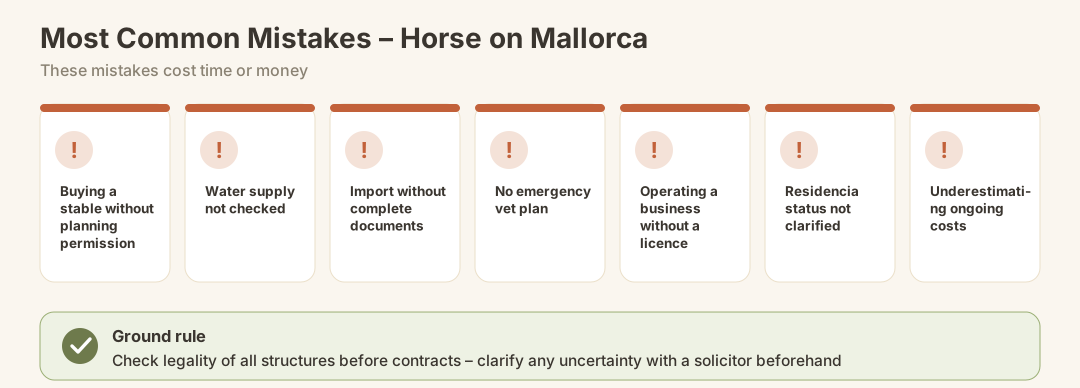
- Purchasing stable buildings without planning permission: Older fincas often have stables that were never granted planning permission. When purchasing such buildings, you take on the risk of regularisation.
- Water supply not checked: A well that is sufficient in winter can become a problem in high summer. Capacity and drinking water quality for horses are part of due diligence.
- Import without complete documentation: A missing health certificate or absent TRACES notification can block transport or result in quarantine.
- No emergency veterinary plan: Anyone on Mallorca who does not know a reliable large-animal emergency vet can quickly find themselves helpless at night when colic is suspected.
- Commercial use without a licence: Anyone who even occasionally gives riding lessons or takes in livery horses is exposed to risk without the appropriate permits and autónomo registration.
- Residencia status not clarified: Anyone who lives on Mallorca for more than 183 days a year is liable to pay tax in Spain. Ignoring this risks back-payments.
- Underestimating ongoing costs: Veterinary and farrier costs in particular are often budgeted too low.
What comes next? Registration, residencia and everyday life
Keeping a horse on Mallorca means being present on the island permanently – at least for a considerable part of the year. Anyone who spends more than 183 days in the tax year in Spain automatically becomes a tax resident.
The most important administrative steps for new arrivals:
- Empadronamiento – Registration with the local authority (Empadronamiento Mallorca)
- Residencia – Formally applying for the right of residence (Residencia Spanien)
- NIE number – Tax identification number for all official and financial transactions (NIE-Nummer Mallorca)
- Certificado Digital – For online dealings with public authorities (Certificado Digital beantragen)
- Health insurance – Clarifying access to the public system as a resident (Health Insurance in Spain)
For the complete guide to emigrating, we recommend our main article: Emigrating to Mallorca.
Checklist: Keeping a Horse on Mallorca
Before purchasing the finca:
- Apply for your NIE number
- Open a Spanish bank account
- Engage a solicitor with expertise in Balearic property and agricultural law
- Verify the legality of all stable buildings in the land registry and cadastre
- Have the water supply (well, capacity, quality) checked
- Clarify the local authority regulations for keeping horses on suelo rústico
- Obtain advance clarification on planning permission for the intended equestrian facility
For the horse import:
- EU equine passport current and complete
- Have an official animal health certificate issued
- Submit the TRACES notification in good time
- For Swiss horses: clarify the border inspection post (BIP) and any potential quarantine requirements
- Engage a transport company with experience in equine transport
After arrival on Mallorca:
- Apply for a REGA number for the finca
- Register the horse with the Servicio de Ganadería of the Balearic Islands
- Have the equine passport updated with the new keeper's address
- Identify a local vet and emergency vet (large animal) in the area
- Engage a farrier
- Apply for empadronamiento and residencia
Conclusion
Mallorca is genuinely one of the finest destinations in Europe if you want to keep horses whilst enjoying a Mediterranean lifestyle. The climate, the landscape, the infrastructure, and the equestrian community on the island are real assets. At the same time, the path to getting there is far from straightforward: the legal status of the finca and its buildings is crucial, importing horses requires careful planning, and ongoing costs need to be calculated realistically. Anyone who does their homework — with a good solicitor, an experienced gestoría, and a clear financial plan — stands an excellent chance of building their dream project on solid foundations.
Official Sources
- Conselleria d'Agricultura, Pesca i Alimentació (Servicio de Ganadería, Balearic Islands): https://www.caib.es/govern/organigrama/area.do?lang=de&coduo=9
- Registro de Explotaciones Ganaderas (REGA), Ministry of Agriculture: https://www.mapa.gob.es/es/ganaderia/temas/produccion-y-mercados-ganaderos/registro-explotaciones-ganaderas/
- TRACES – EU system for live animal movements: https://webgate.ec.europa.eu/tracesnt/
- Equine law and horse passport (EU Regulation 2021/963): https://eur-lex.europa.eu/legal-content/DE/TXT/?uri=CELEX%3A32021R0963
- Consell de Mallorca – Rural planning: https://www.conselldemallorca.cat
- ATIB – Agència Tributària de les Illes Balears (ITP, property transfer tax): https://www.atib.es
- Agencia Tributaria (AEAT) – taxes, autónomo: https://www.agenciatributaria.es
- Ministry of Agriculture, Fisheries and Food – animal health and imports: https://www.mapa.gob.es/es/ganaderia/temas/sanidad-animal-higiene-ganadera/