Opening a Bank Account in Spain: Resident vs Non-Resident (2026)
A Spanish bank account is not a nice-to-have — it is the foundation for virtually everything you need to sort out on Mallorca or anywhere else in Spain: rent, electricity, water, phone, salary, pension, taxes. Anyone who tries to manage all of this through a German account will quickly run into resistance from landlords and authorities, because Spanish direct debits require a Spanish IBAN beginning with ES. This guide explains which account types exist, which documents you need, how to proceed as a non-resident without an NIE, when it is worth switching to a resident account — and which mistakes will cost you time and money.
Want to get started straight away and not sure where to begin?
Day-to-day life in Spain runs on direct debits (domiciliaciones). Utility providers such as Endesa or Naturgy collect electricity and gas bills automatically — but only from a Spanish IBAN. The same applies to mobile phone contracts, insurance policies, and municipal charges. Anyone buying a property pays notary fees, taxes, and ongoing community charges almost exclusively through a local account. Landlords also typically require a Spanish IBAN for the rental deposit and monthly payments.
There is also the cost factor: anyone processing every payment through a German account will incur foreign transaction fees, exchange-rate spreads, and sometimes returned direct debit charges. A Spanish account eliminates all of this friction entirely.
Please note: There is no legal obligation to open an account — but without a Spanish account you will be held up at almost every routine transaction.
The three account types at a glance
Spanish banks make a fundamental distinction based on your residency status. There are two main categories plus one regulated specialist account:
Account type
For whom
Spanish term
Resident account
Persons with registered residence in Spain (TIE or Empadronamiento)
Cuenta de residente
Non-resident account
Persons without Spanish residence, e.g. holiday-home owners
Cuenta de no residente
Basic payment account
EU residents, asylum seekers, certain non-EU nationals who cannot be deported
Cuenta de Pago Básica
Resident account (Cuenta de residente)
The standard account for anyone living in Spain on a permanent basis. It generally offers more favourable terms, a wider range of products (credit, mortgage, salary account), and no or lower account maintenance fees — particularly when a salary or pension is paid into the account.
Non-resident account (Cuenta de no residente)
The entry-level account for holiday-home owners, buyers ahead of their move, and anyone who does not yet have Spanish residency. It works for direct debits and transfers, but is often more expensive: according to available sources, these accounts typically cost around 10–15 € per month, which over the course of a year adds up to 120–180 € per person. Anyone who remains on a non-resident account after receiving their NIE and Empadronamiento is paying this surcharge for no benefit whatsoever.
Cuenta de Pago Básica (basic payment account)
This regulated account was introduced to give people without a secure residency status access to banking services. It is available to EU citizens with lawful residence, asylum seekers, and persons without a residence permit who cannot legally be deported. Its features are limited to the essentials.
Non-resident account: requirements and documents
As a non-resident, you can open an account at most major Spanish banks – you do not need to be registered in Spain to do so. The key document is the Certificado de No Residente (certificate of non-residency), which the vast majority of banks require. You apply for it at the General Directorate of Police (Dirección General de la Policía) by presenting your passport.
Typical documents for non-residents (may vary by bank):
Document
Details
Passport or EU national identity card
Must be valid; EU citizens may present a national identity card
Certificado de No Residente
Apply at the Policía Nacional
Proof of address in your home country
Recent utility bill or bank statement, no more than 3 months old
Proof of income
Pay slip, tax return, pension statement
NIE number
Not always mandatory, but expected by many banks
Please note: Some branches will accept a set of documents that another branch of the same bank will reject. This is not an isolated occurrence – according to practical reports, it is the norm. If you are turned away, try a different branch before switching banks.
Resident account: what you need and when to switch
Once you have formally registered your Spanish residence – meaning you hold an Empadronamiento and a TIE (Tarjeta de Identidad de Extranjero) – you are entitled to a resident account. Switching is worthwhile straight away, as ongoing costs drop significantly and you gain access to a wider range of products.
Typical documents for residents:
Document
Details
NIE number
Mandatory; printed on the TIE
TIE (Tarjeta de Identidad de Extranjero)
Or a valid Residencia certificate
Empadronamiento (registration confirmation)
Proof of registered address in Spain
Passport or EU national identity card
For identity verification
Proof of income or employment
Pay slip, pension statement or similar
If you enter on a long-stay visa – such as the non-lucrative visa or the digital nomad visa – you will generally become tax-resident in Spain during the first full calendar year. Plan for a resident account from the outset.
Tip: The Empadronamiento is the most effective first document to bring to the bank. Many municipalities accept temporary addresses supported by a written declaration of consent from the property owner – obtain it as early as possible.
The NIE Number: What It Is and How to Get It
The NIE (Número de Identificación de Extranjero) is the Spanish tax and identification number for foreigners. Banks, authorities, employers and notaries use it for virtually all official transactions.
EU citizens are legally required to apply for the NIE within three months of arriving in Spain. Non-EU citizens generally receive the NIE automatically as part of the visa process.
Two ways to obtain an NIE:
Route
Location
Processing time 2026
Fee
Spanish consulate abroad
Consulate in Germany
Approx. 3–8 weeks
Formular 790, Código 012
Policía Nacional / Oficina de Extranjería in Spain
In person with a cita previa (appointment)
Generally faster
Formular 790, Código 012
Please note: The NIE certificate issued via the consulate is only valid for three months. Anyone who applies well before their move may need to reapply. You can find full details about the NIE in our dedicated guide: NIE number Mallorca.
Step by step: opening a bank account as a non-resident
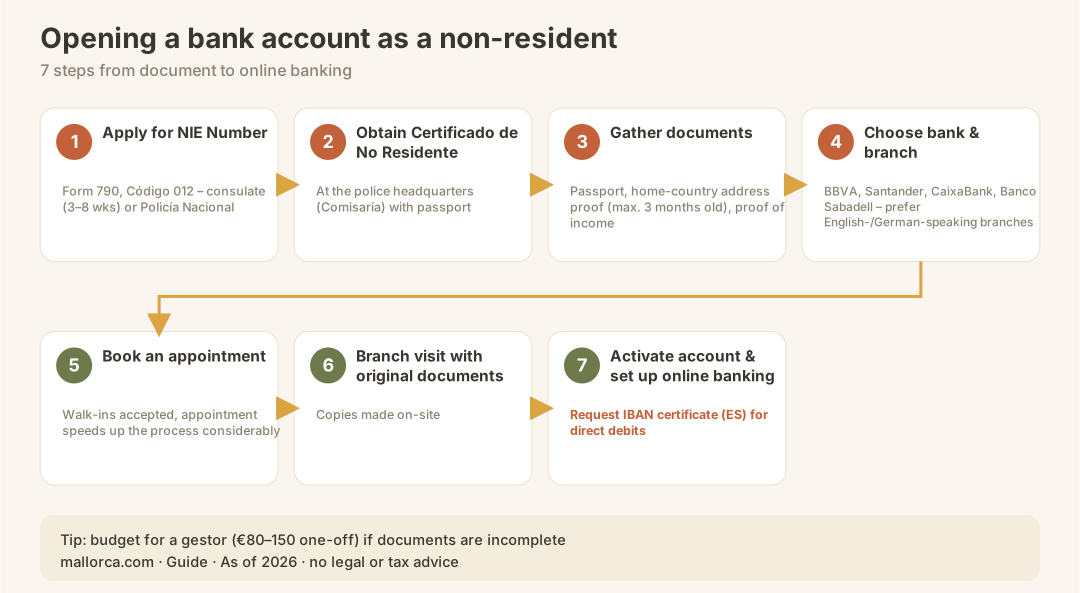
Apply for your NIE (if you do not already have one) – Formular 790, Código 012, either through the consulate or in Spain with a cita previa.
Obtain a Certificado de No Residente – from the relevant police headquarters (Comisaría de Policía) on presentation of your passport.
Gather your documents – passport or national ID card, proof of address from your home country (no more than 3 months old), proof of income, NIE certificate, Certificado de No Residente.
Choose a bank and branch – Major banks such as BBVA, Santander, CaixaBank and Banco Sabadell have English-speaking and, in some cases, German-speaking staff.
Book an appointment – Many branches accept walk-ins, but an appointment speeds up the process considerably.
Branch visit – Bring all original documents; copies will be made on the spot.
Activate the account and set up online banking – Usually possible straight away; request an IBAN certificate for direct debits.
Tip: Budget 80–150 € for a gestor if you are unsure during your first bank visit or don't have all your documents to hand. The investment often saves weeks of waiting. Our guide to the gestoría in Spain explains how to find the right adviser.
Step by step: opening a bank account as a resident
Secure your empadronamiento – The registration certificate from your local authority is the first step. See the empadronamiento registration guide.
Apply for residencia / TIE – No TIE, no resident account. Full details in the guide Residencia in Spain.
Confirm your NIE number – It is printed on the TIE.
Prepare proof of income – Payslip, pension notice, business registration as an autónomo, or proof of sufficient personal funds.
Choose a bank – Read the fee structures carefully: account maintenance is often free if your salary or pension is paid in (cuenta nómina).
Branch visit or online application – Some banks and neobanks (e.g. N26) allow a fully online account opening.
Converting an existing non-resident account – If you already have a cuenta de no residente, ask the bank explicitly to switch it over — it does not happen automatically.
The two-account strategy: why one account is often not enough
A solution that works well in practice is running two accounts side by side:
Account
Function
Spanish bank account (ES-IBAN)
Rent, utilities, taxes, insurance, local salary payments
International account (e.g. Wise or Revolut)
International transfers, currency conversion, income from Germany
The Spanish account handles all local direct debits and payments to public authorities. The international account minimises exchange-rate losses on incoming payments from Germany — such as pensions, rental income, or salaries. Anyone who tries to manage everything through a single account will regularly run into high transfer fees or rejected direct debits.
Account maintenance fees and hidden costs
Spanish bank charges can appear low at first glance – but the details make all the difference. Here are the most common cost traps:
Type of charge
Typical situation
Non-resident account maintenance
Generally around 10–15 €/month, i.e. 120–180 €/year
Resident account with nómina
Often free when salary/pension is paid in
Resident account without nómina
Fees possible depending on the bank
International transfers (SWIFT)
Fees depending on bank and amount
Cash withdrawal at another bank's ATM
Fees depending on your contract
Returned direct debit (devolución)
Can be costly, depending on the bank
Please note: Anyone who remains on a non-resident account after receiving their TIE and Empadronamiento is paying higher fees for no reason whatsoever. Actively ask your bank to switch you to a resident account.
Neobanks and online alternatives
Not every account opening has to take place in a branch. Some banks and fintechs offer fully digital processes:
N26: As a German bank with an EU banking licence, N26 allows you to open an account entirely online – no branch visit required, in German. However, the IBAN is German (DE), not Spanish (ES). This can cause issues with some Spanish payment partners, as some explicitly require an ES IBAN.
Wise and Revolut: Not traditional bank accounts, but very useful for international transfers and currency conversion. Not a substitute for local direct debits.
Spanish direct banks (e.g. OpenBank by Santander): Some offer a fully online account opening, but require Spanish documents (NIE, Empadronamiento).
Please note: A DE IBAN is not sufficient for many Spanish direct debits. Always check whether your utility provider, landlord or insurer requires an ES IBAN before relying exclusively on a neobank.
Most common mistakes when opening a bank account in Spain
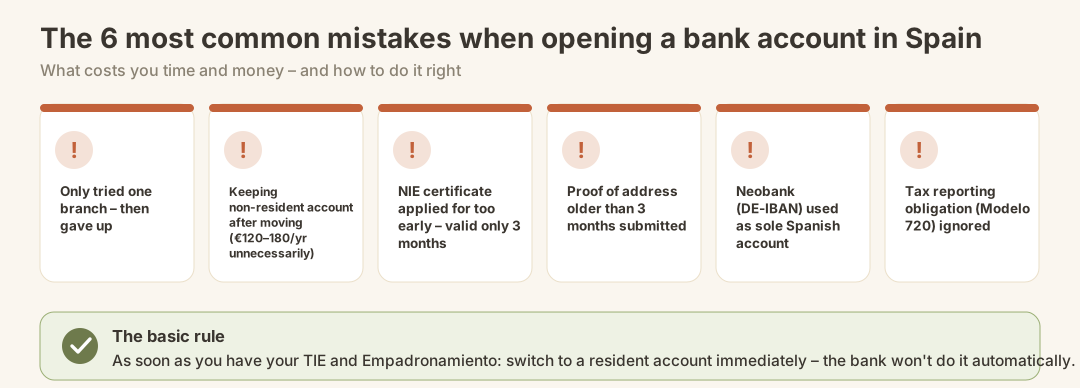
Relying on just one branch – Decisions are made at branch level, not bank level. Been turned down? Try a different branch.
Keeping a non-resident account after moving – Typically costs an unnecessary 120–180 €/year. Switch immediately after receiving your TIE and Empadronamiento.
Applying for an NIE certificate from the consulate too early – It is only valid for three months. Plan your timing carefully.
Forgetting proof of address from your home country – Many people fall at this hurdle because their utility bill is more than 3 months old.
Going to the bank without Spanish language skills and without accompaniment – Much of the information is only available in Spanish. A gestor or accompanying person saves time.
Using a neobank as your sole Spanish account – A DE-IBAN is not accepted everywhere.
Ignoring tax reporting obligations – Anyone holding accounts in multiple countries must keep an eye on the Modelo 720 in Spain.
What comes next? Account opened – next steps
With a Spanish bank account, you are set up for everyday life. The typical next steps:
Clarify your tax situation: As a resident, you are liable for income tax in Spain (IRPF). Overview in the guide: Taxes as a resident (IRPF)
Declare assets held abroad: Accounts, properties and securities held abroad may need to be declared via Modelo 720.
Sort out health insurance: You need insurance cover for your residencia. More: Health insurance in Spain
Checklist: Opening a bank account in Spain
As a non-resident:
Passport or EU national identity card (valid)
Certificado de No Residente obtained (Comisaría de Policía)
Proof of address from your home country, no more than 3 months old
Proof of income (pay slip, pension notice, tax assessment)
NIE number applied for (Formular 790, Código 012) – if required by the bank
Branch with English- or German-speaking staff selected
Backup branch identified in case the first branch declines
As a resident:
Empadronamiento in place
TIE / residencia certificate issued
NIE number confirmed
Proof of income up to date
For existing non-resident accounts: conversion to resident account requested
Tax obligations (IRPF, Modelo 720) discussed with gestor
Conclusion
Opening a Spanish bank account is faster than many newcomers expect – provided the paperwork is in order. The decisive step is choosing the right account type: as a non-resident you start with the Cuenta de no residente and the Certificado de No Residente; as a resident you use your NIE, TIE and Empadronamiento for a more cost-effective resident account. Anyone who still holds the more expensive non-resident account after obtaining residency is typically paying up to €180 per year more than necessary.
The two-account strategy – a Spanish account for local direct debits and Wise or Revolut for international transfers – has proven its worth in practice and saves on fees in the long run. Budget a gestor buffer of €80–€150 in case the bureaucracy hits a snag. With the right setup, day-to-day financial life in Spain becomes considerably smoother.
Official Sources
Agencia Estatal de Administración Tributaria (AEAT) – NIE, tax identification, Modelo 720: https://www.aeat.es
Banco de España – Supervision of Spanish credit institutions, consumer rights: https://www.bde.es
Formulario 790, Código 012 (NIE fee) – Available via the AEAT and police websites
BOE (Boletín Oficial del Estado) – Legal framework for Spanish banking law: https://www.boe.es
Can I open a bank account in Spain without a NIE?
As a non-resident, opening an account without a NIE is possible at some banks — you will need the Certificado de No Residente and your passport. As a resident, however, the NIE is mandatory.
What is the Certificado de No Residente?
It is an official certificate confirming that you do not have a registered address in Spain. You apply for it at the Spanish police headquarters (Comisaría de Policía) by presenting your passport.
How long does it take to open a bank account in Spain?
With all the required documents, an account can be opened in a single branch visit. Online banking is often available immediately. Without complete documentation or if the NIE is missing, the process can take considerably longer.
How much does a non-resident account in Spain cost?
According to available sources, it is typically around 10–15 € per month, i.e. 120–180 € per year. Once you have your TIE and Empadronamiento, you should switch to a resident account.
Is a German IBAN (e.g. from N26) sufficient for Spanish direct debits?
Not always. Some Spanish utility providers, landlords and insurers insist on an ES-IBAN. Clarify this directly with the relevant provider before signing up.
What is the Cuenta de Pago Básica?
A regulated basic payment account for EU residents, asylum seekers and certain individuals without regular residence status. Its features are limited to basic payment services.
Do I need to declare foreign accounts in Spain?
As a tax resident in Spain, you may be required to report assets held abroad — including bank accounts — via the Modelo 720. Consult a tax adviser or gestor for guidance on this.
Can I convert my non-resident account into a resident account?
Yes, most banks will carry out this conversion once you present your TIE and Empadronamiento. It does not happen automatically — you need to proactively request it from your bank.