
Double Taxation Agreement Germany–Spain: Who Taxes What?
You have relocated your main place of residence to Mallorca or Spain – or are planning to – and are wondering whether you now have to pay taxes in two countries. The Double Taxation Agreement between Germany and Spain (DTA for short) addresses exactly that: which country has the right to tax which type of income, and which method is used to avoid double taxation. The current agreement entered into force on 18 October 2012 and has been applied since 1 January 2013 – replacing the previous DTA of 1966. In this guide, you will find out what rules apply to your pension, dividends, interest, rental income and capital gains, how the two central avoidance methods work, and which common mistakes you should definitely avoid.

Does the DTA affect you directly – as a retiree, investor or property owner in Mallorca?
- 📩 Submit a personal enquiry — We connect you with vetted tax advisers and gestorías in Mallorca
- Taxes as a resident in Spain (IRPF)
What it's all about: the DTA and its two core methods
The DTA between Germany and Spain is an international treaty that determines which of the two states may tax a particular type of income – and how the other country responds to taxes already paid. To ensure you are not taxed twice on the same income, the agreement generally provides for two methods:
1. Credit method Income from Germany is also subject to tax in Spain (as the country of residence), but the tax already paid in Germany is credited against the Spanish tax liability. The net result is that you only pay once – specifically, whichever of the two tax rates is higher.
2. Exemption with progression clause Certain income from Germany is fully exempt from tax in Spain. However, it is still counted as part of your total income, which determines the tax rate applied to all your other income. The higher your exempt German income, the higher the Spanish tax rate on your remaining earnings may therefore be.
Which method applies to which type of income depends on the specific article of the DTA – and that is exactly what we will now examine in detail.
Please note: The DTA covers income tax and wealth tax only. There is no double taxation agreement between Germany and Spain for inheritance and gift tax. In these cases, only the respective national law applies.
When are you actually liable to tax in Spain?
Before the DTA comes into play, it must be established where you are tax-resident. Spain considers you a tax resident (Residente Fiscal) if at least one of the following conditions applies:
- You spend more than 183 days in Spain during the calendar year. Sporadic absences are counted as days spent in Spain, unless you can demonstrate tax residency elsewhere by means of an official certificate of residence.
- The centre of your economic interests is in Spain.
- Your spouse (not living separately) and minor children have their habitual residence in Spain (rebuttable presumption).
As a tax resident you are subject to unlimited tax liability in Spain – meaning you must declare your worldwide income in the Spanish income tax return (IRPF). The double taxation agreement (DBA) then prevents Germany from fully taxing the same income again.
| Criterion | Consequence |
|---|---|
| > 183 days/year in Spain | Tax resident, unlimited IRPF liability |
| Centre of economic life in ES | Tax resident, even without proof of 183 days |
| Family mainly in Spain | Rebuttable presumption of tax residency |
| < 183 days, centre of life in DE | Tax resident in Germany; non-resident tax in ES may apply |
Tip: Further details on registering as a resident can be found in the guide Residencia Spanien.
Pensions: Germany's new withholding tax rules
This point affects most German emigrants directly. The old DBA of 1966 allowed German pensions to be taxed exclusively in Spain. The new DBA, which has been in force since 2013, has redistributed the taxing rights:
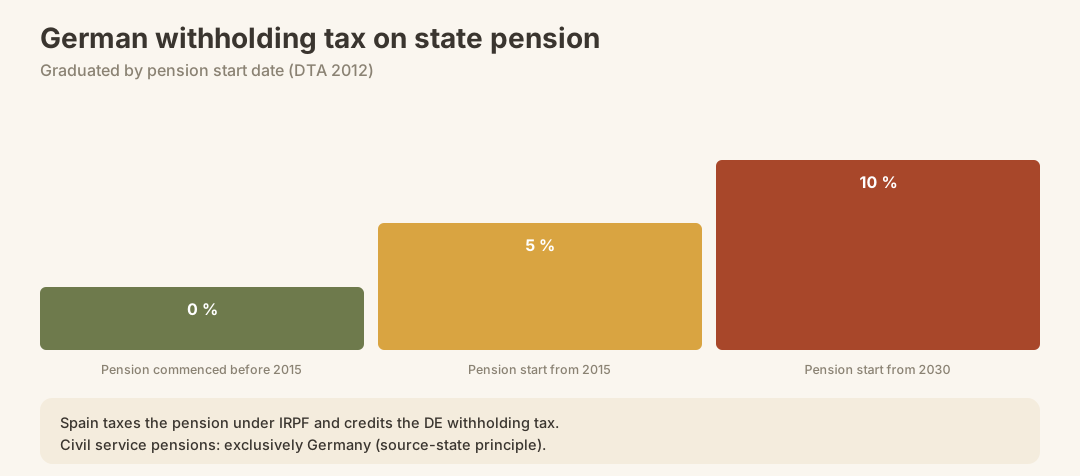
State pension, occupational pension, Riester and Rürup pension
Germany, as the paying state (source state), has reclaimed a limited withholding tax right – albeit on a graduated basis depending on when the pension commenced. This applies to pensions whose accumulation was state-subsidised in Germany over a period of more than twelve years:
| Pension commencement | Withholding tax Germany (source state) |
|---|---|
| Before 2015 | 0 % (exclusive right of taxation: Spain) |
| From 2015 (first pension payment) | 5 % withholding tax in Germany |
| From 2030 (first pension payment) | 10 % withholding tax in Germany |
Spain nevertheless taxes the pension as the country of residence under IRPF – but credits the withholding tax retained in Germany.
Civil-service pensions (paying-state principle)
For civil-service pensions the so-called paying-state principle applies: the pension is taxed in the country that pays it – i.e. in Germany. Spain exempts it (subject, where applicable, to a progression clause). This rule already applied under the old double-taxation agreement and has remained unchanged.
Private pensions without state subsidy
For other pensions without state subsidy over a period of more than twelve years, the exclusive right of taxation lies with the country of residence, i.e. Spain.
Please note: Whether the withholding tax retained by Germany is fully credited against the Spanish tax liability depends on the amount of the respective tax liability. An individual calculation by a tax adviser is worthwhile – particularly for higher pensions.
More details on the specific tax return in Spain can be found in the guide Taxing a German pension in Spain.
Dividends: shared right of taxation with a withholding-tax cap
Dividends from German sources that you receive as a Spanish tax resident are subject to a shared right of taxation:
- Germany may retain withholding tax – up to a maximum of 15 % pursuant to DBA Art. 10 (where the holding in the distributing company exceeds 10 %, the rate is reduced to 5 %).
- Spain taxes the dividend under IRPF and credits the withholding tax retained in Germany.
| Situation | Withholding tax DE (DTA maximum rate) | Taxation ES |
|---|---|---|
| Holding < 10 % | max. 15 % | IRPF, credit of DE withholding tax |
| Shareholding ≥ 10 % | max. 5 % | IRPF, credit of DE withholding tax |
The reverse situation: Spanish dividends for German residents
If you are resident in Germany and receive dividends from Spain, the same principle applies in reverse: Spain may withhold a maximum of 15 % withholding tax (DTA Art. 10). In Germany, the Spanish dividend must be declared in full (100 % of its value). The German flat-rate tax on investment income (Abgeltungsteuer) is 25 % plus the solidarity surcharge and, where applicable, church tax (effectively approx. 26.375 %). The 15 % withholding tax paid in Spain can be credited, meaning approximately 11.375 % remains payable in Germany.
Note: Persons resident in Germany may claim the saver's allowance (Sparerpauschbetrag). The specific amounts may change as a result of legislative amendments; please check the currently applicable figure with the Bundeszentralamt für Steuern.
Interest: Spain's exclusive right to tax
The DTA is unambiguous on this point: interest income from German sources may not be taxed by Germany as the source state (DTA Art. 11). The exclusive right to tax rests with the state of residence — i.e. Spain. For you as a Spanish tax resident, this means: interest from German bank accounts or bonds flows directly into your Spanish IRPF return, with no German withholding tax.
Royalties: Also taxed exclusively in Spain
Similarly to interest, royalties from German sources (DTA Art. 12) are also subject to the same rule: Germany has no withholding tax right. The income is taxed exclusively in Spain. For authors, patent holders, or software developers relocating to Mallorca, this can be a relevant consideration.
Property and rental income: Taxation in the state where the property is situated
A clear principle applies to property: the right to tax lies with the country in which the property is located. This applies both to ongoing rental income and to capital gains on disposal.
| Type of income | Right to tax | Method in Spain |
|---|---|---|
| Rental income from DE property | Germany (primary) + Spain | Credit for tax paid in DE |
| Capital gain on DE property | Germany | Credit in Spain |
| Rental income from ES properties | Spain (IRPF or IRNR) | — |
| Capital gains on ES properties | Spain | — |
Shares in property-rich companies: Germany may also tax gains from the sale of shares in companies whose active assets consist of at least 50 % of immovable property situated in Germany. This is an exception to the general principle that capital gains are allocated to the state of residence.
Employment and permanent establishments
Employees (DBA Art. 14)
Employment income may in principle be taxed in the country in which the work is physically performed. If you are resident in Spain and work for a German company in Germany, Germany has the right to tax the portion performed there. Exception: If you spend fewer than 183 days within twelve months in Germany and the employer is not resident in Germany, the right to tax remains with Spain.
Permanent establishments (DBA Art. 7)
Germany may tax the profits of a permanent establishment situated in Germany. In Spain, the tax paid in Germany is credited. Currently under discussion: the OECD published updated guidance on the creation of permanent establishments through remote working at the end of 2025, which will feed into the model conventions in 2026 — and may therefore indirectly affect the German-Spanish DBA as well. Anyone working remotely from Mallorca for a German company should keep a close eye on these developments.
Overview: who taxes what — the DBA allocation table
| Type of income (DBA article) | Right to tax — Germany | Right to tax — Spain | Method ES |
|---|---|---|---|
| Property income (Art. 6) | Yes | Yes | Credit |
| Permanent establishment profits (Art. 7) | Yes (permanent establishment) | Yes | Credit |
| Dividends (Art. 10) | Withholding tax (5 % / 15 %) | Yes | Credit |
| Interest (Art. 11) | No | Yes | — |
| Royalties (Art. 12) | No | Yes | — |
| Capital gains (Art. 13) | No (exceptions: DE real estate, permanent establishment, property-rich companies) | Yes | Credit (under DE law) |
| Employment income (Art. 14) | Yes (place of activity DE) | Yes | Exemption/credit |
| Statutory pension (from 2015) | Yes, 5 % withholding tax | Yes | Credit |
| Civil-service pension | Yes (paying-state principle) | No (exemption) | Progression clause |
| Private pension (without tax relief) | No | Yes | — |
No double taxation agreement for inheritance and gifts: what you need to know
This is one of the most important pitfalls for German emigrants: between Germany and Spain there is no double taxation agreement covering inheritance and gift tax. This means that, in the event of an inheritance, both countries can in principle levy inheritance tax – Germany on worldwide assets if the deceased or the heir is subject to unlimited tax liability in Germany, and Spain on assets situated in Spain.
Avoiding double taxation is only possible through the respective national law (e.g. by way of a tax credit). The Balearic Islands in particular have specific rules on inheritance tax that can be advantageous for direct relatives. Early estate planning – ideally including a Spanish will – is therefore essential.
Tip: The guide Spanish Will explains why, as a property owner in Mallorca, you need a Spanish will.
Exchange of information: the tax authorities know about each other
One point that is frequently underestimated: Germany and Spain actively exchange tax-relevant data. Anyone who thinks they can simply conceal income from the other country is mistaken. Both countries have committed to the automatic exchange of information. The Spanish tax authority (Agencia Tributaria) is informed of German pension payments, and the German tax office receives information about assets and income in Spain.
For you, this means: full transparency and correct declaration in both countries is not optional – it is a legal obligation. This also applies to the reporting requirement for foreign accounts and assets via the Modelo 720.
Most common mistakes regarding the double taxation agreement between Germany and Spain
Forgetting the dual declaration: Anyone who, as a tax resident in Spain, declares German rental income or dividends only in Germany is committing a tax compliance breach in Spain. The credit method requires you to declare the income in Spain – even if it is not taxed in full there again.
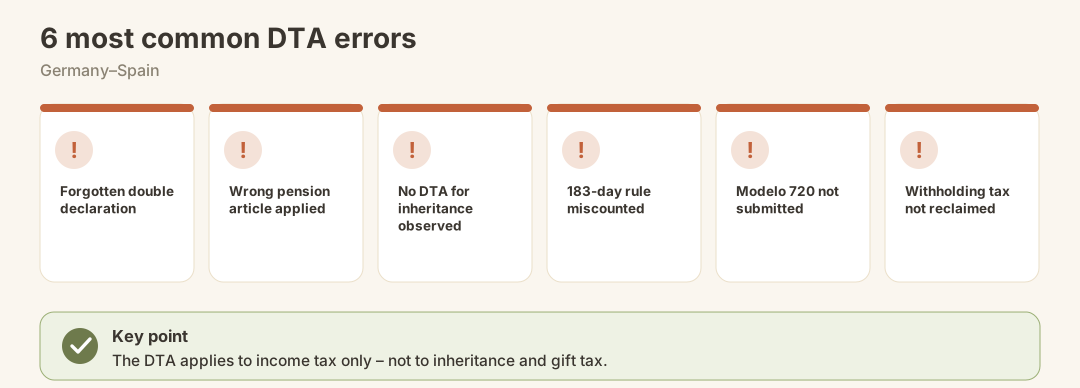
Applying the wrong pension article: The different treatment of the statutory state pension (new withholding tax rules), civil service pension (source-state principle) and private pension regularly leads to errors. Anyone who treats all pensions the same will either overpay or risk additional back payments.
No double taxation agreement for inheritance: Many people assume that the double taxation agreement also covers inheritance tax. This is incorrect. Without early estate planning, genuine double taxation can arise.
Miscounting the 183-day rule: Sporadic absences from Spain are in principle counted as days of presence in Spain, provided you cannot produce a certificate of residence elsewhere.
Modelo 720 not submitted: Foreign bank accounts, properties and securities portfolios above certain threshold values must be reported. Anyone who overlooks this risks significant penalties.
Withholding tax not reclaimed: If Germany withholds more than the maximum rate under the double taxation agreement (e.g. more than 15% withholding tax on dividends), you can reclaim the excess amount from the German Federal Central Tax Office (Bundeszentralamt für Steuern).
What comes next? Your next steps
Once you have recognised that the double taxation agreement is relevant to your personal situation, these are the sensible next steps:
- Clarify tax residency: Are you already officially registered as a tax resident in Spain? Start with the Empadronamiento and the Residencia.
- Inventory your sources of income: List all sources of income in both countries – pension, rental income, investment portfolio, shareholdings.
- Engage a tax adviser: The combination of German and Spanish tax law is complex. An adviser (Asesor Fiscal) with experience on both sides is not a cost centre but an investment. Help finding a Gestoría on Mallorca.
- Check Modelo 720: Do you hold foreign assets above the reporting thresholds? If so, the Modelo 720 reporting obligation applies to you.
- Initiate estate planning: Particularly if you own property in both countries, the inheritance tax issue should be addressed at an early stage.
Checklist: applying the double taxation agreement correctly
- Tax residency clearly established in one country (certificate of residence available)
- Type of pension(s) identified: statutory / civil service pension / occupational pension / private
- Withholding tax on dividends checked: maximum rate under the double taxation agreement observed?
- Interest and royalty income fully declared in Spanish IRPF
- Rental income from Germany declared in Spain (credit method)
- Modelo 720 checked for foreign assets
- Estate planning and will in place (note in particular: no double taxation agreement covers inheritance!)
- Tax adviser with knowledge of both tax systems engaged
- Days spent in Spain correctly documented (threshold: 183 days)
Conclusion
The Germany–Spain double taxation agreement of 2012 is a well-structured set of rules that provides clear answers for most types of income — but it is not a self-running system. Pensions are treated differently depending on their type and the date payments began, dividends are subject to a shared taxing right with source-country caps, interest and royalties belong exclusively to Spain, and property is governed by the principle of the location of the asset. What the DTA does not resolve: inheritance and gift tax. Anyone who plans ahead, takes both declaration obligations seriously and engages an experienced adviser can work well within the DTA framework — and will ultimately pay neither twice nor too much.
Official sources
- DTA Germany–Spain (2011/2012) — Full text as PDF from the Federal Ministry of Finance: https://www.bundesfinanzministerium.de/Content/DE/Standardartikel/Themen/Steuern/Internationales_Steuerrecht/Staatenbezogene_Informationen/Laender_A_Z/Spanien/2012-01-20-Spanien-Abkommen-DBA-Gesetz.pdf
- Federal Ministry of Finance — Country-specific information: Spain: https://www.bundesfinanzministerium.de/Web/DE/Themen/Steuern/Internationales_Steuerrecht/Staatenbezogene_Informationen/Laender_A_Z/Spanien/spanien.html
- Agencia Tributaria (AEAT) — Spanish tax authority, IRPF information: https://www.agenciatributaria.es
- Federal Central Tax Office (BZSt) — Refund of foreign withholding taxes: https://www.bzst.de
- ATIB – Agència Tributària de les Illes Balears: https://www.atib.es