
Palma de Mallorca local tax payment dates for 2026
If you own a property or vehicle in Palma, do not assume there is just one annual tax deadline. In 2026, tax payment dates in Palma de Mallorca fall in spring and autumn: the municipal waste charge and vehicle tax are payable in spring, while property tax is due in autumn. A separate fee may also apply for vehicle access to a garage. Whether you also need to pay tax on economic activities depends on what you do and any exemptions that apply.
This overview shows you when each tax or charge is due, where to check outstanding amounts and why not receiving a letter does not mean there is nothing to pay. It distinguishes recurring municipal charges from other tax obligations, such as filing returns with the national tax authority. If your property is outside Palma, the calendar of the municipality where it is located applies – even if both places are on Mallorca.

When are taxes due in Palma de Mallorca?
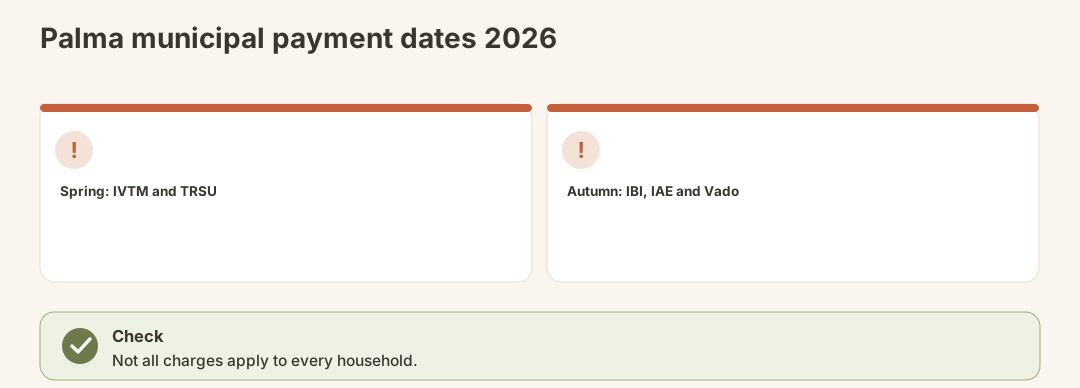
For the municipal taxes and charges listed here, there are two main voluntary payment periods in 2026:
| Tax or charge in Palma | Spanish name | Voluntary payment period in 2026 |
|---|---|---|
| Vehicle tax | IVTM | 16 March to 1 June |
| Municipal waste treatment charge | TRSU | 16 March to 1 June |
| Property tax | IBI | 15 September to 1 December |
| Tax on economic activities, if payable | IAE | 15 September to 1 December |
| Fee for vehicle access to a property or garage | Vado or gual | 15 September to 1 December |
These periods are for voluntary payment, not an additional grace period afterwards. Check the specific amount due before paying: not every tax or charge applies to every household.
What is due in spring?
In Palma, the TRSU waste charge and IVTM vehicle tax can be paid from 16 March up to and including 1 June 2026 be paid. If you have set up a direct debit for vehicle tax, payment is scheduled to be taken around 14 May. Check that it has actually gone through.
For vehicle tax, what matters is who is listed as the registered keeper at the start of the tax year. Selling the vehicle later does not automatically cancel the tax due for that year. You can find out more in our guide to vehicle tax in Spain.
Please note: In Palma, the waste collection charge and property tax have different payment periods in 2026. Paying TRSU in the spring does not mean you have also paid IBI.
Which taxes and charges are due in autumn?
For IBI, IAE and Vado, Palma’s voluntary payment period runs from 15 September to 1 December 2026. The three charges share the same timetable but apply in different circumstances:
| Tax or charge | When it may apply to you | What you should check |
|---|---|---|
| IBI | You own a property in Palma. | Has the property tax bill for the property been issued and paid? |
| IAE | You carry out an economic activity and are not exempt. | Is there actually an amount to pay? |
| Vado, also known as gual | Public road space is used for access to a property or garage. | Has a charge been issued for the access? |
The IBI tax liability arises at the start of the calendar year. If you have bought or sold a property, you should therefore check particularly carefully who is liable for the tax. We have a separate guide to IBI in Spain.
With IAE, not receiving a bill is not necessarily a mistake: Individuals are exempt from this tax; newly established activities are also generally exempt during the first two tax periods.
Who needs to keep an eye on which charges?
Your place of residence alone does not determine which local charges you face. A property owner may receive an IBI bill even if they do not use their home in Palma year-round. A resident who does not own property, on the other hand, may be liable for IVTM as a vehicle owner. The Vado fee depends on how the driveway is used; IAE applies only to activities for which a payment is actually due.
| Your situation | Check in particular | Don't confuse this with |
|---|---|---|
| Property in Palma | IBI and TRSU; Vado, if applicable | Paying IBI does not replace any other tax return. |
| Vehicle registered in Palma | IVTM | A change of ownership during the year does not automatically settle the annual charge. |
| Business activity | Whether IAE is payable | Not everyone who is self-employed pays IAE. |
| Property in another municipality | That municipality's local tax calendar | Palma's deadlines do not automatically apply there. |
Especially if you do not live in the property yourself, you should distinguish between local charges and any potential national tax obligations. For more information, see our overview of non-resident tax in Spain.
Does Palma's calendar apply elsewhere on Mallorca?
No. Even neighbouring municipalities may have different payment periods and different combinations of charges. These examples for 2026 show why you should always check where the property is located and which municipality is responsible:
| Municipality | Example payment period in 2026 | Charges covered in the example |
|---|---|---|
| Palma | 15 September to 1 December | IBI, IAE and Vado |
| Manacor, Marratxí and Artà | 15 September to 1 December | IBI and IAE |
| Alcúdia | 1 September to 2 November | Autumn municipal payment period |
| Inca | 1 September to 1 December | Including IBI, IAE, waste collection charges and IVTM |
| Calvià | 1 September to 15 November | IAE; other regular municipal charges have a different payment period |
Even if 2 municipalities have the same deadline, that does not mean the same charges are payable in both. For a broader overview, read our guide to municipal taxes in Mallorca.
Where can you check and pay outstanding amounts?
The Balearic tax authority ATIB administers several municipal charges for Palma. Its online portal is a good place to start when checking the municipal tax calendar and outstanding charges. On its online payments page, the City of Palma explicitly distinguishes between payments handled by the town hall and charges administered by ATIB.
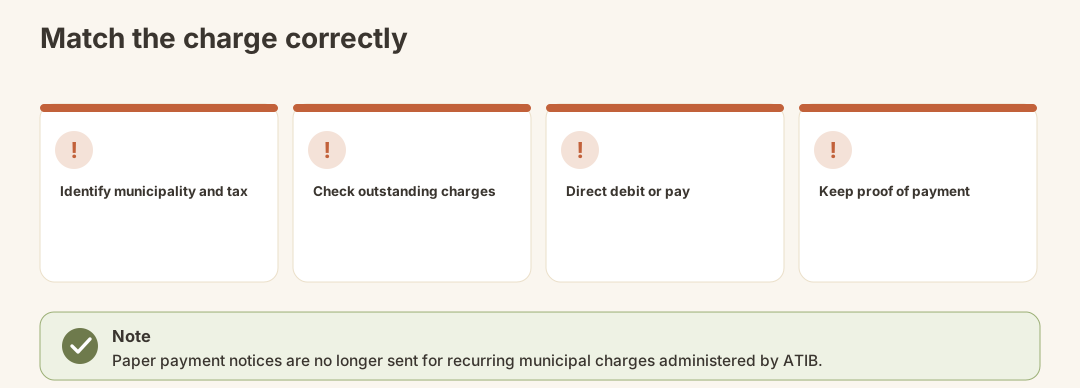
Here’s what to do:
- Identify the municipality and the charge. Check whether the charge relates to Palma and whether it is for IBI, TRSU, IVTM, IAE or Vado.
- Check the outstanding charge. Check the property or vehicle concerned and the amount shown against your records.
- Choose how to pay. For a charge administered by ATIB, use its online portal; for a payment handled directly by the town hall, follow the City of Palma’s instructions.
- Check that the payment went through. Keep the payment receipt or, if you pay by direct debit, check that the payment has been taken.
Note: Paper payment notices are no longer sent for recurring municipal charges administered by ATIB. So don’t wait for a letter before checking whether you have an outstanding charge.
What happens if the payment deadline passes?
After the voluntary payment period, you should not simply pay an outstanding amount using the previous payment details. First check its current status and the amount now shown as due. Late payment may incur surcharges and, in some cases, additional costs.
This applies whether you missed the original bill or assumed it would be collected by direct debit. If an amount has already been collected, check your proof of payment before paying again. If the issue is not a missed payment but a tax assessment you believe is incorrect, you can find guidance on the procedure in our guide to appealing a tax assessment in Spain.
The most common mistakes with Palma’s municipal taxes
- Assuming all charges are due in autumn. In Palma, TRSU and IVTM fall in spring 2026, while IBI, IAE and Vado fall in autumn.
- Using another municipality’s calendar. A property outside Palma does not automatically follow Palma’s deadlines.
- Waiting for a letter in the post. For recurring ATIB charges, you should check what you owe yourself.
- Assuming a direct debit mandate means payment has been made. What matters is whether the money was actually collected.
- Confusing municipal payments with other tax obligations. Paying IBI does not tell you whether, for example, you need to file a non-resident tax return.
Checklist for your payment deadlines
- I have checked which municipality is responsible for the property and vehicle.
- I have identified the charges that apply to me.
- I have noted the relevant voluntary payment period for each charge in 2026.
- I have checked for outstanding amounts through the relevant online portal.
- I have checked my direct debit mandates against the payments actually collected.
- I have filed my payment receipts so I can match them to the property or vehicle later.
What next?
After paying, it is worth reviewing your other obligations as a property owner. The guide to ongoing property taxes in Mallorca helps you distinguish municipal charges from other types of tax. For more guidance on keeping payment receipts and tax documents, see our guide to retention periods for tax records in Spain.
For the next tax year, check the relevant calendar again. The dates in this article apply specifically to 2026.
Conclusion
In Palma, there is no single payment deadline for all municipal taxes: in 2026, the waste collection fee and vehicle tax are payable from 16 March to 1 June, while property tax, business tax where applicable, and Vado are payable from 15 September to 1 December. What matters is which charges actually apply to you. Check them in good time with the relevant authority, and make sure any direct debit you have set up is working.
This is not legal or tax advice. If you are unsure whether a particular charge applies to you or is lawful, you will need an individual assessment.
Official sources
- ATIB – Agència Tributària de les Illes Balears
- ATIB online portal
- Ajuntament de Palma: Payment of public charges, fees and fines