
Riester pension in Spain: subsidy repayment and tax on payouts
You have been paying into a Riester pension, a Rürup basic pension, or a company pension scheme for years – and are now planning to spend your retirement on Mallorca or elsewhere in Spain. The key question is: what happens to your Riester pension in Spain – does the subsidy have to be repaid, where are the payouts taxed, and what role does the double taxation agreement play? This guide explains the basic tax rules, the current DTA between Germany and Spain, the differences between Riester, Rürup and company pensions, and the most important pitfalls that emigrants need to be aware of.

The foundation: the new DTA between Germany and Spain since 2013
For a long time, an old double taxation agreement dating from 1966 applied, under which German pensioners resident in Spain paid tax on their pension exclusively there. That changed fundamentally: the new DTA between Germany and Spain entered into force on 18 October 2012 and has been applied since 1 January 2013.
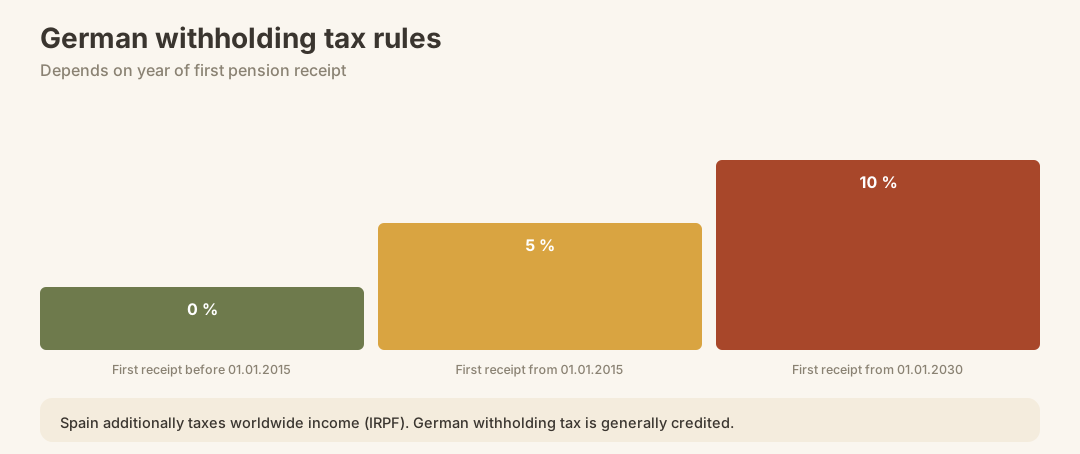
The core principle of the new agreement: Germany, as the source state, retains limited withholding tax rights on statutory pensions. For pensioners who receive their pension for the first time from 2015 onwards, this withholding tax rate is 5 %. Anyone who retires for the first time from 2030 onwards will pay 10 % withholding tax in Germany on their statutory pension.
For pensioners who were already receiving their pension before 1 January 2015, the old rules continue to apply: the pension is taxed exclusively in Spain, and no tax return needs to be filed in Germany.
Withholding tax overview by date of first pension receipt
| Date of first pension receipt | German withholding tax right | Taxation in Spain |
|---|---|---|
| Before 01.01.2015 | None (Spain has sole jurisdiction) | In full, as a taxpayer on worldwide income |
| From 01.01.2015 | 5 % withholding tax | Yes, with credit applied |
| From 01.01.2030 | 10 % withholding tax | Yes, with credit applied |
Please note: These withholding tax rules do not apply automatically. As a resident in Spain, you must declare your total worldwide income in your Spanish IRPF return. The withholding tax deducted in Germany is generally credited against your Spanish tax liability in order to avoid genuine double taxation.
Riester pension in Spain: no longer any obligation to repay when moving within the EU
This was long the biggest stumbling block: anyone who emigrated to France, Spain or Austria previously had to repay all state allowances and tax savings from the Riester subsidy – the so-called 'harmful use' rule. The European Court of Justice overturned this with its ruling of 10 September 2009 (case reference C-269/07), finding it incompatible with EU law. The court held that this repayment obligation impeded freedom of movement within the EU.
Germany subsequently revised the Riester regulations by law: anyone who moves to an EU country or an EEA state in retirement does not have to repay the government subsidy. This also applies to Mallorca and Spain as a whole.
What has specifically changed
| Point | Old regulation (before ECJ ruling) | New regulation (after legislative amendment) |
|---|---|---|
| Move to an EU country in retirement | Full repayment of the subsidy | No repayment |
| Wohn-Riester for a property abroad | Not possible | Possible for EU/EEA properties |
| Cross-border commuter (residence abroad, employment in DE) | No entitlement to allowance | Entitlement to allowance, provided compulsorily insured in DE |
| Payments abroad | Subsidy-neutral (new) | Full taxation of payments in the country of residence |
Please note: The removal of the repayment obligation does not mean that the payments are tax-free. On the contrary – Riester pension payments must be taxed in full in Spain. As you are liable to tax there as a resident on your worldwide income, the payments are included in the Spanish IRPF calculation.
The double taxation agreement also contains a provision for state-subsidised pension products: the withholding tax of 5% or 10% described above applies expressly also to Riester and Rürup pensions, provided their accumulation phase was state-subsidised in Germany over a period of more than twelve years.
Rürup pension (Basisrente) abroad: no clawback risk
The Rürup pension – also known as the Basisrente – works differently from Riester: here the state provides support exclusively through tax deductions, not through direct allowances. This has an important consequence for those emigrating: there is no government subsidy that could be reclaimed. The Rürup pension is therefore generally unproblematic when you move abroad.
Key features of the Rürup pension with regard to Spain
| Feature | Regulation |
|---|---|
| State subsidy | Tax deduction only, no direct allowances |
| Risk of repayment upon moving abroad | None |
| Lump-sum payout | Not possible – only as a lifelong annuity |
| Borrowing against / inheritance | Not possible |
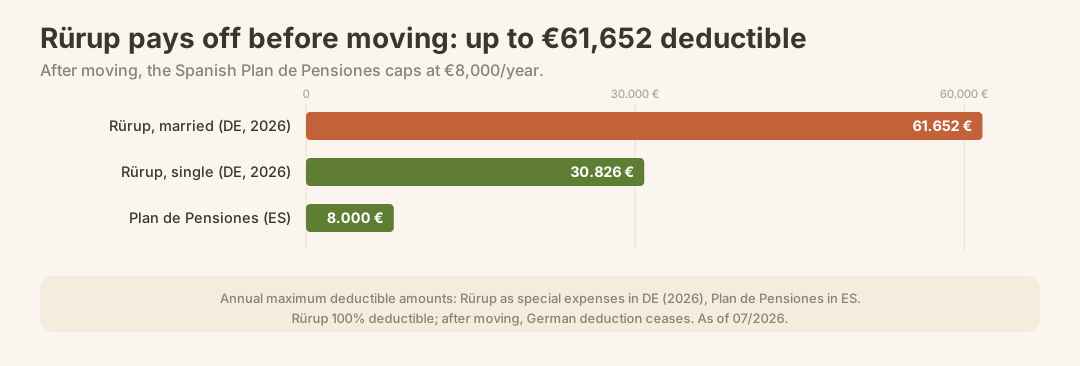
| Contribution deduction (2026, single) | Up to €30,826 annually as special expenses |
| Contribution deduction (2026, married) | Up to €61,652 annually as special expenses |
| Tax deductibility since 2023 | 100% of contributions deductible |
| Taxation of payouts | Deferred – fully in the country of residence |
As Rürup payouts are treated as recurring annuity payments and the new double taxation agreement applies to state-subsidised pensions with a build-up period of more than twelve years, the German withholding tax rates of 5% or 10% may also apply here – depending on the date of first receipt. Spain taxes the remainder within the framework of IRPF.
Note: Anyone who is still liable to tax in Germany and is planning retirement in Spain should make maximum use of the Rürup scheme before moving – contributions are 100% deductible in 2026. After the move, the German tax deduction benefit ceases, as unlimited tax liability in Germany no longer applies.
Occupational pension provision (bAV): What applies in Spain?
Occupational pension provision covers direct insurance schemes, pension funds, pension trusts, support funds, and direct commitments. The decisive factor for tax treatment in Spain is the double taxation agreement.
According to the new Germany–Spain double taxation agreement, occupational pensions are generally subject to the country-of-residence principle: anyone residing in Spain pays tax on their occupational pension there – as a rule within the normal IRPF progression, i.e. together with all other income. Germany has no or only limited withholding tax rights over most forms of occupational pension, provided the pension has not been state-subsidised for more than twelve years and falls under the special double taxation agreement provision.
Caution regarding civil service pensions: These are taxed according to the paying-state principle in the paying state – i.e. in Germany – regardless of where the recipient lives. This is an exception to the general country-of-residence principle. You can find more on this in the guide on civil service pensions and Spain.
Spanish IRPF: How pension income is taxed
As a resident in Spain – that is, if you spend more than 183 days per calendar year there or have your centre of life there – you are subject to unlimited tax liability on your worldwide income. This means: Riester pension, Rürup pension, occupational pension, statutory pension from Germany – everything feeds into the Spanish IRPF return (Modelo 100).
Spain has a progressive income tax rate. There are no blanket favourable special arrangements for retirees as exist in some other EU countries, but the personal allowance and age-related deductions can reduce the effective tax burden. A detailed overview of the possible deductions can be found in the guide to IRPF deductions in the Balearic Islands.
Please note: The specific IRPF tax rates vary depending on the tax year, income level, and Balearic Islands surcharge. A binding assessment of your individual tax liability can only be provided by a locally based tax adviser with experience of Spanish expat taxation.
Wohn-Riester and property in Spain
A particularly interesting aspect for buyers in Mallorca: since the legislative reform following the ECJ ruling, it is generally possible to use the Riester subsidy for the purchase of an owner-occupied property in another EU country — including a finca or an apartment in Mallorca.
However, there is one important condition: the property must be the primary residence. A purely holiday home or a secondary property does not qualify. In addition, the usual Wohn-Riester rules apply: the capital withdrawn from the so-called Wohnförderkonto is taxed on a deferred basis upon reaching retirement age — the so-called "Eigenheimrentenplan". The same applies in Spain: the accumulated notional amounts in the Wohnförderkonto are taxed annually from the point of retirement, either in Germany (withholding tax) or in Spain (IRPF), depending on the allocation under the double taxation agreement.
Caution: Wohn-Riester is complex, and the tax consequences upon the sale of the property or the relinquishment of primary residence status can be considerable. Seeking advice before signing any contract is strongly recommended.
Spanish pension provision as a supplement: Plan de Pensiones
Anyone who is employed in Spain or earns income there as a resident can also contribute to the Spanish equivalent of private pension provision: the Plan de Pensiones. Contributions are tax-deductible in Spain and reduce the taxable IRPF income. According to available sources, the maximum amount deductible per year is 8.000 Euro. Unlike Rürup, the invested capital can also be placed into a variety of investment strategies.
| Feature | Plan de Pensiones (Spain) |
|---|---|
| Annual maximum deductible amount | 8.000 € (according to available sources) |
| Deduction from taxable IRPF income | Yes, up to the maximum amount |
| Lump-sum contribution possible | Yes, as a one-off payment to reduce tax liability |
| Pay-out | Upon reaching retirement age, as a pension or lump sum |
| Inheritability | Yes (unlike Rürup) |
The Plan de Pensiones is of particular interest to expatriates who are still working in Spain or working as an autónomo and wish to actively manage their Spanish tax liability.
Modelo 720: Reporting Obligation for Assets Held Abroad
Anyone who is tax-resident in Spain and holds assets in Germany – including Riester or Rürup accounts with a total value exceeding €50,000 per category – is generally required to declare these in the Modelo 720 . This declaration of foreign assets is one of the most important and most frequently overlooked obligations for Germans living in Spain.
Pension provision products fall under the reporting requirements if they are to be classified as life insurance contracts or bank deposits. The precise distinction is complex and depends on the product structure. More on this in the detailed guide on the Modelo 720 reporting obligation.
Most Common Mistakes Regarding Riester Rente and Spain
Forgetting or applying too late for residencia: Anyone who lives in Spain for more than 183 days but has not applied for residencia enters a legal grey area – both in terms of taxation and health insurance. More on this: Applying for residencia in Spain.
Failing to check double taxation in good time: Many people who move abroad initially pay twice – withholding tax in Germany and IRPF in Spain – without applying for a tax credit. A certificate of fiscal residence (Certificado de Residencia Fiscal) from the Spanish tax authority AEAT is the key to applying to the German tax office for an exemption or reduction.
Cancelling the Riester contract instead of suspending it: Cancelling the Riester contract upon moving to another EU country constitutes harmful use and results in the repayment of the subsidy. Suspending the contract or continuing it without making new contributions is generally the more sensible course of action.
Failing to submit the Modelo 720: Not declaring foreign assets can result in severe penalties in Spain, even if the assets themselves are entirely legitimate.
Treating a civil service pension like an ordinary pension: Civil service pensions are taxed in Germany, not in Spain – even with residencia. Anyone unaware of this will submit incorrect tax returns.
Ignoring the withholding tax allocation after retirement begins: The 5%/10% rule depends on the year of first pension receipt , not the date of relocation. Someone who moves to Spain in 2028 but has been receiving a pension since 2018 falls into the 5% category.
What Comes Next? Registration, Tax Number, Health Insurance
Before your German pension payments can flow to Spain in a tax-compliant manner, you need to complete a number of steps:
- Obtain your NIE number – without a tax identification number, nothing works in Spain.
- Empadronamiento – registration with the residents' registration office of your municipality: Empadronamiento on Mallorca.
- Apply for residencia – EU citizens apply for the Residencia (CUE) as proof of their residency: Residencia in Spain.
- Certificado de Residencia Fiscal apply at the AEAT – this proof of tax residency is the basis for double taxation treaty exemption applications with the German tax office.
- Clarify health insurance – as a retiree from Germany, depending on your situation, the S1 form or private health insurance may be applicable: S1 Form Spain.
- Open a bank account in Spain – for receiving pension payments and paying Spanish taxes: Open a bank account in Spain.
- First IRPF return – at the latest in the year following your move, you must file a tax return in Spain if your total income exceeds the filing threshold.
Checklist: Riester, Rürup & occupational pension when moving to Spain
- Riester contract do not cancel – suspend it or continue it without contributions
- Check whether Wohn-Riester was used and what consequences the sale/relinquishment of residence entails
- Year of first pension receipt document (decisive for 5%/10% withholding tax)
- Make maximum use of Rürup contributions until the move (100% tax-deductible in DE)
- Obtain occupational pension documents and have the double taxation treaty classification checked
- Certificado de Residencia Fiscal apply at the AEAT
- Submit an exemption application to the German tax office (if entitled under the double taxation treaty)
- Modelo 720 check for reporting obligation (retirement savings accounts > 50.000 €)
- Examine a Plan de Pensiones in Spain as a supplementary tax planning option
- Engage a tax adviser with double taxation expertise: Tax Adviser Spain Expat
Conclusion
The good news: your Riester pension is not lost in Spain. Thanks to the ECJ ruling and the subsequent change in German law, you do not have to repay the government subsidies when you move to another EU country. The Rürup pension is not an issue in any case, as it involves no direct allowances. What matters most, however, is what comes next: all payments – Riester, Rürup, occupational pension – are taxed in Spain as worldwide income under IRPF. On top of that, depending on when your pension begins, Germany retains withholding tax rights of 5 % or 10 %. Anyone who understands both systems, plans ahead in good time, and obtains the correct certificates can reliably avoid genuine double taxation. The key is individual advice before the move takes place – not after.
Official sources
- ECJ ruling C-269/07 (Riester pension and EU law): curia.europa.eu
- Double Taxation Agreement Germany–Spain (in force since 18.10.2012, applied from 01.01.2013): Federal Ministry of Finance – Treaty Database
- Deutsche Rentenversicherung – Pension Abroad: www.deutsche-rentenversicherung.de
- Agencia Tributaria (AEAT) – IRPF and tax residency: www.agenciatributaria.es
- Modelo 720 – reporting obligation for foreign assets: www.agenciatributaria.es/modelo720
- Federal Government – Third Relief Package (Rürup 100 % tax-deductible from 2023): www.bundesregierung.de
This guide provides a general overview of the legal position and does not replace legal or tax advice on your individual circumstances. Laws and deadlines may change; the linked official sources are authoritative.