
Tarifa Plana Autónomo Spain: How to Secure the Discount – and Not Lose It
Anyone launching a self-employed career in Spain as an autónomo benefits from the tarifa plana autónomo Spain and pays a flat rate of just 88.64 Euro per month to the Seguridad Social during the first year — regardless of how much they earn. Compared with the standard system, which can cost up to 607 Euro per month depending on income, that adds up to savings of several thousand euros over the course of the first year. Sounds good. The catch: the discount demands a precise approach. Anyone who muddles the order of registration, earns too much too soon, or underestimates the conditions for an extension will lose the benefit — retrospectively. This guide explains how the tarifa plana works, what you need in order to apply for it, how to extend it, and what the most common mistakes are. With concrete figures, deadlines, and the complete tramos system from month 13 onwards.

Self-employed on Mallorca or in Spain — and you want to leave nothing to chance?
- 📩 Submit a personal enquiry — We help you take the right steps in the right order
- Find a tax adviser for expats in Spain
What is the Tarifa Plana — and why does it exist?
The tarifa plana (broadly translated: flat rate or flat-rate contribution) is Spain's most important instrument for encouraging new businesses. Instead of immediately contributing to the standard income-related system, new autónomos pay a heavily reduced fixed contribution to the Seguridad Social for twelve months.
Technically it is not a subsidy but a contribution reduction within the RETA — the Régimen Especial de Trabajadores Autónomos, the social insurance system for the self-employed in Spain. The current legal basis is the Ley 31/2022 (Budget Act), which was continued in 2025 and 2026 by the Real Decreto-ley 16/2025.
The discount applies to social insurance contributions. Taxes — i.e. IRPF via Modelo 130 and IVA via Modelo 303 — are entirely unaffected and run as normal from the very beginning.
The exact figures: what you actually pay in the first year
The frequently cited amount of '80 euros' is the base cuota. Since 2026, the MEI supplement (Mecanismo de Equidad Intergeneracional) has been added, which has risen to 0,9 % of the minimum contribution. This gives the actual monthly contribution:
| Component | Amount 2026 |
|---|---|
| Base cuota (tarifa plana) | 80,00 €/month |
| MEI supplement (0,9 %) | 8,64 €/month |
| Total contribution months 1–12 | 88,64 €/month |
This amount applies for all 12 months of the initial period — regardless of whether you turn over 500 Euro or 8,000 Euro in the first month. That is the crucial difference from the standard system, which is directly linked to your net profit.
Note: Some sources cite "87 euros" — this corresponds to an older figure that does not include the MEI surcharge, which has since been raised to 0.9%. The confirmed amount for 2026 is 88.64 euros.
Eligibility: Who qualifies?
Not every autónomo receives the tarifa plana automatically. The Seguridad Social checks the following conditions at the time of registration:
| Condition | Detail |
|---|---|
| First-time RETA registration or waiting period | In the last 2 years there must have been no RETA membership |
| Extended waiting period for prior use | Anyone who has previously benefited from the tarifa plana must have waited 3 years |
| No autónomo colaborador | Contributing family members (colaboradores) have their own bonus schemes |
| No outstanding debts with Hacienda or SS | At the time of registration, all contributions and taxes must have been settled |
Please note: Autónomos societarios (directors of an S.L.) and family members working in the business are excluded from the tarifa plana and are subject to their own separate rules.
Step by step: Registering in the correct order
The most common source of error is registering in the wrong order. The correct sequence must be followed without exception — otherwise you will lose your entitlement to the tarifa plana or may have to pay backdated penalties.
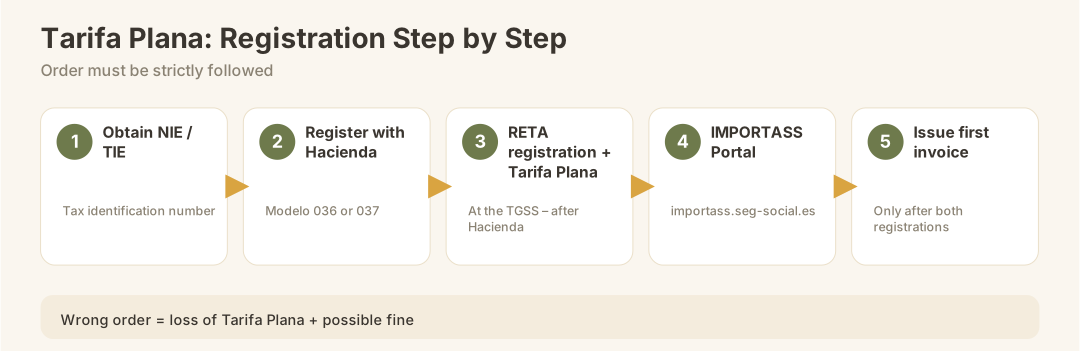
- Obtain your NIE / TIE — Without a tax identification number, nothing can proceed. If you do not yet have residencia, please read our guide to residencia in Spain.
- Register with the Agencia Tributaria (Hacienda) — Submit the Modelo 036 or 037, with which you register your business activity and your tax regime (IVA liability or exemption).
- Registration in the RETA with the Tesorería General de la Seguridad Social (TGSS) – Only after registering with the Hacienda. At this point you also apply for the tarifa plana.
- Use the IMPORTASS portal – Via the TGSS online portal (importass.seg-social.es) you can complete the registration digitally and apply for the reduced Cuota directly.
- Issue your first invoice – You may only legally invoice once both registrations have been completed.
Warning: Anyone who reverses the order or issues invoices before registering risks fines and the loss of the tarifa plana.
The extension to 24 months: when and how
After the first 12 months the tarifa plana does not end automatically – it can be extended by a further 12 months under one condition:
Your assessable net income (rendimiento neto computable) must be below the SMI (Salario Mínimo Interprofesional).
The extension results from the annual settlement by the Seguridad Social. You must however ensure that you make no changes at the end of month 12 that would rule out the extension.
| Period | Requirement | Monthly Cuota |
|---|---|---|
| Months 1–12 | Initial registration, waiting period fulfilled | 88,64 € |
| Months 13–24 | Net income < SMI | 88,64 € (continued) |
| From month 25 onwards (or earlier if exceeded) | Regular Tramos system | 205,88 € to approx. 607,31 € |
Note: The SMI may change annually. Have the requirement checked by a gestoría at the end of month 11 so that you do not slip into the standard system unprepared.
From month 13: the income-based Tramos system
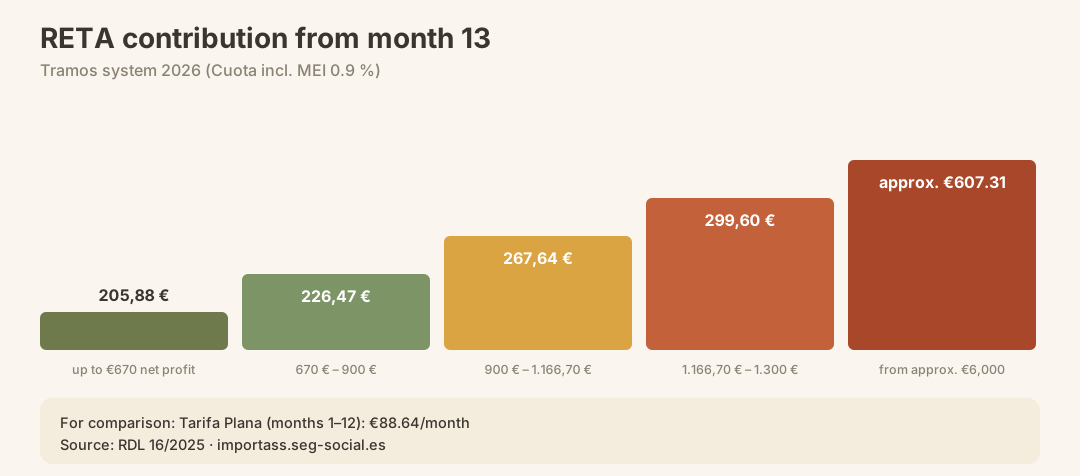
Anyone who cannot extend the tarifa plana or who contributes under the standard system after 24 months switches to the 15 contribution brackets (tramos) of the income-based system in force since 2023. For 2026, Real Decreto-ley 16/2025 has frozen the base rates from 2025 – only the MEI surcharge rose from 0.8 % to 0.9 %.
| Net monthly profit | Base cuota | Cuota with MEI (2026) |
|---|---|---|
| Up to 670 € | 200,00 € | 205,88 € |
| 670 € – 900 € | 220,00 € | 226,47 € |
| 900 € – 1.166,70 € | 260,00 € | 267,64 € |
| 1.166,70 € – 1.300 € | 291,00 € | 299,60 € |
| 1.300 € – approx. 1.700 € | approx. 294 € | approx. 303 € |
| Approx. 2.000 € – 4.000 € | approx. 320 €–420 € | approx. 330 €–430 € |
| From approx. 6.000 € | 589,64 € | approx. 607,31 € |
Note: The middle tramos are based on the frozen 2025 values in accordance with RDL 16/2025; the full table is published by the TGSS at importass.seg-social.es.
The system works on a forecast basis: you declare your expected income at the start of the year, pay your monthly contributions accordingly – and once the year is closed, your actual cuota is reconciled against what you have paid. Anyone who underestimated pays the difference; anyone who overestimated receives a refund.
Tarifa Plana and taxes: what runs separately
The tarifa plana applies exclusively to social security contributions. Tax obligations begin from day one:
| Tax | Form | Due date |
|---|---|---|
| Income tax advance payment | Modelo 130 | Quarterly: April, July, October, January |
| Value added tax (IVA) | Modelo 303 | Quarterly: April, July, October, January |
| Annual income tax return | IRPF / Renta | April–June of the following year |
As a rule of thumb, gestorías recommend setting aside from the very beginning 20% of net profit aside for IRPF. At higher income levels, tax rates rise considerably – read our guide on taxes as a resident in Spain.
Find out more about the quarterly Modelos in the guide Modelo 303 and 130 for Autónomos.
Total costs in the first year: what you really need to budget for
A realistic monthly overview for a newly registered Autónomo in Spain:
| Cost item | Amount/month (Year 1) |
|---|---|
| Tarifa plana (Cuota RETA) | 88,64 € |
| Gestoría (recommended) | 50–100 € |
| Accounting software / invoicing tool | 0–15 € |
| IRPF reserve (approx. 20% of net profit) | variable |
| IVA (passed on to clients) | pass-through |
| Fixed costs excluding IRPF reserve | approx. 150–200 € |
From month 13 onwards, social security contributions alone rise to around 205 to 607 Euro per month depending on income. Anyone who bases their business plan solely on the starting figure of "80 Euro" will significantly underestimate the total financial burden.
The most common mistakes – and how to avoid them
Many expats lose the tarifa plana not because they fail to meet the requirements, but because they make administrative errors. The most common ones are:
1. Issuing invoices before registering with RETA This is one of the most costly mistakes: issuing even a single invoice before the official registration risks fines and forfeits your entitlement to the tarifa plana for that month.
2. Registering with Hacienda and RETA simultaneously or in the wrong order The RETA registration must follow the Hacienda registration – not before it, and not simultaneously without clear documentation.
3. Assuming the tarifa plana renews automatically The extension into year 2 is tied to the SMI. Anyone who has earned well in the first year and has not carried out a review will be caught off guard in month 13 by a significantly higher Cuota.
4. Forgetting to set aside an IRPF reserve The tarifa plana saves on social security contributions – not income tax. Anyone who fails to build up a reserve from the outset will face liquidity problems at the year-end.
5. Outstanding debts with Hacienda at the point of registration Anyone with outstanding tax debts loses their entitlement. This also applies to small outstanding amounts from earlier German tax years that have not yet been settled.
6. Waiting period calculated incorrectly The 2-year period runs from the last day of RETA deregistration, not from the last day of actual activity.
What comes after the Tarifa Plana?
The transition to the regular Tramos system is the most critical moment for new Autónomos. Here is what you should prepare:
- Income forecast for the following year submit in good time to the TGSS via IMPORTASS – ideally in the final quarter before the tarifa plana expires
- Inform your gestoría so that the Cuota change is implemented correctly and on time
- Adjust your cash flow: From month 13 onwards, fixed costs can increase considerably depending on your income bracket
- Review IRPF advance payments: As income rises, so do tax rates – adjusting your Modelo-130 payments can reduce back payments
- Keep an eye on your pension contribution base: Your future pension entitlement in Spain depends directly on the contributions you have actually paid – more on this in the guide Applying for a pension in Spain
Special considerations for expats on Mallorca and the Balearic Islands
The same national rules apply to the tarifa plana on the Balearic Islands as in the rest of Spain – social security is a national matter. What differs on the islands:
- The Balearic regional government offers additional support for Autónomos, such as grants for new business start-ups. These are independent of the tarifa plana and require separate applications.
- For IRPF deductions that apply specifically in the Balearic Islands, it is worth consulting our guide on IRPF deductions in the Balearic Islands.
- Anyone who has not yet registered their place of residence should first clarify the Empadronamiento – it is a prerequisite for many subsequent steps.
- Health insurance: As an Autónomo you are covered by social insurance through RETA and are therefore entitled to the public healthcare system. Many self-employed people supplement this with private health insurance – our private health insurance comparison for Spain.
Checklist: Applying for the Tarifa Plana correctly
- NIE / TIE available and valid
- Empadronamiento completed (required for Balearic grants and subsidies)
- No outstanding debts with Hacienda or Seguridad Social
- Last RETA deregistration was at least 2 years ago (3 years if the tarifa plana was previously used)
- Modelo 036 or 037 submitted to the Agencia Tributaria (before RETA registration)
- RETA registration with the TGSS, simultaneously applying for the tarifa plana – via importass.seg-social.es
- Gestoría engaged or tax adviser appointed for the first quarterly filings
- IRPF reserve of at least 20 % set up
- Appointment entered in month 11 to review the conditions for extension
- Income forecast for the Tramos system from month 13 or 25 prepared
Conclusion
The tarifa plana autónomo in Spain is one of the most effective start-up aids for self-employed people within the Spanish system – but it does not run itself. 88,64 euros per month instead of up to around 607 euros represents a genuine financial buffer during the build-up phase. Anyone who completes the registration in the correct order, takes their tax obligations seriously from day one, and keeps an eye on the conditions for extension can get off to a significantly less burdened start for 12 or even 24 months.
From month 13 or 25, the income-based Tramos system requires careful planning – both with regard to the Cuota forecast and income tax. Anyone who works with an experienced Gestoría or a tax adviser for expats in good time will avoid the most costly surprises.
Official Sources
- Tesorería General de la Seguridad Social (TGSS) – IMPORTASS portal for RETA registration and Cuota management: importass.seg-social.es
- Agencia Tributaria (AEAT) – Modelo 036/037, Modelo 130, Modelo 303: agenciatributaria.gob.es
- Ley 31/2022, de 23 de diciembre – Presupuestos Generales del Estado, legal basis for the tarifa plana: boe.es
- Real Decreto-ley 16/2025 – Freezing of Tramos base rates for 2026, MEI adjustment to 0,9 %: boe.es
- Seguridad Social – Régimen Especial de Trabajadores Autónomos (RETA): seg-social.es
- Agència Tributària de les Illes Balears (ATIB) – Regional tax authority for Balearic special regulations: atib.es