
Ses Covetes – Guide to Mallorca’s Small Beach Settlement
.jpg)
Places to stay in Ses Covetes
AdTo load the accommodation map by our partner Stay22, we need your consent for marketing cookies. Your consent applies to all marketing content on mallorca.com.
Ses Covetes is a small beach settlement in southern Mallorca, precisely on the stretch of coast where Sa Ràpita merges into the protected landscape of Es Trenc. The coast is its focal point: fine sand, shallow water, dunes and the rockier area of Es Freu define the scenery.
Its small size makes getting around particularly easy. Paths between residential and holiday homes quickly lead to the sea, while more beach landscapes extend in both directions. Ses Covetes is therefore less suited to traditional sightseeing than to a long day at the beach, a coastal walk or a stay where the sea sets the rhythm of the day. Families appreciate the gentle entry into the water, while Es Freu, with its rocks and stony seabed, is better suited to exploring and snorkelling.
Despite its proximity to the famous Es Trenc, Ses Covetes is not a developed holiday resort. Restaurants and beach bars make up the most visible amenities, but large shopping areas, a promenade lined with shops or a prominent nightlife scene are not part of the settlement’s character. In summer, beachgoers, holiday residents and events at S’Embat bring the place to life; outside the season, its role as a residential area on the edge of a protected coastal landscape becomes more apparent.
For people who live here or are looking for a home by the sea, this means proximity to nature, but also a clear dependence on the larger places nearby. A car remains the most practical option for regular errands and trips towards Palma. Ses Covetes is therefore particularly suitable for people who deliberately choose a small, seasonal coastal settlement and do not expect the infrastructure of an established village.
History of Ses Covetes
The Summer Coastal Settlement
Toward the end of the 19th century, the site served Mallorcan families as a summer colony.
Today, a quiet residential settlement and a heavily visited summer coastline come together here.
Es Freu as a Former Quarry Site
The rocky area of Es Freu tells the story of an earlier use of the coast. Stone was quarried there and, according to historical accounts, was used for Palma’s city wall and La Seu Cathedral, among other structures. Anyone looking across the rocky ground today therefore sees not only an alternative to the sandy beach, but also a landscape that once served as a source of raw materials.
Its significance is instead revealed by the connection between the rocky stretch of coast and Palma’s major construction projects. Since Ses Covetes otherwise has little monumental architecture, Es Freu is the most tangible local link to the past.
From Holiday Retreat to Protected Coastal Settlement
Today, Ses Covetes lies beside a protected beach and dune landscape. Nature conservation means that the settlement is not defined by its houses alone: the dunes behind the beach, the open coastline and the transition to Es Trenc are equally part of it. A fence separates the dunes from the beach.
A more recent chapter in the settlement’s history began in 2005 with the founding of S’Embat. Through word of mouth, a small chiringuito at the entrance to the settlement developed into a well-known meeting place for residents, artists and visitors. Live music, small-scale performances and a deliberately relaxed style gave Ses Covetes a cultural identity during the summer season that extends far beyond the settlement’s small size.
Things to See in Ses Covetes
Platja de Ses Covetes
Platja de Ses Covetes is the natural centre of the settlement. Fine, pale sand and a gently sloping seabed characterise the main section. In calm weather, the water remains shallow for a long way near the shore, making access pleasant and the beach particularly appealing to families. On windier days, however, the exposed character of the southern coast can become clearly noticeable.
Dunes begin behind the beach, while only a narrow strip of tourist infrastructure is concentrated in front of the settlement. This is precisely what distinguishes it from larger seaside resorts: there is no long, densely developed hotel promenade between the houses and the water. Beach, dunes and residential settlement follow directly one after another. The compact section can nevertheless feel lively during the busiest summer months, so an early visit promises more peace and an easier search for parking.
Es Freu
Es Freu adjoins the sandy beach as a rockier and more rugged section of the landscape. The ground here alternates between rocks, stones and smaller access points to the water. Water shoes are therefore useful, especially for sensitive feet or when exploring the shoreline. When the sea is calm, the area offers better conditions for snorkelling than the uniform sandy seabed of the main beach.
The site is also the most important historic landscape feature in Ses Covetes. Stone was quarried here and is associated with buildings in Palma. The contrast between today’s recreational use and the work once carried out on the same coast is particularly interesting. Es Freu suits visitors who want more than simply to lie on the sand and would like to examine the transition between rock, water and settlement more closely.
Es Trenc Dune Landscape
The protected dune and beach landscape connected to Es Trenc begins immediately beside Ses Covetes. The dunes are not merely a decorative backdrop, but a sensitive part of the coastal system. A fence separates the dunes from the beach. Climbing over barriers or taking shortcuts through vegetated areas damages the very landscape that attracts so many visitors.
From the beach, the view feels unusually open: instead of an uninterrupted row of large buildings behind the sand, there are dune formations and low vegetation. The best views are from the beach area. The landscape can be appreciated at eye level while walking along the water’s edge.
S’Arenal de sa Ràpita
The pale sandy beach continues towards Sa Ràpita. S’Arenal de sa Ràpita is therefore not an isolated attraction, but a natural extension of the coastal experience. Anyone unable to find a suitable spot on the main beach of Ses Covetes, or wishing to take a longer walk, can follow the shore in this direction.
The transition clearly shows just how small Ses Covetes actually is. After only a short time, the settlement recedes and the wide bay takes centre stage. The view opens towards Sa Ràpita, where the coastal town is larger and the maritime facilities are more extensive. This side is particularly easy for orientation: Ses Covetes lies between the beach of Sa Ràpita and the beginning of Es Trenc.
The Character of the Settlement
What is worth seeing is the unusually direct proximity of low-rise residential buildings, sandy beach, rocky area and protected dunes. The settlement can be explored quickly on foot; its appeal lies not in individual façades, but in the short distances between the houses and the coast.
Ses Covetes is a former summer colony and a present-day beachside residential settlement. The most rewarding walk connects the entrance to the settlement, the main beach, Es Freu and part of the coastline.
Food and Drink
S’Embat
S’Embat is the most culturally distinctive venue in Ses Covetes. It was founded in 2005 as a small chiringuito at the entrance to the settlement and became known primarily through word of mouth. Its significance extends beyond food and drink: between the end of May and mid-October, the programme includes live music, jam sessions, jazz, funk, circus acts, magic, comedy and family-friendly performances.
The style is deliberately relaxed and slightly bohemian. Artists, island residents and international visitors meet here in an atmosphere more reminiscent of an open-air summer cultural venue than a conventional beach club. Anyone looking solely for a quiet evening should check whether an event is taking place before visiting. Families should note that part of the programme is explicitly designed as a shared experience and not only for an adult nighttime audience.
Outside the event period, S’Embat no longer plays its role as a continuous pace-setter for the settlement. For residents, this makes the seasonal nature of Ses Covetes particularly clear: in summer, a social meeting place forms around the venue, while the coastal settlement becomes considerably quieter in winter.
Beach Restaurants and Chiringuito Culture
Other restaurants and beach venues are concentrated in the immediate vicinity of the water. Their strength lies less in a historically established inn tradition than in their connection with a day at the beach. A drink after swimming, a meal close to the beach or a break between a walk and the return journey all fit the rhythm of the place. The dining scene is therefore clearly focused on the coast and the season.
When planning the day, visitors should bear in mind that Ses Covetes does not have a large restaurant district. The compact selection can be correspondingly busy on heavily visited summer days; outside the main season, significantly reduced operation should be expected. Anyone needing a broad choice independent of beach businesses will find a more practical everyday environment in the larger neighbouring towns.
The characteristic place to eat and drink is instead the chiringuito: informal, close to the sand and strongly shaped by the weather and time of year. It is therefore advisable to check current opening hours and programmes for individual venues rather than planning a visit around a supposedly year-round dining scene.
Eating, drinking and staying in Ses Covetes
The best-rated businesses from our directory, ordered by Google rating — not by advertising.
Activities and Excursions
Swimming and Beach Days
The main activity in Ses Covetes is swimming. The sandy section has a gentle entry into the water and is well suited to children and less experienced swimmers on calm days. The shallow shoreline should nevertheless not be mistaken for a supervised swimming pool: wind, waves and conditions in the open sea remain decisive. Local notices and any instructions from lifeguards should take priority over the visual impression created by the clear water.
The location is convenient for a longer stay because beach facilities and restaurants are close together. Shade is limited in the open beach landscape, however. Sun protection and drinking water are therefore essential, even if a stop at a restaurant is planned. At the height of summer, early morning is worthwhile not only because of the temperatures, but also because conditions on the beach are less crowded and easier to assess.
Snorkelling at Es Freu
Es Freu is the more interesting choice for snorkellers. Rocks and the varied seabed create more structure than pure sand. Water shoes make access easier, and particular care is required when the sea is rough: the rocky edge is less forgiving of waves and uncertain footing than the main beach.
The area does not have a prepared underwater route. Its appeal lies in independent exploration close to the coast when conditions are suitable. For families with small children, the sandy section is generally more comfortable; older children and adults who are confident swimmers will find a more varied shoreline at Es Freu.
Coastal Walk to Es Trenc
From Ses Covetes, the coast towards Es Trenc can be explored on foot. The route follows the beach and provides an immediate impression of the protected dune landscape. Sturdy footwear is not essential everywhere, but can be comfortable when walking longer sections or when the sand is hot.
It is important to remain on the beach. The dunes are not a freely accessible viewpoint. Enough time and sun protection must be allowed for the return, as the open coast offers hardly any shade. The walk is particularly suitable in the morning or later in the day, when the light and temperature are more pleasant.
Walk to Sa Ràpita
In the opposite direction, the coast leads to S’Arenal de sa Ràpita and onwards towards Sa Ràpita. This route is a good option for combining the beach and a harbour atmosphere in a single excursion. Sa Ràpita is larger than Ses Covetes and is the nearest reference point for maritime infrastructure and additional amenities.
The walk also reveals the landscape’s transition from the small settlement to the more expansive bay. Anyone who does not wish to return along the same route should arrange the return journey in advance; plans should not rely on spontaneous connections being available at any time directly beside the beach.
Cycling Along the Southern Coast
The flat landscape of southern Mallorca generally makes Ses Covetes a good starting point for bicycle tours between the coast and the countryside around Campos. Distances within the settlement itself are short, but the access roads are used by beach traffic in summer. Visibility, defensive riding and careful route selection are therefore more important than the gentle gradients.
The contrast between the open coastal landscape and the rural surroundings is particularly appealing. A bicycle can work well for leisure rides, but it does not automatically replace a car in everyday life: shopping, appointments and trips to Palma involve distances for which motorised transport is significantly more practical.
Beaches in Ses Covetes
One beach with its own page belongs to Ses Covetes.
Getting There and Getting Around
By Car from the Airport
From Palma Airport, the road route follows the Ma-19 and then the Ma-6030 to Ses Covetes. The journey covers 44 kilometres by road and takes around 41 minutes. In practical terms, this means a largely straightforward drive through the south of the island before the final roads towards the coast become narrower and more affected by local excursion traffic.
During the main summer period, additional time should be allowed for the final sections and the search for parking. The measured journey time nevertheless remains a good basis for planning: Ses Covetes can be reached from the airport in less than an hour, but lies far enough from the large holiday resorts around the Bay of Palma to retain a distinctly smaller-scale character.
By Car from Palma
From the centre of Palma, the route via the Ma-19 and Ma-6030 covers a total of 50 kilometres by road. The journey takes around 52 minutes. This is easily manageable for a day trip, but daily commuting involves a regular journey of almost an hour in each direction before possible city traffic and the search for parking in Palma are added.
Anyone living in Ses Covetes and frequently working in Palma should therefore not consider the location a suburb of the capital. It is a coastal residential location in the south with a direct road connection, but without a short urban commute. Working from home, flexible working hours or less frequent journeys are better suited to this distance than a tightly scheduled daily routine requiring physical attendance.
Parking at the Beach
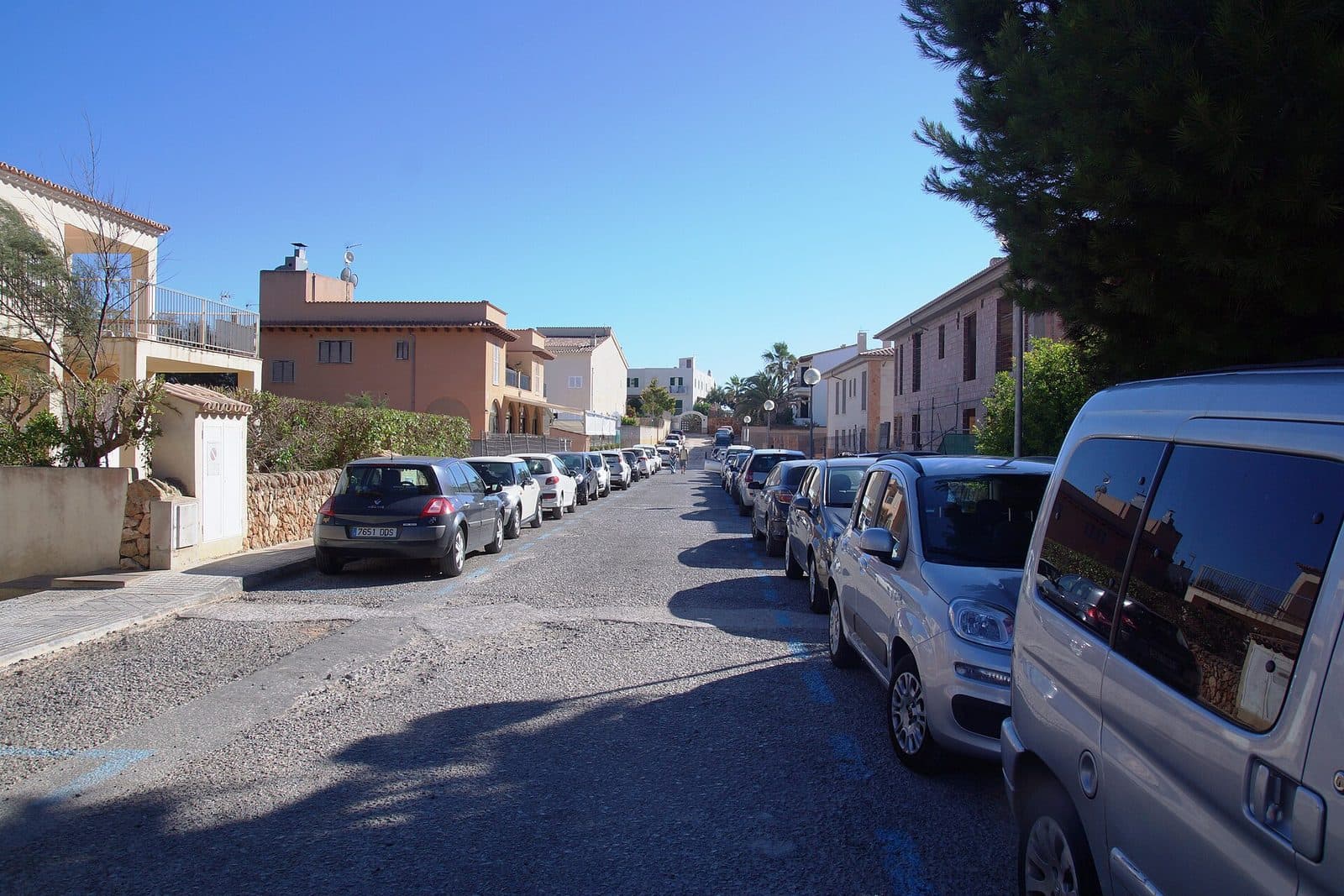
Parking is available around the settlement and the beach access points. Free spaces may be available, but they fill quickly during the busiest summer months. Those who arrive early have a better chance of finding a space within a reasonable walking distance and avoid unnecessary driving through the small streets.
Illegal parking is not a viable alternative, especially at the edge of protected areas. Access routes, dune areas and marked restricted zones must be kept clear. Since Ses Covetes is compact, it is worth accepting a legal space slightly farther away and covering the remaining distance on foot.
Bus Services and Getting Around Without a Car
Bus stops are concentrated in the nearby area of Sa Ràpita and along Avenida Miramar. The coast is therefore accessible by public transport in principle, but the final section to the chosen accommodation or beach access point must be included in the planning. The timetable information displayed on the page shows which connections are currently operating.
For a single beach visit, the bus can work well if both the outward and return journeys are planned in advance. In everyday residential life, a car is more flexible, particularly for shopping, medical appointments and regular journeys outside the immediate coastal area. A compact settlement is not automatically a place where every daily journey can be completed on foot.
Bus lines to Ses Covetes at a glance
| Line | Route | Departures/day | First | Last |
|---|---|---|---|---|
| 508 | Sa Ràpita - Palma | 75 | 06:25 | 23:05 |
| 518 | Sa Ràpita - Campos | 28 | 08:55 | 21:03 |
From the official GTFS feeds (TIB/SFM), no real-time data. The figures cover all stops in the town; weekend and holiday services differ — check with the operator before travelling.
Getting there by bus
Club Nàutic sa Ràpita 1 (13006) · 1.5 km as the crow flies
- 508Sa Ràpita - Palma · Daily
- 518Sa Ràpita - Campos · Daily
Club Nàutic sa Ràpita 2 (13005) · 1.5 km as the crow flies
- 508Sa Ràpita - Palma · Daily
- 518Sa Ràpita - Campos · Daily
Escorball (13026) · 2.5 km as the crow flies
- 518Sa Ràpita - Campos · Daily
Av. Miramar 2 (13003) · 2.6 km as the crow flies
- 508Sa Ràpita - Palma · Daily
Timetable data: official GTFS feeds (TIB/EMT), no real-time — check with the operator before travelling.
Living in Ses Covetes
Everyday Life Between Residential Settlement and Holiday Destination
Ses Covetes is a residential and holiday settlement, not a fully developed small-town centre. In summer, beachgoers, restaurants and holiday stays shape the daily rhythm. Distances to the sea are short, while traffic around the beach access points increases. For residents, this means a marked contrast between lively months and a considerably quieter low season.
Residential areas are mainly oriented towards the coast and access roads. Low-rise buildings and proximity to the protected landscape shape the surroundings more strongly than public squares or prestigious streetscapes. Anyone who enjoys walking to the sea in the morning and does not need an urban environment will find a distinctive quality of life here. Anyone expecting a daily choice of shops and services will need to plan regular journeys to larger places.
Local Shopping and Services
The clearly documented local amenities are geared towards the beach, dining and seasonal visitors. When choosing a permanent home, it is essential to check the facilities actually needed in Sa Ràpita, Campos or other larger places in detail.
A car makes everyday life considerably easier. A bus journey can replace individual trips, but shopping, appointments and several errands in one day are easier to combine by car. For people who do not drive, the exact distance from the home to the served bus stops should be considered as carefully as the seasonal timetable.
Winter in Ses Covetes
After the end of the swimming season, Ses Covetes becomes considerably quieter. The beach landscape remains its greatest advantage, but part of the summer activity disappears. This is particularly evident at S’Embat, whose cultural programme runs from the end of May to mid-October. Other coast-oriented businesses may also operate on a reduced basis outside the main season.
For permanent residents, this tranquillity is either the main reason for choosing the location or a practical limitation. Walks by the sea and the low density of the settlement become more appealing; spontaneous dining, events and everyday encounters become less frequent. Anyone who needs year-round social and commercial activity directly outside their door will be better served in a larger place.
Commuting and Working
The journey to Palma covers 50 kilometres by road via the Ma-19 and Ma-6030 and takes around 52 minutes. Regular commuting is therefore possible, but time-consuming. The location is better suited to people with flexible working arrangements, jobs in the south of the island or a daily routine that is not tied to the capital every day.
The airport is 44 kilometres away by road and the journey takes around 41 minutes. This is generally convenient for frequent travellers, without Ses Covetes feeling directly affected by the airport environment. When assessing a residential location, however, it is more important to consider how often journeys to Palma, schools, medical facilities or larger shopping areas will actually be required.
Who Ses Covetes Suits as a Place to Live
Ses Covetes suits people who deliberately seek proximity to the sea, low-rise development and a pronounced low season. Having a car, being willing to travel for everyday needs and maintaining a degree of independence from the local restaurant trade are essential requirements. The settlement’s structure also suits homes used only part of the year, reflecting its historical development as a summer colony.
It is less suitable for households that need all important facilities within walking distance or expect a short daily commute to Palma. Families should not assess school and childcare journeys based on the beach location, but organise them separately. Older residents and people without a car should pay particular attention to bus stops, access to medical care and winter services.
Practical Information for Your Visit
The Best Time of Day
Ses Covetes is most pleasant in the early morning or later in the day. In the morning, the beach and access roads are usually easier to navigate, the light falls softly on the water and dunes, and the heat is less intense during a longer walk. Anyone primarily wishing to swim should nevertheless consider current sea conditions and not decide based on the time alone.
In July and August, the small beach becomes significantly busier. Arriving early then improves not only the choice of where to lie, but also the parking situation. Outside the peak summer period, the coast is quieter, although the dining and cultural offerings may be more limited.
How Long to Stay
The settlement itself can be explored quickly. A short stay is enough for a walk through the streets, to the main beach and onwards to Es Freu. Its real value, however, comes from spending additional time by the water or taking a longer coastal walk. Ses Covetes is not designed for traditional sightseeing involving museums and several historic monuments.
Half a day or a full day at the beach therefore makes more sense than a tightly scheduled sightseeing stop. Anyone who only wants a brief impression should ideally combine the settlement with Sa Ràpita or a walk towards Es Trenc. This makes the coastal setting easier to understand than simply visiting the central beach access point.
Equipment for the Beach and Rocky Area
For the sandy beach, standard swimming equipment, sun protection and drinking water are sufficient. Natural shade is scarce. Water shoes are recommended for Es Freu because the ground is rockier and stony in places. Snorkelling equipment is more worthwhile there than over the uniform sandy seabed of the main beach.
The dunes are protected and separated from the beach by a fence. Beach visitors should not regard barriers as inconvenient obstacles to shortcuts, but as protection for a sensitive coastal system. Rubbish should be placed in the designated bins or taken away again.
What to Expect
Anyone wishing to experience a beach, a small rocky area, dunes and summer chiringuito culture will find everything within a compact area.
Before an evening visit to S’Embat, it is advisable to check the current programme, as live music and performances significantly change the atmosphere. An early start is better for a quiet day at the beach; for culture and socialising, an event day may be exactly the right time.
Upcoming dates
Latest news from Campos
- Cala Major park: Palma takes 1,200m² plot for green space
- 27 Mallorca towns lack Alcover and La Balanguera
- Mallorca TIB stops gain 200 upgrades for better waits
- Mallorca raises 180,000 plants for forests and dunes