
Capella d'en Ramon LLull – Viewpoint near Deià
.jpg)
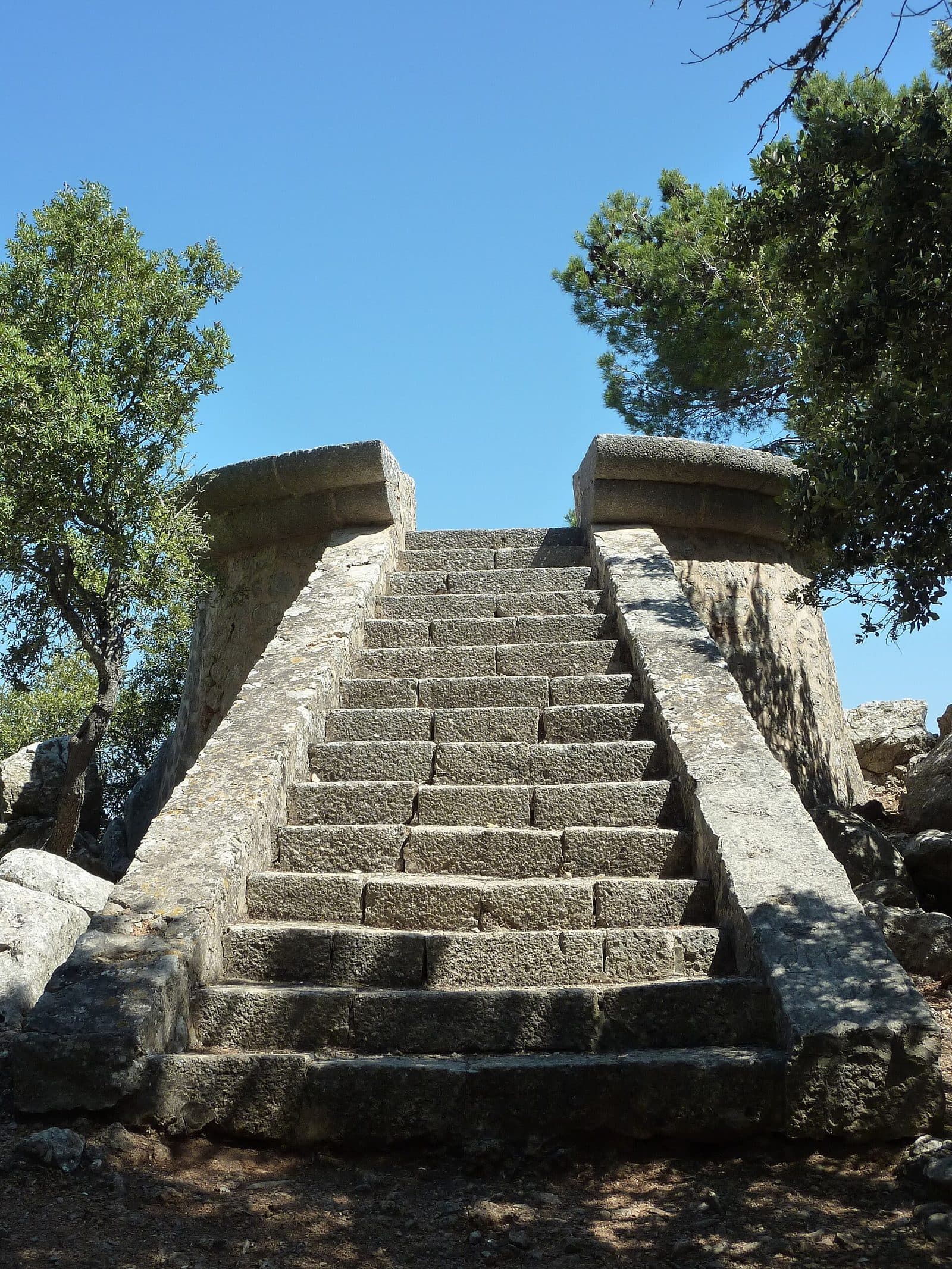
The Capella d'en Ramon LLull is not a fully preserved place of worship but a small historic viewpoint with an impressive chapel ruin near Deià. Among the remains of the circular structure, three themes that have shaped northwestern Mallorca come together: the memory of Ramon Llull, the cultural landscape of the Serra de Tramuntana and the work of Archduke Ludwig Salvator.
The damage is precisely what makes the site so revealing. The open sections show how compactly the chapel was designed, while its location makes the idea behind its construction easier to understand: it was not intended to be a large sacred space, but a deliberately placed monument within the landscape. Those seeking a quiet historic site rather than an exhibition or a fully furnished interior will find its particular appeal here.
A visit is especially suited to travelers who want to see Deià as more than just a beautiful mountain village. The chapel offers an introduction to Mallorca's intellectual history and the work of Archduke Ludwig Salvator. To understand it better, it is worth paying attention to the circular ground plan, the surviving masonry and the traces of destruction at the site.
History and significance
Archduke Ludwig Salvator
The pivotal moment in the history of the Capella d'en Ramon LLull came in 1876. Archduke Ludwig Salvator had it built in honor of Ramon Llull and commissioned architect Federic Wachsman to design it. The building was therefore not part of Llull's medieval work but was created many centuries later as a historical memorial.
This distinction is important: the chapel is not an authentic place where the philosopher stayed or worked. Instead, it shows how strongly Llull was regarded as a figure of intellectual identity in 19th-century Mallorca. Ludwig Salvator did not choose an urban square for this tribute but had the monument built in the landscape of the northwest coast.
Ramon Llull and Miramar
Ramon Llull was born in Palma in the 13th century and worked as a writer, philosopher, mystic, theologian, teacher and missionary. He wrote texts in several languages, including Catalan, Latin and Arabic. His significance therefore extends far beyond Mallorca; on the island, he is also regarded as a key figure in Catalan intellectual and linguistic history.
In Miramar, Llull founded a missionary school for Oriental languages in 1276. The area on the north coast is therefore closely associated with his educational and missionary project. Later, two eras effectively met in Miramar: Llull's medieval legacy and Ludwig Salvator's landscape culture. The chapel makes this connection visible in a single small structure.
The lightning strike
In 1974, the chapel was severely damaged by a lightning strike. What can be seen today therefore does not preserve the complete original appearance of 1876. Yet the ruin is more than a mere remnant: the building's biography can be read in it, from its prestigious foundation and the loss of its furnishings to its present condition as a historic landmark in the landscape.
The remains are associated with the history of the S'Estaca estate. This distinguishes the Capella d'en Ramon LLull from a regularly operated museum or village church. Its value lies in the interplay of memorial site, ruined architecture and viewpoint—and in the question of why this particular landscape was chosen to commemorate Mallorca's best-known medieval thinker.
What to see
The circular structure
Federic Wachsman designed a circular Neo-Romanesque building with a diameter of 6,5 meters. Its architecture drew on medieval forms without itself being medieval. This historicizing design was particularly appropriate for the building's purpose as a monument to Ramon Llull.
Its small size focuses attention on its form. Instead of a subdivided church interior with several chapels or naves, this was a compact centrally planned building. The curve of the wall and the strength of the architectural concept can still be traced in the surviving sections. Today, the damaged areas open the structure to the outside, making the ground plan, the course of the walls and the ruinous condition immediately legible.
The Neo-Romanesque forms
Wachsman used a Neo-Romanesque architectural language. The circular design gave the chapel a sense of unity and made it appear like a carefully composed monument. Despite the destruction, this effect is still recognizable when the surviving sections of wall are viewed not individually but as parts of an originally complete circle.
It is therefore worth changing perspective slowly during the visit. From close up, the materials, broken edges and damage attract attention; from a little farther away, the geometric idea becomes clearer. The chapel is understood less through decorative details than through its silhouette and integration into the surroundings.
The lost Llull sculpture
The building originally had a clear focal point: a sculpture of Ramon Llull made from Carrara marble. It was created by the Italian sculptor Giovanni Dupré. The work gave the foundation a specific subject and turned the small chapel into a monument dedicated to an individual.
The sculpture is no longer in its original location but is now in Palma Cathedral. Anyone visiting the ruin should therefore not expect a furnished interior or a figure of Llull. This absence has itself become part of the site's character: the masonry still defines the space once created for Dupré's work, while the furnishings are preserved elsewhere.
The traces of 1974
The lightning strike not only changed the historic form but has itself become the most visible chapter in the building's history. Open sections of wall and missing structural elements show that the Capella d'en Ramon LLull was not an artificially created Romantic ruin. It was built as a complete structure and was severely damaged only by the event of 1974.
This sets the site apart from a classic viewing pavilion. The landscape remains important, but attention is also directed toward the fragment itself. Anyone who stops only briefly to take a photograph may easily overlook how many layers of time come together here: Llull's medieval legacy, Ludwig Salvator's concept for the monument, Wachsman's architecture and the later destruction.
Visiting the chapel
A small site with rich context
The Capella d'en Ramon LLull does not require a lengthy museum tour. The structure itself is compact, and there is neither a sequence of exhibition rooms nor a preserved historic interior to walk through. The length of a visit therefore depends primarily on whether the chapel is treated merely as a brief viewpoint or considered within its historical context.
For a thoughtful visit, a simple sequence is worthwhile: first take in the overall circular form from a little distance, then examine the surviving walls and fractures, and finally view the location as part of the cultural landscape around Deià and Miramar. In this way, a small ruined building becomes a vivid introduction to the commemorative culture of the 19th century.
Light and perception
Good daylight helps distinguish the curve, wall structure and damaged sections. Because the chapel's impact today comes primarily from its exterior form and the contrast between surviving and lost structural elements, visibility of the masonry is more important than any supposed interior. A particular time slot without crowds cannot be reliably specified, so the visit should not be planned solely around expected visitor numbers.
The view is also part of the overall experience rather than a photographic backdrop detached from the history. Anyone who connects the landscape with Miramar and the northwest coast will understand the chapel better than through a purely architectural examination.
Before setting out
Confirmed opening hours and admission conditions are not available. Because the site is associated with the S'Estaca estate, visitors should check before traveling whether the viewpoint is currently accessible and which route can be used. The designation as a chapel should not be taken to imply regular church services or an interior that is open at all times.
The Capella d'en Ramon LLull is primarily a historic landmark in the landscape. Its strength lies not in extensive furnishings but in its focus on a few clearly recognizable elements: circular form, ruined wall, location and the memory of Llull.
Directions and parking
From Palma Airport
From Palma Airport, the route initially follows the Ma-20, then the Ma-1110 and finally the Ma-10 to Deià. The road distance to the village is 32 kilometers, and the drive takes around 48 minutes. The Ma-10 is the main road through this part of the Serra de Tramuntana.
These directions explicitly end in Deià and not directly at the Capella d'en Ramon LLull. The precise location should be checked in advance for the final section to the viewpoint, as should current accessibility around S'Estaca.
From central Palma
From central Palma, the route follows the Ma-1110 and the Ma-10. The road distance to Deià is 27 kilometers, and the drive takes around 52 minutes. Here too, the time and distance refer to Deià. Additional planning is required for the onward drive or subsequent route to the chapel. Anyone combining the visit with Miramar or a stay in the village should treat the viewpoint as a separate item on the itinerary.
Parking and public transport
The Ca Madò Pilla and Son Gallard bus stops are served in the surrounding area. They may be relevant when planning a journey without a car, but they do not replace the need to check the final section to the chapel. In the Tramuntana, proximity to a bus stop does not automatically mean that access is short, level or clearly signposted.
Bus lines to Capella d'en Ramon LLull at a glance
| Line | Route | Departures/day | First | Last |
|---|---|---|---|---|
| 203 | Valldemossa / Deià | 203 | 06:41 | 22:38 |
From the official GTFS feeds (TIB/SFM), no real-time data. The figures cover all stops in the town; weekend and holiday services differ — check with the operator before travelling.
Getting there by bus
Ca Madò Pilla 1 (63005) · 0.3 km as the crow flies
- 203Valldemossa / Deià · Daily
Ca Madò Pilla 2 (63004) · 0.5 km as the crow flies
- 203Valldemossa / Deià · Daily
Son Gallard 1 (18008) · 0.7 km as the crow flies
- 203Valldemossa / Deià · Daily
Son Gallard 2 (18007) · 0.8 km as the crow flies
- 203Valldemossa / Deià · Daily
Ermita de la Trinitat 1 (63003) · 1.7 km as the crow flies
- 203Valldemossa / Deià · Daily
Sa Foradada (18009) · 2.0 km as the crow flies
- 203Valldemossa / Deià · Daily
Ermita de la Trinitat 2 (63011) · 2.0 km as the crow flies
- 203Valldemossa / Deià · Daily
Timetable data: official GTFS feeds (TIB/EMT), no real-time — check with the operator before travelling.
Nearby places
Deià
Deià lies between the slopes of the Serra de Tramuntana and the Mediterranean. The village's present form largely dates back to the Moorish period, when terraces and irrigation systems were created. After the Christian conquest, Deià initially belonged to Valldemossa before becoming independent in 1583. Later, olive terraces spread ever farther across the slopes, giving the surroundings their silvery green color.
Since the late 19th century, the village has attracted artists, writers and musicians. This makes the Capella d'en Ramon LLull an unusually good fit for Deià: it too was created at a time when the landscape of the northwest was no longer viewed solely in agricultural terms but was being discovered and described as a cultural space. A walk through the village therefore provides a fitting context, although the chapel itself should not be sought in the village center.
Miramar
Miramar is the most important addition for anyone wishing to understand the name Ramon Llull behind the chapel. He founded his missionary school for Oriental languages there in 1276. Centuries later, the area became closely associated with Ludwig Salvator. Miramar thus brings together the very two figures whose connection also lies behind the Capella d'en Ramon LLull.
The visit should not, however, turn into a search for a supposedly medieval chapel. The small circular chapel dates from the 19th century and was founded by the Archduke. Miramar provides the historical context, while the ruin itself tells the story of Llull's later veneration.
Cala Deià and the coast
Anyone wishing to combine the historical focus with the coastal landscape can include Cala Deià in the day's itinerary. The small cove lies below the village and has a pebble and rocky beach. It offers a different emphasis from the chapel ruin: below, direct contact with the sea; above, the culturally shaped landscape around Deià and Miramar.
For a broader route along the northwest coast, Valldemossa or Port de Sóller are also options. Here, the drive is part of the landscape experience, but it requires more time and attention than a comparable journey across the island's flat interior.
Local insider tips
Picture the complete circle
From a little distance, the originally enclosed circular structure is easier to recognize. Only then is it worth examining the broken edges and open sections of wall that tell the story of the lightning strike in 1974.
Notice the empty space
Giovanni Dupré's Carrara marble sculpture of Ramon Llull once stood at the center. It is now in Palma Cathedral; at the chapel, its former position remains perceptible as a deliberate empty space.
Combine it with Miramar
Miramar provides the crucial historical context: Ramon Llull founded a missionary school there in 1276. Ludwig Salvator had the chapel built in 1876 in honor of Ramon Llull.
Check the final section in advance
The stated driving routes lead only as far as Deià. Before setting out, check the precise location and current accessibility around S'Estaca.