
Mirador dels Tudons near Deià: Tramuntana Viewpoint
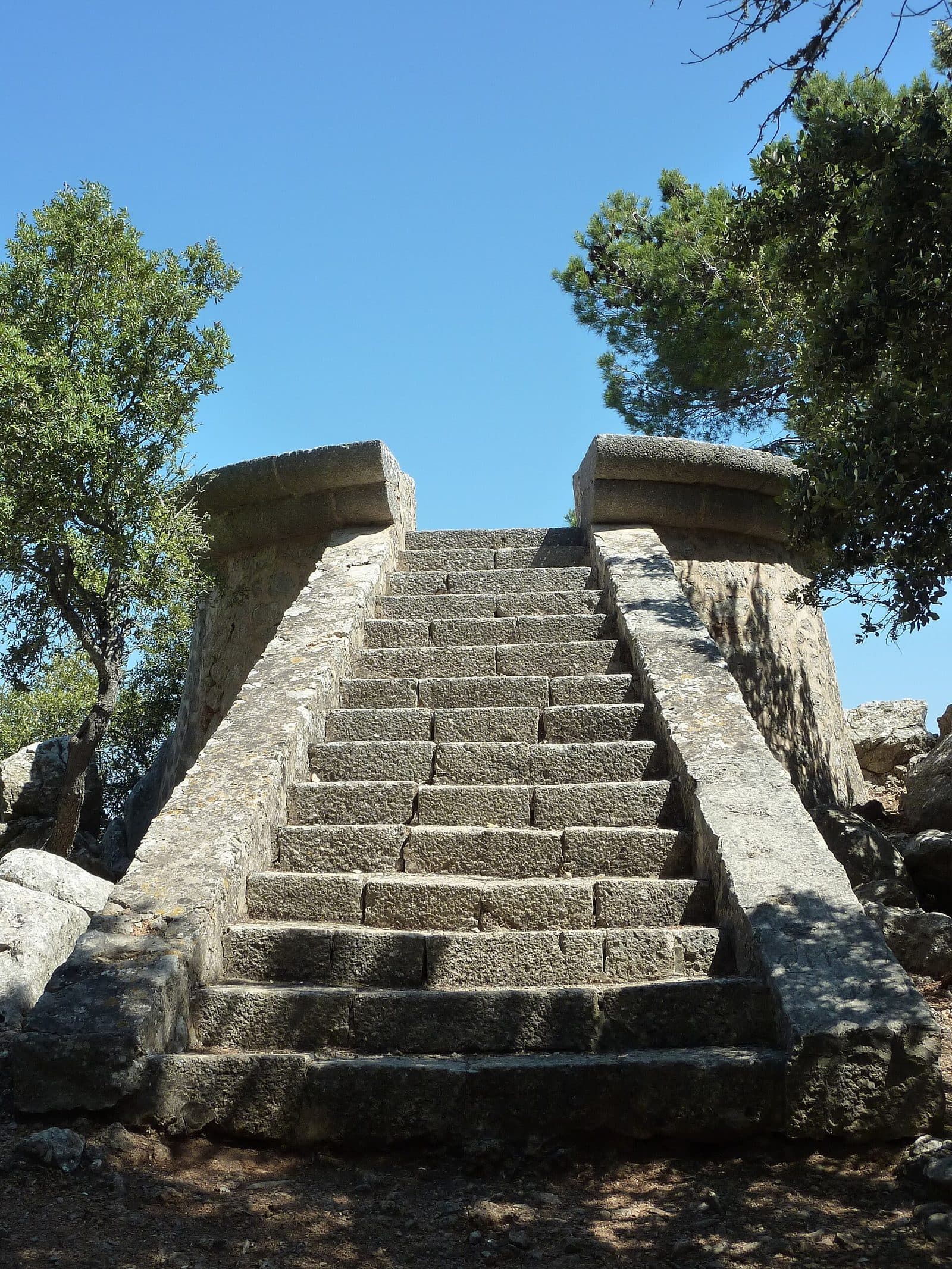
.jpg)
Mirador dels Tudons is a viewpoint near Deià in northwestern Mallorca. It is not one of the island’s large, staged panoramic stops, but one of those places whose appeal comes from its location in the Serra de Tramuntana. Anyone already traveling along the mountain road or visiting Deià can include the stop in a day trip as a peaceful change of perspective.
What matters here is less a single attraction than the landscape around Deià. Mountains, cultivated slopes, olive trees, and the honey-colored stone houses characteristic of the village shape this part of the Tramuntana. The viewpoint helps visitors appreciate this interplay of natural and cultural landscapes from a little distance. It is especially suitable for travelers driving slowly through the northwest, taking photographs, or pausing between two longer activities. The viewpoint alone offers too little for a dedicated half-day excursion; combined with Deià, a drive on the Ma-10, or a detour to the coast, however, it makes for a rewarding stop.
Clear identification of the location is important: This article refers exclusively to the viewpoint near Deià on Mallorca. Similarly spelled entries are also associated with other places. The destination should therefore always be checked in navigation together with Deià.
What to See
The first impression comes from the elevated location and the broader context of the landscape. Deià lies between the mountains of the Serra de Tramuntana and the northwest coast, giving the terrain a strongly layered appearance. Vegetated slopes, rocky sections, and land used by people follow one another within a confined area. At Mirador dels Tudons, the focus is not on a single structure but on the opportunity to view this pattern as a whole.
The Landscape Around Deià
The surroundings of Deià tell the story of a landscape that has been cultivated and inhabited for a long time. Olive trees are as much a part of the scenery as stony slopes and the village houses set closely against the terrain. From a viewpoint, it becomes clearer how little space the topography leaves for broad settlement areas. Paths, roads, and buildings must adapt to gradients and terrain edges rather than imposing a regular pattern on them.
This contrast in particular distinguishes the northwest from the island’s flatter regions. The eye does not rest on a straight horizon but moves across foregrounds, stepped slopes, and mountain contours, with the spatial effect changing according to the light and visibility. A photograph usually captures only one section; it is more rewarding to experience the viewpoint without a camera at first and examine each direction in turn.
The Cultural Landscape of the Tramuntana
The Serra de Tramuntana is appreciated not only for its mountain forms. The connection between nature and historically shaped land use is equally characteristic. Around Deià, olive groves, stone buildings, and settlements adapted to the slopes show how closely life here is tied to the terrain. The viewpoint provides an appropriate setting in which to read this cultural landscape not merely as beautiful scenery, but as the result of sustained work.
It is worth observing the subtle transitions: Where does the denser vegetation end, where do cultivated areas begin, and how do walls or buildings follow the lines of the slope? Such details often become apparent only when the eye is not immediately fixed on a supposed main subject. Mirador dels Tudons is therefore more a place for observation than a stage for a single iconic photograph.
Deià in the Mountains
Deià is known for its narrow lanes, traditional stone houses, and setting among olive trees. From the viewpoint, this character can be placed within its landscape context; afterward, a walk through the village often becomes easier to understand. Down among the houses, façades, steps, and lanes shape the impression, while an elevated view conveys the hillside location more clearly.
Anyone visiting several Tramuntana viewpoints should not confuse Mirador dels Tudons with Mirador de Sa Foradada. Sa Foradada is known for its view of the perforated rock and as a sunset location. Mirador dels Tudons is a separate destination near Deià and should be searched for as such.
Visiting the Viewpoint
A stop at Mirador dels Tudons does not require a fixed route. The experience consists of arriving, getting oriented, and looking attentively. Instead of driving on immediately, it is advisable to choose a safe place to stand and calmly take in the landscape. Only then does it become clear which direction or section has the strongest personal appeal.
A Short Scenic Stop
The viewpoint works well as an intermediate stop on a drive through the Tramuntana. The amount of time worth spending here depends on the purpose of the visit: A short stop is enough for a first impression, while photographers or those interested in the landscape may stay longer. There is no fixed visiting time because neither an exhibition nor a prescribed sequence of spaces determines the experience.
For precisely this reason, visitors should not approach the Mirador expecting a major attraction. Its value lies in breaking up the journey. After the curves and changing perspectives of the mountain region, the stop provides an opportunity to experience the terrain from somewhere other than a moving vehicle. Anyone who then explores Deià on foot also gains an appealing contrast between distant views and the confined spaces of the village.
Light and Crowds
At viewpoints, the light is generally more pleasant when the sun is not high and harsh above the landscape. However, the time of day that provides the preferred view at Mirador dels Tudons depends on the weather, season, and viewing direction. A blanket guarantee of a sunset view would be misleading. Even with clouds or light haze, the stop need not lose its appeal: The layering of the slopes can become especially distinct, even when long-distance visibility remains limited.
Current Visiting Conditions
No binding opening hours or current admission fee are recorded for Mirador dels Tudons. Current information should therefore be checked before traveling there, particularly when road closures, construction work, or temporary access restrictions may be possible. Information about other viewpoints must not be applied to this location.
The same applies to older entries in map and travel portals. In addition to variant spellings, similar names appear with different locations. For planning purposes, the combination of the full name and Deià is therefore more important than an isolated result for “Tudons.”
Getting There and Parking
The journey leads into Mallorca’s mountainous northwest. The main transport route near Deià is the Ma-10, which winds through the Serra de Tramuntana and connects numerous villages and scenic locations. The stated distances and driving times apply specifically to Deià; the final section to Mirador dels Tudons depends on the chosen starting point and local access route.
From Palma Airport
The road distance from Palma Airport to Deià is 32 kilometers. The drive takes around 48 minutes and follows the Ma-20, then the Ma-1110, and finally the Ma-10. This time should be understood as a guide under normal traffic conditions. The final part of the route enters the mountain region, where bends and heavy excursion traffic can slow progress.
In Deià, the navigation destination should be checked again using the full name. Search results that mention Valldemossa or another location do not refer to the viewpoint described here. For the final section, current map information and local signage are decisive.
From Central Palma
The road distance from central Palma to Deià is 27 kilometers. The drive takes around 52 minutes and follows the Ma-1110 and the Ma-10. Although the route is shorter than the one from the airport, the recorded route data indicate that it takes slightly longer. Day-trip planning should also account for the fact that the stated driving time ends in Deià and not directly at the viewpoint.
The Ma-10 is more than simply an access road: It forms an essential part of the scenic experience. Nevertheless, drivers must keep their attention on the road. Only safe and suitable stopping places should be used for photographs and extended viewing.
Parking and Bus
A reliably designated parking situation directly at the Mirador is not included in the available visitor information. It is therefore advisable to stop only where this is clearly permitted and where neither the road nor access points are blocked. In the Tramuntana in particular, apparently open roadside areas are not automatically parking spaces. If the situation is full or unclear, it is better to skip the stop than to maneuver in a place with poor visibility.
The bus stops Ca Madò Pilla 1 and Ca Madò Pilla 2, as well as Son Gallard 1 and Son Gallard 2, are located in the wider area. Because no specific, verified walking route from these stops to the viewpoint is documented, the final stage should be planned in advance using current timetables and maps. The mere proximity of a bus stop does not guarantee easy or safe access on foot in mountainous terrain.
Bus lines to Mirador dels Tudons at a glance
| Line | Route | Departures/day | First | Last |
|---|---|---|---|---|
| 203 | Valldemossa / Deià | 203 | 06:41 | 22:38 |
From the official GTFS feeds (TIB/SFM), no real-time data. The figures cover all stops in the town; weekend and holiday services differ — check with the operator before travelling.
Getting there by bus
Ca Madò Pilla 1 (63005) · 0.3 km as the crow flies
- 203Valldemossa / Deià · Daily
Ca Madò Pilla 2 (63004) · 0.4 km as the crow flies
- 203Valldemossa / Deià · Daily
Son Gallard 1 (18008) · 0.6 km as the crow flies
- 203Valldemossa / Deià · Daily
Son Gallard 2 (18007) · 0.7 km as the crow flies
- 203Valldemossa / Deià · Daily
Ermita de la Trinitat 1 (63003) · 1.6 km as the crow flies
- 203Valldemossa / Deià · Daily
Ermita de la Trinitat 2 (63011) · 1.9 km as the crow flies
- 203Valldemossa / Deià · Daily
Sa Foradada (18009) · 1.9 km as the crow flies
- 203Valldemossa / Deià · Daily
Timetable data: official GTFS feeds (TIB/EMT), no real-time — check with the operator before travelling.
Nearby Attractions
Mirador dels Tudons benefits from having Deià nearby. The village is one of the best-known destinations in the northwest and combines a striking appearance with a long-standing attraction for artists, writers, and travelers. Among the stone houses and narrow lanes, the same topography that can be seen on a larger scale from the viewpoint becomes apparent.
Deià
A walk through Deià is the most obvious addition to the visit. The houses follow the slope, lanes climb uphill, and restricted views of the surroundings repeatedly open up between the buildings. Rather than seeing the village only while passing through, it is worth taking a leisurely walk. This reveals how closely architecture and terrain are connected.
Deià’s reputation as a village of artists and writers arose not only from its seclusion, but also from the powerful effect of its landscape. The writer Robert Graves is among the best-known figures associated with the village. His former home is now used as a museum. Galleries and cultural venues continue this artistic tradition without Deià having entirely lost its character as a mountain village.
Cala Deià
Below the village lies Cala Deià, a small cove with pebbles and rocks. It offers a clear contrast to the elevated landscape view: Instead of viewing slopes from a distance, visitors are directly on the coast. However, access and parking should be planned separately from the visit to the Mirador; although both destinations share the same local setting, they do not form one connected visitor site.
Anyone including the cove in a day trip should not automatically expect a comfortable beach day. Cala Deià is primarily a compact rocky and pebbly coastal landscape. A clear order is advisable when combining the destinations so that repeated journeys between the mountain road, village, and coast are avoided.
The Ma-10 and Sa Foradada
Continuing along the Ma-10 connects Deià with other scenic locations in the Serra de Tramuntana. Mirador de Sa Foradada, between Deià and Valldemossa, is particularly well known. The view there focuses on the characteristic rock with its opening; the location is also popular at sunset.
Sa Foradada should be treated as a separate stop. The fame of this viewpoint makes it easy to mix up the names and images of different Miradores. Mirador dels Tudons is neither an alternative name for Sa Foradada nor the viewpoint near Valldemossa that is similarly named in some directories.
The place it belongs to
Deià in the place guidePractical Information for Your Visit
A viewpoint may look straightforward on a map, but its location in the Tramuntana requires a little more attention than a stop in the island’s flat interior. Weather, road traffic, and the safe choice of where to stand have a greater effect on the quality of the visit than an extensive sightseeing program.
Clothing and Footwear
Sun protection remains important in the northwest as well. At the same time, weather in the mountains can feel different from conditions in Palma or on sheltered beaches. A light additional layer is therefore useful in changeable weather.
Visiting with Children
With children, the visit should be planned as a short, supervised scenic stop. Whether the location is suitable for a particular family should be decided according to current conditions on site. The visit becomes more engaging when the view is paired with a simple observation task: Families can look together for olive trees, houses on the slope, or the lines of the mountain flanks. This makes the stop more than a photo break without requiring information panels or an exhibition.
What Not to Expect
Mirador dels Tudons should not be planned as a museum, archaeological excavation, or historical building complex. The name of the viewpoint is not evidence that a talaiot can be visited here. Talaiots are prehistoric tower-like structures on Mallorca and Menorca, built from large dry-laid stones; however, this general meaning must not be applied to the Mirador without location-specific evidence.
Nor should visitors rely solely on automatically generated lists of places. Similar names and variant spellings can lead to a different destination. Anyone who checks the name, Deià as the location, and the route of the Ma-10 together before departure will avoid the most common mix-up and have more time for the scenic stop itself.
Local insider tips
Check Deià in the Destination Name
When using navigation, always check “Mirador dels Tudons, Deià.” Similarly spelled map entries are also associated with Valldemossa and do not lead to the viewpoint described here.
Plan It as a Ma-10 Stop
The Mirador works best as an intermediate stop on a drive along the Ma-10. Combined with a walk through Deià, the short scenic break becomes a well-rounded Tramuntana excursion.
View the Landscape Before the Village
First observe the hillside landscape from the viewpoint, then explore Deià on foot. This makes it easier to see how closely stone houses, lanes, olive trees, and terrain belong together.
Do Not Take Photos Immediately
Before taking the first photograph, spend a few moments looking for the different layers of the landscape. Slopes, vegetation, and cultivated areas often create more interesting subjects than a single section chosen too quickly.