
Coves de Campanet – Mallorca's Quiet Stalactite Caves
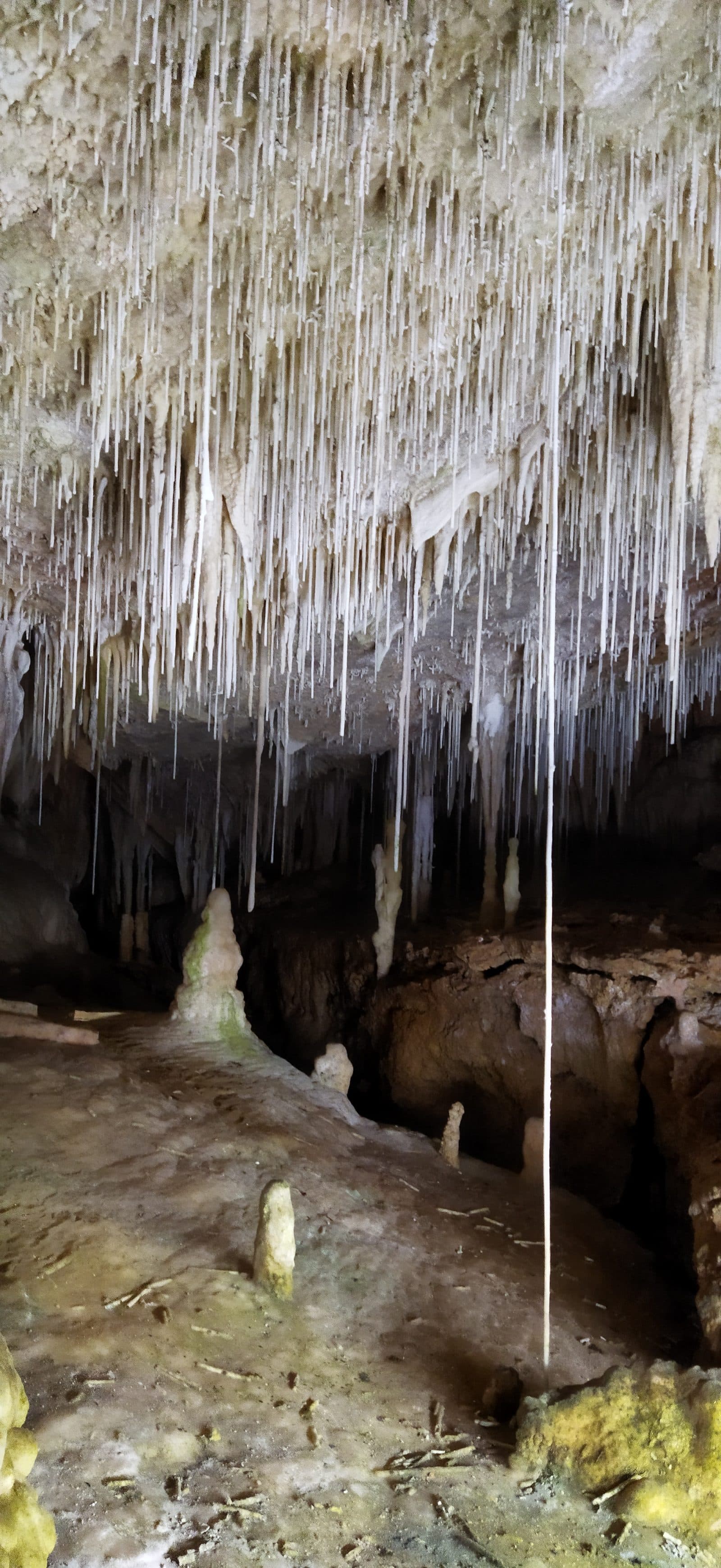

The Coves de Campanet near Cala Tuent lead into a hidden landscape shaped by limestone, water, and time. Stalactites hang from the ceiling like delicate tubes, while stalagmites grow up from the floor to meet them, with galleries and larger chambers opening out in between. Rather than a staged cave show, the focus here is on the natural forms of the rock.
The tour is compact enough for a half-day excursion yet still varied: over roughly 400 meters, narrow passages alternate with more spacious chambers and places where small pools of water have collected. The restrained lighting reveals the contours without obscuring the character of the underground spaces. This particularly suits visitors who prefer to observe geology in peace rather than amid loud music and show effects.
The visit also begins pleasantly above ground. The path leads up from the parking area to an estate with Mediterranean plants, old trees, terraces, and a courtyard. From the terrace, views extend across the rural surroundings, while inside the cave, coolness and humidity set the rhythm. Families, nature enthusiasts, and travelers seeking a break from the sun and beach on hot days will find this a manageable destination.
History and significance
The draft rising from the ground
It began not with a planned cave expedition, but with a search for water. Local residents knew of a fresh current of air emerging from an opening in the ground only around 15 centimeters wide. Guillem Torres i Cladera, owner of the So na Pacs estate, commissioned a search for an underground water source so the land could be used more effectively. The sound and coolness at the opening eventually raised the suspicion that a watercourse might lie beneath it.
In June 1945, Bartomeu Palou i Bennàsser, known as “Xineta,” widened the hole and gained access to the cavity. Instead of the hoped-for water source, an extensive world of stalactites and stalagmites was revealed. Xineta also built the first access ladder. The story of the discovery still explains part of the special appeal of the Coves de Campanet today: their entrance was not found by researchers in a widely visible rock face, but betrayed its presence through a barely perceptible breath from underground.
Opening the caves to visitors
After the discovery, master builder Antoni Salvà i Torres and Joan Siquier Alemany received permission to make the caves accessible to tourists. Architect Josep Ferragut designed the buildings, terraces, steps, and gardens outside, as well as the route and access corridor inside. On 10 November 1948, the Coves de Campanet opened to visitors.
Historic photographs show that the site soon became more than a geological excursion destination. Members of the VI. American Fleet came here in 1952, and a local folklore group performed for the occasion. A caricature drawn by Xavier Cugat and dedicated by singer and actress Abbe Lane in 1957 is also among the surviving mementos. Even Mexican actress María Félix was photographed having lunch on the large terrace.
A window into Mallorca's prehistory
The cave itself reaches back into a far more distant past. Its geological development spans more than 10 million years. Water seeped through the limestone, dissolved minerals, and deposited them again drop by drop. In this way, the speleothems visible today were formed—the scientific collective term for stalactites, stalagmites, columns, and other cave formations.
During the work to open the caves, fossil remains of Myotragus balearicus were discovered. Native to Mallorca and Menorca, this animal resembled a small goat and became extinct around 4,000 years ago. The discovery made it clear that the Coves de Campanet are more than a beautiful natural formation: they constitute a valuable underground archive for geology, paleontology, and the study of endemic species.
What to see
Stalactites, stalagmites, and columns
The sense of scale changes after just the first few steps. Conical and tubular stalactites grow down from the ceilings; some appear solid and stocky, while others are so delicate that they are known as “macaroni.” Beneath them, stalagmites rise from the floor. Where the two have joined over long periods, massive limestone columns stand between the ceiling and the ground.
The formations differ in more than size alone. Mineral deposits produce pale ivory tones, earthy shades of brown, and in places a warm, golden shimmer. On some walls, the limestone resembles folded fabric or petrified curtains, while other sections consist of slender points and densely packed tubes. These delicate deposits in particular are considered one of the cave's special features.
The galleries
The circular route extends for around 400 meters through interconnected galleries and chambers. In total, the cave system covers approximately 3,200 square meters. Large cavities alternate with narrower transitions, creating not one overwhelming central chamber but a sequence of changing perspectives. At times, the ceiling lies close above the path; shortly afterward, a broader space opens out again.
The lighting remains comparatively subtle. It highlights individual contours, flowstone surfaces, and wall structures without turning them into a sound-and-light show. This gives the eye time to adjust to the darker surroundings. In some places, small pools reflect the light and serve as a reminder that moisture not only created the cave but continues to shape its slow development.
Romantic Chamber and Lake Chamber
Several spaces have evocative names that help visitors find their bearings. These include the Romantic Chamber and the Lake Chamber.
Enchanted Castle and Palm Chamber
The Enchanted Castle and the Palm Chamber are also among the named spaces. Both illustrate particularly well why stalactite caves have always inspired the imagination: nature intentionally imitates nothing, yet creates forms in which the eye recognizes familiar shapes.
Sound Waterfall
The Sound Waterfall is another of the named spaces. Beneath the visible beauty lies a sensitive habitat as well. The constant humidity and distinctive conditions inside provide a refuge for endemic species. Fossil discoveries and present-day cave fauna therefore make the Coves de Campanet a place where natural history can be experienced not only as something to observe, but as an ongoing process.
Visiting the caves
From the garden into the cave
The path leads uphill from the parking area to the entrance. Potted plants, palms, cypresses, holm oaks, and almond and olive trees shape the transition from the open landscape to the cave. Before descending, visitors can pause on the terrace or in the courtyard. The café offers an opportunity to spend any waiting time not in a plain entrance hall, but with views across the valley. Inside, the atmosphere changes quickly: the light becomes dimmer, the air cooler, and the solid paths repeatedly include steps and uneven sections.
Time for the circular route
Allow approximately 40 minutes for the cave tour itself. Visitors who examine the formations more closely, take photographs, or listen to the audio guide without rushing will need correspondingly longer. The walk between the parking area and the entrance, along with any time spent on the terrace, must also be added. The Coves de Campanet are therefore suitable for more than a brief stopover; with a leisurely break before or after the cave, they become a full excursion.
The chambers are most impressive when visitors do not rush from one station to the next. The delicate tubular stalactites and the layered wall surfaces are especially worth a second look. The larger shapes stand out immediately, while small limestone points, pools of water, and formations that have almost grown together are easily overlooked.
Quieter times to visit
Outside the busiest parts of the day, there is more room to keep some distance from the next group in the galleries and observe the formations in peace. Anyone with a flexible schedule should therefore avoid peak times. Particularly in summer, the cave offers a pleasant break from the heat of the day. Nevertheless, it should not be regarded merely as a refuge from the temperature: the contrast between the bright terrace, the cool entrance, and the silent chambers is part of the experience and makes a visit equally appealing in changeable weather.
Getting there and parking
From Palma and the airport to Cala Tuent
The listed travel details expressly refer to Cala Tuent, not to the cave entrance. From Palma Airport, the route follows the Ma-30, Ma-13, and Ma-2130. The journey covers 72 kilometers by road and takes around 105 minutes to Cala Tuent. From central Palma, the 69-kilometer route follows the Ma-13 and Ma-2130 and takes around 109 minutes.
The journey time is not explained by distance alone. After the faster section on the Ma-13, the character of the route changes toward the Tramuntana. Bends and narrower mountain roads require more attention than the motorway. Extra time is therefore advisable, especially when oncoming traffic, excursion traffic, or slow vehicles determine the pace.
The final stretch to the attraction
Because the stated distances and journey times apply only as far as Cala Tuent, they should not be understood as exact door-to-door directions to the Coves de Campanet. For the final stretch, use up-to-date navigation and follow local signs to the attraction. No bus stop is recorded in the immediate vicinity, so a private car or individually arranged transport is the more reliable plan for this journey.
There is a parking area at the cave estate below the entrance. From there, an uphill path and steps lead on foot to the terrace and entrance. Shoes kept within easy reach during the drive are more practical than smooth sandals left in the trunk. Especially after the tour, allow enough time to walk back to the vehicle rather than scheduling the onward journey immediately after the audio guide ends.
Plan the mountain drive realistically
The journey should be treated as part of the excursion. A departure time that appears sufficient on paper can quickly become tight on the winding sections. Anyone who needs a break before the booked or planned cave visit should also account for the walk uphill from the parking area to the entrance.
Practical information for your visit
Footwear and clothing
Sturdy, comfortable shoes are the most important preparation. The circular route has been prepared for visitors, but it passes through a natural cave with steps and uneven ground in places. Walking slowly is particularly sensible where your gaze automatically turns upward toward the stalactites.
It is cooler inside than on the sunny terrace. A light additional layer is therefore comfortable even on warm days. Anyone who gets cold easily should not enter the cave wearing only beach clothes. By contrast, there are sunny areas in front of the entrance.
Visiting with children
The manageable duration of approximately 40 minutes makes the tour generally family-friendly. Many formations can be introduced to children through their names: the Enchanted Castle, Palm Chamber, and Sound Waterfall provide recognizable points along the route. At the same time, the cave remains a sensitive natural environment. Children should stay on the designated paths and be held by the hand on steps if they are not yet steady on their feet.
For very young children, bear in mind that their attention will be required across several galleries and that the ground is not like a level walking path. A short stay on the terrace before descending can help the tour begin calmly.
Considerate photography
The subtle lighting rewards a steady viewpoint more than hurried snapshots. Pale formations, pools of water, and deep shadows often lie directly beside one another. Anyone who looks first and photographs afterward will find it easier to recognize the finer structures. Other visitors should still be able to pass; narrow galleries are not suitable for lengthy photography stops in the middle of the path. Do not expect a loud production, and that is precisely what defines the character of the Coves de Campanet: the experience arises from natural forms, subdued light, and humid air.
Local insider tips
Allow time for the terrace
Do not rush directly from the parking area into the cave: the terrace and garden, with cypresses, holm oaks, olive trees, and almond trees, offer sweeping views across the rural surroundings.
Look for the delicate tubes
Alongside the large columns, the slender, tubular “macaroni” stalactites deserve attention. They appear less conspicuous than the massive formations but are among the cave's most delicate limestone features.
Notice the named chambers
The Sound Waterfall is one of the named spaces, along with the Romantic Chamber, Lake Chamber, Enchanted Castle, and Palm Chamber.
Notice the pools of water
Some chambers contain small pools of water. In the subtle lighting, they reflect the cave formations and reveal that moisture continues to shape the cave today.
Avoid peak times
Outside the busiest parts of the day, there is more space between visitors. This makes it easier to observe the delicate formations.