
els Arcs near Cala Tuent – Tramuntana Arches
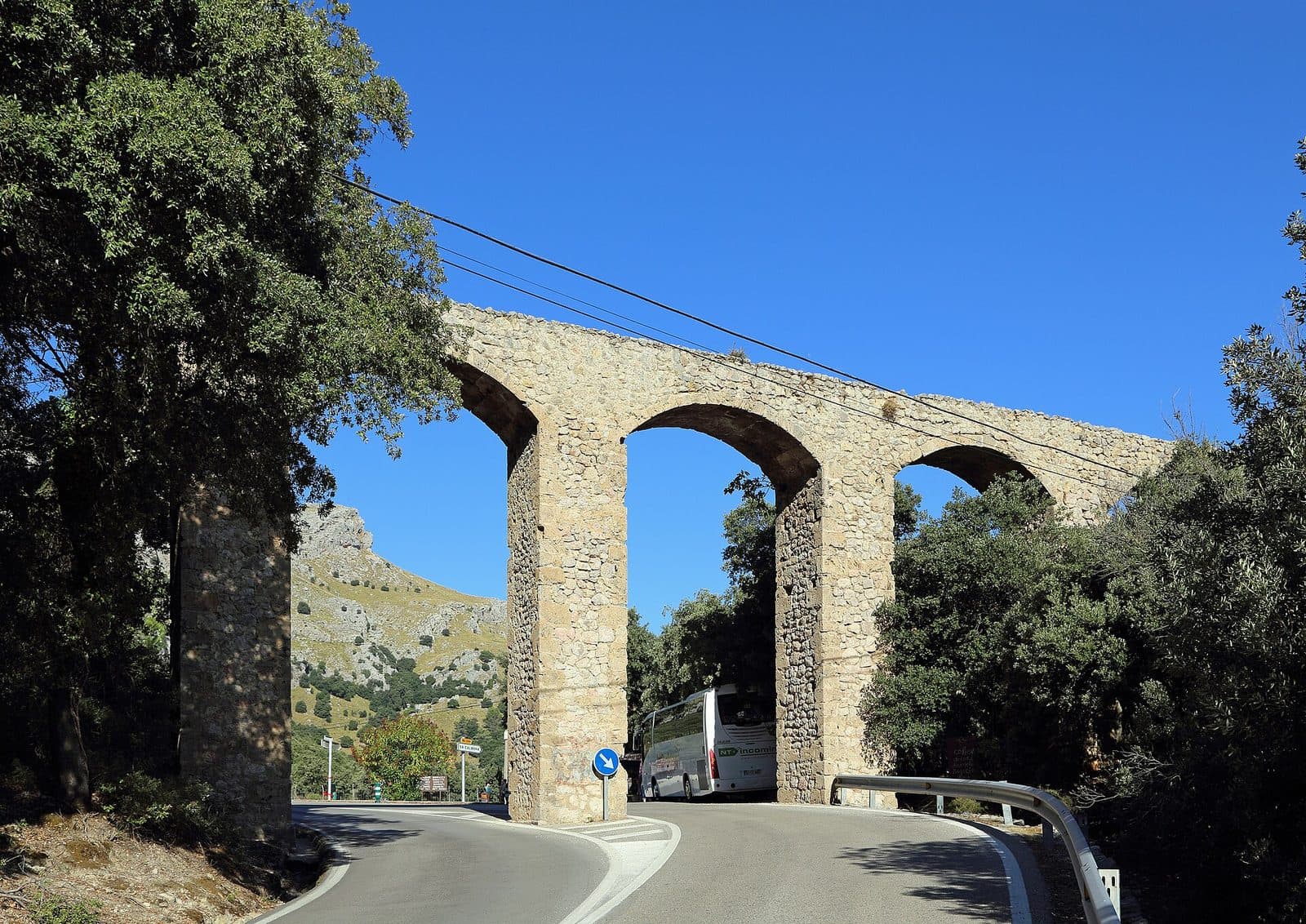

The location alone makes els Arcs an unusual destination. The attraction lies in Mallorca’s remote northwest near Cala Tuent, where roads through the Serra de Tramuntana do not simply lead from place to place but follow slopes and cuttings in tight bends. At its heart is the Turixant Aqueduct with the arches that give els Arcs its name. Its appeal lies in the immediate meeting of structure, road, and mountain landscape. A small café sits beneath the aqueduct; the spot is particularly popular with cyclists as a peaceful stop on the demanding route through Escorca.
A detour is therefore especially worthwhile for travelers who want to experience Mallorca’s northwest as more than just scenery. The arches give the road junction a character of its own and create a distinct human-made accent between wooded slopes and rocky terrain. Anyone already heading to Cala Tuent, Sa Calobra, or the mountain roads around Escorca can easily incorporate els Arcs into the day.
As a destination in its own right, els Arcs is more of a focused stop than an attraction that fills several hours. That is precisely its strength: stop, study the sequence of arches, look out across the surrounding landscape, and only then continue along the winding road. For architecture enthusiasts, cyclists, and admirers of small places presented without spectacle, this is often more appealing than a fully staged tourist sight.
What to See
The Turixant Aqueduct
The arches are the first thing to catch the eye. They are the defining element of els Arcs and the reason the place remains memorable. The Turixant Aqueduct spans the area above the small café and gives the site a clearly legible architectural form. Instead of a solid façade, there is a sequence of openings: mass and empty space alternate, while the landscape beyond remains part of the view through the arches.
This arrangement is easier to appreciate from a short distance than from directly beneath the structure. The row of arches does not look like an isolated showpiece but like part of the terrain. Its outline does not follow an urban street frontage; it stands against the irregular forms of the Tramuntana. Depending on your viewpoint, some openings appear against wooded slopes and others against more open sky. The structure frames the surroundings without obscuring them.
The site is documented as a small rest stop beneath the Turixant Aqueduct. The focus is on the relationship between the arches and the terrain, as well as the short pause at the road junction.
The Road Junction
Its location at the junction shapes the experience just as strongly as the aqueduct itself. Here, the Ma-10 meets the road toward Sa Calobra. This makes els Arcs a landmark in a region where turnoffs, bends, and changes in elevation determine the rhythm of the journey. The structure does not mark an enclosed square but a point of transition: one route continues through the Tramuntana, while the other descends toward the rugged coast.
This roadside setting explains why cyclists particularly value the spot as a place to pause. Anyone riding through the mountains under their own power experiences the arches not only as a photo subject but also as a visible stopping point after a route full of climbs and bends. Motorized visitors, by contrast, should remember that road traffic remains part of the setting. Taking care when stopping and changing viewpoints is more important than searching for the supposedly perfect picture.
Views of the Tramuntana
Els Arcs offers views across the surrounding mountain landscape. The arches form a fixed foreground, with the much more irregular lines of the Serra de Tramuntana beyond. This contrast is precisely what makes the location worth seeing: regular architecture set against terrain whose slopes and cuttings follow no geometric order.
The spot offers an excellent view of the surrounding landscape. Sometimes the aqueduct dominates, sometimes the road, and sometimes the scenery framed by the openings. Those who step out briefly and immediately continue will see the arches; those who stay a few moments longer will notice how much their effect depends on the backdrop.
Visiting els Arcs
A Stop at the Aqueduct
The Turixant Aqueduct and its sequence of arches define this rest point on the mountain road. Visitors coming specifically for the architecture should not stand only directly beneath the arches. A little distance makes it easier to appreciate the complete sequence and its position within the terrain.
A short stay is enough simply to view the structure. More time can be spent combining the view with a break at the small café beneath the aqueduct or making els Arcs part of a longer tour through Escorca. There is therefore no reliable standard visit duration: the site works both as a quick photo stop and as a rest point during a bicycle or car journey. Opening hours and admission details are not recorded.
Time of Day and Traffic Flow
No reliable daily visitor pattern has been documented for els Arcs. However, the experience of the site depends heavily on traffic. During a quiet moment, the relationship between the arches, road, and mountain landscape can be observed more closely; when excursion traffic is heavier, navigating the area safely requires more attention. This is particularly true at the turnoff toward Sa Calobra.
An early arrival can be practical for a longer day trip, but it does not guarantee an empty site. Cyclists also use the route, and the roads to Sa Calobra and Cala Tuent are themselves part of the region’s appeal. More important than any particular time is allowing sufficient time in reserve: travelers who are not in a hurry can wait for a safe opportunity to stop and do not need to make a spontaneous decision at the junction.
Els Arcs as a Stop Along the Route
The visit feels most appropriate when it is not artificially expanded into a major sightseeing program. The attraction tells its story through its location: the aqueduct spans the rest point, the Ma-10 meets the road to the coast, and the Serra de Tramuntana rises all around. These three layers can be understood quickly, yet their clarity makes them memorable.
Cyclists experience els Arcs as a distinctive break along the route. Drivers can use the stop to organize the next stage of their journey before continuing toward Sa Calobra or Cala Tuent. The same applies to both groups: the structure is not a destination competing with a long list of activities, but a place that rewards close observation.
Getting There and Parking
From Palma
The road distance from central Palma to Cala Tuent is 69 kilometers; the journey takes around 109 minutes and follows the Ma-13 and Ma-2130. This information expressly applies to Cala Tuent, not to the immediate vicinity of els Arcs. The attraction lies within the Serra de Tramuntana road network at the junction of the Ma-10 and the road toward Sa Calobra. The exact directions for the final section should therefore be checked before departure.
The journey time is explained less by an exceptionally long distance than by the nature of the mountain roads. After the faster sections in the island’s interior come winding routes where a considerably slower speed is appropriate. Oncoming traffic, cyclists, and limited visibility along the road require close attention. Visitors should not wait until they are passing to look for els Arcs; it is better to mark the turnoff on the route in advance.
From Palma Airport
The road distance from Palma Airport to Cala Tuent is 72 kilometers. The journey takes around 105 minutes and follows Ma-30, Ma-13, and Ma-2130. Here too, the measured route ends in Cala Tuent. Els Arcs is not a conventional building on a local street with a house number but lies on the mountain route at the turnoff toward Sa Calobra.
Anyone driving directly after landing should not underestimate the long, winding final stage. The route is not suitable for a rushed journey between two appointments. Extra time is advisable because the pace on the Ma-10 and the branching roads depends on visibility, traffic, and cyclists. A vehicle whose dimensions and transmission are familiar will make driving through the tight bends easier.
Parking and Public Transport
No dedicated visitor parking area is documented for els Arcs. Because the site lies at a road junction, vehicles should stop only where they can remain completely and safely outside the carriageway. Bends, junctions, and access roads must be kept clear. A quick photo stop does not justify risky roadside parking.
Parking is also limited in Cala Tuent. Anyone combining the visit with the bay should therefore not assume that a space will always be available right beside the water at the end of the road. No bus stop has been recorded in the immediate vicinity of els Arcs. A car, motorcycle, or suitably prepared cycling tour are therefore the most practical options for a predictable journey.
Bus lines to els Arcs at a glance
| Line | Route | Departures/day | First | Last |
|---|---|---|---|---|
| 231 | Port de Sóller - Alcúdia | 8 | 10:00 | 19:40 |
From the official GTFS feeds (TIB/SFM), no real-time data. The figures cover all stops in the town; weekend and holiday services differ — check with the operator before travelling.
Getting there by bus
Escorca 2 (19007) · 2.3 km as the crow flies
- 231Port de Sóller - Alcúdia · Daily
Escorca 1 (19006) · 2.3 km as the crow flies
- 231Port de Sóller - Alcúdia · Daily
Timetable data: official GTFS feeds (TIB/EMT), no real-time — check with the operator before travelling.
Nearby Attractions
Cala Tuent
Cala Tuent lies between steep mountain slopes on Mallorca’s northwest coast. The bay is enclosed by the headlands of Morro des Forat and Penyal Foradat; its shore consists of pebbles, stones, and smaller sandy sections. Wooded slopes rise behind the coast, while Puig Major defines the broader mountain backdrop. Continuing from els Arcs to the bay therefore brings a distinct change: from a road junction in the mountains down to the water.
The cove is not a fully equipped resort beach. Visitor numbers are described as moderate, parking is limited, and no lifeguard service is available. Cold and sometimes strong currents can occur outside the marked swimming area. This limited infrastructure helps preserve the landscape’s character, but swimming requires more personal responsibility than at a supervised urban beach.
A visit to els Arcs and Cala Tuent works well together because the two places reveal different sides of the same region. At the aqueduct, arches, roads, and mountain terrain shape the view; at the cove, the landscape opens toward the sea. Sufficient time should be allowed for this combination, as the winding connection is not merely an incidental transfer.
Sa Calobra and Torrent de Pareis
At the junction by els Arcs, the road branches toward Sa Calobra. This makes the attraction a suitable brief introduction to or conclusion of a journey there. Sa Calobra and Torrent de Pareis are among the Tramuntana’s best-known destinations, but they should not be treated as quick additions to an itinerary. The drive itself already requires attention and time.
Anyone wishing to combine Cala Tuent and Sa Calobra in a single day should plan according to actual road conditions rather than the apparently short distance on the map. Els Arcs serves as a landmark between these choices: continue along the Ma-10, descend toward the coast, or pause beneath the arches. This is precisely why the location is useful, even though its actual sightseeing program remains modest.
Lluc and the Mountain Route
In the other direction, the Tramuntana route leads toward the area around Lluc. The sanctuary and surrounding mountain landscape provide a cultural counterpoint to the coast. Els Arcs can serve as an intermediate stop without requiring a major detour or a separate day’s itinerary.
However, combining Lluc, els Arcs, and a coastal destination only makes sense if journey times are calculated generously. The number of kilometers alone does not determine travel time on the mountain roads. Bends, photo stops, bicycle traffic, and limited parking all shape the schedule. Fewer destinations and more time at each usually make for a calmer and more memorable day here.
The place it belongs to
Cala Tuent in the place guidePractical Information for Your Visit
Clothing and Footwear
Anyone combining the visit with Cala Tuent should keep the rocky shore in mind; sturdy shoes are more comfortable there than delicate sandals.
Visiting with Children
Children can easily appreciate the large arches and unusual location, but els Arcs is not a playground or activity area. Its immediate proximity to the road junction requires constant supervision. Cala Tuent also demands attention: the beach consists predominantly of pebbles and stones, there is no lifeguard service, and stronger currents may occur outside the marked swimming area. For families, the value of combining the two locations therefore lies more in sharing the landscape experience than in enjoying a carefree beach day with comprehensive facilities.
What Not to Expect
The defining features are the Turixant Aqueduct, its sequence of arches, and the view across the landscape. The location should also not be mistaken for complete seclusion. The junction is part of an important excursion route through Escorca and is used by cars, motorcycles, and cyclists. Peace and quiet are not automatic. They emerge in the moments between traffic, when the regular arches once again make a stronger impression than the road beneath them.
Local insider tips
Step Back for the Best View
Do not remain only directly beneath the Turixant Aqueduct. From a short distance, the complete sequence of arches can be seen together with the Tramuntana slopes, while the landscape remains visible through the openings.
A Rest Stop on Mountain Stages
Els Arcs is particularly popular with cyclists as a peaceful place to stop. The small café sits beneath the aqueduct at the junction of the Ma-10 and the road toward Sa Calobra.
Combine It with Cala Tuent
After seeing the arches, it is worth continuing to the coast: Cala Tuent has a rocky shoreline between Morro des Forat and Penyal Foradat. Allow enough time for the winding onward journey.
Mark the Turnoff in Advance
Els Arcs lies at a road junction, not on an easily recognizable local street. It is best to mark the junction of the Ma-10 and the road to Sa Calobra in the navigation system before setting off.