
Nus de sa Corbata – Mallorca's Famous Tie Knot
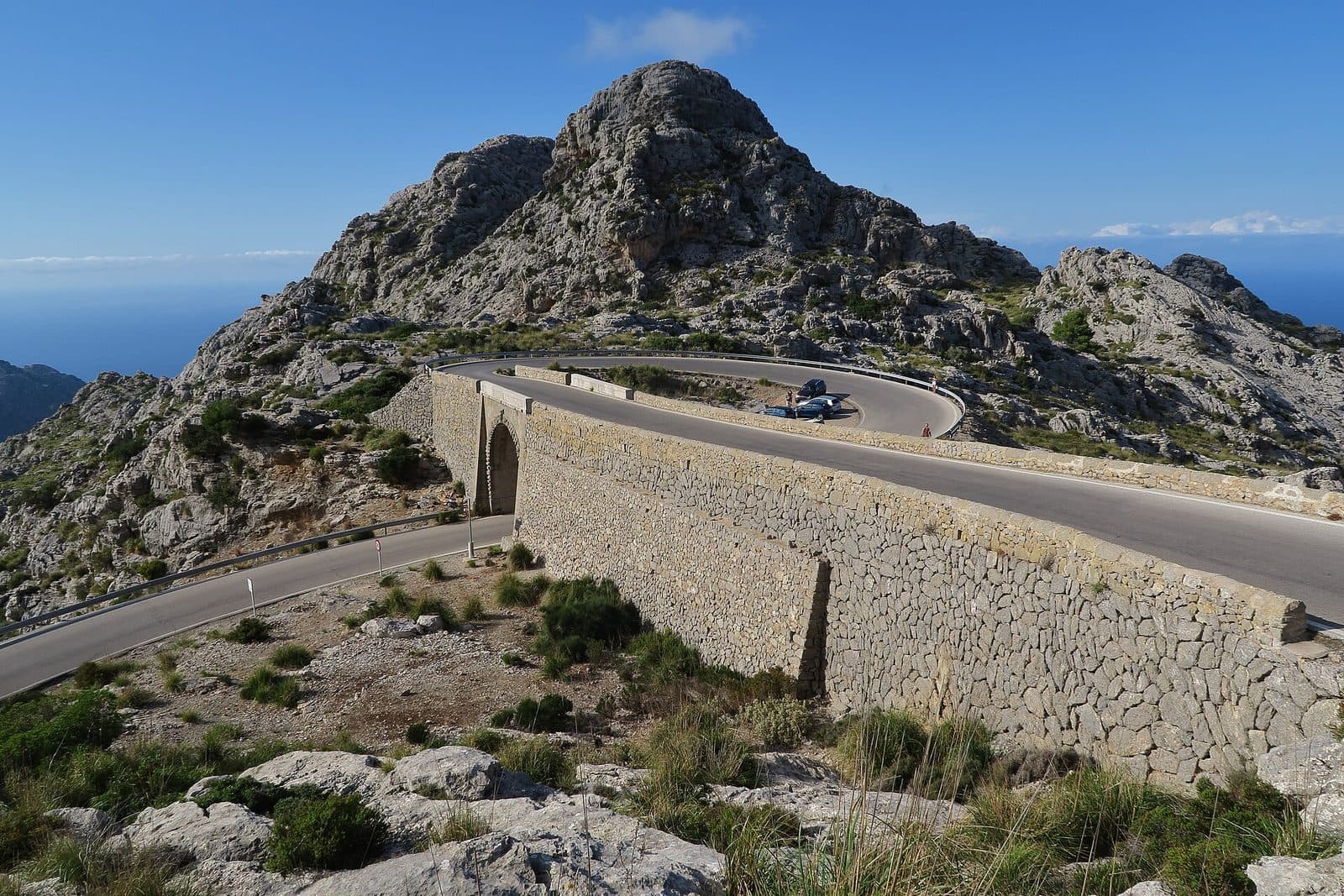

Amid the gray limestone of the Serra de Tramuntana, the road performs a maneuver that is initially hard to comprehend: it turns, crosses over itself, and disappears beneath its own carriageway. Nus de sa Corbata, Mallorcan for “tie knot,” is the most distinctive section of the mountain road to Sa Calobra.
The attraction is not a building you enter, but a combination of road, bridge, and landscape. That is precisely what makes it so appealing: only while driving does the bend reveal itself as an engineering solution; from a safe position beside the road, you can then see how skillfully it was laid into the rocky slope. The short stop is especially worthwhile for anyone interested in road construction, photography, or the cultural landscape of the Tramuntana. The knot is also a well-known stage destination for road cyclists. Those simply trying to reach the coast as quickly as possible, however, may easily overlook the fact that the structure itself, not just the view, is the attraction here.
History and significance
The frequently told origin story begins with a tie: the engineer is said to have conceived the unusual loop while tying a knot. Whether the idea truly arose this way can hardly be separated from the later myth. Even so, the image is apt, because at this point the road overlaps like a tied ribbon.
Planning the road
The road to Sa Calobra was built in the early 1930s. Its planners faced a difficult task: the remote coast had to become accessible by road, yet highly fragmented karst mountains lie between the uplands and the sea. A straight route would have suited neither the gradient nor the shape of the terrain.
The carriageway therefore follows the natural contours, changes direction through tight hairpin bends, and gradually loses elevation. Blasting was used only to a limited extent; instead, walls made from local limestone support large sections of the route. Nus de sa Corbata resolves a particularly difficult change in terrain: the loop lengthened the road and kept the gradient under control without requiring an even tighter conventional hairpin bend.
Road building as a cultural landscape
The knot's significance therefore extends beyond its unusual shape. It demonstrates how modern road construction and traditional Mallorcan stonework came together. Dry-stone specialists known as margers built retaining walls that hold the carriageway against the slope. This traditional dry-stone work forms part of the evolved cultural landscape that has been recognized as a UNESCO World Heritage Site since 2011.
Today, Nus de sa Corbata continues to serve its original purpose as part of an active road while also becoming a symbol of the route to Sa Calobra. Drivers experience it as a surprising change of direction, cyclists as a distinctive point on a demanding mountain route, and photographers as a rare example of a road becoming a subject in its own right.
What to see
The crucial moment lasts only briefly while driving: the upper carriageway traces a broad arc, crosses a masonry bridge, and then passes beneath itself at a lower level. Only when you look back does the movement come together in your mind as a complete knot.
The 270-degree loop
The centerpiece is the 270-degree bend. It is not merely a hairpin but a three-dimensional loop in which two levels of the same road intersect. From above, you initially see the curved edge of the road, while the lower lane partly disappears into the terrain. From a side angle, it becomes clearer how the carriageway loses elevation while changing direction.
This legibility is precisely what makes the site interesting. Other mountain roads impress with a succession of tight hairpins; here, a single engineering idea can be observed. Anyone who looks beyond the view will recognize that each section of the bend performs a function: the arc adds distance, the bridge creates the crossing, and the lower passage carries the route onward toward the coast.
The stone arch bridge
At the crossing, a single-arch bridge carries the upper carriageway. Its pale limestone masonry blends in color with the surrounding rock. Carefully shaped wedge stones in the arch combine to form a stable ring. Above them, parapets capped with dressed stones border the carriageway.
Up close, it is worth letting your gaze move between the arch and the retaining walls. The bridge does not look like a separate structure added later, but visually merges with the walls and rocky slopes, making the engineered construction appear almost like part of the mountain. Its design nevertheless remains easy to recognize: the active road above, the more shaded passage below, and the irregular Tramuntana rock all around.
The dry-stone walls
Less conspicuous but equally important to the structure are the retaining walls along the route. They hold back the slope and create a stable base for the carriageway. Local stone was used, and its rough surfaces and muted colors soften the transition between the built and natural landscapes.
Those who pay attention to detail will notice different types of workmanship: regularly laid sections around the bridge arch, rougher-looking surfaces in the retaining walls, and neatly finished wall tops along the parapets. Nus de sa Corbata is therefore worth seeing not only from a distance. Its quality is equally evident in the small structural transitions that are easily missed when driving through quickly.
Views of the mountain road
Around the knot, views open onto further sections of the winding Ma-2141. Ribbons of road emerge between rocks, disappear behind folds in the terrain, and continue farther down the slope. Cars, coaches, and cyclists provide a sense of scale while also making clear that this is not a disused monument but an active transport link.
The most impressive overall view is found where the upper loop, bridge, and lower passage can all be seen at once. A telephoto lens emphasizes the road's geometry, while a wider frame shows how subtly the pale masonry blends into the karst mountains.
Visiting Nus de sa Corbata
At Nus de sa Corbata, the visit usually begins inside the vehicle. The road approaches the knot through more bends, but your attention must remain on the carriageway. Only when crossing the bridge and subsequently passing beneath the same lane does the principle become a physical experience. A safe stop afterward provides the second perspective: you can now trace the route you have just driven from the outside.
Drive through and look back
A short stay is enough for the knot itself if you only want to view and photograph the shape of the bend. More time is worthwhile if you want to study the bridge arch, stonework, and the course of the adjoining road more closely. The experience centers on the structure and its mountain setting.
Anyone wishing to take photographs should not try to stop beside the first visible stretch of asphalt. The complete loop can only be understood from suitable angles, while rocks or road embankments obscure part of it elsewhere. Before taking any picture, finding a safe position away from the carriageway is therefore more important than pursuing a supposedly perfect perspective.
Traffic on the Ma-2141
The scene changes with every vehicle. Coaches demonstrate particularly clearly why the bends had to be planned so carefully; cyclists reveal the gradient, which is less noticeable from a car. At the same time, this traffic demands attention. People beside the road should not step suddenly onto the carriageway, and vehicles must not block the flow of traffic for a photograph.
During busy periods, excursion traffic, motorcycles, rental cars, and bicycles converge in a confined space. Nus de sa Corbata then feels lively but also more unsettled. By late afternoon, the large excursion coaches are often already on their return journey, making it easier to observe the road's shape with fewer distractions. This does not replace cautious driving, however: even during quieter periods, the bend remains part of a public mountain road.
A roadside visit, not a scheduled attraction
The available visitor information for Nus de sa Corbata lists neither fixed opening hours nor an admission fee. Because mountain road conditions and access can change, current information should be checked before setting out. If you plan the knot as a stop on the way to the coast, you do not need a long sightseeing block; having enough time for the winding route is more important.
Getting there and parking
The final kilometers are the true prelude to the attraction. Nus de sa Corbata lies on the Ma-2141 between Coll dels Reis and Sa Calobra. This road is narrow and winding, and it is popular with cars, coaches, motorcycles, and bicycles alike. Journey times therefore cannot be judged as they would be on an ordinary rural road, because oncoming traffic and slow-moving vehicles can have a considerable effect on your pace.
From Palma and the airport
From central Palma, the recorded route to Cala Tuent follows the Ma-13 and Ma-2130. It covers 69 road kilometers and takes around 109 minutes. From Palma Airport, the route begins on the Ma-30 before joining the Ma-13 and Ma-2130. Cala Tuent is 72 road kilometers away, with a journey time of around 105 minutes.
These measurements explicitly apply to Cala Tuent, not to a parking place directly at Nus de sa Corbata. The tie knot lies on the Ma-2141 along the shared mountain access to the coastal coves. When navigating, you should therefore check the attraction itself as an intermediate destination rather than treating the figures measured for Cala Tuent as a precise arrival time at the knot.
The Ma-2141
From the mountain pass, the Ma-2141 winds through the karst terrain with numerous changes of direction. Caution is advisable, especially on your first drive. The views tempt you to look sideways, while a coach or an uphill cyclist may already be appearing beyond the next bend. Anyone prone to motion sickness or uncomfortable on narrow mountain roads should take the succession of bends into account when planning the excursion.
The knot can be experienced in both directions, but the impression differs. On the descent toward the coast, the surprising transition from the upper to the lower level takes center stage. On the return journey, the structure can be recognized in advance and followed more deliberately. Anyone already traveling to Cala Tuent or Sa Calobra can therefore experience the site from two directions.
Stopping safely
Nus de sa Corbata remains first and foremost a section of road. You should stop only where the vehicle can be positioned completely and legally away from the carriageway. Tight bends, bridge edges, and junctions are not places for photographs. If no safe space is available, continue driving; another opportunity often arises on the return journey.
The road environment must also be treated with caution on foot. Bends with limited visibility may lie between a parked vehicle and a suitable viewpoint. The safest visit is therefore not a sudden braking maneuver but a calm stop in which traffic and the standing area are checked first, with the camera used only afterward.
Nearby places to visit
Farther down, the coastal landscape opens beyond the concentrated geometry of the tie knot. Nus de sa Corbata is therefore particularly easy to include in a day trip where the road is not merely a means of reaching the destination but part of the destination itself. Nevertheless, the long and winding approach leaves less time for several major activities than a glance at the island map might suggest.
Cala Tuent
Cala Tuent lies in a secluded setting on the northwest coast, framed by the mountains of the Serra de Tramuntana. The cove pairs well with a visit to Nus de sa Corbata because both places share the same defining quality: their impact comes from the immediate transition between limestone mountains and coast. After examining the bridge and retaining walls from an engineering perspective, the natural landscape takes center stage there.
The approach to the cove remains winding, and the beach is more natural than comfort-oriented. Anyone combining Cala Tuent with the tie knot should therefore not plan the excursion like a quick detour to an urban beach. A generous day is more suitable, allowing time for the drive itself, a safe stop at Nus de sa Corbata, and time on the coast.
Sa Calobra and Torrent de Pareis
Continuing along the Ma-2141 brings you to Sa Calobra. The small coastal village and the access to Torrent de Pareis are the best-known destinations at the end of the serpentine road. They also explain why so much excursion traffic passes through the tie knot. A stop at Nus de sa Corbata fits easily into either the outward or return journey without needing to become an extensive sightseeing program of its own.
Allow sufficient extra time for this combination. Traffic on the mountain road, time on the coast, and the return journey through the Tramuntana demand more attention than an ordinary beach trip. Anyone who wants to experience Nus de sa Corbata properly should not treat it merely as a photo stop between tightly scheduled destinations.
Lluc and Gorg Blau
On the approach through the mountains, the Lluc monastery and Gorg Blau reservoir are other well-known Tramuntana destinations. Both are better considered optional stops on a carefully chosen route than mandatory items on the same day's itinerary. Lluc adds a cultural and historical element, while Gorg Blau draws attention to the high-mountain landscape.
At Nus de sa Corbata in particular, fewer stops allow for greater awareness. Anyone who treats every bend merely as a stretch of road between attractions will miss the site's real appeal. Here, the road itself tells a story of terrain, stone craftsmanship, and the art of making a difficult route passable.
Local insider tips
Read the knot first
Do not photograph only the view: the most informative angle is one from which the upper carriageway, stone arch bridge, and lower passage can all be seen together. Only then does the 270-degree loop become fully understandable.
Study the bridge arch
Many people immediately follow the vehicles with their eyes. The wedge-shaped stones of the bridge arch, the dressed coping stones on the parapet, and the transition to the rougher retaining walls are equally worth seeing.
Visit later for a quieter view
By late afternoon, the large excursion coaches are often already on their return journey. The bend can then often be viewed more calmly—but it remains an active mountain road where traffic may appear at any time.
Experience both directions
On the descent, crossing over and then beneath your own lane comes as a surprise. On the return journey, the structure is already familiar and can be followed more deliberately. Each direction offers a different view of the knot.