
Santa Eulàlia in Palma: Historic Gothic Parish Church
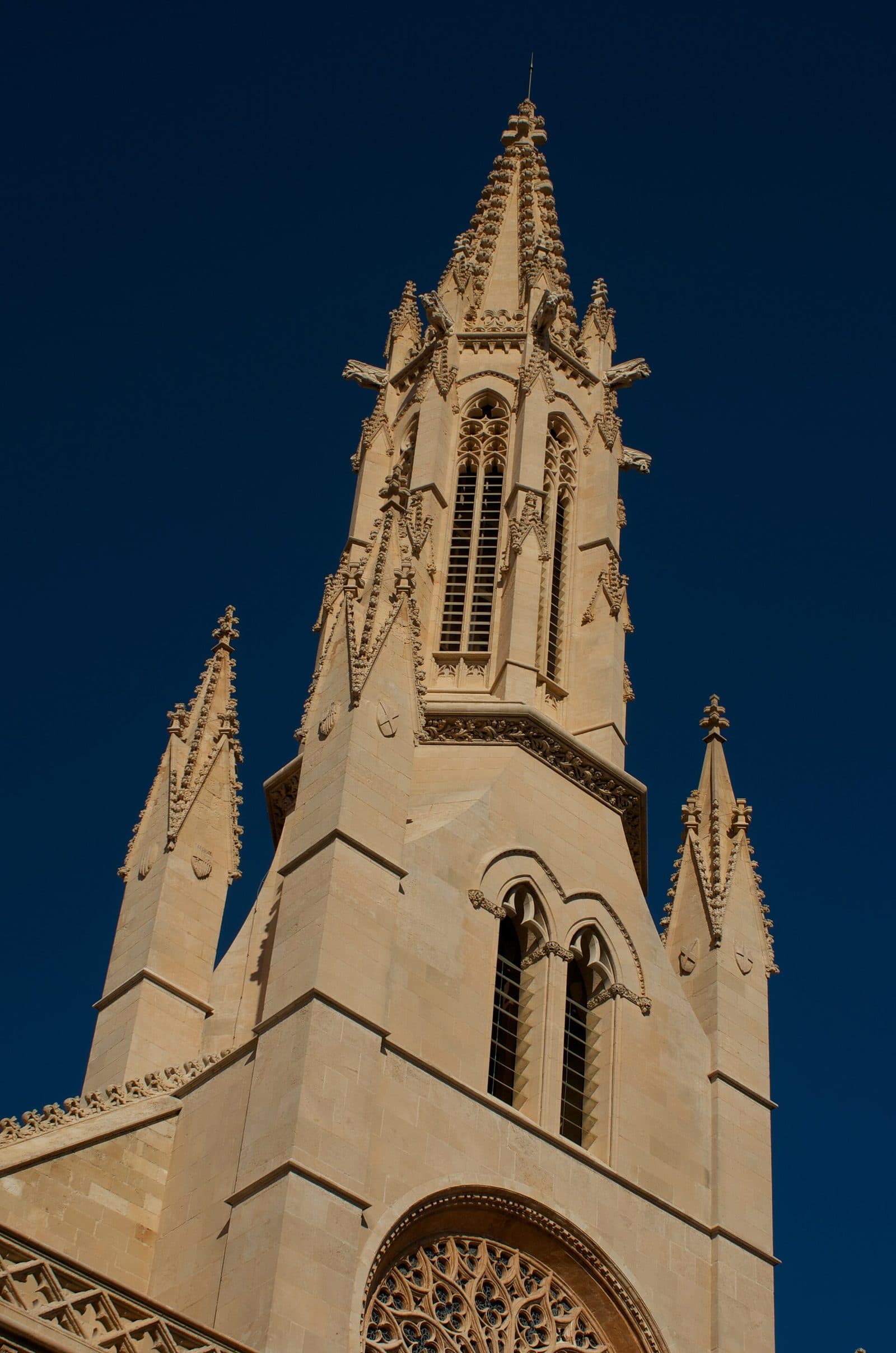

Santa Eulàlia, one of Palma's oldest parish churches, rises amid the dense maze of lanes in the Old Town. Visitors approaching from Plaça de Cort soon find themselves unexpectedly facing its tall Gothic Revival façade. Behind it, however, lies no uniform building from a single period but a place of worship that evolved over centuries: medieval Gothic architecture, Baroque altars, and the façade rebuilt after an earthquake each tell a different part of its history.
Santa Eulàlia is particularly rewarding for visitors who want to discover more of Palma than the cathedral alone. The church was one of the island capital's most important medieval parishes and remains a Catholic place of worship today, not a museum that can be visited independently of everyday church life. Inside, its appeal lies in looking closely: the chapels contain medieval panel paintings, Baroque altarpieces, and reminders of the brotherhood of blacksmiths and silversmiths. Even a pulpit associated with the preacher Vincent Ferrer has survived. Those who gain access to the rooftop terraces encounter the church from an entirely different perspective: buttresses, gargoyles, rose windows, and pinnacles come into view at close range, with the rooftops of the Old Town spreading out beyond them.
Santa Eulàlia is equally suitable for a brief detour or a focused art-historical visit. What matters is less the size of the available time window than a willingness to distinguish the individual phases of construction. Outside, the story begins in the Middle Ages and initially seems to end at the façade in the Gothic Revival style of the late nineteenth century. Inside, it continues through many small details.
History and Significance
The First Chapel
Only a few years after the Christian conquest of Mallorca, King Jaume I commissioned a chapel on this site. The year given is 1236. The choice of patron saint points to the origins of many conquerors and settlers from Catalonia: Eulàlia of Barcelona was especially venerated there and gave the new parish church her name.
Together with Sant Miquel, Sant Jaume, and Santa Creu, Santa Eulàlia was one of Palma's oldest churches. Its considerable dimensions reflect the parish's importance in the thirteenth century, when it was assigned an especially large district of the city. The building was therefore not merely a place for worship; its size also conveyed the parish's significance.
Expansion into a Gothic Church
The early chapel gradually developed into a High Gothic church. Construction continued until 1414. The cruciform, three-aisled building thus preserves the spatial concept of medieval Palma: soaring stone architecture, clearly defined aisles, and side chapels. The Chapel of Saint Eligius was associated with the brotherhood of blacksmiths and silversmiths.
The church is also connected with Mallorca's royal history. Jaume II, son of Jaume I, is said to have taken his oath here during his coronation as King of Mallorca. Events of this kind demonstrate that Santa Eulàlia possessed significance far beyond the everyday life of a city parish. It provided a ceremonial setting in which ecclesiastical order and secular authority visibly came together.
Cemetery, Market, and Urban Society
The square in front of Santa Eulàlia originally served a different purpose from today. A cemetery occupied the site until the end of the sixteenth century; the space was subsequently used as a marketplace. This transformation is characteristic of the Old Town's development: a forecourt once shaped by the church became a place of commerce and public life, while the church itself retained its religious function.
Distinctive traces of urban society can be found at the side door, also known as the Silversmiths' Door, and in the Chapel of Saint Eligius immediately behind it. The saint was regarded as the patron of blacksmiths and silversmiths. This connection is made visible by the motif of a silver vessel, which appears both on the altar and on a marble slab in the floor. The entrance also recalls the history of Mallorcan converts and their descendants, among whom the silversmithing trade was strongly represented.
Earthquake and Gothic Revival Reconstruction
The earthquake of 1851 damaged the church. Between 1894 and 1903, the main façade and bell tower were rebuilt in the Gothic Revival style. Santa Eulàlia therefore initially appears younger from the outside than it actually is. The Gothic side walls and the historicizing front visibly belong to different building phases, even though the reconstruction deliberately adopted the formal language of the Middle Ages.
Santa Eulàlia has been protected as a Bien de Interés Cultural since 1931. It is therefore not only a parish church but also an officially recognized Spanish cultural heritage site. Its significance lies precisely in the fact that it is not a monument frozen in time: medieval architecture, later works of art, alterations, and continuing religious use remain layered over one another to this day.
What to See
Main Façade and Bell Tower
The front facing Plaça de Santa Eulàlia is the most visible part of the reconstruction following the earthquake. Its Gothic Revival design was created between 1894 and 1903 and uses forms that appear considerably older. Anyone looking at the church only from the front might therefore assume that the entire building dates from the same construction phase.
A viewpoint from which both the façade and one of the side walls can be seen is more revealing. From there, the difference between the medieval structure and the later front becomes legible. The bell tower also belongs to the Gothic Revival reconstruction. It creates a vertical accent within the confined urban setting, while the side walls speak more strongly of the Gothic church's massive construction.
A statue of Saint Eulàlia from 1621 stands in the main portal. It is older than the present façade and connects the renovated exterior with the long-standing veneration of the church's patron saint. This juxtaposition is characteristic of Santa Eulàlia: individual older works were incorporated into an architectural context that did not acquire its current appearance until centuries later.
Three-Aisled Interior
Behind the front lies a three-aisled interior arranged on a cruciform plan. Its scale is not merely a means of representation but an echo of the once extensive parish. From the central axis, the side aisles and chapels are easy to survey; during a slow circuit, attention then shifts from the overall architecture to the individual altars and paintings.
The church is not experienced like an exhibition with a strictly prescribed sequence. It makes sense to perceive the space as a whole first and then view the chapels one after another. This allows the Gothic structure to remain recognizable as the setting, even though many furnishings date from later centuries. Visitors who immediately search only for individual works of art may easily overlook how strongly architecture and decoration enter into dialogue here.
Medieval Art in the Chapels
Among the important medieval works is a depiction of the Salvator Mundi by Francesc Comes. Other works include the Dormitio of the Virgin, depicting her falling asleep, as well as altarpieces of Saints Lucia, Barbara, and Blasius. These pieces offer an impression of Mallorca's distinctive medieval art and make Santa Eulàlia worth seeing beyond its architecture alone.
The works are not displayed in a neutral museum space but remain within a sacred context. As a result, pictorial subjects, chapels, and liturgical use are more closely interconnected than they could be in a gallery. For visitors, however, this also means that consideration for prayer and worship takes precedence over the most comprehensive possible tour.
Baroque Altarpieces
Several chapels show how extensively the interior continued to develop after the Middle Ages. The Baroque works include altarpieces of Saint Bartholomew, the Pietà, and Saint Eligius. Their more opulent forms and more strongly narrative visual language contrast with the austere character of the Gothic space.
The Chapel of Saint Eligius near the side door is especially interesting. It was associated with the brotherhood dedicated to the patron saint of blacksmiths and silversmiths. The silver vessel on the altar and floor slab is more than a decorative accessory: it refers to the craft behind the foundation and use of the chapel. Visitors who notice this symbol can see how the professional association visibly marked its place within the church.
Vincent Ferrer's Pulpit
Santa Eulàlia preserves the pulpit from which Vincent Ferrer is said to have preached. The preacher was popularly known as the Angel of the Apocalypse. A portrait in the upper section of the pulpit and a memorial stone bearing the year 1413 commemorate his appearance.
This detail is easily missed if attention is directed only toward the altars. Yet it leads directly into the acoustic and social world of a medieval parish church: the pulpit was the place from which the spoken word was projected throughout the space. Unlike a painting, it therefore evokes an event, its listeners, and the impact of a famous preacher.
Sant Christ Chapel
The Sant Christ side chapel contains an old crucifix that may have been brought to Mallorca by Jaume I as early as 1229. The tradition should be approached with caution, but this very connection explains the special attention given to the cross. It touches upon the founding period of Christian Mallorca and reaches back conceptually to a time before the first chapel of Santa Eulàlia was built.
For visitors, its value does not lie solely in whether this early origin can be conclusively proven. The crucifix demonstrates how sacred objects become bearers of historical memory over generations. In a church whose architecture has been altered several times, a single object can embody the claim of reaching back to the beginning of the Christian era following the conquest.
Rooftop Terraces
The rooftop terraces opened to visitors in 2024 and provide a perspective hidden from the church interior. Here, buttresses, gargoyles, rose windows, and pinnacles can be examined at close range; the bell tower rebuilt in the Gothic Revival style between 1894 and 1903 also comes into view. Graffiti on the walls is another detail that only becomes apparent at this height.
Above the rooftops, the church's position within historic Palma also becomes clear. Visible landmarks include Sant Francesc, Can Vivot, the Seminari, Montesión, and Santa Clara. The view is less about a single panorama than the dense structure of the Old Town, where churches, aristocratic residences, and convents are separated by only narrow streets. As terrace access may depend on current visitor arrangements, its availability should be checked in advance.
Visiting Santa Eulàlia
From the Square into the Church
It is best not to begin the visit immediately at the portal but with a brief walk across the square and along one of the side walls. Only then does the contrast between the Gothic Revival façade and the older Gothic structure become clear. The route then continues into the three-aisled interior, where the central axis deserves attention first, followed by the chapels.
Santa Eulàlia is an active parish church. Services, prayers, and church events may restrict tourist access or require an especially discreet visit. Opening times and admission details are not reliably documented and should be checked immediately before visiting. The same applies to the rooftop terraces, whose access may be organized differently from general entry to the church interior.
How Long to Spend and Suggested Route
About three-quarters of an hour is a useful guideline for seeing the church, chapels, and most important works of art. Visitors who only view the façade and take a brief look inside will need less time. If the rooftop terraces are accessible or there is a deeper interest in the altarpieces, the visit can be extended accordingly.
A clear route helps prevent important details from being overlooked. After taking in the overall impression of the interior, the medieval paintings, Baroque altars, Chapel of Saint Eligius, pulpit, and finally the Sant Christ Chapel form useful conceptual stops. The church makes its impression not through a single overwhelming display but through a succession of historical layers.
Quieter Times to Visit
Santa Eulàlia generally receives significantly fewer visitors than the cathedral. Nevertheless, it can become busier around services. Early morning is especially pleasant for viewing the exterior, when fewer passersby are crossing the small square. For the interior, a time between church celebrations is preferable, provided the church is accessible then.
Visitors wishing to take photographs should not use the space directly in front of the façade as their only viewpoint. A slightly angled perspective reveals more of the building's structure and makes the transition between construction phases visible. Inside, liturgical use always takes priority; photography notices and restricted areas should be respected.
Getting There
From the Airport to Palma
From Palma Airport, the route into the island capital follows the Ma-19. Palma is 11 kilometers away by road, and the journey takes around 20 minutes. These details expressly apply to the route as far as Palma, not directly to the church portal. For the final section, the route continues into the historic center around Plaça de Cort and Plaça de Santa Eulàlia, as the church is not located on a major arterial road but within the Old Town's intricate street network.
Walking Through the Old Town
Plaça de Cort is the easiest point of reference. From there, Santa Eulàlia is only a short walk away. The route passes through an area where distances are better covered on foot than by car. The church can also easily be included in an Old Town walk from the cathedral; the available information describes the journey as only a few minutes on foot.
When approaching, it is worth not following only the most direct navigation to the portal. A small loop across the square and along the side wall reveals more of the building than the quickest route. Although the dense urban fabric makes a completely unobstructed view difficult, it also vividly conveys the medieval parish church's position within the cityscape.
By City Bus
Several city bus stops are located around the church. Plaça de Cort is the most convenient point of reference; additional stops are distributed across the adjoining squares and streets of the Old Town. From there, the journey continues with a short walk. The final stretch passes through busy central areas where pedestrians have the most practical access.
Anyone combining Santa Eulàlia with other destinations in the center will not need additional transport once there. The major sights of the historic Old Town are so close together that walking between the church, city hall square, cathedral, and eastern Old Town is more practical than taking another bus or car journey.
Bus lines to Santa Eulàlia at a glance
| Line | Route | Departures/day | First | Last |
|---|---|---|---|---|
| 3 | Pont d'Inca / Joan Carles I | 6 | 07:37 | 09:46 |
| 25 | s'Arenal - Pl. Reina | Catedral | 6 | 09:35 | 12:41 |
| 20 | Portopí - Son Espases | 4 | 07:17 | 07:31 |
From the official GTFS feeds (TIB/SFM), no real-time data. The figures cover all stops in the town; weekend and holiday services differ — check with the operator before travelling.
Getting there by bus
662-pl. de Cort · 0.1 km as the crow flies
- CCCircular Centre Ciutat · 08:00–08:00 · Daily
663-pl. d'en Coll · 0.1 km as the crow flies
- CCCircular Centre Ciutat · 08:00–08:00 · Daily
664-pl. de sa Quartera · 0.2 km as the crow flies
- CCCircular Centre Ciutat · 08:00–08:00 · Daily
106-pl. del Mercat · 0.2 km as the crow flies
- 3Pont d'Inca / Joan Carles I · 08:00–08:00 · Daily
- 4Ses Illetes - Pl. Columnes · 08:00–08:00 · Daily
- 7Son Gotleu - Son Serra - Sa Vileta / Son Vida · 08:00–08:00 · Daily
- 20Portopí - Son Espases · 06:06–22:40 · Daily
52-pl. del Mercat · 0.3 km as the crow flies
- 4Ses Illetes - Pl. Columnes · 08:00–08:00 · Daily
- 7Son Gotleu - Son Serra - Sa Vileta / Son Vida · 08:00–08:00 · Daily
- 20Portopí - Son Espases · 06:06–22:40 · Daily
- 35Aquàrium - Pl. Reina | Catedral · 06:21–22:41 · Daily
983-Jutjats Nous · 0.4 km as the crow flies
- CCCircular Centre Ciutat · 08:00–08:00 · Daily
105-pl. de Joan Carles I - Catedral · 0.4 km as the crow flies
- 3Pont d'Inca / Joan Carles I · 08:00–08:00 · Daily
- 4Ses Illetes - Pl. Columnes · 08:00–08:00 · Daily
- 7Son Gotleu - Son Serra - Sa Vileta / Son Vida · 08:00–08:00 · Daily
- 20Portopí - Son Espases · 06:06–22:40 · Daily
453-pl. de la Reina - Catedral · 0.4 km as the crow flies
- 25s'Arenal - Pl. Reina | Catedral · 06:36–21:01 · Daily
986-pl. de la Reina - Catedral · 0.4 km as the crow flies
- 35Aquàrium - Pl. Reina | Catedral · 06:21–22:41 · Daily
- CCCircular Centre Ciutat · 08:00–08:00 · Daily
1048-pl. de Joan Carles I · 0.4 km as the crow flies
- 25s'Arenal - Pl. Reina | Catedral · 06:36–21:01 · Daily
- 35Aquàrium - Pl. Reina | Catedral · 06:21–22:41 · Daily
985-pl. de Joan Carles I · 0.4 km as the crow flies
- CCCircular Centre Ciutat · 08:00–08:00 · Daily
53-pl. de Joan Carles I - Catedral · 0.4 km as the crow flies
- 4Ses Illetes - Pl. Columnes · 08:00–08:00 · Daily
- 7Son Gotleu - Son Serra - Sa Vileta / Son Vida · 08:00–08:00 · Daily
- 20Portopí - Son Espases · 06:06–22:40 · Daily
Timetable data: official GTFS feeds (TIB/EMT), no real-time — check with the operator before travelling.
Nearby Attractions
Plaça de Cort
Plaça de Cort, home to Palma City Hall, lies only a few steps from Santa Eulàlia. The square is a suitable starting point for a church visit because it marks a clear transition between civic representation and sacred space. From the open city hall square, the route enters the narrower network of lanes before another small square opens in front of Santa Eulàlia.
This proximity also explains why the church, despite its tucked-away location, was never on the margins of historical events. Administration, market life, and the parish were closely connected. The former cemetery in front of Santa Eulàlia, its later use as a market, and its proximity to city hall can be understood during a walk as parts of the same urban history.
The Cathedral and Royal Palma
Toward the sea, a visit can continue to La Seu Cathedral and Almudaina Royal Palace. Santa Eulàlia should not be regarded as a smaller substitute for the cathedral. Its strength lies in the perspective it offers on a medieval city parish: the Saint Eligius brotherhood, the silversmithing trade, preaching, and local art stand out more clearly than the monumental self-representation of an episcopal church.
A combined walking tour makes the differences especially easy to understand. The cathedral embodies the island capital's grand ecclesiastical and political ambitions; Santa Eulàlia shows how religion was organized in the everyday life of an urban neighborhood. Both buildings are shaped by Gothic architecture, but their scales and historical functions differed.
Sant Francesc and the Eastern Old Town
Sant Francesc lies east of Santa Eulàlia. The route passes through a part of Palma where churches, convents, courtyards, and former aristocratic residences follow one another closely. Santa Clara and Montesión can also be included in a longer walk without reducing Santa Eulàlia to a mere intermediate stop.
Those able to visit the rooftop terraces will already have seen several of these places from above. The walk at street level then changes character: towers and roofs that previously appeared as elements of the city panorama become landmarks within the maze of lanes. The terrace view thus provides a practical reference for further exploration of Palma.
Gothic Architecture Walk Through the Old Town
Santa Eulàlia is well suited to a walking tour comparing different forms of Gothic architecture. Alongside the ecclesiastical Gothic of the cathedral and parish church, Palma also offers examples of secular Gothic architecture. At Santa Eulàlia itself, the crucial point is not to stop at the Gothic Revival façade. Only the side walls, interior, and possibly the roof level reveal the building's medieval core.
Visitors with limited time in Palma can include the church between Plaça de Cort and the cathedral. Those with a stronger interest in art history may find the opposite direction more rewarding: from Santa Eulàlia onward to Sant Francesc and through the eastern Old Town lanes. Both routes can be completed entirely on foot.
The place it belongs to
Palma in the place guidePractical Visitor Information
Clothing and Conduct
Santa Eulàlia remains a place of prayer even during tourist visits. Visitors should dress respectfully. Touring the chapels is inappropriate during a service. Anyone who happens to enter during a celebration can either remain quietly at the back or continue the visit at a later time.
Footwear and Rooftop Terraces
The rooftop terraces are about more than the view: their real appeal lies in the close-up perspective on buttresses, gargoyles, pinnacles, rose windows, and marks on the walls. Access to the terraces should nevertheless be checked in advance. Their opening to visitors was announced in 2024, but this does not imply permanent daily access. Anyone coming specifically for the rooftop area should therefore not rely solely on older visitor reports.
Visiting with Children
Gargoyles, the statue of the saint at the portal, the silver vessel in the Chapel of Saint Eligius, and the pulpit provide specific features for children to find. The contrast between the old side wall and the later façade can also be recognized without extensive prior knowledge. As this is an active church, children must remain quiet and may not use chapels or liturgical areas as play spaces. For families, a short, clearly structured route is therefore often more enjoyable than trying to examine every altarpiece in detail.
What Santa Eulàlia Is Not
Santa Eulàlia is neither a monastery museum nor a scaled-down version of La Seu. Its appeal arises from the original context: parish church, chapels, the Saint Eligius brotherhood, preaching site, and art have accumulated in the same place over centuries. Those expecting a spectacular presentation may overlook the quieter details. The most rewarding discoveries are often small: the motif on the floor slab in the Chapel of Saint Eligius, the commemorative signs on the pulpit, the difference in age between the statue of the saint and the façade, or the transition from the Gothic Revival front to the Gothic side wall.
Local insider tips
Compare the Building Phases
Do not look at the façade only from directly in front. From an angled viewpoint, the Gothic Revival front and older Gothic side walls can be seen together—the most revealing exterior view of Santa Eulàlia.
Look for the Silver Vessel
In the Chapel of Saint Eligius near the side door, a silver vessel appears on the altar and on a marble slab in the floor. It refers to the brotherhood of blacksmiths and silversmiths.
Do Not Miss the Pulpit
The pulpit associated with Vincent Ferrer is easily overlooked among the altars. A portrait in the upper section and the memorial stone bearing the year 1413 commemorate his sermon at Santa Eulàlia.
Check Terrace Access in Advance
The rooftop terraces offer close-up views of gargoyles, buttresses, rose windows, pinnacles, and old graffiti. As access cannot be assumed to be available at all times, it is worth checking current arrangements before visiting.
Approach via Plaça de Cort
The short route from Plaça de Cort provides an especially vivid transition from Palma's representative city hall square into the tighter Old Town fabric around the parish church.